
As a performance marketer running campaigns across Meta, TikTok, Google, or programmatic networks, you’ll often see CTR and CPI within benchmarks while downstream metrics like retention, purchase intent, or ROAS diverge. This disconnect exists because traditional reporting aggregates performance at the creative or campaign level, masking how individual creative elements influence user intent and behavior.
That's where creative analytics comes in. By 2026, not having it will become a competitive disadvantage.
Key Highlights
Creative analytics measures why campaigns work by tracking emotional response, behavioral engagement, and which specific creative elements drive results, not just clicks and impressions.
Brands improve ROAS by understanding which emotional angles resonate, then iterating fast instead of guessing, moving from weekly testing to continuous optimization.
In 2026, emotional resonance backed by data is what separates winning creatives from invisible ones, because audiences have tuned out generic messaging entirely.
Mapping creative variables (character type, hook style, background, CTA) to performance metrics reveals exactly what drives engagement, so you can scale winning elements instead of copying whole creatives blindly.
Teams using creative analytics identify winners faster and kill underperformers immediately, meaning faster iteration and better ROI without higher spend.
What Is Creative Analytics (And Why It's Different)?
Creative analytics is the practice of decomposing creatives into measurable elements (hook, visual, audio, copy, CTA, format) and correlating their presence with performance signals such as CTR, CVR, IPM, watch time, and post-install quality metrics. Emotional response is inferred through behavioral proxies and qualitative signals, not directly measured.
Traditional analytics tells you: "Certain ad got 50,000 impressions and a 3% CTR."
Creative analytics tells you: "This ad resonated emotionally with 18-24 year-old women in urban markets because the hook tapped into their fear of missing out, and the visual style felt authentic instead of polished."
See the difference?
Creative analytics combines three things:
Emotional response tracking: How does this creative feel to people? Does it land? Does it inspire action or just scroll-past indifference?
Behavioral data analysis: What do engagement patterns tell you about what's actually working? Not just clicks, but watch time, shares, comments, dwell time, and sentiment shift.
Creative performance metrics: Which specific creative elements drive results? Is it the character? The hook copy? The background? The color palette? Where's the actual leverage?
Together, these reveal the why behind your numbers. And when you understand the why, you can scale what works and kill what doesn't with confidence instead of guessing.
Why Creative Analytics Matters More in 2026
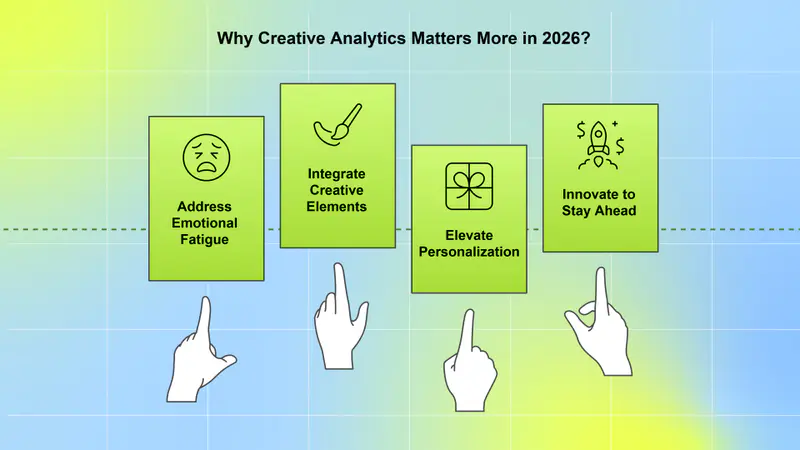
1. Emotional fatigue is real
People see hundreds of brand messages daily. The ones that break through aren't the ones with the best targeting; they're the ones that feel relevant, authentic, or surprising. If your creative doesn't create an emotional response (positive or negative), it's invisible.
2. Data alone isn't enough
Pure performance metrics can't explain why one creative outperforms another by 40% when they have identical targeting and budget. The answer lies in storytelling, visual impact, and how well the message aligns with what the audience actually cares about.
3. Personalization is table stakes
Brands that understand emotional drivers can tailor experiences at scale. Spotify doesn't just recommend songs; it understands the feeling you want. Nike doesn't just sell shoes; they sell identity and aspiration. That's creative analytics in action.
4. Competition is copying faster
Winning creative concepts get cloned within days. But if you only understand what worked (the output) without understanding why it worked (the creative elements), you can't innovate. You can only copy.
Without creative analytics, you're playing defense. With it, you can predict what works before you launch.
How Data-Driven Creativity Actually Changes Your ROI
Most brands treat creativity and data as separate functions. Creatives do their thing, then analysts measure it and either celebrate or do a postmortem.
That's backward.
When you integrate creative analytics into your workflow, everything changes:
You test faster
Instead of launching a campaign and waiting a week to see if it works, you can identify winning creative elements after 2–3 days and launch variations immediately. A/B testing becomes continuous, not periodic.
You iterate with confidence
You know exactly what to change because the data tells you. Change the hook. Keep the character. Adjust the color. Test different CTAs. Each iteration is informed by the last one.
You personalize at scale
Different audience segments respond to different emotional triggers. With creative analytics, you can tailor creative to segments based on behavioral patterns without losing efficiency. One base concept, multiple emotional angles, tested and proven.
You allocate the budget smartly: In high-volume accounts, early creative signal detection can significantly reduce wasted spend cycles by several days, allowing you to pause underperformers almost immediately.
You iterate with agility: Teams often shorten iteration loops meaningfully when element-level insights are available, accelerating the testing and deployment of winning variations.
Building Authentic Emotional Connections Through Data
Brands win when they understand what their audience actually cares about, not what brands assume they care about.
Brands like Nike and Spotify still rely heavily on performance metrics, but they pair them with deep creative testing and audience insight frameworks that prioritize emotional positioning alongside conversion efficiency.
Emotional branding powered by creative analytics means:
- Understanding motivation, not just behavior
Why does someone click? Is it FOMO? Curiosity? Identification? Desire? Once you know the emotional driver, you can tailor all future creative around it. - Building trust through consistency
When your messaging consistently resonates emotionally, trust compounds. People start expecting your brand to "get" them. That's loyalty. - Personalizing without being creepy
Personalization fails when it feels invasive. But when you're personalizing based on genuine emotional insights, "people who value sustainability respond to this angle", it feels thoughtful instead of surveillance-y.
The brands dominating in 2026 aren't the ones with the most data. They're the ones using data to deepen emotional connection instead of just optimizing for clicks.
The Technology Making This Possible
Aggregate data from multiple sources, Unify performance data from 10+ major Ad networks and key MMPs (AppsFlyer, Singular, etc.), social platforms, and landing pages into one single source of truth.
Map creative elements to performance, which specific variables drive which metrics
Visualize emotional and behavioral data, see patterns, not just numbers
Enable continuous testing, Launch variations quickly without complex setup
AI and machine learning have made this accessible. Sentiment analysis can now parse audience reactions in real time. Behavioral tracking can identify micro-patterns humans would miss. Predictive models can rank creative concepts based on historical similarity and past performance patterns, but they do not guarantee outcomes. These models assist prioritization, not replace live testing.
If you're still measuring creative performance using only CTR and ROAS, you're leaving massive opportunity on the table. The brands winning now are the ones using tools, such as Segwise, that map creative variables to emotional responses and behavioral outcomes.
Tools like Segwise use AI to automatically tag creative elements (character, hook, background, and CTA type) and map them against performance metrics across platforms. Instead of wondering why one creative work works, you can see exactly which elements drive engagement and replicate them. That's the difference between guessing and knowing.
What's Coming: Creative Analytics in 2026 and Beyond

- Real-time emotional data: Platforms might offer sentiment analysis built into dashboards. You'll know if a creative is landing emotionally.
- Predictive creative scoring: AI will predict which concepts will perform before you launch them, based on patterns from thousands of campaigns. Imagine A/B testing in your head before investing media spend.
- Hyper-personalization at scale: Creatives will be dynamically adjusted based on individual user signals, not just demographic targeting, but based on what emotional resonance works for that specific person or cohort.
- AI-assisted creative production: Generating variations based on what's working will become standard. Upload your top-performing creative, and AI will generate 50 variations testing different angles, keeping elements that perform. Platforms like Segwise already enable this today by automatically generating new ad creative variations using your existing performance data. The platform intelligently recombines winning elements such as hooks, CTAs, visual styles, formats, and narrative structures that have historically driven ROAS, conversions, and engagement.
Brands that start building creative analytics capabilities now will own 2026. Those who wait will be playing catch-up.
The Reality Check
Here's what creative analytics is not:
A replacement for creative quality. Bad ideas with good data are still bad ideas.
A way to automate creativity. It's a way to make creativity smarter.
A shortcut to viral success. It's a way to optimize for your actual audience, not random internet luck.
Here's what it is:
A way to eliminate guesswork from creative decisions
A system for understanding why audiences respond to what they respond to
A competitive advantage in markets where attention is scarce
A path to better ROI without bigger budgets
Conclusion: Creative Analytics Is Now a Business Imperative
The brands dominating in 2026 won't be the ones with the biggest budgets or the most talented creatives. They'll be the ones using data to understand why their creatives work, then building systems to repeat, test, and scale that understanding faster than anyone else.
Creative analytics isn't a "nice to have" anymore. It's the difference between competing and winning.
If you're not measuring emotional response, behavioral patterns, and creative element performance, you're missing the insights that actually drive ROI. You're optimizing for metrics instead of insights.
Start now. Pick one campaign. Implement one tool. Test one idea. See what happens when you actually understand why your creative works instead of just knowing it does.
This approach is most relevant for UA managers, growth leads, and performance marketers managing multi-creative, multi-platform budgets where creative fatigue, signal loss, and rapid iteration are daily challenges.
Want to simplify how you measure and optimise creative performance? Segwise's AI agents automatically tag creative elements (including playable ads) and map them to performance metrics across all your platforms, no manual tagging, no spreadsheets. Start understanding why your creatives work, then scale what actually resonates.
Start your 14-day free trial and see the difference systematic creative analysis makes.