
The era of scaling Meta (Facebook/Instagram) ads with just basic bidding strategies is over. Today, performance on Meta is almost entirely a creative game driven by data and AI.
In fact, industry research suggests that the creative itself now accounts for between 70% and 80% of an ad's performance outcome, overshadowing factors like targeting and bidding.[1] Your creative asset is the most influential lever you have left, and the best UA teams know that Meta’s algorithm can only scale what the creative gives it.
To consistently win in this environment, you need a specialized third-party tool stack. These platforms plug the critical gaps left by Ads Manager—namely, creative analysis, attribution, and data centralization—allowing you to move faster and feed the algorithm with the high-quality signals it craves.
This deep dive breaks down the four essential tools and platforms that elite mobile game studios, DTC brands, and performance agencies use to maximize creative ROAS and sustain long-term growth on Meta Ads.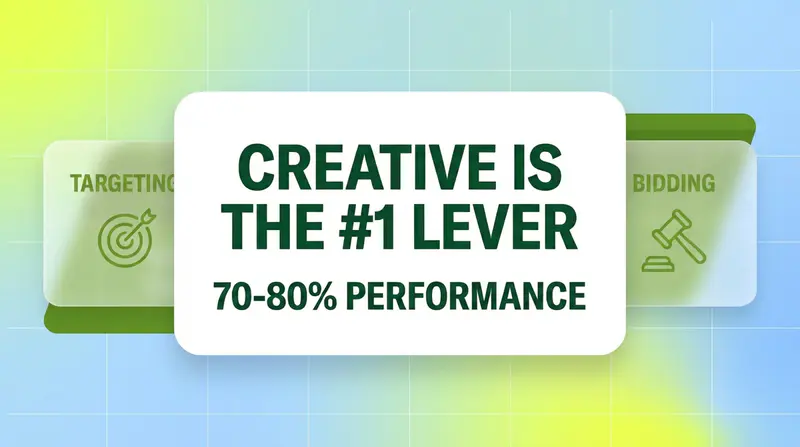
Key Takeaways:
Creative is the #1 Lever: Creative quality drives the vast majority of Meta Ad performance; winning here is non-negotiable for scale.[1][2]
AI for Insights, Not Just Production: The highest-impact tools use AI for element-level analysis—breaking down why a specific hook, color, or audio element is winning, rather than just generating new variations blindly.
Unified Data is Foundational: You must unify data from Meta, MMPs (AppsFlyer/Adjust), and other ad networks into a single view to catch creative fatigue early and accurately attribute performance.
Enterprise Automation is Scale-Driven: Automation platforms (like Smartly.io) offer immense scale but are designed and priced for high-volume, enterprise budgets.
CAPI is Essential: For accurate optimization, ensure your stack leverages server-side tracking (Meta Conversions API) and first-party data, as Meta’s algorithm prioritizes these signals for better performance.[2]
The 4 Game-Changing Tools for Meta Ad Growth
The modern Meta Ads stack is built on best-in-class solutions across Creative Intelligence, Automation, Attribution, and Data Infrastructure.
1. Segwise: The AI-Powered Creative Intelligence Engine
The fastest path to scaling ROAS on Meta is understanding which specific creative elements—not just which videos—are driving down-funnel performance. Segwise is an AI-powered creative intelligence platform built to solve this exact problem, making it the non-negotiable cornerstone of a performance stack.
Context & Positioning
Segwise moves beyond vanity metrics and superficial dashboards by focusing entirely on tying creative elements to performance outcomes (ROAS, retention, KPI events). Its no-code integration with 10+ networks and MMPs saves UA teams significant time on manual data consolidation. It unifies all your creative data from Meta, Google, TikTok, and other major ad networks with your MMP data (AppsFlyer, Adjust, Branch, Singular) into one view, allowing UA managers and creative teams to speak the same language.
Key Features
Multimodal AI-Powered Creative Tagging: This is the core differentiator. Segwise’s AI analyzes video, audio, image, and text components to automatically tag creative elements (e.g., hooks, CTAs, characters, visual styles, emotional tone, voiceover style). This eliminates the manual labor of creative tagging, saving teams up to 20 hours per week.
Creative-to-ROAS Mapping: Every single tag is mapped to performance metrics like installs, retention, and ROAS. This shows you definitively, for example, that "green backgrounds" and "male voiceovers" are delivering a 50% higher ROAS than your average creative, enabling data-driven creative briefs that save time.
AI-Powered Creative Generation: Generate data-backed creative variations informed by performance insights. Create multiple iterations instantly using winning elements (hooks, CTAs, visual styles) identified through tag analysis.
Proprietary Creative Fatigue Detection: The platform uses proprietary algorithms to monitor performance decline across all platforms simultaneously. It provides an early warning system that alerts your team before performance tanks, reducing wasted ad spend.
Asset Clustering & Treatment Comparison: Segwise automatically groups creatives that share similar/identical core assets, allowing you to directly compare different treatments (how the asset was used) to find the most effective approach.
Competitive Creative Tracking: You can monitor competitors' ads on Meta (Facebook/Instagram) and analyze their messaging patterns, hooks, and CTAs using the same AI tagging system to spot white space opportunities.
When You Should Try It
Try Segwise if you are a mobile game studio, DTC brand, or performance agency spending over $50k/month and struggling with creative iteration speed and connecting creative elements to true ROAS. It is invaluable for closing the feedback loop between UA and creative teams. If you utilize playable ads (a key feature for mobile gaming), Segwise is the only platform that tags these interactive ad units.
Limitations
Segwise is highly specialized for creative performance optimization; it is designed to complement, not replace, your existing attribution (MMP) or bidding tools.
2. Smartly.io: Enterprise Creative Management & Automation
Smartly.io has long been the premier enterprise platform for large advertisers who need to manage massive-scale campaigns, especially those relying on Dynamic Creative Optimization (DCO) and product feeds.
Context & Positioning
Positioned as a full-funnel creative and media management solution, Smartly.io is built for organizations managing multi-million-dollar budgets who need to automate the creation and deployment of thousands of personalized ads. It excels at leveraging product feeds to create highly relevant, dynamically generated creatives.
Key Features
Dynamic Creative Optimization (DCO): Allows advertisers to automatically generate thousands of personalized ad variations by combining different images, videos, headlines, and CTAs based on a product catalog or data feed.
Advanced Budget and Bid Automation: Offers sophisticated algorithms that go beyond Meta’s native Advantage+ tools, allowing for custom bidding rules, predictive budgeting, and cross-channel optimization (Meta, Pinterest, Snapchat).
Creative Templates and Workflow: Provides a centralized workflow for creative teams to build templates, reducing the time spent on creating ad variations for different placements and audiences.
Cross-Platform Scaling: Manages and optimizes campaigns across multiple social media platforms (Facebook, Instagram, Pinterest) from a single interface.[3]
When You Should Try It
Smartly.io is best suited for enterprise-level DTC or e-commerce brands with deep product catalogs that require high-volume DCO. It’s also ideal for large agencies or in-house teams that need centralized control over millions in ad spend across global markets. If your primary challenge is production scale and bidding sophistication at the top of the funnel, Smartly.io is a top contender.
Limitations
Smartly.io is a major enterprise investment. Pricing is typically usage-based, taking a percentage of ad spend, and generally requires a substantial minimum annual commitment, making it cost-prohibitive for smaller advertisers.[3][4]
3. AppsFlyer/Adjust: Attribution Foundation and MMP Data
An MMP is not a performance tool in the traditional sense, but it is the indispensable foundation that makes all other tools effective. In a post-iOS 14 world, accurate measurement is the only way to accurately measure ROAS on Meta.
Context & Positioning
Mobile Measurement Partners (MMPs) like AppsFlyer or Adjust serve as the single source of truth for attribution, linking a user's ad click (on Meta, Google, TikTok, etc.) to a specific in-app conversion or event. They are critical for accurate ROAS calculation and fraud prevention. AppsFlyer has recently enhanced its offering with a dedicated Creative Optimization suite.[6]
Key Features
Accurate Cross-Platform Attribution: Measures true user acquisition cost and down-funnel performance (LTV, retention) for users acquired through Meta Ads, ensuring you aren't over-optimizing based on skewed platform-reported data.
Conversions API (CAPI) Integration: Facilitates server-side event tracking, which is essential for giving Meta’s algorithm the most accurate, high-fidelity conversion data, resulting in better campaign optimization.[2]
Creative Optimization Suite (Add-on): AppsFlyer and Adjust both offer features that pull creative data from ad networks, automatically aggregate assets, and use AI to break them down into elements for performance analysis and fatigue detection.[7][8]
Fraud Protection and Validation: Cleanses your data by identifying and blocking fraudulent installs and clicks, ensuring your Meta Ad budget isn't wasted on bad traffic.
When You Should Try It
If you are a mobile-first business (mobile game or subscription app), an MMP is non-negotiable. It is the only way to accurately calculate ROAS and LTV from your Meta spend. You need an MMP from day one to ewhansure your performance data is trustworthy.
Limitations
While MMPs have developed creative tools (like AppsFlyer's Creative Optimization add-on), their primary strength remains attribution. They are not built for rapid-fire creative iteration, competitive analysis, or the depth of element-level analysis that specialized creative intelligence platforms provide. For example, MMP add-ons typically do not support playable ad tagging, which is crucial for mobile game studios.
4. Funnel.io: Data Aggregation and Reporting Infrastructure
The final piece of the high-performance puzzle is centralizing all your clean, attributed data for advanced reporting and business intelligence (BI). Meta Ads Manager alone cannot provide the unified view needed for executive reporting.
Context & Positioning
Funnel.io is a robust data aggregation platform that pulls data from over 500 marketing and advertising sources, cleans it, normalizes it, and sends it to your BI tool (like Looker Studio, Tableau, or a data warehouse). Its primary job is to create a single, unified marketing data set.
Key Features
Massive Connector Library: Connects to all major ad networks (Meta, TikTok, Google) and a multitude of other marketing tools, ensuring all your data is in one place.[9]
Data Normalization and Transformation: Automatically standardizes naming conventions and data structures across platforms, eliminating the tedious, error-prone manual work of data cleaning for cross-channel reporting.
Data Destination Flexibility: Exports clean data directly to your favorite reporting tools (Looker Studio, Sheets, Power BI) or into your data warehouse (BigQuery, Snowflake) for advanced analysis.[9]
Historical Data Access: Provides reliable access to historical data, enabling long-term trend analysis that is crucial for understanding seasonal or creative performance cycles.[10]
When You Should Try It
Funnel.io is best for enterprise teams, large agencies, or high-growth mid-market brands with multiple channels and complex reporting needs. If your UA team is spending too much time cleaning spreadsheets instead of optimizing, or if your C-suite demands unified, high-level reports, a data platform like Funnel.io is necessary.
Limitations
Funnel.io is infrastructure. It is excellent at moving and cleaning data, but its native visualization capabilities may be basic[11]. You will still need a separate BI tool (and its associated cost) to build advanced dashboards. Pricing is usage-based (Flexpoints), which can be difficult to predict as your data volume grows.[9]
The Performance Marketer's Decision Framework
Choosing the right tool depends on your team's budget, scale, and immediate pain point. Use this framework to prioritize your next investment beyond Ads Manager:
Creative Stack Investment Checklist
When you begin evaluating creative-specific platforms, demand concrete evidence for these critical features to ensure you're getting a true performance boost:
Multimodal Analysis: Does the AI analyze the visuals, audio, and text of a video ad together, or just one component? (Look for Multimodal AI).
Element-to-KPI Mapping: Can you see the ROAS or CPA tied directly to a specific hook line, background color, or CTA placement? (If not, it's just a dashboard, not intelligence).
Fatigue Proactivity: Does the tool alert you when performance is about to drop based on proprietary logic, or does it only report the drop after the fact?
Integration Completeness: Does it integrate with Meta and your other key channels (TikTok, Google) and your MMP (AppsFlyer, Adjust, Branch, Singular)? Ensure all four MMPs are covered for seamless data comparison.
Conclusion: Building Your Meta Ad Success Stack
The single biggest takeaway for any modern performance marketer is that creative is the new targeting. As Meta’s algorithm gets better at finding the right audience with minimal input, your creative asset is the only thing that separates you from your competitors.
To maximize your Meta Ad ROAS and ensure sustainable growth, you need to combine a specialized set of four platforms:
Creative Intelligence (Segwise): To tell you what to create next, informed by element-level ROAS data and fatigue signals.
Automation (Smartly.io): To automate the scaling of those winning creatives with intelligent bidding and budget allocation.
Attribution (AppsFlyer/Adjust): To provide the clean, verified ROAS data that fuels both your creative decisions and your automation tools.
Data Infrastructure (Funnel.io): To unify all these signals for executive reporting and advanced BI analysis.
The time saved on manual data consolidation and the efficiency gained from data-backed creative decisions will immediately impact your bottom line. Stop guessing, start leveraging AI for creative intelligence, and build your high-performance Meta Ad stack today.
Want to see how an AI Creative Intelligence platform like Segwise can transform your creative performance? Learn more today to see how its multimodal AI tagging and AI generation capabilities can identify your next winning creative element and drive a measurable increase in creative ROAS.
Frequently Asked Questions
How important is a third-party tool for Meta Ads if I use Advantage+?
It is highly important. Meta’s Advantage+ suite excels at bidding and audience finding, but it is still fundamentally limited in creative analysis and cross-platform data unification. A tool like Segwise complements Advantage+ by telling you what to put into the campaign (winning creative elements) and by tracking the full-funnel ROAS using MMP data, which Meta's platform data can sometimes miss.[2]
When should a small business start using these tools?
Small businesses with limited ad spend (under
5,000/month)shouldprioritizeanMMP(AppsFlyer/Adjust)firstforaccurateattribution.Oncespendreaches∗∗5,000/month) should prioritize an MMP (AppsFlyer/Adjust) first for accurate attribution. Once spend reaches **5,000/month)shouldprioritizeanMMP(AppsFlyer/Adjust)firstforaccurateattribution.Oncespendreaches∗∗
10k–$50k per month**, you should look into a creative intelligence tool like Segwise to scale your creative output efficiently. Enterprise automation is only necessary when ad spend consistently hits six figures or more monthly.
What is the biggest difference between Funnel.io and an MMP like AppsFlyer?
AppsFlyer (MMP) is primarily a measurement and attribution tool: it tells you where an install came from and calculates true ROAS. Funnel.io is a data aggregation and warehousing tool: it collects, cleans, and normalizes data from various sources (including Meta and AppsFlyer) and pipes it into your company’s BI system (e.g., Tableau or BigQuery). They solve different but complementary problems.
Can AI-Powered Creative Tagging replace my creative strategist?
No. AI tagging tools, like Segwise, eliminate the manual, repetitive labor of tagging and scoring creatives, and they surface statistically significant patterns (e.g., "blue CTAs perform better"). They do not replace the human creative strategist's job of interpreting those insights, developing the next big idea, or producing the final asset. The AI handles the science, and the strategist handles the art and interpretation.
How can I detect creative fatigue before it kills my ROAS?
You need a tool with proprietary fatigue detection like Segwise. It monitors performance trends against a baseline (e.g., CTR, CVR, or ROAS over a set period) and sends proactive alerts when proprietary algorithms detect a statistically significant early decline in key metrics—often before the decline is obvious in Ads Manager. You need to use these alerts to pause the creative or inject new variations.
Is server-side tracking (CAPI) still necessary in 2025?
Yes, it is more critical than ever. With continued data privacy changes, Meta's algorithm strongly prioritizes event data received via the Conversions API (CAPI) for better optimization and targeting. Advertisers report that server-side tracking delivers up to three times more weight within Meta’s algorithm than pixel-only events, leading to better optimization and lower costs.[2]