
TikTok Creative Challenge (TCC) lets brands crowdsource performance ads from a curated pool of TikTok creators in exchange for revenue-shared rewards, and now lives inside TikTok One. For app user acquisition (UA) teams, that means a steady pipeline of native, low-cost creator video, but it works best when paired with a real evaluation system that picks the few winners out of a noisy submission pool.
If you are running mobile app UA on TikTok in 2026, you have probably looked at TCC and asked the only question that matters: does it actually feed your ad account with creatives that move installs and ROAS, or is it just creator volume for the sake of it? The honest answer is somewhere in the middle, and depends on how you brief, evaluate, and follow up on what you get. This post unpacks the mechanics, economics, and edge cases so you can decide whether TCC belongs in your UA creative stack.
We will cover what TCC is today (after the TikTok One consolidation in 2025), how creator economics and brand controls actually work, what types of creative win, where TCC tends to break for app UA teams, the volume math, and how to brief in a way that does not waste creator effort. Where Segwise fits the workflow, we say so plainly.
Also read The Creative Trends That Actually Move CPI in 2026
Key Takeaways
TCC is a TikTok program where creators with 50K+ followers, age 18+, and a US-based account submit video ads against brand briefs, and earn rewards based on the qualified views, clicks, and conversions their ads drive once the brand promotes them, per TikTok's launch announcement.
Brands can receive up to 30 ad creatives within roughly 10 days per challenge, with submissions running as in-feed ads on the For You Feed and never appearing on the creator's own profile, according to TikTok.
The premium TTCC+ tier provides 1:1 support and fully subsidised creator fees in exchange for an ad spend commitment of $50K/month minimum, per AdvertiseMint's program breakdown.
Microsoft used TCC to receive 20 assets, ran with eight in the holiday window, and used the remaining 12 as always-on content, with KPIs surpassed and the brand stating that some Microsoft teams now use only Creative Challenge content on TikTok, per the TikTok For Business case study.
Creator earnings in the original beta ranged from $22K to $34K per month with bonuses of $200 to $6K, but payment is revenue-shared and not guaranteed upfront, per ICYMI by Lia Haberman and The UGC Club.
TCC and Creator Marketplace were folded into TikTok One starting March 2025, so the briefing and discovery flow now lives inside a single creative command center, per TechCrunch.
TikTok One creator content boosted with Spark Ads drove a 159% higher engagement rate than non-creator content posted in TikTok Ads Manager at parity CPM, per TikTok's internal analysis.
TCC's biggest weakness for app UA is volume without judgement: the program produces a lot of variants, and picking which two or three to push to spend is the work that decides whether the program pays off.
What TikTok Creative Challenge Is in 2026
TCC began as an in-app program where TikTok creators could browse brand briefs, submit a video ad, and earn rewards based on how that video performed once the brand promoted it. The original 2023 program had roughly 400 creators participating, redeeming rewards via a Discord server, and serving brands like Uber Eats, Zynga, Alibaba, and TikTok itself, per ICYMI by Lia Haberman.
The mechanics are still the same, but the wrapping changed. In February 2025, TikTok announced it would sunset the standalone Creator Marketplace and roll it (along with Creative Exchange, now Partner Exchange, and Creative Challenge) into TikTok One. On April 1, 2025, the standalone marketplace fully shut down and traffic was redirected, per TechCrunch.
So when an app UA team asks "is TCC worth it?" today, the practical question is: is the Creative Challenge module inside TikTok One a useful creative source for my install campaigns? The brand-side workflow now sits next to creator discovery, content suite, partner exchange, and Symphony AI tooling, all under one login.
The eligibility bar for creators stayed where it started: minimum 50,000 followers, US-based account, 18+, per TikTok's Creative Center FAQ.
How It Works: Creator Economics and Brand Controls
The flow is straightforward. A brand writes a brief inside TCC, including the reward pool, do's and don'ts, and product details. Creators in the program browse briefs, pick the ones they want to make, shoot a vertical video ad, and submit it. TikTok reviews submissions, the brand approves, and approved videos run as in-feed ads on the For You Feed (never on the creator's profile), according to TikTok's launch announcement.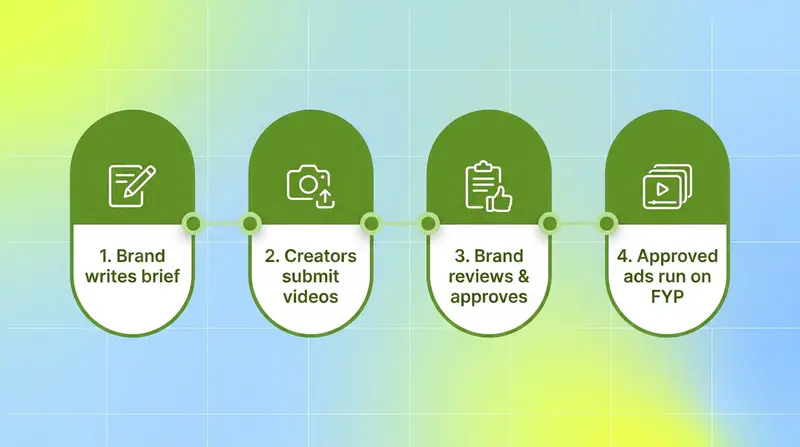
Creator payouts are performance-based. Rewards are influenced by qualified video views, clicks, and conversions, per TikTok. In the original beta, top creators were earning $22K to $34K per month with milestone bonuses of $200 to $6K, per ICYMI by Lia Haberman. The UGC Club documented the bonus tiers: a Newcomer bonus ($20 for first approved submission), Guaranteed bonus ($200 if at least four submissions each generate $10 or more in rewards in a single month), Breakthrough bonus ($300 for one submission generating $300 or more in 30 days), and a Creative Master bonus ($100 for any submission earning $1,000 or more in 30 days, redeemable repeatedly).
There is a real catch on the creator side: TCC does not guarantee payment upfront. Payment terms are described in the advertiser terms of service as "determined according to a revenue share/earnings schedule on each creative challenge", and creators give up usage rights when they submit, per emarketer's analysis.
For brands, the controls work as follows. The self-serve tier lets you write a brief, see up to 30 ad creatives within ~10 days, and accept or reject submissions before they ever leave the platform. The premium TTCC+ tier adds 1:1 advertiser support, exclusivity checks, scheduling of creator preferences, and access to top performing creators, in exchange for a minimum ad spend commitment of $50K/month, per AdvertiseMint. Microsoft, who used TTCC+, described the premium package as fully subsidising creator fees, with all investment going to ad spend, and called the briefing process "super easy" with a 10-minute brief-to-platform setup, per the TikTok For Business case study.
What Types of Creative Win on TCC
Across TCC briefs, the consistently winning formats look like this:
Native UGC: hook in the first 1–2 seconds, creator-shot vertical video, no overproduced edits.
Problem/solution narratives, especially for utility apps and games where a "before/after" moment lands quickly.
Testimonial-style direct address, often with a creator showing the app in use on their own phone.
Genuine product reactions for casual mobile games, where the creator's surprise or amusement does the selling.
Creator-led "explain to a friend" formats that translate the product's value in a few sentences.
These formats line up with what TikTok itself documents about platform-led content. According to TikTok's own analysis cited inside TikTok One, creator content boosted with Spark Ads drove a 159% higher engagement rate than non-creator content posted in Ads Manager, at the same CPM. Authenticity and native feel are doing the lifting, not polish.
For app UA specifically, three creative variables matter most: hook, value proposition clarity, and a clean CTA tied to install. TCC creators are typically good at the first two and inconsistent on the third, which is why brand approval and post-submission editing matters.
Common Pitfalls for App UA Teams
TCC's structural advantage (volume) is also where app UA teams get hurt if they don't plan for it. Here are the failure modes that show up most often.
Volume becomes noise. Receiving 30 submissions in 10 days sounds great until you realise nobody on the team has bandwidth to evaluate them at the level of hooks, CTAs, and audio cues. Most teams either watch the first few and pick favourites, or push everything to spend and let the auction figure it out, neither of which is rigorous.
Creator misalignment with app category. General-purpose UGC creators are great for DTC and lifestyle apps, but mobile gaming, fintech, and subscription apps often need creators with category fluency. The 50K-follower threshold is broad, and a brief that does not specify the audience can pull in creators whose content reads like an ad for a different product entirely.
Generic CTAs that do not align with attribution. Some submissions end with vague "check it out" CTAs instead of "download now" or app-store-specific language. For app UA where you are tracking installs through MMPs (AppsFlyer, Adjust, Branch, Singular), this matters because creative without a clear install trigger underperforms.
Usage rights and creator goodwill. Creators give up extensive rights when they submit, and the absence of guaranteed upfront payment has been a sticking point, per Ad Age coverage cited by emarketer. Brands that recycle TCC creative aggressively in non-TCC channels can run into problems.
No tagging of why winners win. This is the biggest one. After a TCC challenge, app UA teams typically end up with two or three high-performing creatives and 25+ duds. Without a system that captures what specifically the winners had in common (hook style, talent demographic, on-screen text pattern, audio choice, CTA wording), the next brief is written from intuition rather than data. The volume advantage gets squandered because the learning loop never closes.
This last point is where Segwise's creative tagging earns its keep. Segwise's multimodal AI tags every TCC submission across hooks, CTAs, characters, visual styles, on-screen text, audio emotion, and more. It maps each tag to install and ROAS performance via your MMP data (AppsFlyer, Adjust, Branch, Singular), so when the next TCC brief is being written, you are working from a list of tag patterns that actually drove installs in your account, not gut feel.
Cost and Creative Volume Math
The economics of TCC look unusual the first time you model them, because the brand-side cost structure is different from typical UGC engagements.
In a standard UGC arrangement, brands pay creators per asset (commonly $300–$1,500 per video, with usage rights extra), then layer ad spend on top. Volume is bottlenecked by budget, since 20 UGC videos at $800 each equals $16K before media.
In TCC, the brand pays media spend on the videos that get approved and run as in-feed ads. Creators are compensated out of revenue-share rewards funded by TikTok against ad spend, plus performance bonuses. In the premium TTCC+ tier, creator fees are fully subsidised, so 100% of the brand's investment goes to media. The trade is the $50K/month minimum spend commitment and the constraint that creative is exclusive to TikTok auction ads, per AdvertiseMint.
The simple math: if you commit $50K/month in TikTok ad spend and run a TCC+ challenge, you get up to 30 native videos within 10 days with zero direct creative production cost. Compare that to producing 30 UGC videos in-house or via an agency, which on a typical $500–$1,000 per asset rate would cost $15K–$30K before media. TCC turns roughly $15K–$30K of creative production cost into media spend, assuming you can absorb the $50K commitment.
Two caveats. First, you still pay in time: brief writing, submission review, edit requests, and post-campaign analysis. Microsoft's team reported the brief took 10 minutes, but the analysis after delivery is real work. Second, "up to 30 creatives" is not the same as "30 winning creatives". Industry-wide, the actual ratio of UA-grade winners to total UGC submissions is closer to 1-in-10, which is why evaluation infrastructure matters more than volume.
When to Use TCC vs Traditional UGC

The choice between TCC and traditional UGC (creator marketplace gigs, agency UGC packages, in-house creators) is not binary. TCC fits some UA situations and not others.
Use TCC when:
- Your TikTok ad spend is high enough to justify the spend commitment for TTCC+, and you need ongoing creative volume to feed an auction that fatigues fast.
- You have a clear brief with strong product hooks and want native creator interpretation rather than scripted execution.
- You can absorb 30 submissions and have a workflow (or a tagging tool) to evaluate them rigorously.
- You are testing into a new audience segment on TikTok and want native voices without committing to long-term creator relationships.
Use traditional UGC when:
- You need cross-channel usage rights (TCC creative is exclusive to TikTok auction ads, per AdvertiseMint).
- You want a specific creator's voice, audience, or category expertise rather than a pool.
- You need iterative collaboration and revisions across many rounds (traditional UGC is more flexible here).
- Your TikTok spend is below the TTCC+ threshold and the self-serve TCC tier feels too thin for your team's bandwidth.
A pragmatic mobile gaming team often runs both: TCC for high-volume native variants on top-of-funnel campaigns, and traditional UGC creators for higher-effort hero pieces and cross-channel reuse on Meta and YouTube.
How to Brief for TCC
The brief is the only lever you have before submissions arrive. A weak brief produces noise; a sharp one produces a tighter distribution of usable assets.
What works in TCC briefs, drawing on Microsoft's reported approach and TikTok's own brief prompts, per the TikTok For Business case study:
Lead with the audience and the problem they have. Not "we are a meditation app", but "we are a sleep-and-anxiety app for adults aged 25-45 who can't shut their brain off at night."
Specify the hook style with examples. TikTok's brief prompts ask for must-haves and must-avoids. Use them. Reference 2-3 winning hook patterns from your existing top creatives or from competitor research.
List product features to highlight, not script. Microsoft credited TikTok's brief prompts with helping their team identify which product features creators should spotlight.
State the CTA exactly. "Tap to download" or "search [app name] in your app store". Vague CTAs cost installs.
Set creative do-not-do's. No green-screen tutorials, no voiceover-only edits, no on-screen text that obscures the product, etc. Specifics here cut at least a third of the bad submissions.
Define your win condition. Are you optimising for video views, click-throughs, or installs/ROAS via your MMP? Make this explicit so creators can self-select for the right format.
After delivery, do not just watch the videos and pick favourites. Tag every submission systematically (hook type, CTA, talent, on-screen text, music genre, scene structure), match those tags to performance once the ads start running, and let that signal drive the next brief. This is the part most teams skip, and the part that determines whether the next TCC cycle improves on the last one or repeats the same hit-rate.
TikTok Creative Challenge for App UA in 2026: The Bottom Line
So is TCC worth it for app UA? Yes, conditionally. If you can absorb the spend commitment, write a sharp brief, and put real evaluation work behind the submissions, TCC delivers native creator content at media-only cost, with brand controls that improved meaningfully when the program moved into TikTok One. For mobile gaming, subscription apps, and DTC brands running consistent TikTok UA, it is one of the cheapest ways to keep your auction fed with native variants.
The economics tilt against you only if you treat TCC as a "creative ATM": brief loosely, push everything to spend, hope for winners. The whole point of having 30 submissions in 10 days is to find the few that actually move installs, and that requires a tagging and feedback loop, not just instinct.
That is the Segwise fit. Multimodal creative tagging labels every TCC submission across hooks, CTAs, characters, visuals, and audio, then creative analytics maps each tag to install and ROAS performance through Meta, Google, TikTok, Snapchat, YouTube, AppLovin, Unity Ads, Mintegral, IronSource, plus AppsFlyer, Adjust, Branch, and Singular. The next TCC brief gets written from your actual winning patterns, and your team saves up to 20 hours per week that would otherwise be spent on manual creative tagging and spreadsheet work, with up to 50% ROAS improvement from catching winners (and fatigue) earlier.
Frequently Asked Questions
Is TikTok Creative Challenge still active in 2026?
Yes. TCC continues as a program, but it now lives inside TikTok One, the unified creative platform that consolidated Creator Marketplace, Partner Exchange, and Creative Challenge starting in March 2025, per TechCrunch. The brief, submission, and approval flow are still the core mechanic. To evaluate which submissions are worth pushing to spend, app UA teams use creative analytics tooling such as Segwise, alongside competing options.
What does TikTok Creative Challenge cost for brands?
The self-serve tier was originally offered with no creative production fee during the testing phase, with brands only paying media on approved videos, per Admiral Media. The premium TTCC+ tier requires a minimum of $50,000/month in ad spend in exchange for fully subsidised creator fees and 1:1 support, per AdvertiseMint. Always confirm current pricing with your TikTok representative.
How does TCC compare to TikTok Spark Ads or hiring UGC creators directly?
Spark Ads let brands boost organic creator content as paid ads. Direct UGC hires (via TikTok One Creator Marketplace, Influee, or agencies) get you specific creators and broader usage rights. TCC sits in between: pre-vetted creator pool, brief-based pitching, performance-based payment, and TikTok-only auction ad usage. For app UA scale, many teams use all three: Spark Ads to amplify proven organic content, TCC for native volume, and direct UGC for hero pieces and cross-channel reuse. Creative analytics platforms like Segwise compare performance across all three sources at the creative-element level.
What does this mean for a UA manager running mobile games on TikTok?
For UA managers in mobile gaming, TCC is most useful when your TikTok auction is fatiguing fast and your in-house creative pipeline can't keep up with variant volume. The discipline that determines whether TCC pays off is post-submission evaluation: which hook structures, talent types, and CTAs actually drove installs at acceptable CPI. Without systematic evaluation, you spend on the wrong creatives. With it, TCC becomes a 30-asset-per-cycle volume engine for your top-funnel campaigns. Tools like Segwise sit specifically at the creative-element layer (hooks, CTAs, on-screen text, audio patterns), while broader UA stacks like Triple Whale and standard MMP dashboards cover funnel metrics that are not creative-tag granular.
Can I reuse TikTok Creative Challenge ads on Meta or YouTube?
Generally no. TCC creative is exclusive to TikTok auction ads, and any revisions need TCC approval, per AdvertiseMint. If cross-channel usage is critical, hire UGC creators directly via TikTok One Creator Marketplace or other platforms where you can negotiate broader rights upfront. App UA teams running cross-channel often run TCC for TikTok-specific volume and a separate UGC track for Meta and YouTube reuse.
How do I pick which TCC submissions to push to ad spend?
Tag every submission across creative variables (hook type, talent, CTA wording, on-screen text, music style, scene structure), then watch installs and ROAS at the variable level once ads run. The winners share patterns; the losers share patterns too. Segwise's multimodal AI does this tagging automatically and maps it to MMP data via AppsFlyer, Adjust, Branch, and Singular, so the shortlist of submissions worth scaling is generated rather than guessed at. Other creative analytics options exist; what matters is closing the loop between submission and install signal.
How long does a TCC brief take to set up?
Microsoft reported that copying their existing media brief into TCC took about 10 minutes, per the TikTok For Business case study. Brief setup is the fastest part. The longer work is upfront audience and hook research before writing the brief, and post-delivery evaluation across the up to 30 submissions you receive within 10 days.
Who actually owns TCC creative once submitted?
Creators give up extensive usage rights when they submit, per emarketer's coverage citing Ad Age. Brands can use approved creative on TikTok auction ads, with revisions subject to TCC approval. This is one of the structural concessions creators are making in exchange for performance-based revenue share, and it's worth understanding before you build TCC into your long-term UA plan.