
If you've ever stared at your Meta creative budget wondering whether to shoot another video or just knock out a batch of static images, you're asking the right question. Just in the wrong way.
The real question isn't "which format is better." It's "which mix fits what my brand actually needs to do right now?"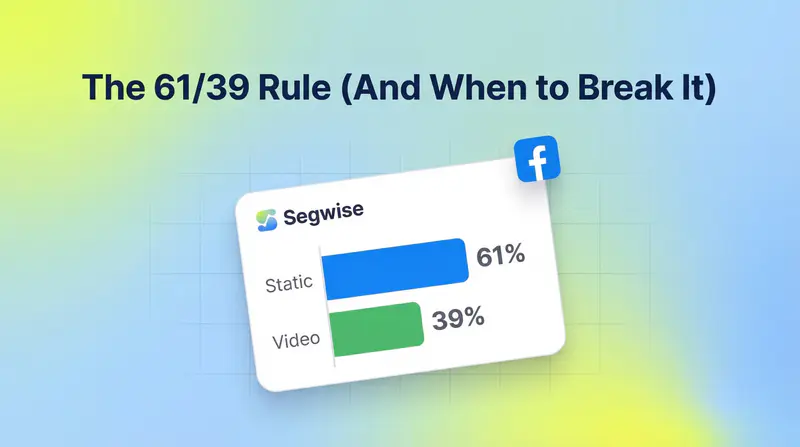
A 2025 analysis of 67,000 Facebook ads across 100+ top-performing accounts by Curtis Howland of MisfitMarketing found that the median account ran 61% static and 39% video. But that median hides a wildly divergent picture underneath. Beauty and shapewear brands like Shapellx ran 97% video. SHEIN ran 1%. Both are scaled, profitable businesses.
So what does that mean for you? The answer lives in your product type, your funnel stage, and how fast your creative team can actually move.
Key Takeaways
The median Meta account runs about 61% static and 39% video, but industry and product type drive massive divergence from that number
DTC brands demonstrating visible product transformations should skew toward 70%+ video; established retailers with strong brand recognition can lean static
According to MHI Growth Engine's analysis of $30M+ in DTC ad spend, video generates 35-50% higher CTRs but static ads maintain 40-60% lower CPMs -- both matter depending on where a prospect is in your funnel
Static ads fatigue 30-50% faster than video (refresh cycle: 20-30 days vs 40-60 days for video), so your ratio also affects how much creative production you need to sustain
For mature Meta advertisers, MHI's framework recommends a 60-70% video / 30-40% static budget split at $30K+/month, with video covering cold prospecting and static handling retargeting
The best ratio is the one your own data tells you, not the industry benchmark
Also read Average ROAS for eCommerce in 2026: Benchmarks and Insights
Why There's No Universal Answer
The "best" static/video ratio depends on three things: product category, funnel stage, and budget.
Product Category Drives the First Signal
Some products need to be seen in motion. A shapewear brand needs before/after transformation. A skincare brand needs texture, glow, and application ritual. A home workout app needs energy. For these categories, static images don't do the same persuasion work.
According to Howland's dataset, beauty, skincare, and shapewear brands consistently ran 80%+ video in their mixes. Shapellx hit 97%.
On the other end: SHEIN (1% video) and Calvin Klein (6% video) rely almost entirely on static. Brand recognition does the heavy lifting. Users already know what these products are. A clean product shot with a price point is enough to trigger the conversion.
A useful heuristic: if a customer watching your ad for the first time could understand your product's value from a single image, static can work. If they need to see it in use, you need video.
Funnel Stage Dictates Format Role
Format and funnel stage have a consistent relationship on Meta. According to ATTN Agency's 2026 benchmarks:
Video CTR: 1.9% vs. Static CTR: 1.1%
Video CPA: $48.20 vs. Static CPA: $34.50
Video engagement: 5.2% vs. Static engagement: 1.4%
Video wins on reach and engagement. Static wins on cost-per-acquisition. That split maps directly onto funnel stages.
Top of funnel (cold audiences): Video. Higher CPMs are worth it for the reach and engagement signal Meta's algorithm uses to find your next buyers. MHI's Meta data from Q4 2025 shows video generates 35-50% higher ROAS on cold audiences, with Reels and Stories placements going nearly all-video.
Bottom of funnel (retargeting): Static. These users already know your product. They need a clear offer, a sharp image, and a reason to click. Static's lower CPA makes the economics work here.
Budget Shapes How Much of Either You Can Sustain
Production costs create a practical ceiling. According to MHI Growth Engine, static ads cost $50-200 per asset; quality video costs 5-10x more. For brands spending under $20K/month, running 70%+ video isn't just unnecessary. It's often not sustainable.
The standard recommendation: start heavy on static to validate hooks and messaging angles cheaply, then reinvest those learnings into video once you've found what resonates.
What the Data Shows by Industry
Howland's analysis surfaced clear industry-level patterns:
Heavy video (70%+):
- Beauty and skincare brands
- Shapewear and body transformation products
- DTC brands with visible product transformations
- Subscription apps demoing features or benefits
Heavy static (70%+):
- Established retailers with strong brand recognition
- Direct-response promotions and time-sensitive offers
- Fashion brands running product catalog ads (static works for catalog; video for cold traffic on the same brand)
- Retargeting across all categories
ATTN Agency's 2026 benchmarks break it down further by vertical:
E-commerce/DTC: 60% video, 40% static recommended
SaaS/Technology: 70% static, 30% video
Fashion/Apparel: 60-70% video for cold prospecting, 70%+ static for catalog and retargeting
For mobile game studios and subscription apps, the MHI data suggests video drives 20-40% better conversion rates when the product requires demonstration or emotional storytelling, which most apps do.
The Mechanics That Shifted in Meta's Favor for Video
One reason the industry keeps defaulting to old ratios: the economics of video on Meta shifted significantly between 2022 and 2024.
According to Ads Analysis, three structural changes reshaped the picture:
5G and improved mobile bandwidth eliminated the load time penalty video used to carry. Video now loads nearly as fast as static in most markets.
Video compression improvements (H.265/HEVC codecs) cut file sizes without degrading quality.
Meta's algorithm shifted toward immersive formats. As Meta competes with TikTok and YouTube for time-on-platform, video generates higher watch time and engagement signals, which the auction system rewards with better placement and lower CPMs.
The result: video is no longer a premium-budget play. UGC-style video -- shot on a phone, edited with a free tool -- can outperform polished production and costs a fraction of what a studio shoot did five years ago.
Creative Fatigue: The Hidden Reason Your Ratio Keeps Changing
Even if you find a winning static/video split, it won't stay optimal. Creative fatigue is why.
MHI Growth Engine's data shows static ads fatigue 30-50% faster than video:
Static: needs refreshing every 20-30 days at moderate spend
Video: holds 40-60 days before performance drops
This has a direct implication for production volume. If you run a 60/40 static/video split, you're generating roughly twice the production volume on the static side to maintain performance at scale.
Frequency is your early warning signal. Once frequency hits 2.5-3.0 on a creative, performance typically starts declining. According to creative refresh guidelines for Meta in 2026, tracking hook rate (3-second video plays divided by impressions) and hold rate (ThruPlays divided by impressions) gives you earlier signals for video before ROAS drops.
If you're running significant creative volume, monitoring fatigue manually across dozens of active creatives and multiple formats gets expensive fast. Platforms like Segwise track creative performance at the element level across Meta and other ad networks -- flagging when specific hooks, visual styles, or CTAs are declining before your ROAS does. Teams running high creative volume use it to know which specific formats to refresh and which to extend, instead of swapping everything on a fixed calendar.
The implication: your static/video ratio needs to account for your production capacity, not just your campaign goals.
How to Actually Set Your Ratio
There's no formula that outputs the right number universally. But there's a decision framework that works:
Step 1: What does your product need?
If customers need to see the product in motion to understand it, lean toward 70%+ video. If a still image communicates value completely, static can anchor your mix.
Step 2: Where is your audience in the funnel?
Cold traffic on Meta responds better to video for engagement. Warm audiences in retargeting convert more efficiently on static. Map your format split to audience temperature.
Step 3: What's your production ceiling?
Be honest. If you can produce 3 quality videos per month and 15 static variants, your ratio reflects that reality, not your aspirational mix. Start from what you can sustain.
Step 4: Let your data override your assumptions.
Per MHI's framework: allocate 8-12% of ad spend to creative production. Split 60-70% of that budget to video, 30-40% to static, once you're spending $30K+/month. Below that threshold, skew static-heavy for testing velocity.
Step 5: Monitor for fatigue, not just ROAS.
ROAS drops are lagging indicators. Watch frequency, hook rate, and CTR trends. Refresh static every 20-30 days. Let winning video run longer.
What Good Creative Volume Looks Like
The Howland data offered one more useful benchmark: the median top account ran 491 ads over 30 days, with 28 unique ad copies, 24 unique headlines, and 21 unique landing pages. Creative volume wasn't an afterthought. It was the strategy.
That level of output isn't about throwing things at the wall. It's about testing at the element level: same concept, different hook. Same visual, different CTA. Same offer, different angle.
According to Ads Rater's 2025 analysis, a hybrid approach -- video for awareness, carousels and static for consideration and conversion -- delivers the best overall ROAS when both formats are deployed intentionally by funnel stage, rather than as a blanket split.
The Answer You Can Actually Use
Here's a practical starting framework based on the data:
Under $20K/month: 70% static, 30% video. Prioritize testing velocity. Find what hooks work before committing to video production.
$20K-$100K/month: 50/50 to 60% video / 40% static. Video covers cold prospecting and Reels. Static handles retargeting and offer-specific messaging.
$100K+/month: 65-70% video, 30-35% static. At this spend, Meta's algorithm rewards video at the top of funnel at scale. Static does targeted conversion work in retargeting layers.
Adjust from these baselines based on your product category (transformation products benefit from more video) and your production reality.
Conclusion
There's no single correct static/video ratio for Meta ads. The 61/39 median from Howland's 67,000-ad analysis is a useful anchor, but the range runs from 1% to 97% video among profitable accounts, and both extremes work in the right context.
What matters is knowing why your mix is what it is. Is it driven by product type? Funnel stage? Production capacity? Data from your own campaigns? Or is it just what you've always done?
If you're running creative at any serious volume and don't have a clear read on which format, hook, or CTA is actually driving performance, that's the real problem. Segwise automatically tags every creative element across your Meta and other ad network campaigns -- hooks, visual styles, CTAs, audio, and more -- so you can see at a glance whether your video or static creatives are driving installs, ROAS, or both. Teams using Segwise save up to 20 hours per week and see 50% ROAS improvements by knowing exactly which creative variables to scale.
Frequently Asked Questions
What is the average static vs. video ratio for Meta ads?
Based on analysis of 67,000 Facebook ads across 100+ top accounts, the median account runs approximately 61% static and 39% video. However, this varies widely by industry -- beauty and shapewear brands regularly run 80-97% video, while established retailers with strong brand recognition can run 90%+ static successfully.
Does Meta's algorithm favor video over static?
Yes, increasingly. According to Ads Analysis, Meta's auction system now rewards video with better placement and lower CPMs because video generates higher watch time and engagement signals. Reels and Stories placements are nearly all-video environments. That said, static ads still outperform on CPA for retargeting and direct-conversion campaigns.
How quickly does creative fatigue hit static vs. video ads on Meta?
MHI Growth Engine's data shows static ads fatigue 30-50% faster than video. Expect to refresh static creatives every 20-30 days at moderate spend, while video can hold 40-60 days. Monitor frequency (flag at 2.5-3.0) and CTR trends as early signals rather than waiting for ROAS to drop.
Should DTC brands use more video than static on Meta?
Generally yes, especially for products that require demonstrating visible transformation or benefits. The data suggests DTC brands needing to show product value should target 60-70% video in their mix for cold prospecting, while using static for retargeting layers. Below $20K/month in ad spend, starting with static-heavy testing to validate messaging is more cost-effective before scaling into video production.
Can you use a carousel instead of choosing between static and video?
Yes. Carousel ads work well in the consideration stage, combining multiple images or short clips. According to Carrotcake AI's 2025 analysis, carousel ads perform particularly well for e-commerce by showcasing multiple products without requiring full video production. Notably, Howland's data found only 40% of top accounts used even a single carousel, suggesting it remains underused relative to its value.
How many creative variants should I be running on Meta?
Howland's top-account data shows the median account ran 491 active ads with 28 unique copy variants, 24 unique headlines, and 21 unique landing pages over 30 days. Meta's own recommendation is 3-5 active ads per ad set to give the algorithm optimization room. Volume matters for learning, but it should come from systematic element-level testing, not from randomly producing new concepts.
What's the best ratio of static to video for retargeting on Meta?
For retargeting specifically, static generally outperforms. ATTN Agency's 2026 benchmarks show static delivering a $34.50 CPA versus $48.20 for video in retargeting-heavy Meta campaigns. Warm audiences who already know your product don't need a video explanation. A sharp product image with a clear offer typically converts more efficiently.
Does UGC video count toward the video side of the ratio?
Yes. UGC-style video (phone-shot, minimal editing) performs comparably to polished production on Meta, sometimes better because it blends with organic content in the feed. According to Ads Analysis, UGC's rise is one of the main reasons video production costs have dropped and video's share of creative mixes has increased. You no longer need a production team to compete with video.