
You're at $5M in annual revenue. Meta is profitable. The CEO walks in and asks: "Why aren't we on TikTok?"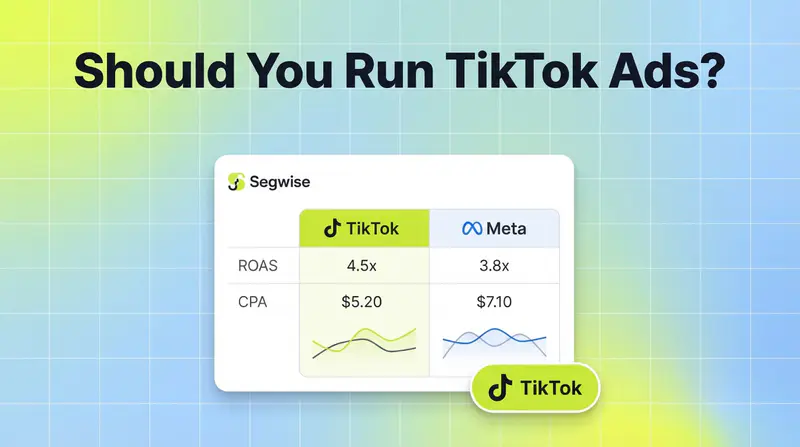
This conversation plays out in boardrooms and Slack threads across DTC brands every week. TikTok's ad platform has matured fast. It generated $23 billion in ad revenue in 2024, up 43% year-over-year. Engagement rates on the platform sit at 4.07%, over four times higher than Instagram. Founders see competitors talking about TikTok results on LinkedIn, investors ask about diversification, and the FOMO is real.
But the data tells a more complicated story. An analysis of 500 DTC ad accounts by MHI Media found that Meta still accounts for 62% of total DTC ad spend in 2026, while TikTok delivers a median ROAS of 2.1x versus Meta's 2.8x. The gap is not enormous, but the operational demands TikTok places on creative teams are.
The question isn't whether TikTok works. It does. The question is whether you're ready for it yet.
Key Takeaways
TikTok delivers lower ROAS than Meta in most categories: 2.1x median vs 2.8x for DTC, according to MHI Media's 500-account dataset
TikTok creative burns fast: top-performing ads fade in 4-7 days vs 18-30 days on Meta, requiring 80-120 fresh creatives per month vs 50-80 on Meta
Cheap CPMs don't equal cheaper CAC: TikTok CPMs average $9-12 vs Meta's $12-16, but conversion rates lag, often resulting in comparable or higher cost per acquisition
Mastering your primary channel first is the standard playbook: RevenueCat's ad diversification analysis recommends staying focused on one social platform if your budget is under $100K/month
The CMO test: before adding any channel, check four things: creative hit rate, media buying efficiency, website CVR, and LTV:CAC. If you don't know these numbers, you're not ready
The right question isn't TikTok vs Meta: it's whether your creative engine is optimized enough that adding TikTok would amplify results rather than dilute them
Also read What Is Hook Rate and How to Improve It
The Case For TikTok (And Why It's Tempting)
TikTok has real advantages. CPMs average $9-12 versus Meta's $12-16, which means cheaper reach at the top of the funnel. For products under $100 with strong visual appeal, like beauty, fashion, gadgets, and food, the impulse-buy environment drives fast conversions. According to Aligned Agency's 2026 benchmark data, e-commerce brands see average CPAs of $18-42 on TikTok, with the platform consistently delivering 30-40% lower CPAs than Instagram for impulse purchases.
The platform has also grown up. What was an experimental channel in 2023 is now a full-funnel acquisition machine. TikTok's algorithm has gotten good at finding buyers, not just viewers. You can run in-feed ads, collection ads, spark ads, and dynamic showcase ads. The ad toolkit now rivals Meta's for most use cases.
So why not just go for it?
What the Data Actually Says: TikTok vs Meta Side by Side
Here's the honest comparison from MHI Media's analysis of 500 DTC accounts:
The CPM gap looks like an opportunity. The creative demand gap is the trap most brands fall into.
TikTok's creative burnout rate is unforgiving. Koro's 2025 platform analysis found that TikTok creatives fatigue in 4-7 days compared to 10-14 days for Instagram Reels. TikTok CPA is also highly volatile: the same analysis noted CPAs swinging from $15 to $60 in a single week due to creative fatigue. That's not a rounding error. That's a business model risk.
Maintaining TikTok performance means running fresh creative constantly. Top-performing DTC brands using TikTok as a primary channel are producing 80-120 creative assets monthly, according to MHI Media. If your creative team is already stretched keeping Meta fresh, adding TikTok doesn't just create a new channel. It creates a new bottleneck.
The Creative Engine Test: Are You Ready?
Here's the CMO framework that should gate your TikTok decision. Before you add any new channel, you need to pass four tests on your existing one.
1. Creative hit rate
Are you launching one new creative concept for every $10K in monthly ad spend? And out of those launches, are 10% becoming consistent winners? Are 1% becoming breakout hits that drive 50% of your revenue?
Most brands at $5M can't answer yes to all three. They're running the same 3-5 creative concepts and refreshing the messaging instead of the concept itself.
2. Media buying efficiency
Is your testing budget under 20% of total spend? If you're spending more than that on testing, you haven't found a reliable system. You're still in discovery mode.
3. Website conversion rate
Is your CVR above 3%? If you're sending expensive traffic to a site that converts under 2%, adding TikTok just means paying for more people to bounce. Fix the funnel first.
4. LTV:CAC ratio
Are you at 3:1 or better? And are you first-order breakeven by month 3? If not, the unit economics on Meta aren't right yet. Adding another channel doesn't fix unit economics. It just adds complexity.
If you can't answer confidently on all four, the problem isn't which channels you're on. The problem is the creative and operational engine. According to MHI Media's 500-account dataset, creative format alone explains 3x more variance in ad performance than audience targeting. The channel matters less than what you're running on it.
Why 8-Figure Brands Aren't Actually Diversified
There's a common misconception about how large DTC brands operate. The assumption is that $50M+ brands got there by running Meta, TikTok, Google, YouTube, Pinterest, and Snapchat simultaneously. That's what founders tell the press. It's not what the data shows.
RevenueCat's deep-dive on ad channel diversification found a consistent failure pattern: a brand starts testing Snapchat, TikTok, and Pinterest at the same time. They end up with a bunch of channels they're doing an okay job at, instead of one funnel they're crushing. The operational drag from managing multiple channels, with different creative requirements, different attribution windows, and different optimization loops, actively damages performance on existing channels.
RevenueCat's recommendation is direct: if your budget is under $100K/month, focus on nailing one social platform. Keyword-based channels like Apple Ads or Google Search can run in parallel, but social ad diversification before that threshold spreads learning too thin.
TCF's ecommerce marketing analysis backs this up: Meta alone can drive 80% of revenue at the 7-figure level, and that's not a bug. It's a feature. Focusing means the algorithm gets more spend, more signal, and more time to optimize. The limitation on Meta at $160K/month isn't scale. There are brands spending $500K/month in the same niche. The limitation is creative, optimization, and unit economics.
When You Actually Should Add TikTok
There is a right time to add TikTok. It's not when the CEO asks why you're not on it. It's when you can say yes to three specific questions.
Do you have the human capital? TikTok needs a dedicated creative pipeline. Not Meta videos repurposed into TikTok format. Native, lo-fi, UGC-style content that looks like organic posts. "Ads that look like ads are ignored," per Koro's platform analysis. You need a system: creators, briefing, rapid iteration, fast approval loops.
Do you have extra budget for a real test? Testing TikTok properly requires $500-1,500 per month minimum to gather signals, and realistically $3,000+ to scale. That budget should sit outside your existing Meta spend, not cannibalize it. Bidease's 2025 survey of 100 mobile marketers found that running 2-4 week sprints with limited spend, clear KPIs, and a defined hypothesis before scaling is the best approach.
Do you know how you'll measure incremental lift? If you can't separate TikTok's contribution from a general lift in brand awareness, you can't make good budget decisions. This means incrementality testing, or at minimum a clear media mix attribution view before you start.
If all three are yes, and you've passed the creative engine test, TikTok can meaningfully complement Meta. The most effective strategy is using TikTok for upper-funnel discovery and retargeting on Meta where conversion intent is higher, per Koro's 2025 analysis. Brands that get this hybrid right see Meta and Google performance improve as TikTok drives brand recognition. The channels compound.
If You Do Add TikTok: Realistic Expectations
Going in with Meta-calibrated expectations for TikTok is a setup for early exits. Here's what the benchmark data actually shows for 2026.
CPA: Expect $18-42 for e-commerce, $35-89 for service-based businesses. Highly variable based on creative quality.
ROAS: The blended ROAS benchmark for DTC brands on TikTok is 2.5-3.5x from MHI Media's 40-brand omnichannel dataset, compared to Meta's 3-4x. Lower immediate returns, but with higher top-of-funnel volume potential. Note: the 500-account median dataset shows 2.1x across all brand sizes and creative maturity levels. New TikTok accounts typically start below the 2.5x threshold until creative systems mature.
Time to consistent results: Expect 90-120 days before creative systems mature and results stabilize. Don't evaluate TikTok performance after 30 days.
Creative investment: Plan for 70% media spend, 30% creative production. The platform penalizes static-image creative adapted from other platforms. Fresh, native video content is the cost of entry.
Breakeven math: For e-commerce, target minimum 3x ROAS to stay profitable. Most TikTok-acquired customers need 60-90 days to become profitable on lifetime value, so cash flow management matters more here than on Meta.
Conclusion
The TikTok question has a clean answer if you ask it right. The question isn't "should we run TikTok ads?" It's "have we earned the right to expand?"
Earning that right means knowing your creative hit rate, keeping media buying disciplined, running a website that converts above 3%, and hitting 3:1 on LTV:CAC. If those numbers are solid and you have the budget and team to run TikTok natively, it's a real growth lever. If they're not, TikTok is a distraction that makes the underlying problem harder to see.
This is exactly where creative analytics becomes a competitive edge. If you're running performance ads at scale across Meta, or ready to add TikTok, knowing which creative elements are actually driving performance (not just which campaigns look good) is what separates brands that can scale from brands that plateau. Segwise's AI-powered creative intelligence platform connects data from Meta, TikTok, Google, Snapchat, YouTube, AppLovin, Unity Ads, Mintegral, IronSource and MMPs including AppsFlyer, Adjust, Branch, and Singular. It gives you a unified view of what's working, catches creative fatigue before it burns budget, and shows you exactly which hooks, CTAs, and formats are driving ROAS. Before you decide whether to add TikTok, you should know if you've fully unlocked what you already have. See how Segwise helps performance teams answer that question.
Frequently Asked Questions
Is TikTok cheaper than Meta for advertising?
TikTok CPMs average $9-12 compared to Meta's $12-16, making it cheaper to reach audiences. But cheaper reach doesn't always mean cheaper acquisition. MHI Media's 500-account analysis found TikTok's median CPA for DTC is $44 versus Meta's $38, despite the CPM gap, because conversion rates on TikTok lag behind Meta's.
How much should I budget to test TikTok ads?
A meaningful test requires a minimum of $500-1,500 per month in media spend, with $3,000+ needed to start gathering scalable signals, according to Aligned Agency's 2026 data. Budget this separately from existing Meta spend and run 2-4 week sprints with clear KPIs before scaling.
How often do TikTok ads need creative refreshes?
TikTok creative fatigues in 4-7 days, compared to 10-14 days for Instagram Reels and 18-30 days for Meta feed ads. Top-performing DTC brands on TikTok produce 80-120 creative assets per month to sustain performance, per MHI Media. This is the biggest operational challenge for brands expanding from Meta.
Should I run TikTok or Meta first?
If you're starting from scratch, RevenueCat recommends focusing on one social platform first, especially if your budget is under $100K/month. For most DTC brands, Meta offers deeper targeting data, higher conversion rates, and more stable creative performance as a starting point.
What's the realistic ROAS for TikTok ads?
Blended ROAS for DTC brands on TikTok averages 2.5-3.5x for brands with mature creative systems, based on MHI Media's omnichannel dataset of 40+ brands. The broader median across all brand sizes is 2.1x. Meta's blended ROAS runs 3-4x, but TikTok delivers higher top-of-funnel volume and brand discovery. Brands that run TikTok effectively often see downstream improvement in Meta and Google performance.
When is it too early to expand to TikTok?
It's too early if your creative hit rate on Meta is below 10%, your testing budget exceeds 20% of total spend, your website CVR is under 3%, or your LTV:CAC is below 3:1. Failing any of these means your core channel isn't optimized. Adding TikTok adds operational complexity without fixing the underlying problem.
Does TikTok work for mobile app advertisers?
Yes. TikTok is a major UA channel for mobile gaming studios, subscription apps, and consumer apps targeting Gen Z and Millennial audiences. Benchmark CTRs of 2.5-5% for food delivery and DTC apps are competitive. The same creative velocity requirements apply though. TikTok's algorithm rewards native, entertainment-first ad formats over traditional app install ads.
Can I run TikTok and Meta at the same time on a limited budget?
Not effectively. RevenueCat's analysis is clear: splitting a limited budget across channels reduces learning speed on both platforms, dilutes optimization cycles, and adds operational overhead that smaller teams can't absorb. Focus on mastering one social platform first. Google Search and Apple Ads can run in parallel without competing for the same creative and optimization resources.