
Updated August 2026. This post has been substantially revised. Meta shipped Creative Breakdown on 11 July 2025, which gives asset-level metrics inside flexible-format and Advantage+ Creative ads — so the older claim that Meta shows you nothing below the ad level is no longer true, and we have corrected it. Meta also changed its click-through attribution definition on 3 March 2026, which breaks comparability with 2025 creative benchmarks. Both changes are covered below.
Short answer: use the native Meta and TikTok tools for what they are genuinely good at — free, immediate, authoritative delivery data, and (on Meta) asset-level reporting inside Advantage+ Creative and flexible-format ads. Use Segwise when you need what neither platform offers at any price: element-level tagging (hook line, first frame, voiceover, character, CTA wording) tied to ROAS, one view of the same creative concept across networks, playable-ad analysis, and AI generation of the next round of creatives. They are layers, not alternatives.
When you’re spending heavily on Meta advertising and TikTok ads, you need to know exactly which creative dollars are generating returns. The platforms' built-in dashboards are far more capable than they were two years ago — Meta in particular now reports at the asset level — but they still stop short of telling you which element inside a creative moved the number, and neither will ever show you the same concept running across both networks side by side.
The truth is, improving your Return on Ad Spend (ROAS) in today's complex environment requires going beyond basic metrics like impressions and click-through rates. We need to cut through the noise and pinpoint the actual creative variables driving success. This is the difference between simple monitoring and truly actionable ROAS insights.
Key Highlights
Meta now reports at the asset level. Creative Breakdown (launched 11 July 2025) shows delivery status, reach, impressions, cost per result, spend, engagement rate and link CTR for each image or video inside a flexible-format or Advantage+ Creative ad. Any comparison that says Meta shows nothing below the ad level is out of date.
But asset-level is not element-level. Meta’s Creative Breakdown is table-view only (charts are disabled), does not work on Dynamic Creative ads, and is explicitly informational rather than prescriptive — Meta advises against using it to manually pause underperforming assets, because aggregate metrics cannot override real-time algorithmic delivery. It will tell you video A beat video B. It will not tell you that the reason was the hook line in the first two seconds.
TikTok’s native tooling is generous but inward-facing. Creative Center is free and strong on trends, Top Ads and Symphony AI generation — but it surfaces competitor and industry ads rather than your own account’s creative performance, offers no element-level tagging, and provides no data for any other platform.
Neither gives you a cross-network view, and neither can read a playable ad. If the same concept runs on Meta, TikTok, Google and an app network, you have four unconnected numbers and no way to compare the concept itself.
Segwise creative analytics delivers deeper, actionable ROAS insights by mapping creative tagging to performance metrics and cross-platform analysis, surpassing the built-in limits.
Segwise features include granular video performance breakdowns, competitor creative tracking, influencer impact assessment, and advanced trend detection across creatives, enabling faster optimization.
The built-in dashboards miss element-level patterns. Which character, which hook dialogue, which on-screen text overlay, which cut at second three, which CTA wording — these are not dimensions in Ads Manager or TikTok Ads Manager, at any spend level. That is the gap that actually costs money.
Your 2025 creative benchmarks are no longer comparable. Meta’s 3 March 2026 attribution change means click-through attribution now counts link clicks only, with other interactions moved to “engage-through”, and the video-view threshold dropped from 10 seconds to 5. Any CTR or ROAS baseline you built in 2025 needs re-basing before you compare anything to it.
By revealing underperforming creatives and key element contributions, Segwise enables smarter budget allocation and enhanced ad effectiveness beyond surface-level data.
Cost: the native tools are free and always will be. Segwise is a paid layer with a 7-day free trial that backfills up to two weeks of history on connection (up to three months on paid plans). The question is not which is cheaper — it is whether element-level insight, cross-network comparison, playable coverage and generated creative are worth a line item at your creative volume.
Understanding Analytics in the Context of Meta and TikTok
Analytics on platforms like Meta and TikTok serve a vital function: revealing audience behaviour and quantifying creative impact. They are authoritative on delivery — impressions, engagement, conversions, video completion — because they are the delivery system. They are also free. Before arguing about what they lack, it is worth being precise about what each one now actually does, because both moved significantly in 2025 and 2026.
What Meta Ads Manager natively offers in 2026
Creative Breakdown (launched 11 July 2025) — asset-level metrics for each image or video inside a flexible-format or Advantage+ Creative ad: delivery status, reach, impressions, cost per result, amount spent, engagement rate, link CTR. Before this shipped, you genuinely could not get performance data on individual creative enhancements. This is the single biggest reason older comparisons of Meta’s creative reporting are wrong.
Dynamic Creative element breakdown — a separate, older report. Note that Creative Breakdown does not work on Dynamic Creative ads; the two are distinct.
Standard Breakdowns — delivery, placement, time and action breakdowns applied at ad level.
Ad-level performance tables — still the baseline creative view most teams actually work in.
AI creative generation via Advantage+ Creative, with generated assets now visible inside Creative Breakdown.
Meta’s documented limitations. Creative Breakdown is table view only — bar and trend charts are disabled. Data covers campaigns from 1 July 2017 onward. It does not work with Dynamic Creative. And Meta positions it as informational, not prescriptive: it advises against using it to manually pause underperforming assets, on the grounds that aggregate metrics cannot override real-time algorithmic delivery. Beyond that: it is asset-level rather than element-level, so you cannot connect a hook, a first frame, a voiceover, a CTA style, a character or a colour palette to bottom-of-funnel KPIs; there is no diagnostic layer telling you which stage failed (attention vs engagement vs conversion); creative asset data sits apart from performance data; there is no cross-network view; and playable and interactive ads are not effectively analysed.
The 2026 wrinkle: Meta moved the goalposts under you
Three platform changes matter for anyone comparing creative numbers year over year:
3 March 2026 — attribution definition change. Click-through attribution now counts link clicks only; other interactions moved to “engage-through”, and the video-view threshold dropped from 10 seconds to 5. Reported CTR and ROAS shift against 2025 baselines as a direct result. If a creative “improved” in March 2026, check that it wasn’t the metric definition that improved.
January 2026 — Advantage+ Shopping became Advantage+ Sales, and the Advantage+ framework extended across sales, app installs and lead gen. Legacy ASC and AAC campaigns can no longer be created via the Marketing API. If your naming conventions or reports still say “Advantage+ Shopping”, they are out of date.
2026 — the Andromeda ads-retrieval engine expanded across all campaign types, which makes creative quality (copy specificity, visual intent) function as a targeting variable. Creative is no longer only the thing being measured; it is part of the delivery mechanism.
For scale context: Meta reported Family Daily Active People of 3.60 billion on average for June 2026, with advertising revenue of $59.363B in Q2 2026, up 27% year over year. This is not a channel anyone opts out of — which is exactly why the reporting gaps are worth solving rather than ignoring.
What TikTok Ads Manager and Creative Center natively offer in 2026
TikTok Creative Center — completely free: Top Ads library, Keyword Insights, Creative Insights, Top Products, Trends, Symphony AI tools, Video Generator, Commercial Music Library.
Top Ads dashboard — a searchable library of high-performing TikTok ads with engagement data.
Symphony suite inside Ads Manager — script generation, digital avatars, AI dubbing, automated product video. Symphony Agent turns a brief into a TikTok-ready ad; Symphony Avatar adds voiceover, product demos and virtual try-on.
Creative Upgrades — redesigned asset management combining historical creatives, AI-generated assets and trending videos.
Agentic Hub — build AI agents with Skills for reporting, audience discovery and budget optimisation.
Trend intelligence — hashtag tracking, trending audio, creator discovery, Keyword Insights.
Credit where it is due: on generative creative tooling inside the ad platform, TikTok is ahead of Meta, and Creative Center is one of the best free research tools in advertising.
TikTok’s documented limitations. It is TikTok-only — it provides no data or tools for any other advertising platform, so there is no cross-network view. Creative Center shows competitor and industry ads, not your own account’s creative performance, which is a distinction a lot of teams discover late. There is no element-level tagging, so native tools cannot identify which creative elements drive performance across your account. You cannot download videos directly from the Top Ads library. Some advanced features require a verified Ads Manager account. And native tools cannot read playable ads — a hard blind spot for gaming and app advertisers.
The shared gap list
Strip out the platform-specific detail and six gaps are common to both:
No cross-network view of the same creative concept.
Asset-level at best, never element-level — no hook, first-frame, CTA, character or audio tagging tied to ROAS.
No diagnosis of why a creative failed — attention, engagement or conversion.
Creative assets and performance data live in separate places.
Playable and interactive ads are not analysed.
Metric definitions shift under you — see Meta’s March 2026 attribution change — breaking historical comparison.
However, the real challenge for high-volume advertisers is interpreting this data. Watch time and click-through rate are essential signals, but they answer “which ad” and, on Meta since July 2025, “which asset” — never “which element”. Knowing whether the King character or the Forest background caused a performance boost is still impossible with platform data alone, on either network, at any spend level. Optimising ROAS requires exactly those nuances, which is why performance marketers layer something on top of the native tools rather than replacing them.
Introducing Segwise Creative Analytics: Features and Benefits
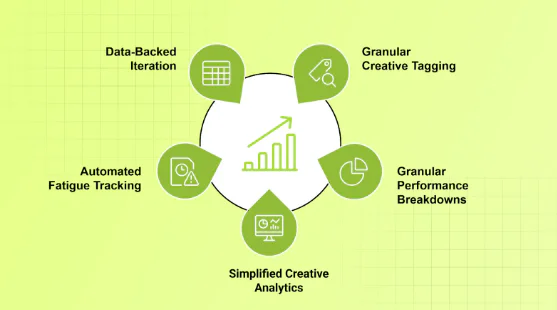
Segwise Creative Analytics fills the gap left by native platforms by offering a powerful blend of data unification and AI-powered creative analysis. Segwise is focused on building a platform that leverages multimodal AI to help marketing teams monitor campaigns, get creative insights, and improve ROAS with data-backed, auto-generated creative iterations.
We know that improving Creative ROAS requires simplifying creative tagging and analytics. Our solution automates the hard work and provides actionable insights.
Key features that go beyond the capabilities of the native dashboards include:
Granular Creative Tagging: Our multimodal AI automatically tags creative elements across images, videos, and playables, identifying key creative variables like hook scene dialogues, influencer traits, and audio components. You can also add custom tags unique to your performance.
Granular Creative Performance Breakdowns: Identify which specific creative variables drive engagement and conversion.
Simplified Creative Analytics: Automatically tag, classify, and map every creative element from backgrounds to CTAs, to key performance metrics like ROAS and CPA. Instantly reveal what's truly working, eliminating manual guesswork.
Automated Creative Fatigue Tracking: Proactively monitor all creatives across every ad network to spot early signs of performance decline. Set custom thresholds and get alerts before burning budget on fatigued ads.
Creative Strategy Agent (AI Chat): an always-on creative strategist that holds full context across your creative, tag, fatigue, asset-cluster and competitor data. Ask “which hook style drove the most installs on TikTok last month?” or “what separates my top five Meta creatives from my bottom five?” in plain language and get an answer — or a formatted, shareable report — without building a dashboard first.
AI Creative Generation, not just iteration: the Creative Generation Agent produces net-new, data-backed creatives from your winning patterns — static images, video ads including AI UGC, interactive playables, and scene-by-scene video storyboards you can produce in-house or hand to an agency. It remixes winning hooks, CTAs, characters and visual styles from across different top performers rather than reskinning a single ad, you refine outputs by prompting, and you export in each network’s aspect ratios (1:1, 4:5, 9:16, 16:9). Every generated creative is auto-tagged and tracked once live, so its results feed straight back into the model that produced it.
Playable ad tagging: Segwise is the only platform that tags playable (interactive) ads. Neither Meta nor TikTok native tooling can read them.
Asset clustering: automatically groups ads that share the same underlying footage, images or audio, so you can isolate which specific treatment — a new hook, a different CTA, a music swap — actually caused the ROAS difference between two near-identical creatives.
Competitor Tracking Agent: monitors, tags and gap-analyses competitors’ live ads with the same multimodal AI, surfacing messaging angles nobody in your category is using and angles that are already oversaturated. Currently Meta (Facebook and Instagram); more platforms in development.
These capabilities empower performance marketers to identify underperforming content quickly, stop wasted spend, and optimize campaigns for significantly better ROAS.
Side-by-Side Comparison: Segwise vs Built-In Meta/TikTok Analytics

Segwise pulls all your creative data from every ad network you work with and unifies it in one dashboard. This cross-network analysis, down to every creative tag, provides value that native dashboards cannot.
Capability | Segwise | Meta Ads Manager (native) | TikTok Ads Manager / Creative Center (native) |
Deepest reporting granularity | Element level — hook line, first frame, on-screen text, spoken dialogue, character, audio mood, CTA wording, colour palette, scene changes | Asset level via Creative Breakdown (since 11 Jul 2025) — each image or video inside a flexible-format or Advantage+ Creative ad | Ad level for your own account; no element-level tagging |
Custom tags | ✔ Define brand- or campaign-specific tags; nomenclature tagging from existing file-naming conventions | ❌ | ❌ |
Cross-network view of the same creative concept | ✔ One unified dashboard across 15+ ad networks and MMPs | ❌ Meta only | ❌ TikTok only — provides no data for any other platform |
Works on Dynamic Creative / Advantage+ | ✔ Tags the underlying assets and their elements regardless of ad format | Partial — Creative Breakdown covers Advantage+ Creative and flexible format, but does not work on Dynamic Creative (a separate, older element breakdown exists for those) | N/A |
Charts and visual trend analysis of creative data | ✔ Custom dashboards, Card View with thumbnails, custom metrics | ❌ Creative Breakdown is table view only — bar and trend charts are disabled | Partial — trend tooling is strong, but for market trends, not your account’s creative |
Prescriptive vs informational | Prescriptive — tag-to-metric mapping, recommendations, and generated creatives built on winning elements | Informational by design — Meta advises against using Creative Breakdown to manually pause underperforming assets, because aggregate metrics cannot override real-time algorithmic delivery | Informational; Symphony generates, but not from your own performance data |
Your own account’s creative performance vs market research | Your account, plus competitor ads via the Competitor Tracking Agent | Your account | Both, but separately — Creative Center surfaces competitor and industry ads, not your own account’s creative performance |
Creative fatigue detection | ✔ Native, with configurable thresholds and email/Slack alerts, across every connected network | ❌ Not a feature — requires manual interpretation of diminishing returns on CTR/CPA | ❌ Not a feature |
Playable / interactive ad analysis | ✔ The only platform that tags playable ads | ❌ | ❌ Native tools cannot read playables |
Asset clustering (isolating which treatment caused the difference) | ✔ Groups ads sharing the same footage, images or audio | ❌ | ❌ Creative Upgrades stores and organises assets, but does not cluster by shared source material |
AI creative generation | ✔ Grounded in your winning-element data: static, video (incl. AI UGC), playables, video storyboards, prompt-based editing, multi-aspect-ratio export, generated creatives auto-tagged and tracked | ✔ Advantage+ Creative generates assets, and they now appear in Creative Breakdown — but generation is platform-directed, not driven by your own element-performance data | ✔ Symphony (script generation, avatars, dubbing, product video), Symphony Agent, Video Generator — strong tooling, again not grounded in your own element-level results |
Always-on AI strategist over your creative data | ✔ Creative Strategy Agent (AI Chat), full account context, on-demand report generation | ❌ | Partial — Agentic Hub builds agents with Skills for reporting, audience discovery and budget optimisation, within TikTok |
MMP and in-app event data alongside creative | ✔ AppsFlyer, Adjust, Branch and Singular, including custom in-app events; choose network or MMP numbers per report | ❌ Meta’s own conversion signal only | ❌ TikTok’s own conversion signal only |
Authoritative delivery and auction data | Reads it from the networks — never more current or more authoritative than the source | ✔ It is the source of truth | ✔ It is the source of truth |
Cost | Paid; plans published on segwise.ai. 7-day free trial, up to 2 weeks of history backfilled on trial and 3 months on paid | Free — included with your ad account | Free — Creative Center requires no ad spend to browse |
Metrics and Data Insights
Effective ROAS optimisation requires focusing on key metrics beyond basic volume counts. Take an illustrative example — the numbers below are made up to show the shape of the difference, not benchmarks. Meta tells you a video has a given CTR, and since July 2025 it will also tell you how each individual asset inside that ad performed. What neither Meta nor TikTok will tell you is that every creative featuring the “King” character outperforms your account baseline while every creative opening on a dialogue hook underperforms it — because “character” and “hook type” are not dimensions in either platform. Segwise tags those elements automatically and maps each one to ROAS, CTR, CPI and your custom in-app events, so you can brief the next round of creatives around the King rather than guessing.
One 2026 caveat worth building into your process: because Meta redefined click-through attribution on 3 March 2026 — link clicks only, video-view threshold cut from 10 seconds to 5 — CTR and ROAS figures pulled from Ads Manager are not comparable to 2025 baselines. Combined with Andromeda making creative quality a targeting variable, that is a good argument for holding your creative history in a system whose metric definitions and tag taxonomy you control, rather than re-basing spreadsheets every time a platform changes a definition.
Ease of Use and Integration
While built-in analytics are immediately accessible, they lack the depth required for advanced optimization. Segwise, on the other hand, provides seamless, no-code integrations with 15+ ad networks and attribution tools like MMPs or custom data sources, minimizing setup complexity.
Segwise offers intuitive, customizable dashboards that consolidate data from multiple platforms, facilitating faster decision-making without disrupting your existing workflows.
Reporting and Customization
Segwise excels in customizable reporting, offering a level of flexibility that native content analytics tools cannot match. Instead of generic, one-size-fits-all reports, Segwise lets you create reports and custom dashboards focused on the key metrics that align with your specific ROAS goals, such as influencer impact or creative element performance.
Furthermore, Segwise allows you to subscribe to specific reports and receive automated email and Slack alerts for them. For instance, you could set up an alert that delivers a report on your top-performing characters every morning, meaning you don't need to manually check a dashboard daily.
Pricing and Value for Money
The native tools are free, and that is a real advantage — not a footnote. Meta’s Creative Breakdown and standard Breakdowns come with your ad account at no cost, and TikTok Creative Center is free to browse whether or not you spend a dollar, including Top Ads, Keyword Insights, Trends and the Symphony AI tools. For a team running a handful of creatives a month, that is genuinely sufficient, and paying for a layer on top would be waste.
Segwise is a paid layer. Plans are published on segwise.ai, with a 7-day free trial. Historical data backfills the moment you connect a source — up to two weeks on the trial, up to three months on paid plans — so you can test tag accuracy against creatives whose results you already know, rather than waiting for new data to accumulate. Setup is no-code and OAuth-based: roughly five minutes per source, 10–15 minutes to connect everything, no engineering.
The honest way to frame the money: you are not replacing free tooling, you are adding a layer. The layer pays for itself when the questions you cannot answer — which hook, which character, which CTA, which concept across which network, which playable — are costing you more than the subscription.
For scaled advertisers (Mobile Games, DTC, or Subscription Apps), the value of quickly identifying winning creative patterns and optimizing budget allocation significantly outweighs the initial investment. If your goal is speed, deep insights, and maximized ROI, advanced analytics like Segwise is a necessity, not a choice.
Which Tool Should You Choose? Decision Guide for Advertisers
The choice depends on your scale and strategic goals.
If you are... | Use... | Reason... |
Running small campaigns, or spending on one network only, with simple monitoring needs | Built-in tools only | Free, immediate, and authoritative. Meta’s Creative Breakdown gives you asset-level performance inside Advantage+ Creative and flexible-format ads, which covers a lot of ground. Do not pay for a layer you do not need yet. |
Researching what is working in your category, or generating first-draft creative fast | TikTok Creative Center + Symphony | Free, and the best market-research and in-platform generation tooling of the two networks. Just be clear that Creative Center shows competitor and industry ads, not your own account’s creative performance. |
Running the same creative concept across two or more networks | Segwise (on top of the native tools) | Neither platform shows you anything outside itself. Cross-network comparison of the same concept is structurally impossible natively. |
Shipping creatives weekly and needing to know which element won | Segwise | Asset-level tells you video A beat video B. Element-level tells you the hook, character, CTA wording or audio mood that made the difference — and that is what a brief is written from. |
Running playable or interactive ads | Segwise | Neither Meta nor TikTok native tooling can read a playable. Segwise is the only platform that tags them. |
Spending heavily through Advantage+ / Dynamic Creative | Both, deliberately | Creative Breakdown covers Advantage+ Creative and flexible format but not Dynamic Creative, and it is informational rather than prescriptive by Meta’s own guidance. A tagging layer fills the gap without giving up the platform’s delivery data. |
Needing a creative bottleneck solved, not just measured | Segwise | Advantage+ Creative and Symphony both generate assets, but from platform-side signals. The Creative Generation Agent generates from your element-level winners and tracks the results back into the same model. |
Where the native tools are genuinely the better choice
A comparison worth trusting has to concede this. On several points the platforms win outright, and no third-party layer changes that:
They are the source of truth. Delivery, auction dynamics, reach and frequency come from the platform. Segwise reads that data; it can never be more current or more authoritative than its source.
They are free. Creative Breakdown and Creative Center cost nothing, and Creative Center does not even require spend.
Meta’s asset-level Creative Breakdown is real and useful. If your creative is mostly Advantage+ Creative and flexible-format ads on Meta alone, it may be all the granularity you need.
TikTok Creative Center is the best free creative research tool in advertising, and Symphony’s generation stack — avatars, dubbing, product video, brief-to-ad — is ahead of what Meta offers in-platform.
Zero integration risk. No connector to configure, no permissions to review, no vendor to onboard.
Which is the point: Segwise is not a replacement for Ads Manager. It is the layer that answers the questions Ads Manager is not built to answer — and it reads the native data rather than competing with it.
If you prioritize optimizing ROAS quickly and efficiently, you need tools that reveal the hidden performance drivers in your creatives.
Conclusion: Maximizing ROAS with the Right Creative Analytics Tool
Meta and TikTok analytics provide the necessary foundation of campaign data, and both have improved materially — Meta with asset-level Creative Breakdown since July 2025, TikTok with Symphony, Creative Upgrades and the Agentic Hub. What neither provides is element-level attribution of performance to the specific creative decisions your team actually makes, a single view of a concept across networks, playable coverage, or generation grounded in your own winning patterns.
Maximizing ROAS hinges on choosing a creative analytics tool that provides depth and actionability. Segwise achieves this by automating creative tagging and providing cross-platform analysis down to the individual creative element. This enables you to streamline your decision-making, identify winning creative patterns, and ensure every dollar spent works harder for measurable returns.
If you are serious about creative optimisation and moving beyond hunches, start your 7-day free trial with Segwise — up to two weeks of your creative history is backfilled the moment you connect an account, so you can check the tagging against creatives you already know the results of before you commit to anything.
FAQs
1. Does Meta show creative performance below the ad level?
Yes, since 11 July 2025. Meta’s Creative Breakdown reports delivery status, reach, impressions, cost per result, spend, engagement rate and link CTR for each individual image or video inside a flexible-format or Advantage+ Creative ad. It is table view only, it does not work on Dynamic Creative ads, and Meta positions it as informational rather than prescriptive.
2. What is the difference between asset-level and element-level creative reporting?
Asset-level tells you how each file — this video, that image — performed. Element-level tells you how the things inside the file performed: the hook line, the first frame, the on-screen text, the voiceover, the character, the CTA wording, the audio mood, the colour palette. Meta reports at the asset level. TikTok reports at the ad level. Neither reports at the element level, which is the granularity a creative brief is actually written at.
3. Can Meta or TikTok show me the same creative across both platforms?
No. Each platform reports only on itself; TikTok’s own documentation is explicit that it provides no data or tools for any other advertising platform. Cross-network comparison of one creative concept requires a layer that reads both.
4. Is TikTok Creative Center free, and does it show my own ad performance?
It is completely free, including Top Ads, Keyword Insights, Creative Insights, Trends, the Symphony tools and the Commercial Music Library. But it surfaces competitor and industry ads rather than your own account’s creative performance — that lives in Ads Manager, at the ad level. Some advanced features require a verified Ads Manager account.
5. Did Meta change how creative metrics are calculated in 2026?
Yes. On 3 March 2026, click-through attribution changed to count link clicks only, other interactions moved to “engage-through”, and the video-view threshold dropped from 10 seconds to 5. Reported CTR and ROAS therefore shift against 2025 baselines. Separately, Advantage+ Shopping was renamed Advantage+ Sales in January 2026, and the Andromeda retrieval engine now treats creative quality as a targeting variable.
6. Can native tools analyse playable ads?
No. Neither Meta nor TikTok native tooling reads playable or interactive ad units — a hard blind spot for gaming and app advertisers. Segwise is the only platform that tags them.
7. Do I still need the native dashboards if I use Segwise?
Yes, and you always will. The platforms are the source of truth for delivery, auction and reach data, and they are free. Segwise reads network data (and MMP data from AppsFlyer, Adjust, Branch or Singular) and adds the element-level, cross-network and generation layer on top. It is not a replacement for Ads Manager.
8. How long is the Segwise free trial, and how much history do I get?
7 days. Historical data is imported automatically when you connect a source — up to two weeks on the trial, up to three months on paid plans.
9. Which is better for mobile games specifically?
If playables carry meaningful spend, Segwise, because nothing native can read them. Beyond that, game UA usually runs across Meta, Google, TikTok, Axon (AppLovin), Unity Ads and Mintegral at once, and the cross-network view is where the native tools structurally cannot help.
About This Comparison
Methodology. Written and maintained by the Segwise team, who work daily inside live UA and DTC ad accounts across Meta, Google, TikTok, Snapchat, Axon (AppLovin), Unity Ads and Mintegral, alongside all four major MMPs. For this August 2026 revision, Meta and TikTok native capabilities and limitations were re-checked against the platforms’ current documentation and product announcements, Meta’s Q2 2026 results (Family DAP of 3.60 billion for June 2026; advertising revenue $59.363B, +27% YoY), and TikTok’s own product preview.
What changed in this update. The original December 2025 version of this post argued that the native platforms show nothing below the ad level. Meta’s Creative Breakdown, launched 11 July 2025, made that wrong, so we corrected it: the defensible claim is asset-level, not element-level — table-only, not available on Dynamic Creative, informational rather than prescriptive, no cross-network view, and unable to read playables. We also added Meta’s 3 March 2026 attribution change and flagged the one illustrative CTR figure in the post as illustrative rather than a benchmark, added the Advantage+ Sales rename, documented TikTok’s current native tooling in full, and corrected the Segwise free trial length to 7 days.
A note on what we did not claim. TikTok’s Creative Insights help documentation does not publish eligibility thresholds or a lookback window, so we have not stated any spend or impression threshold for it.
Bias disclosure. We build Segwise, so treat the verdicts as ours. Where the free native tools are the better choice, we have said so — and for a lot of advertisers they are.