
Updated August 2026. Adnova’s pricing, feature set and product scope were re-verified against adnova.ai/pricing and adnova.ai in August 2026, including its Creative Analytics 2.0 release, which this post previously did not account for. Note that adnova.ai is the product compared here; adnova.marketing is an unrelated company.
Short answer: Adnova is the better buy for hands-on, Meta-first ecommerce brands and small agencies that want creative research, competitor tracking and bulk ad launching in one low three-figure tool, from $119/mo billed annually ($150 month-to-month). Segwise is the better buy for UA and performance teams that need element-level creative intelligence across app networks and MMPs, playable-ad tagging, an always-on Creative Strategy Agent, and AI creative generation. They solve different halves of the problem: Adnova is workflow and execution, Segwise is intelligence and production.
Key Takeaways
Different jobs. Adnova is a creative research, workflow and launching platform (75M-ad inspiration library, competitor Detective, bulk Ad Launcher, Creative Hub, 1,000+ Meta ad templates). Segwise is a creative intelligence and generation platform (multimodal element-level tagging, tag-to-metric mapping, fatigue detection, AI Chat, creative generation).
Adnova’s analytics got significantly better. Creative Analytics 2.0 delivers AI reports analysing creative performance across 14 dimensions, and Scenes adds AI creative tagging and asset splitting. If you read an older comparison that treated Adnova as a bulk ad launcher with a thin analytics tab, that is out of date.
Adnova is not a creative generator. This is worth being precise about, because a lot of roundups get it wrong in the other direction: Adnova offers no AI image or video generation product. It gives you 1,000+ pre-built Meta static templates for Canva and Figma, plus Scenes for asset splitting. Segwise generates net-new statics, video (including AI UGC) and playables from your own winning patterns.
Coverage is the sharpest structural difference. Adnova is Meta-first (Facebook, Instagram, TikTok) with no MMP integration. Segwise reads 15+ ad networks and MMPs, including Axon (AppLovin), Unity Ads and Mintegral, and AppsFlyer, Adjust, Branch and Singular, so it can tie creative to installs, in-app events and LTV.
Pricing transparency goes to Adnova. It publishes a full rate card and runs a free tier (1 workspace, 1 user, $25K monthly ad spend limit). Segwise publishes plans on segwise.ai with a 7-day free trial.
Which of your creatives are driving installs and which are quietly burning your ad budget?
If you don’t have that answer at your fingertips, you’re not alone. Many UA teams are stuck guessing which visuals, dialogues, or CTAs are working, relying on scattered dashboards and manual tagging. Meanwhile, performance drops, creative fatigue goes unnoticed, and new user growth slows down just when you need it most. That’s where platforms like Segwise and Adnova step in.
This blog compares Segwise vs Adnova side-by-side to help you decide which platform best fits your needs and goals.
How we checked this. Every Adnova price, plan limit and feature below was read off Adnova’s own current public pages in August 2026 rather than from third-party roundups. Where a figure isn’t published, we say so instead of estimating.
What is Segwise?
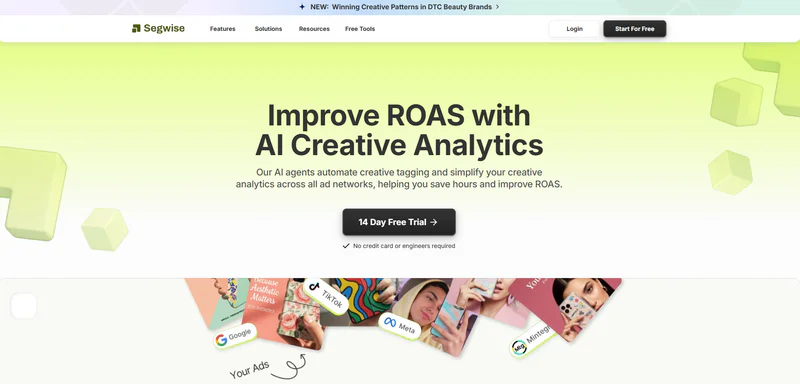
Segwise is an AI-powered creative analytics and generation platform that automates the analysis and optimization of ad creatives, so UA and performance marketing teams understand which creative elements drive performance. It also alerts you when creatives start fatiguing and helps you shift budgets before results drop.
It connects creative elements (hooks, dialogues, visuals, formats, audio, characters, CTAs) directly to business outcomes (ROAS, CPA/CPI, LTV, IPM, conversion rates), so teams stop guessing what works and start scaling creatives with data-backed confidence. Segwise is the only platform that tags playable ad elements and interactive components.
It connects to 15+ ad networks and MMPs: Meta (Facebook/Instagram), Google, TikTok, YouTube, Snapchat, Axon (AppLovin), Unity Ads, Mintegral and more, plus AppsFlyer, Adjust, Branch and Singular: with no-code OAuth setup taking around five minutes per source. Historical data backfills automatically on connection: up to two weeks on the 7-day free trial, up to three months on paid plans.
Under the hood it runs four specialised agents:
Creative Tagging Agent: multimodal tagging across video, audio, image and text, plus custom brand-specific tags and nomenclature tagging from your existing file names. The only platform that tags playable (interactive) ads.
Creative Strategy Agent (AI Chat): an always-on creative strategist with full context across your creative, tag, fatigue, asset-cluster and competitor data. Ask “what separates my top five creatives from my bottom five?” in plain language and get an answer, or a formatted shareable report, without building a dashboard. It also powers fatigue detection, new-creative tracking and asset clustering.
Creative Generation Agent: produces net-new, data-backed creatives from your winning patterns: static images, video ads including AI UGC, interactive playables, and scene-by-scene video storyboards. It remixes winning hooks, CTAs, characters and styles across different top performers rather than reskinning one ad, you refine by prompting, and you export in every network’s aspect ratios. Generated creatives are auto-tagged and tracked once live, so results feed back into the model that made them.
Competitor Tracking Agent: monitors, tags and gap-analyses competitors’ live ads with the same multimodal AI. Currently Meta (Facebook and Instagram); more platforms in development.
What is Adnova?

Adnova (adnova.ai) is an AI-powered creative research, workflow and launching platform. It brings together creative analytics, an inspiration library, competitor intelligence, asset collaboration and bulk ad launching in one tool, aimed squarely at the operational end of the market: hands-on, Meta-first ecommerce brands and small agencies. Adnova claims 5,000+ brands and agencies as customers.
Its current feature set is genuinely broad, and materially wider than “bulk ad launcher”:
Creative Analytics 2.0: AI reports analysing creative performance across 14 dimensions. This is Adnova’s headline recent launch and the single biggest reason older comparisons of the product understate it.
Inspirations: a searchable library of a claimed 75 million ads, with AI inspiration search.
Detective: tracks competitor ad launches and extracts their strategy.
Bulk Ad Launcher: launch 100+ ads at once across platforms. Segwise does not launch ads at all, so this is a straightforward Adnova win.
Creative Hub: asset review, feedback collection and team collaboration.
Scenes: AI creative tagging and asset splitting for video production.
Ad Templates: 1,000+ pre-built Meta static ad templates for Canva and Figma.
Every paid tier includes AI Tagging, AI Competitor Reports, AI Inspiration Search, AI Comment Analysis and AI Review Analysis.
One thing to be clear about, because roundups often get it wrong: Adnova is not a generative creative tool. Its own site emphasises analytics and workflow automation, and it offers no AI image or video generation product. What it gives you instead is templates you fill in yourself, and Scenes for splitting existing footage. If you have seen Adnova grouped with AI ad generators, that classification is wrong.
Where it stops, accurately stated. Adnova’s analytics are ad-platform-side and Meta-first: its paid network connections are Facebook, Instagram and TikTok, with no app or programmatic networks (Axon/AppLovin, Unity Ads, Mintegral) and no MMP integration. Without an MMP feed there is no install, in-app event or LTV data, so Creative Analytics 2.0 can report on platform-side metrics across its 14 dimensions but cannot map a creative element to CPI, D7 ROAS or LTV the way an MMP-connected tool can. It also has no custom tagging taxonomy, no nomenclature-based tagging from your file-naming conventions, no playable-ad analysis, and no cross-network clustering of the same creative concept across app networks. For a Meta-and-TikTok DTC brand, none of that may matter. For mobile UA, most of it does.
Now that you know what each tool offers, let’s look at how Segwise and Adnova stack up side by side.
Also Read: Best Ad Creative Management Tools for DTC Brands in 2025.
Feature Overview: Segwise vs. Adnova
While both platforms aim to improve creative performance, here’s a quick look at their core features to show what makes each platform unique:
Feature | Description | Segwise | Adnova |
Creative Analytics | Dashboards and visual reports to explore creative performance. | ✅ Element-level, cross-network, tag-to-metric mapped; Card View with thumbnails; custom metrics | ✅ Creative Analytics 2.0: AI reports across 14 dimensions, platform-side (Meta-first) |
Number of Ad Accounts | Ad account and workspace limits. | Multi-app and multi-brand via Studio View; folders and client-specific views for agencies | Plan-based. Free tier: 1 workspace, 1 user, $25K monthly ad spend limit. Ad Launcher add-on covers 1 ad account, +$20 flat per additional account |
Number of Seats | Seats and access control. | Role-based access (Admin / Editor / Viewer), team folders, multi-project management, public share links for external stakeholders | Configurable by plan; the free tier is a single user |
Nomenclature-Based Tagging | Extract creative metadata from creative names for better organization. | ✅ | ❌ |
Launch Tracking Reports | Monitor the performance of newly launched creatives in real time. | ✅ | ❌ |
Cross-Network Reports | Unified creative performance reports across all ad networks with enhanced visibility | ✅ | ❌ (Focus appears on social creative insights & inspiration, not unified performance across networks) |
Backend & MMP Data | Integrate MMPs with ad network data in one dashboard: the route to install, in-app event and LTV data. | ✅ AppsFlyer, Adjust, Branch and Singular, including custom in-app events; choose network or MMP numbers per report | ❌ No MMP integration, so no CPI / D7 ROAS / LTV mapping |
Clustering Agent | Cluster creatives across ad networks and campaigns to analyze performance. | ✅ | ❌ |
Automated AI Tagging | AI tagging of creative variables, and whether those tags map to performance. | ✅ Multimodal (video, audio, image, text): hooks, dialogue, on-screen text, characters, emotions, music, CTAs: every tag auto-mapped to metrics including MMP events | ✅ AI Tagging on every paid tier, plus Scenes for AI tagging and asset splitting, and Creative Analytics 2.0 reporting across 14 dimensions, but platform-side only, with no MMP outcomes and no cross-app-network mapping |
Creative Fatigue Detection | Catch ads showing early signs of fatigue, with alerts before spend is wasted. | ✅ Native fatigue detection with configurable thresholds (e.g. 20% ROAS decline over 7 days), plus email and Slack alerts, across every connected network | Creative Analytics 2.0 reports performance trends across 14 dimensions; a dedicated fatigue-alerting feature is not documented on Adnova’s public pages |
Programmatic Ad Connections | App and programmatic network connections. | ✅ Axon (AppLovin), Unity Ads, Mintegral and more | ❌ Not supported |
Paid Network Connections | Paid social and search network connections. | ✅ Meta (Facebook/Instagram), Google, TikTok, YouTube, Snapchat and more: 15+ networks and MMPs in total | ✅ Facebook, Instagram and TikTok |
Customer Support | Dedicated CSM for enterprise accounts + live chat & email support. | ✅ | ✅ (Priority / dedicated support available on custom plans) |
Customizable Dashboards | Fully custom dashboards. | ✅ | ✅ (Offers analytics dashboards) |
Custom Tagging | Create and manage your own tagging structure for more granular insights. | ✅ | ❌ |
Creative Generation | AI generation of net-new creative assets from performance data. | ✅ Creative Generation Agent: static images, video (incl. AI UGC), interactive playables, video storyboards; prompt-based editing; multi-aspect-ratio export; generated creatives auto-tagged and tracked | ❌ No AI image or video generation product. Adnova provides 1,000+ pre-built Meta static templates for Canva and Figma, plus Scenes for asset splitting: templates and tooling, not generation |
Playable / interactive ad tagging | Reading and tagging interactive ad units. | ✅ The only platform that tags playable ads | ❌ |
Always-on AI creative strategist | Asking your creative data questions in plain language, with full account context. | ✅ Creative Strategy Agent (AI Chat): qualitative and quantitative, on-demand report generation and report analysis | ❌ AI reports are generated, but there is no conversational agent over your account data |
Bulk ad launching | Pushing ads live in volume from inside the tool. | ❌ Segwise does not launch ads: it analyses and generates creative, then you upload | ✅ Bulk Ad Launcher: 100+ ads at once across platforms. A clear Adnova advantage |
Ad inspiration library | Searchable library of other brands’ ads for research and ideation. | Competitor Tracking Agent monitors and tags your named competitors’ live Meta ads with gap analysis: targeted rather than broad | ✅ Inspirations: a claimed 75 million ads with AI search, plus Detective for competitor launch tracking. Far broader research surface |
Ad templates | Pre-built layouts to produce creative by hand. | ❌ Generates finished creative instead of supplying templates | ✅ 1,000+ pre-built Meta static ad templates for Canva and Figma |
Creative review and collaboration | Asset review, comment threads and internal feedback workflow. | Shared dashboards, subscriptions, public share links and role-based access: reporting collaboration rather than asset review | ✅ Creative Hub: asset review, feedback collection and team collaboration ($39/mo add-on for 100 GB) |
Published pricing | Whether a full rate card is public. | Plans published on segwise.ai; 7-day free trial; up to 2 weeks of history backfilled on trial, 3 months on paid | ✅ Full rate card published: Plus $119/mo annual ($150 monthly), Growth $249/$309, Pro $399/$499, Enterprise custom, plus a free tier |
After comparing their features side by side, the next step is to see which platform aligns better with your specific goals.
Pricing: What Each One Actually Costs
Adnova publishes a full rate card, billed monthly with a 20% annual discount:
Plan | Billed annually (per month) | Billed monthly |
Free | $0 to 1 workspace, 1 user, $25K monthly ad spend limit | $0 |
Plus | $119 | $150 |
Growth | $249 | $309 |
Pro | $399 | $499 |
Enterprise | Custom: contact sales | Custom |
Three products are priced separately as standalone add-ons: Ad Launcher at $79/mo (listed as discounted from $99) for one ad account, with +$20 flat per additional ad account; Creative Hub at $39/mo for 100 GB of storage; and Scenes at $69/mo. A free trial is offered on the paid tiers. So the honest sticker price for a team that wants analytics, bulk launching and asset review together is the plan price plus up to $187/mo in add-ons: worth modelling before you compare headline numbers.
Segwise publishes its plans on segwise.ai and is priced as a creative intelligence platform rather than per workspace. The trial is 7 days, and historical data backfills the moment you connect a source, up to two weeks on the trial, up to three months on paid plans, so you can test tag accuracy against creatives whose results you already know rather than waiting for new data. Setup is no-code and OAuth-based: about five minutes per source, 10 to 15 minutes for everything.
Credit where it is due: Adnova’s pricing transparency is better than most of this category, and a genuine free tier with a $25K ad spend ceiling is a real on-ramp for a small brand. If budget is the binding constraint and you are Meta-first, that matters.
Which Platform Is Right for You?
Choosing between Segwise and Adnova depends on whether you need deep, element-level creative performance or a faster creative research and asset-management workflow with inspiration tools. Below is a clear pick-list to help you decide which platform fits your workflow best:
Choose Segwise if you need:

Proof of what actually drives performance: Segwise’s multimodal AI automatically tags hooks, dialogues, visuals, colors, audio, formats, and playable interactions, then directly maps them to KPIs like IPM, CTR, CPA, ROAS, and LTV. This mean you don’t just see which ad won you know why it won.
One source of truth across networks and attribution: Segwise unifies ad network data with MMP outcomes into a single view, eliminating fragmented dashboards and manual reporting. Creative decisions are tied directly to business results, not surface-level engagement metrics.
Early warnings before creatives start wasting budget: Automated fatigue tracking highlights declining performance patterns so that teams can refresh or iterate creatives before spend efficiency drops, rather than reacting after damage is done.
Creative generation, not just iteration: The Creative Generation Agent produces net-new, data-backed creatives from your winning patterns: static images, video ads including AI UGC, interactive playables, and scene-by-scene video storyboards. It remixes winning hooks, CTAs, characters and visual styles from across different top performers rather than reskinning a single ad, lets you refine outputs by prompting, and exports in every network’s aspect ratios. Every generated creative is auto-tagged and tracked once live, closing the loop between generation and analysis. Adnova has no generative image or video product at all: it offers templates you fill in yourself.
An always-on creative strategist: The Creative Strategy Agent (AI Chat) holds full context across your creative, tag, fatigue, asset-cluster and competitor data. Ask “which hook style drove the most installs last month?” or “what changed between my top and bottom creatives this quarter?” in plain language and get an answer, or a formatted, shareable report, with no dashboard-building first.
Playable-ad coverage and app-network reach: Segwise is the only platform that tags playable (interactive) ads, and it reads Axon (AppLovin), Unity Ads and Mintegral alongside Meta, Google, TikTok, YouTube and Snapchat. If your UA runs through app networks, Adnova simply does not connect to them.
Reporting built for growth and leadership teams: Custom dashboards and automated reports clearly show how creative decisions impact ROAS and growth, making Segwise usable not just for analysts but also for growth leads, too.
So, if creative performance impacts your revenue, Segwise is the platform built for that responsibility.
Choose Adnova if you need:
Adnova is primarily a creative research, workflow and execution tool, with analytics attached, and since Creative Analytics 2.0 the analytics are considerably better than they used to be. It is the right choice if your main goal is:
Fast creative ideation and inspiration at scale. The Inspirations library is a claimed 75 million ads with AI search, backed by Detective for tracking competitor launches. Nothing in Segwise matches that research surface: Segwise tracks the specific competitors you name, not the whole market.
Launching ads in volume from inside the tool. The Bulk Ad Launcher pushes 100+ ads at once across platforms. Segwise does not launch ads at all. If your bottleneck is upload labour rather than creative direction, this is the higher-leverage purchase.
Asset review and internal collaboration. Creative Hub handles review cycles, feedback collection and team collaboration: a workflow Segwise does not attempt.
Producing statics by hand, fast. 1,000+ pre-built Meta static templates for Canva and Figma, plus Scenes for splitting existing footage into reusable assets.
Meta-first ecommerce on a published budget. A full public rate card from $119/mo billed annually, plus a free tier with a $25K monthly ad spend ceiling, makes it easy to start without a sales call.
Platform-side creative reporting across 14 dimensions. Creative Analytics 2.0 is real analytics, not a token dashboard: it just stops at platform metrics, because there is no MMP feed.
What Adnova does not provide is element-level performance intelligence tied to business outcomes. Without MMP integration there is no CPI, D7 ROAS or LTV to map creative elements against; without app-network connections there is no view of Axon, Unity Ads or Mintegral; without custom or nomenclature tagging you work inside Adnova’s 14 dimensions rather than your own taxonomy; and playables are not analysed at all. It helps teams work faster, which is a real and underrated benefit. It is less suited to optimising smarter when ROAS, CPI and LTV across app networks are what you are held to.
Worth saying plainly: these two tools overlap less than the “Segwise vs Adnova” framing suggests. A Meta-first DTC brand that needs research, templates and bulk launching should probably buy Adnova and would get little value from playable tagging. A mobile UA team running six networks and an MMP should probably buy Segwise and would get little value from a Canva template library. A large agency running both kinds of account could reasonably run both.
The decision is simple:
If you want market-scale ad research, templates, asset review and bulk launching, on Meta, Instagram and TikTok, at a published price, Adnova is the better tool, and it is not close.
If you want to know which element inside a creative drives installs, ROAS and LTV across app networks and MMPs, catch fatigue before budget burns, analyse playables, and generate the next round of creatives from what won: Segwise is the better tool.
So, for UA teams serious about scaling winning creatives rather than just producing more of them, Segwise is the stronger fit. For Meta-first ecommerce teams whose bottleneck is production and launch throughput, Adnova genuinely is.
Also Read: Enhancing Creative Campaigns with AI: Top Strategies for Performance Marketing
Conclusion
Choosing between Segwise and Adnova comes down to how deeply you want to connect creative work to user acquisition outcomes, and how much of your bottleneck is production throughput rather than creative direction. Adnova is the better tool if your priority is creative research at market scale, a 75M-ad inspiration library, competitor launch tracking, templates, asset review and bulk launching on Meta, Instagram and TikTok, at a published price from $119/mo billed annually. Its Creative Analytics 2.0 now reports across 14 dimensions, which is real analytics: it just stops at platform-side metrics, because Adnova has no MMP integration and no app-network connections. Segwise is built for UA teams that need clear answers on which creative elements drive installs, ROAS and LTV across 15+ networks and MMPs, including playables, and that want the winning patterns turned into new creatives automatically.
If your goal is to stop guessing, scale winning creatives with confidence, and protect budgets before performance drops, Segwise fits naturally into your UA workflow. Its AI-powered creative tagging automatically identifies and tags creative elements like hook dialogues, characters, colors, and audio components across images, videos, text, and playable ads to reveal their impact on performance metrics like IPM, CTR, and ROAS.
With built-in creative analytics, you can instantly see which creative elements, themes, and formats drive results across all your campaigns and apps, making it easier to decide what to scale and what to pause. Segwise also offers free tools to enhance your workflow at no extra cost. With free tools like Video to Playable for quick MP4-to-HTML conversion via drag and drop, creative optimization becomes both practical and engaging.
So, why wait? Start your 7-day free trial and see which creative elements actually drive growth for your campaigns!
FAQs
1. Can Segwise provide insights into playable ads?
Yes, Segwise is the only platform that offers automated and custom playable ad tagging, providing in-depth insights into interactive ad elements.
2. Can creative optimization platforms help detect creative fatigue?
Yes, some platforms offer creative tracking over time to identify when ads begin to fatigue or perform worse, helping marketers refresh or replace assets before budget waste occurs.
3. What are the limitations of using inspiration-focused tools for UA optimization?
Research-led tools give you breadth, market-scale ad libraries, competitor launch tracking, templates, and increasingly real platform-side analytics too. What they typically lack is a link to attribution data, so they cannot map a creative element to CPI, D7 ROAS or LTV. In Adnova’s case, Creative Analytics 2.0 reports across 14 dimensions but there is no MMP integration behind it, so the outcome metrics stop at the ad platform.
4. How much does Adnova cost?
Adnova publishes its rate card: Plus $119/mo billed annually ($150 month-to-month), Growth $249/$309, Pro $399/$499, and custom Enterprise, with a 20% annual discount applied to the annual figures. There is a free tier (1 workspace, 1 user, $25K monthly ad spend limit) and a free trial on paid tiers. Three add-ons are priced separately: Ad Launcher $79/mo (one ad account, +$20 per extra), Creative Hub $39/mo for 100 GB, and Scenes $69/mo.
5. Does Adnova generate AI creatives?
No. Adnova offers no AI image or video generation product. It provides 1,000+ pre-built Meta static ad templates for Canva and Figma, and Scenes for AI tagging and asset splitting of existing footage. Any roundup listing Adnova among AI ad generators has it wrong. Segwise does generate: statics, video including AI UGC, playables and video storyboards, built from your own winning creative patterns.
6. Which ad networks does each platform connect to?
Adnova connects to Facebook, Instagram and TikTok. Segwise connects to 15+ ad networks and MMPs: Meta, Google, TikTok, YouTube, Snapchat, Axon (AppLovin), Unity Ads, Mintegral and more, plus AppsFlyer, Adjust, Branch and Singular. If your UA runs through app or programmatic networks, that difference is decisive.
7. Can Adnova launch ads? Can Segwise?
Adnova can: its Bulk Ad Launcher pushes 100+ ads at once across platforms, sold as a $79/mo add-on. Segwise cannot; it analyses creative and generates new creative, which you then upload. This is a genuine Adnova advantage and worth weighing if upload labour is your bottleneck.
8. How long is the Segwise free trial, and how much history do I get?
7 days. Historical data is imported automatically when you connect a source, up to two weeks on the trial, up to three months on paid plans, so you can check tag accuracy against creatives whose results you already know.
9. Is it worth running both?
For a large agency, plausibly yes: Adnova for market research, templates, asset review and launch throughput; Segwise for element-level intelligence across app networks and MMPs, playables, fatigue detection and generation. They overlap far less than the head-to-head framing implies.
About This Comparison
Methodology. Written and maintained by the Segwise team, who work daily inside live UA and DTC ad accounts across Meta, Google, TikTok, Snapchat, Axon (AppLovin), Unity Ads and Mintegral, and alongside all four major MMPs. For this August 2026 revision, every Adnova price, plan limit and feature was read directly off adnova.ai/pricing and adnova.ai. Where Adnova does not publish something, or we could not verify it, we have said so rather than estimating.
What changed in this update. We added Adnova’s full published pricing and add-on prices, which the original post omitted entirely; credited Creative Analytics 2.0 (AI reports across 14 dimensions), Scenes, the 1,000+ Meta template library and the 75M-ad Inspirations library, all of which post-date the original; removed two unverified “unlimited” claims about Segwise seats and ad accounts; corrected a network list that named Moloco and mis-spelled it; added Singular to the MMP list; downgraded an undocumented Adnova fatigue-detection claim to what its public pages actually support; and stated explicitly that Adnova is not a generative creative tool, in both directions: it does not generate, and it should not be listed among AI generators.
Bias disclosure. We build Segwise, so the verdicts are ours. The facts are checkable at the links above, and we have added four capabilities where Adnova beats us outright, bulk ad launching, the ad inspiration library, the template library and asset-review collaboration, because a comparison that pretends otherwise is not worth reading.