
If you're spending UA budget without knowing which channels bring in high-CLTV users, you're basically guessing.
The fix is straightforward. Put your money into channels that attract users who actually stay and spend. Segment your audience so you're targeting the right people with the right message. Track acquisition costs against lifetime value constantly, not once a quarter, but as a regular habit. When the data shows a channel is delivering, shift more budget there. When it's not, pull back.
Key Highlights
Stop spreading your UA budget thin across every channel. Focus on the ones that actually bring in high Customer Lifetime Value (CLTV) customers, the users who stick around and spend.
Calculate CLTV with this formula: Average Purchase Value × Purchase Frequency × Customer Lifespan. Update it every quarter because user behavior changes, and your budget decisions need to keep up.
High-CLTV users have patterns: they buy more often, spend more per order, and engage longer. Find these patterns in your data, then build campaigns that speak directly to them.
Segment your audience into high, medium, and low LTV groups using purchase frequency, order value, and engagement data. This isn't optional, it's how you avoid wasting money on users who churn in week one.
Facebook, Instagram, and LinkedIn offer the targeting precision you need. Use custom audiences, lookalike modeling, and retargeting to reach and keep high-value users.
Not all channels deliver the same user quality. Test multiple platforms, track acquisition cost against actual LTV, then scale what works and cut what doesn't.
Understanding Customer Lifetime Value and Its Role in User Acquisition
Customer Lifetime Value (CLTV) tells you how much revenue a user will generate over their entire relationship with your product. It's not about the first purchase or the first month, it's the total.
When you know CLTV, you can make smarter decisions about where to spend. A $50 CPA might seem expensive, but if that user brings in $300 over two years, it's a bargain. On the flip side, a $10 CPA looks great until you realize those users churn in 30 days.
Identify behaviors and segments tied to higher CLTV, then optimize your targeting and budget around them.
What is Customer Lifetime Value (CLTV)?
CLTV measures total revenue a customer generates during their relationship with your business. It shifts your focus from chasing one-time buyers to acquiring users who deliver long-term profitability.
Calculating CLTV helps you decide which acquisition channels are worth the money. If you're spending $100 to acquire a user who brings in $50, the math doesn't work. But if that user brings in $500, you've got a winner. CLTV gives you the clarity to prioritize channels, campaigns, and audiences that drive sustainable growth.
How to Calculate CLTV for Effective Budgeting
Calculating CLTV isn't complicated. Use this formula:
CLTV = (Average Purchase Value) × (Purchase Frequency) × (Customer Lifespan)
Let's break it down:
Average Purchase Value: What does a customer spend per transaction?
Purchase Frequency: How many times do they buy in a year?
Customer Lifespan: How long do they stay active?
Track these metrics in your CRM or analytics platform. Update them regularly, every quarter at minimum, because user behavior shifts. What worked six months ago might not work today. Keeping your CLTV calculation current ensures your budget decisions are based on reality, not outdated assumptions.
Identifying and Targeting High LTV Customers
High-CLTV users have clear patterns. They buy frequently, spend more per order, and engage with your product longer. Your job is to find these patterns in your data and target users who match them.
Start by analyzing purchase history. Who's making repeat purchases? Who's spending above average? Look at engagement frequency, are they opening your app weekly or just once at install? Use demographic and behavioral data to build a profile of your best users, then allocate your acquisition budget to find more of them.
When you target high-CLTV customers intentionally, you stop wasting money on users who'll never convert beyond install.
Techniques for Audience Segmentation Based on LTV
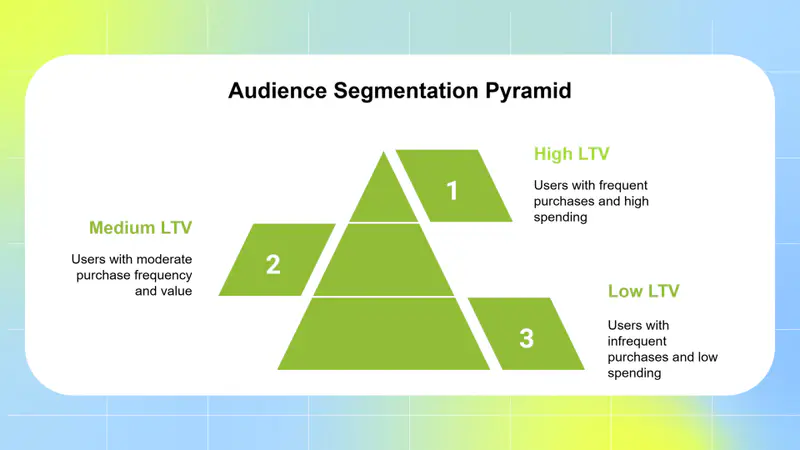
Segment your audience by LTV to make your acquisition strategies sharper. Here's how:
Categorize users into high, medium, and low LTV groups. Don't treat everyone the same. Your high-LTV users deserve different messaging and offers than your low-LTV users.
Analyze purchase frequency and average order value. Users who buy often and spend more are your high-value segment. Focus acquisition efforts on finding similar profiles.
Use behavioral data like engagement and churn rates. A user who opens your app daily is more valuable than one who disappears after a week. Build campaigns that attract engaged users, not just installs.
This segmentation allows you to personalize messaging and allocate budget where it actually matters. If you're running creative analytics to identify which ad elements resonate with high-LTV users, platforms like Segwise can automatically tag creative variables across 10+ ad networks and map them to performance (including post-install metrics from your MMP), helping you spot high-CLTV patterns faster.
Leveraging Different Platforms for High LTV Customer Acquisition
Platforms like Facebook, Instagram, and LinkedIn, excel at precision targeting. You can reach high-CLTV users with personalized ads based on behaviors, interests, and demographics.
Custom audience targeting: Upload your existing high-LTV customer list and create lookalike audiences. This lets you reach users who behave like your best customers.
Dynamic retargeting: Re-engage users who've shown interest but haven't converted yet. These are warm leads, and retargeting can push them over the line.
Content personalization: Tailor your creative and messaging to different LTV segments. High-value users respond to different hooks than bargain hunters.
When you combine precise targeting with strong creative, social platforms become one of your most efficient channels for acquiring users who stay and spend.
Choosing the Right User Acquisition Channels for High LTV Customers
Not all channels are created equal. Some bring in high-quality users. Others bring install volume but terrible retention.
Your goal is to prioritize channels proven to attract high-LTV users. Focus on platforms with precise targeting capabilities, Facebook, LinkedIn, and programmatic advertising are solid starting points.
Here's your process:
Test multiple channels. Don't assume. Run tests on Facebook, Google, TikTok, and programmatic networks to see which delivers the best user quality.
Analyze acquisition cost per high-LTV user. Track CPA alongside CLTV. A channel with a $30 CPA and $200 CLTV beats a channel with a $10 CPA and $40 CLTV every time.
Scale top performers efficiently. When you find a channel that works, increase spend gradually while monitoring user quality. Scaling too fast can dilute performance.
Performance Marketing and PPC Advertising for High-Value Users
Performance marketing is built for this. PPC campaigns let you target high-intent users with precision, reducing wasted spend.
Here's the approach:
Use data-driven audience segmentation: Target users based on behaviors, demographics, and intent signals. Broad targeting wastes money.
Bid on high-intent keywords: Focus on terms that indicate purchase readiness, not just interest. "Buy project management software" beats "what is project management."
Continuously optimize ad creatives and landing pages: Test headlines, visuals, and CTAs. Use AI-powered tools to automatically tag and track which creative elements (like specific headlines or visuals) drive the best post-click performance. A small improvement in conversion rate can massively impact your cost per high-LTV user.
When performance marketing is dialed in, you're not just driving installs, you're driving profitable users who stick around.
Mobile User Acquisition Strategies
Mobile user acquisition requires a different playbook. App store optimization (ASO), targeted social ads, and seamless onboarding are your foundation.
Start with app store optimization. Your app listing is your first impression. Optimize your title, description, screenshots, and reviews to improve visibility and conversion.
Use Facebook and Google Ads for precise targeting. Lookalike audiences help you reach users similar to your best customers. Deep linking improves the user experience by taking users directly to relevant content inside your app.
Simplify onboarding. A clunky onboarding flow kills retention. Make it fast, intuitive, and valuable from the first screen. The easier it is to see value, the more likely users are to stick around.
Emerging Advertising Formats: Digital Billboards and Programmatic DOOH
Digital billboards and programmatic Digital Out-of-Home (DOOH) advertising are gaining traction for user acquisition. These formats offer dynamic, location-based targeting that traditional billboards can't match.
Flexible messaging: Update creative in real-time based on time of day, weather, or audience.
Automated buying: Programmatic DOOH lets you buy and optimize campaigns like you would with digital ads.
Enhanced measurement: Track impressions, engagement, and conversions more accurately than static billboards.
These formats work best for brand awareness and reaching high-CLTV audiences in specific geographic areas. They're not right for every campaign, but they're worth testing as part of a diversified channel strategy.
Allocating Your Marketing Budget Based on Customer Lifetime Value Insights
Budget allocation should be dynamic, not static. Prioritize channels that deliver the highest CLTV customers, and shift spend as data evolves.
Regularly review CLTV metrics. Look at CLTV by channel, campaign, and audience segment every month. What's working? What's not?
Shift funds toward top-performing campaigns. When a channel consistently delivers high-CLTV users, it increases the budget. Don't let top performers plateau because you're spreading the budget too thin.
Reduce spend on low-CLTV audiences. If a segment or channel is bringing in users who churn fast, cut it. Redirect that budget to proven winners.
Budget Allocation Models Centered on CLTV
Use dynamic budget allocation models based on CLTV insights. Here are three approaches:
Tiered allocation by customer value segments: Allocate more budget to acquiring high-LTV users and less to low-LTV segments.
Incremental spend on channels driving highest CLTV: Identify channels with the best CLTV-to-CPA ratio and increase spend incrementally while monitoring performance.
Predictive budgeting leveraging CLTV forecasts: Use historical data to predict future CLTV by segment, then allocate budget proactively.
These models ensure your budget prioritizes profitable users and adapts as trends shift.
Balancing Spend Across Acquisition and Retention
Effective budget allocation isn't just about acquisition, it's about balancing acquisition with retention. Acquiring high-CLTV users is great, but keeping them engaged is what drives long-term value.
Monitor cost per acquisition vs. retention ROI. Compare the cost of acquiring a new user to the cost of retaining an existing one. Often, retention delivers better ROI.
Adjust spend based on the user lifecycle stage. New users need onboarding and engagement. Long-term users need loyalty programs and personalized offers.
Leverage data to optimize both channels simultaneously. Use insights from retention campaigns to improve acquisition targeting, and vice versa.
Measuring and Optimizing ROI for User Acquisition Campaigns
You can't optimize what you don't measure. Track key metrics like Cost Per Acquisition (CPA), Customer Lifetime Value (CLTV), and Return on Ad Spend (ROAS) for every campaign.
Analyze campaign data regularly to identify high-performing channels. Adjust bids, budgets, and targeting based on performance. Use A/B testing to refine creatives and landing pages. Apply attribution models to understand which touchpoints drive conversions.
When you measure accurately, you can optimize continuously, and that's how you maximize long-term profitability.
Key Metrics to Track for High LTV Customer Acquisition

Focus on metrics that connect acquisition efforts directly to long-term value:
Cost Per Acquisition (CPA): How much are you spending to acquire each user? Keep this in check relative to CLTV.
Customer Lifetime Value (CLTV): What's the total revenue a user generates? This is your north star for profitability.
Return on Ad Spend (ROAS): For every dollar spent, how much revenue are you generating? Track this by channel and campaign.
Churn rate: How quickly are users leaving? High churn signals retention problems that no amount of acquisition spend can fix.
These metrics guide smarter budget allocation and help you focus on campaigns that deliver real value. Platforms like Segwise use AI creative tagging to automatically connect ad elements to these long-term outcomes (CPA, CLTV, ROAS), making it easier to see which ad elements drive high-LTV users.
Best Practices for Continuous Campaign Optimization
Optimization isn't a one-time task, it's continuous. Here's how to stay on top of it:
Analyze performance data regularly. Review campaign metrics weekly, not monthly. Trends emerge fast, and you need to catch them early.
Adjust bids, creatives, and targeting based on data. If a creative is underperforming, test a new one. If a segment isn't converting, adjust targeting.
Use A/B testing to refine messaging and landing pages. Test one variable at a time, headline, CTA, visual, to understand what drives performance.
Prioritize scaling high-performing segments. When something works, double down. Pause underperformers to free up budget for winners.
This approach ensures your campaigns stay efficient and your budget goes toward what actually works.
Conclusion: Actionable Steps to Optimize Your UA Budget for High LTV Customers
Optimizing your UA budget for high-CLTV customers comes down to focus and discipline. Here's your action plan:
Calculate CLTV accurately and update it regularly. Use the formula: Average Purchase Value × Purchase Frequency × Customer Lifespan. Refresh it quarterly.
Segment your audience by LTV. Identify high, medium, and low-LTV groups and tailor your acquisition strategy for each.
Prioritize channels that deliver high-CLTV users. Test, measure, and scale the platforms that bring in users who stick and spend.
Balance acquisition and retention. Don't just chase new users, keep the good ones engaged.
Measure constantly and optimize aggressively. Track CPA, CLTV, ROAS, and churn. Adjust campaigns weekly based on performance.
When you align your UA budget with CLTV insights, you stop wasting money on users who disappear and start building a base of profitable, long-term customers.
Want to see which creative elements are driving your high-LTV users? Start your 14-day free trial with Segwise to automate creative tagging, unify data across all your ad networks, and uncover winning patterns that boost your ROAS.