
Updated July 2026.
Short answer: Under Meta's Andromeda update, creative volume and diversity now do the targeting work that bids and audiences used to. The winning play in 2026 is to run 8-12 conceptually distinct concepts per campaign, keep your Creative Similarity Score under 40%, refresh every 2-3 weeks, and feed the system clean conversion signals. Accounts doing this report 20-35% higher ROAS than legacy setups.
Meta's Andromeda update has rebuilt the ad retrieval stage around creative content itself, so the ads that win are now the ones that give the model enough diverse, fresh creative to learn from. For performance teams in 2026, that means creative volume, creative diversity, and fatigue speed are the three levers that decide whether ROAS climbs or quietly bleeds out. Segwise sits exactly in this layer, tagging every creative element across 15+ ad networks and MMPs so teams can see which elements actually drive performance and feed Andromeda the right inputs.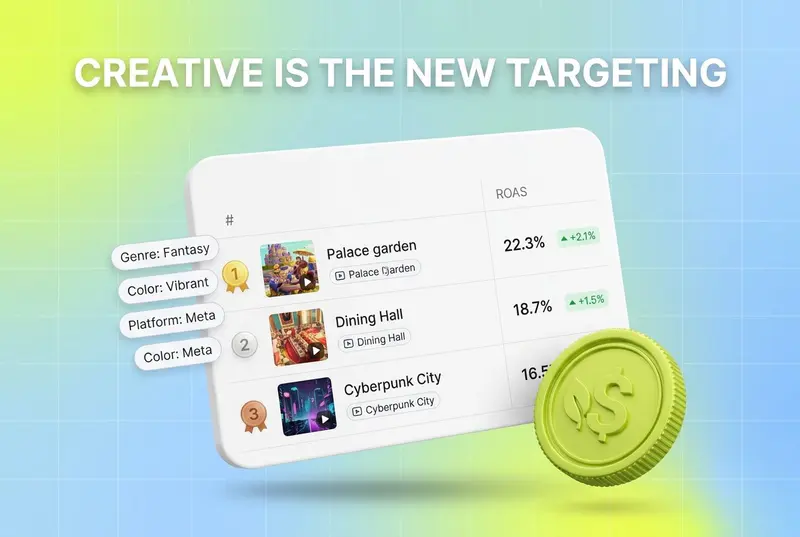
What changed when Andromeda turned on
If your Meta ads "used to work" and now feel inconsistent, you are not imagining it. Meta started rolling out Andromeda in late 2024 and finished the global rollout across every account by October 2025, according to Confect's Andromeda guide. The shift looks subtle on the surface (you still build campaigns the same way) but the system underneath is completely different.
Andromeda is a personalised ads retrieval engine built on the NVIDIA Grace Hopper Superchip, with model complexity that is 10,000x higher than the retrieval system it replaced. Meta's engineering team reported a +6% recall improvement and +8% ads quality improvement on selected segments after deploying it across Facebook and Instagram, per the official Meta Engineering blog post. The retrieval stage is where Meta narrows tens of millions of ads down to a few thousand candidates that compete in the auction, and Andromeda decides who survives that cut by reading the actual content of every creative and matching it to individuals.
The downstream effect on advertisers is straightforward. Targeting matters less. Bidding matters less. Creative does most of the work the algorithm used to do for you. The accounts that have figured this out are seeing 20-35% higher ROAS than accounts running legacy structures, according to 1ClickReport's April 2026 analysis. The accounts that haven't figured it out are watching CPMs climb and creative fatigue hit faster than ever.
This guide pulls together what Andromeda actually rewards in 2026, the data behind the new creative volume reality, and a practical workflow for feeding the algorithm without burning your team out.
Key takeaways
Andromeda enabled a 10,000x increase in retrieval model complexity and shifted optimisation onto creative content itself, per the Meta Engineering blog.
The top third of advertisers run roughly 395 live ads at any time vs 296 for the bottom third, a 33% gap, according to Scaledon's Andromeda data analysis.
Brands testing 20+ new ads per month see 65% higher ROAS than brands testing under 10, per Scaledon.
Ad fatigue windows have shrunk from 6+ weeks to 2-3 weeks under Andromeda, according to Pixel Panda Creative.
Creative Similarity Scores above 60% trigger retrieval suppression, per admetrics.io, so 100 ads that look the same compete as one Entity ID.
Advantage+ creative drives a 22% ROAS lift over manual setups, per Meta's internal testing summarised by 1ClickReport.
One ad set with 25 diverse creatives outperformed five ad sets with five each by 17% on conversions and 16% on cost, per Logical Position's 2026 paid social playbook.
Also read How to beat Meta's Andromeda algorithm: 8 practical steps for creative-led growth
Also read The Andromeda update and its marketing impact
What Andromeda actually is (plain-English version)
Meta runs ad selection in two stages: retrieval and ranking. Retrieval narrows the universe of eligible ads from tens of millions down to a few thousand candidates, fast enough that the auction can finish before a feed item loads. Ranking then picks the final winners from that shortlist using larger, slower models.
As of 2026, that ranking layer is GEM (Meta's Generative Ads Recommendation Model), a foundation model trained at large-language-model scale that Meta credits with up to a 5% conversion lift on Instagram. Andromeda still runs retrieval and decides which creatives even reach the shortlist, so the practical takeaway does not change: your creative has to survive retrieval before GEM ever gets to rank it.
Before Andromeda, retrieval was a stack of smaller models held together with rule-based heuristics, as Meta's engineers describe in the Andromeda announcement. It applied limited personalisation and could not exploit the explosion of generative-AI-built creatives that started flooding the system in 2024. Andromeda replaced that stack with a single deep neural network designed for the NVIDIA Grace Hopper Superchip, with a hierarchical index that can scale to a much larger volume of ad creatives without latency falling over.
Two design choices matter for advertisers:
The first is that Andromeda reads the content of your creative. The retrieval model uses computer vision and semantic analysis to extract latent user-ad interaction signals on the fly, achieving over a 100x improvement in feature-extraction throughput vs the CPU-based components it replaced, per the Meta Engineering blog. The system understands what is actually inside the ad, not just metadata about it.
The second is hierarchical indexing built specifically to handle creative volume from Advantage+ creative. Meta noted that more than a million advertisers used its generative AI tools to produce 15 million ads in a single month, and Andromeda was built so that scale does not crash the retrieval stage. The downside, of course, is that the bar for getting your creative seen at all just got higher.
Net effect: the algorithm now has the capacity to discriminate between very similar ads at the content level, and it actively uses that capacity to pick winners.
Why creative is the new targeting
Under the old system, you could squeeze performance out of a tight audience and a single ad. Under Andromeda, that combination caps your ceiling.
Meta's internal testing found that advertisers using Advantage+ creative saw a 22% increase in ROAS vs manual creative setups, and a structure with one ad set and 25 creatives generated 17% more conversions at 16% lower cost than five ad sets with five creatives each. Both results point in the same direction: the algorithm performs best when you stop fragmenting it and let it choose between many distinct creatives in one place.
Consolidation creates a different problem, though, which is that the system now needs raw material to choose from. Data from Scaledon showed the top third of Andromeda-era advertisers run roughly 395 live ads at any given time, while the bottom third runs 296. That's a 33% gap, or about 99 extra live ads. Brands testing 20+ new ads per month see 65% higher ROAS than brands testing under 10. Volume is no longer optional.
The reason is mechanical. Andromeda decides which ads enter the retrieval shortlist by predicting whether each one will resonate with each individual user. It needs many creative options per audience to find the match. Give it three options, and it picks the best of three. Give it 30 distinct options, and it picks the best of 30 across many segments at once. The math gets better the more you feed it.
That's why creative now drives results the way targeting used to, and why pre-Andromeda habits (one hero image reused everywhere, ads designed like brochures, refreshing only when results drop) actively cap performance even with a strong product.
The creative similarity trap
There's a catch buried in the volume requirement. Andromeda does not actually count 100 lookalike ads as 100 ads. It collapses similar creatives into a single Entity ID, then makes them compete with each other instead of expanding reach.
Meta now exposes this through the Creative Similarity Score in Ads Manager. Performance data from late 2025 suggests scores above 60% trigger retrieval suppression, per admetrics.io. 303 London's diversity guide recommends keeping the index below 40% across active assets so the system treats each ad as a distinct candidate.
The practical implication is that variation has to be meaningful. Different copy on the same hero image will not save you. Different headlines on the same template won't either. The diversity needs to register at the visual, audio, and structural level the model is actually parsing.
A workable rule of thumb in 2026 is to build 8-12 conceptually distinct ad concepts per campaign (different hooks, formats, emotional triggers, visual treatments) and then use Meta's AI tools or your own generation pipeline to produce 2-3 variations per concept. That gets you the volume Andromeda wants without collapsing into a single Entity ID.
Fatigue is now a 2-3 week problem
The other shift that nobody talks about loudly enough: ad fatigue happens twice as fast as it did two years ago.
A single Meta ad concept now burns through its addressable audience in 2-3 weeks, down from 6+ weeks in the pre-Andromeda era, according to Pixel Panda Creative's 2026 analysis. Engagement on a fatigued ad drops 20-30% per week once it starts declining, per Zentric Digital's fatigue playbook. The ranking system penalises low engagement, the retrieval system shifts its preferred candidates, and CPMs drift up while ROAS slides.
The accelerated fatigue is partly Andromeda's content-aware retrieval working as designed. It exhausts the segments that respond to a specific creative faster because it found them more efficiently in the first place. The net effect is that the production cycle has to keep up. Zentric's analysis suggests teams spending over $5K per month need 5-15 new creatives per week to stay ahead of the curve.
Watch for these warning signs at the creative level:
CTR falls more than 10% week-over-week
CPA rises more than 15% week-over-week
Frequency moves above 3.0 on prospecting campaigns
Spend share drops without a budget change
Most teams catch fatigue too late because they monitor account-level dashboards instead of creative-level performance. By the time the campaign metric moves, you have already burned a week or two of budget on a creative that was decaying.
This is where automated, creative-level fatigue tracking earns its keep. Tools that monitor performance decline against configurable thresholds (for example, a 20% ROAS drop over 7 days) across every active ad and every network catch the slide before the budget walks. Segwise's fatigue tracking does exactly this across Meta, Google, TikTok, Snapchat, YouTube, AppLovin, Unity Ads, Mintegral, and IronSource, with custom criteria you set per business.
What working creative actually looks like in the Andromeda era
The accounts winning right now share a few habits.
They build creative systems instead of one-off ads. That means treating each campaign as a portfolio of conceptually different angles (problem/solution, social proof, offer-led, educational, UGC, founder-led) all promoting the same product, plus 2-3 variations of each. The job isn't to pick the winner. The job is to feed the algorithm enough quality options that it can find the winner for each segment.
They test emotional triggers, not just headlines. Andromeda's content awareness extends to tone, pacing, music type, and emotional valence, not only words. Teams that rotate between aspiration, urgency, trust, and curiosity find more winners than teams that just A/B test copy.
They mix high-production brand assets with raw native content. Polished creative still works for trust and category education. Native-feeling content (UGC, founder-led, talking-head) wins on attention and scroll-stop because it does not look like an ad. Both belong in the rotation; neither alone is enough.
They refresh while ads are still working. Replacing a creative that is starting to fade beats replacing one that has already crashed. The leading indicator (CTR softening, frequency creeping up) tells you to launch the replacement now, not next sprint.
They use winning patterns to direct production. The ROI on the next 10 creatives is much higher when those 10 are built around hooks, CTAs, characters, and visual styles your data already shows are working. Tag-level performance data turns creative briefs from guesswork into evidence-based direction.
The last point is where most teams stall. Tagging hundreds or thousands of creatives across multiple networks manually is a 20+ hour-a-week job, and most teams skip it entirely. Without tagging, you can't tell which elements drive performance, which means your next round of production is just intuition.
How to build a creative system that feeds Andromeda
A workable production loop in 2026 looks like this:
Tag every active creative at the element level. Hooks, CTAs, characters, visual styles, emotions, audio components, and text overlays. This is the foundation. Without tags mapped to performance, the rest of the loop runs on intuition. Segwise's creative tagging handles this automatically across 15+ ad networks and is the only platform that tags playable (interactive) ads, which matters for mobile gaming and app teams.
Map tags to performance metrics. Connect every tag to the metrics that actually matter (ROAS, CPI, CTR, install-through-rate, spend share). Teams in mobile gaming, DTC, subscription apps, and agency portfolios need this mapping consistent across Meta, Google, TikTok, Snapchat, YouTube, AppLovin, Unity Ads, Mintegral, and IronSource, plus AppsFlyer, Adjust, Branch, and Singular for unified attribution.
Identify winning patterns weekly. Once tags are mapped to outcomes, the patterns surface. Hooks that show 1.4x ROAS over the account average, characters that drive longer view-through, audio styles that convert, CTAs that drop CPI by 20%. This is the input to your next creative brief.
Generate variations off proven winners. Build 8-12 distinct concepts per campaign, then 2-3 variations each. The variations should differ on the elements your tag data shows actually move performance, not just text changes (our creative testing playbook covers how to structure those tests so the results are readable). Some teams do this in-house. Others use AI-driven creative generation that builds new iterations directly from winning tag patterns and exports them in the aspect ratios each ad network needs.
Track fatigue at the creative level, not the campaign level. Set thresholds per creative (e.g., 20% ROAS decline over 7 days), get alerts before the campaign metric moves, and rotate replacements in while the original is still working.
Monitor competitors for white space. What angles are oversaturated in your category? What hooks are competitors not running? Competitor gap analysis turns into next quarter's testing roadmap.
Repeat on a 2-week cycle. Match the production cadence to the new fatigue window.
Teams running this loop with Segwise report saving up to 20 hours per week per app or brand on manual creative analysis, and up to 50% ROAS improvement from catching fatigue early and shipping data-backed iterations.
The other inputs Andromeda still rewards: structure and signals
Creative is the biggest lever now, but it is not the only one. Andromeda still leans on how you structure campaigns and the quality of the conversion data you feed it, and getting these wrong caps even a strong creative library.
Consolidate the structure. Fragmenting budget across many tiny ad sets spreads the learning thin and hides your real winners. Run one campaign per conversion objective, keep a primary ad set holding your candidate creatives, and give it enough daily budget to gather statistically useful learnings per creative (roughly 50 conversion events per week, objective depending). Use a small separate test campaign for structural experiments. This is the same logic behind the one-ad-set-with-25-creatives result above: fewer, richer pools give retrieval more distinct candidates to choose from for each user.
Feed clean conversion signals. Andromeda and Meta's value optimisers can only prioritise high-value users when the signals arriving are accurate. Run the Conversions API server-side alongside the Pixel and deduplicate with a shared event_id, and send purchase value, currency, and order_id so the system optimises to revenue rather than weak proxies. Where you can, pass first-month revenue or cohort LTV back as a value parameter for higher-fidelity signals. For how these signals connect to real outcomes, see our guide to mobile app attribution.
Bid for value, not raw volume. Once you can reliably send value, run value-maximising bids so spend flows toward users who bring more revenue. If you need to control CPA, start with a conservative cost cap and loosen it as the model learns; heavy bid capping during early exploration stops Andromeda from finding your higher-value cohorts.
Validate lift before you scale. Retrieval is not the final auction, and on-platform conversions are not the same as incremental business value. Run incrementality tests (holdout or lift studies) before major budget increases or creative overhauls, and gate scaling decisions on downstream metrics like 30, 60, and 90 day retention, repeat purchase rate, and AOV rather than short-term CPA alone.
Get iOS measurement right. On iOS, configure SKAdNetwork with a sensible conversion-value mapping built around a few high-signal in-app milestones rather than an over-granular schema, and expect coarse, delayed postbacks. Pair SKAN with server-side signals and your MMP to reconcile attribution and feed value back to Meta. Our breakdown of Meta AEM vs SKAN covers how to blend these sources without double counting.
None of this replaces the creative work. It makes sure the winning creatives you produce get clean feedback, so the intelligence loop keeps compounding instead of optimising toward noise.
What this means for small businesses and lean teams
Andromeda is structurally good for small businesses, even if the transition has been painful. You no longer need massive first-party data sets, hyper-complex audience segmentation, or enterprise tech stacks to compete. What you need is clear messaging, strong offers, and a steady flow of varied, high-quality creative.
The trade-off is that the work has shifted. Where teams used to spend their week tuning audiences and bid strategies, that time now belongs to creative production, creative tagging, and creative testing. Teams that adapt to that workload (with help from AI tooling, agencies, or both) often outperform larger competitors who are slower to make the shift.
The accounts that struggle most are the ones still operating with a 2022 mindset: one hero image reused everywhere, ads designed like brochures, no variation in hooks or messaging, and creative refreshed only when results drop. That approach now caps performance even with a great offer.
The accounts that win are the ones that treat creative as the optimisation lever and build a system around it.
In short, creative volume is the new bid strategy
Meta's Andromeda update did not just change how ads are delivered. It moved the optimisation surface from targeting to creative, and the data behind that shift is no longer ambiguous: more diverse creatives, faster fatigue cycles, and content-aware retrieval mean creative is the lever that decides whether your account scales or stalls in 2026.
The good news is that the playbook is becoming clearer. Build 8-12 distinct concepts per campaign with 2-3 variations each, keep your Creative Similarity Score under 40%, refresh on a 2-3 week cycle, and tag every creative element so you actually know which inputs Andromeda is rewarding. The teams executing this consistently are the ones reporting 20-35% higher ROAS than legacy-structure accounts.
If you're building this loop and the manual work (consolidating cross-platform data, tagging creatives, watching for fatigue, generating new iterations from winning patterns) is eating your week, Segwise is built for exactly this. It connects to 15+ ad networks and MMPs in under 10 minutes, applies multimodal AI tagging across video, audio, image, text, and playable ads, tracks fatigue automatically against your custom criteria, and generates new winning creatives from your top-performing tags. Customers report up to 20 hours saved per week per app or brand and up to 50% ROAS improvement.
Frequently asked questions
What is the Meta Andromeda update?
Meta Andromeda is a personalised ads retrieval engine that replaced Meta's previous ad selection stack starting in late 2024 and finished its global rollout by October 2025, per the Meta Engineering blog. It uses a deep neural network on the NVIDIA Grace Hopper Superchip to read the actual content of every creative and match it to individual users, with 10,000x more model complexity than the system it replaced. Tools like Segwise help teams keep up by tagging every creative element and mapping it to ROAS across Meta, TikTok, Google, Snapchat, YouTube, AppLovin, Unity Ads, Mintegral, and IronSource, plus AppsFlyer, Adjust, Branch, and Singular for unified attribution.
How has Andromeda changed Meta ad performance for advertisers?
Advertisers running modern Andromeda-aligned campaign structures report 20-35% higher ROAS than those running legacy structures, per 1ClickReport, and Advantage+ creative drives a 22% ROAS lift over manual setups, per Meta's internal testing. The flip side is faster fatigue (2-3 weeks vs 6+) and a higher bar for creative volume and diversity. Tools like Segwise track fatigue and surface winning creative elements so teams can adapt without tripling their headcount.
How many creatives do I need to run on Meta in 2026?
Brands testing 20+ new ads per month see 65% higher ROAS than brands testing fewer than 10, per Scaledon's data, and the top third of advertisers run roughly 395 live ads at any time. Most experts recommend 8-12 conceptually distinct concepts per campaign with 2-3 variations each, then refreshing on a 2-3 week cycle. Without creative tagging, identifying which of those concepts actually wins is mostly guesswork, which is why platforms like Segwise that map tags to performance have become standard.
What is the difference between Advantage+ and Andromeda?
Advantage+ is Meta's suite of automation features (audience, budget, placement, creative) that advertisers turn on inside campaign setup. Andromeda is the underlying retrieval engine that powers ad selection across Meta, including but not limited to Advantage+ campaigns. Advantage+ is what you click; Andromeda is what runs underneath. Advantage+ creative users see a 22% ROAS lift on average, per 1ClickReport.
What is the Creative Similarity Score on Meta?
Creative Similarity Score is a metric Meta now exposes in Ads Manager that estimates how similar your ads are to each other within a single ad set. Scores above 60% trigger retrieval suppression because Andromeda groups similar ads under a single Entity ID and makes them compete instead of expanding reach, per admetrics.io. Most performance teams aim to keep similarity below 40% by varying hooks, formats, and emotional triggers, not just copy. Tools like Segwise make this easier by tagging creative elements (hooks, CTAs, characters, visual styles, emotions, audio) so you can spot redundancy before the system does.
why are my Meta ads not working in 2026
Three usual suspects: not enough creative variety (Andromeda needs many distinct concepts to find winners), Creative Similarity Score above 60% (collapsing your ads into one Entity ID), or fatigue inside the new 2-3 week window. Check creative-level CTR, CPA, and frequency before assuming the algorithm broke. Andromeda is also more sensitive to ad set fragmentation than the old system, so consolidating into fewer ad sets with more diverse creatives often unlocks performance. Platforms like Segwise catch fatigue and similarity issues automatically across all your campaigns.
How do I detect creative fatigue under Andromeda?
Watch creative-level CTR (10%+ week-over-week drop), CPA (15%+ rise), frequency (above 3.0 on prospecting), and spend share at the ad level, not the campaign level. Engagement on a fatigued ad drops 20-30% per week once it starts declining, per Zentric Digital. Manual monitoring across hundreds of creatives and multiple networks is unrealistic, which is why most teams use automated fatigue detection. Segwise's fatigue tracking monitors performance decline against custom thresholds across Meta, Google, TikTok, Snapchat, YouTube, AppLovin, Unity Ads, Mintegral, and IronSource simultaneously.
Does Andromeda affect mobile gaming and app advertisers differently?
Yes. Mobile UA campaigns rely heavily on creative variety and run across Meta plus AppLovin, Unity Ads, Mintegral, IronSource, and other gaming-focused networks, so the creative-volume bar is even higher. Playable (interactive) ads, which dominate mobile gaming UA, are particularly hard to analyse manually. Segwise is currently the only platform that tags playable ads automatically alongside video, audio, image, and text creatives, with cross-network rollups via AppsFlyer, Adjust, Branch, and Singular for full-funnel attribution.
How should I structure Meta campaigns for Andromeda?
Keep it consolidated: one campaign per conversion objective, a primary ad set holding your candidate creatives, and broad targeting with smart exclusions rather than many fragmented audience segments. Give each creative enough budget to reach roughly 50 conversion events per week so the system can learn, and run structural experiments in a small separate test campaign. A structure with one ad set and 25 diverse creatives beat five ad sets with five each by 17% on conversions and 16% on cost, per Logical Position, because consolidation gives retrieval more distinct candidates per user.
How do I know if my Andromeda changes are actually working?
Validate with incrementality rather than trusting on-platform numbers alone. Run holdout or lift studies before major budget increases, and track downstream metrics like 30, 60, and 90 day retention, repeat purchase rate, and AOV alongside short-term CPA. Retrieval narrows the field but ranking and the auction still decide what shows, so causal lift tests are the cleanest way to confirm a change moved real business value. See our guide to incrementality testing for how to set these up.