
Updated July 2026.
Most supplement brands try to win by launching more products. Grüns went the opposite direction: one gummy, six customer avatars, and a media strategy built around the idea that relevance beats reach every time. That single-SKU, multi-avatar playbook is what carried Grüns from launch to a $1.2 billion acquisition by Unilever, announced in April 2026, in under three years.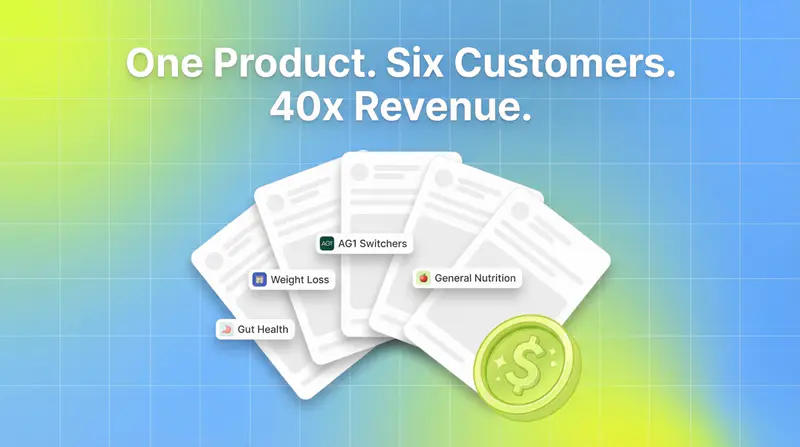
The result? A $500M Series B valuation inside 20 months, then a $1.2 billion exit to Unilever at roughly 32 months, on the back of 40x revenue growth and customer acquisition costs that dropped 14% as they scaled. That's not a fluke. That's a system.
Chad Janis, Grüns' founder, laid it out plainly on Episode 124 of the Operators Podcast: "I'm gonna grow as fast as the world lets me at my CAC ceiling... if that means there's 50,000 customers in a month that I can get at that efficiency, I'm going to go get them."
The efficiency he's talking about comes from a specific insight: the same product solves different problems for different people. Most brands know this in theory. Grüns built an entire media machine around it in practice.
This post breaks down the Grüns playbook: what they actually did, why it works, and what performance marketers can steal from it.
Key Takeaways
Grüns scaled from zero to a $500M valuation in under 20 months, then a $1.2 billion Unilever acquisition at 32 months, all on a single SKU, proving that product breadth matters less than messaging precision.
Running 6 distinct customer avatars - each with dedicated landing pages, testimonials, and ad creative - drove 40x revenue growth and a 14% reduction in customer acquisition costs.
Each avatar funnel uses the same product template but matches the visitor's specific problem: gut health proof for gut health visitors, weight loss proof for weight loss visitors.
Grüns runs 1,200+ live Meta ads at any time, not to flood the feed, but to ensure each potential customer sees something that feels built for them.
Research on ad-to-landing page message match shows poor alignment can inflate cost per engaged lead by 5x. Grüns eliminates that gap by design.
The playbook applies beyond supplements: any brand whose product solves multiple distinct problems can run this segmentation architecture.
Also read Static vs Video Ratio for Meta Ads: What 67,000 Ads Tell Us
The Core Insight Grüns Built a Business On
Grüns makes one thing: a superfood gummy. But their founder didn't think of it as one product solving one problem. He catalogued every distinct reason someone might buy it.
That list became six customer avatars:
General nutrition (filling gaps in your diet)
Gut health ("better poops" - their words, not mine)
Weight loss support
AG1 switchers (skeptics of the powder format)
GLP-1 users (people on Ozempic or Wegovy)
Protein users
Same gummy. Six completely different reasons to buy it. Six completely different conversations to have.
Most brands treat this as a copywriting problem. They write one benefits page that tries to speak to all six groups at once. The result is a page that resonates with none of them deeply. As the Operators Podcast breakdown notes: "The customer thinks: 'This isn't for me specifically.'"
Grüns flips it. Every customer enters a funnel where the product feels like it was built for their exact problem.
What "Avatar-Based Funnels" Actually Means in Practice
The Grüns execution isn't just "run different ads." It's an end-to-end architecture.
Dedicated landing pages per avatar
Not different ads pointing to the same homepage. Completely separate entry points:
/pages/first-order-gut-health/pages/first-order-weight-loss/pages/nutrition-support(for GLP-1 users)Comparison blog content for AG1 switchers
Each page changes the testimonials, the benefit order, and the lead magnets, while the generic product page stays the same for organic traffic.
Ad creative matched to the funnel
A gut health ad leads to a gut health landing page. A GLP-1 ad leads to the GLP-1 support page. There's no moment where the visitor's expectation gets broken.
This isn't just about UX. It's about economics. Research on ad-to-landing page message match found that poor message alignment can inflate cost per engaged lead from $20 to $100 (a 5x swing) on identical traffic. Grüns' 14% lower CAC is, in part, a direct consequence of eliminating that gap.
1,200+ live Meta ads at any time
Grüns runs a large ad library not to maximize impressions but to maximize relevance. When one person searches for "gut health gummies" and another searches for "supplement for people on Ozempic," there's a specific ad waiting for each of them. The creative diversity also works with Meta's Andromeda algorithm, which uses creative signals rather than audience filters to match ads to high-intent users. This is the same shift covered in our Meta Andromeda 2026 creative strategy playbook: in 2026, the creative itself has become the primary targeting mechanism, so a wide, well-differentiated ad library is now an algorithmic advantage, not just a relevance one.
The Framework You Can Steal
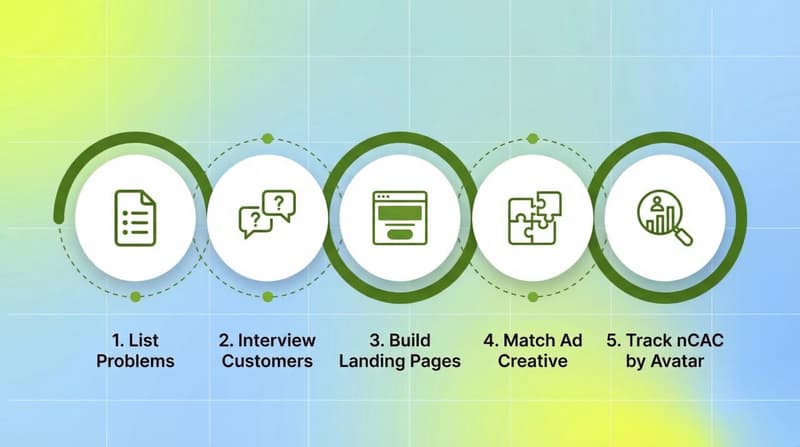
Chad Janis laid out the steps clearly:
List every distinct problem your product solves
Interview customers who bought for different reasons
Build a landing page for each problem (same template, different copy)
Match ad creative to landing page messaging exactly
Track nCAC (new customer acquisition cost) by avatar to see which segments actually convert

The key shift is conceptual: stop asking "how do we describe our product?" and start asking "what different problems do different people hire our product to solve?"
Each answer is its own funnel. Each funnel is its own economic unit.
Why tracking nCAC by avatar matters
Most brands track blended CAC: total spend divided by total customers. That hides everything. If your gut health avatar acquires customers at $18 CAC and your general nutrition avatar costs $62, blended CAC tells you $40. You'd keep spending evenly across both instead of doubling down on gut health.
Tracking nCAC by avatar turns the whole system into an optimization machine. You see which segments are profitable, which are marginal, and which you should test for but not yet scale.
Why This Scales Without Breaking
There's a version of this strategy that sounds exhausting: you're now maintaining 6 landing pages, 6 creative pipelines, 6 content calendars. In practice, Grüns keeps it manageable through templating.
The landing pages use the same layout. The ads follow the same creative structure. Only the proof points, testimonials, and benefit ordering change. The marginal cost of adding a new avatar is low. It's mostly copy variation, not an entirely new production workflow.
Avatar-based funnel research from the DTC space confirms this: "Start with your top two and build from there." Grüns likely started with gut health and general nutrition, proved the model, then added GLP-1 users and AG1 switchers as the supplement landscape shifted.
The system also compounds. Once you know which avatar converts at the lowest CAC, you can put more budget behind those entry points, optimize the creative more aggressively, and develop avatar-specific retention flows downstream.
The Creative Intelligence Problem Hiding Inside This Strategy
There's something Grüns gets right that doesn't show up in the LinkedIn post: you can't manage 1,200+ live ads and 6 avatar funnels without knowing which creatives are pulling weight.
At that volume, manual review doesn't scale. Teams running dozens of avatar-specific creatives per segment need to know which hooks are working, which proof points resonate within each funnel, and when specific creatives start fatiguing before the performance data tanks and budget gets wasted.
This is where creative analytics becomes load-bearing infrastructure, not a nice-to-have. Are your gut health testimonials landing better with before-and-after framing or clinical language? Is the GLP-1 avatar responding to urgency hooks or reassurance messaging? You can't answer those questions without tagging your creatives at element level and mapping those tags back to performance. The stakes are higher in 2026 because the winning DTC formats on Meta are now problem-aware and founder or creator led, and a genuine founder or origin story can stay live for six to twelve months before it fatigues, far longer than a typical promotional ad, which means the few durable hooks are worth finding and protecting. If you want a starting map of what actually converts, our breakdown of the best ad creative hooks for DTC brands in 2026 covers the patterns that repeat across high-spend accounts.
If you're running a multi-avatar strategy at any meaningful scale, tools like Segwise can surface exactly this - automatically tagging creative elements across your ad library (hooks, CTAs, visual styles, benefit statements, audio tone), mapping each tag to performance metrics through creative fatigue detection that catches declining patterns before they drag CAC up. That's the analytical layer that lets a team like Grüns' run 1,200 ads without drowning in spreadsheets.
Grüns' Broader Playbook: Creator Strategy and Retail
The avatar-based ad strategy doesn't operate in isolation. Grüns backed it with a creator flywheel that kept the top of each funnel filled with fresh, credible proof.
Instead of paying macro-influencers, Grüns built a micro-creator network - reportedly 250,000+ individuals, mostly micro and nano in scale - generating UGC that gets repurposed into paid ads. The TikTok-native content feeds their Spark Ads. The YouTube creators build search presence. Everything routes back into the avatar funnels.
They also hit profitability within 14 months of launching and, by the time Unilever came calling, were stocked in 7,000+ retail doors including Target, Sprouts, Walmart, Sam's Club, and Ulta, ranked the #1 greens brand on Amazon, and shipping roughly 10 million gummies a day to over a million customers, crossing $300M+ in annualized revenue. All of it from a company that launched in August 2023 with about $400,000 scraped together from Stanford classmates and raised only around $55 million in total.
The Series B that valued them at $500M brought in celebrity investors: Joe Burrow, Shaun White, Anna Kendrick. But the $1.2 billion valuation Unilever paid didn't come from the celebrities. It came from the unit economics of a system that knows its customers well enough to speak to each of them specifically.
Conclusion: One Product, Many Conversations
Grüns' growth story isn't really about gummies. It's about a discipline most brands don't have: the willingness to treat "customers" as multiple distinct groups rather than a single undifferentiated audience.
The uncomfortable question the Grüns playbook raises for every brand: do you actually know how many different problems your product solves? And are you talking to each of those customers as if you know?
If you're running multi-avatar creative strategies and want to know which elements drive performance within each segment, Segwise connects your ad networks (Meta, Google, TikTok, Snapchat, YouTube, AppLovin, Unity Ads, Mintegral, IronSource) and MMPs (AppsFlyer, Adjust, Branch, Singular), automatically tags your creative elements across video, audio, image, and text, and shows you exactly which hooks and proof points are pulling weight in each funnel. Teams using it typically save up to 20 hours per week on creative analysis - time that goes back into building the next avatar.
Frequently Asked Questions
What is the Grüns ad strategy?
Grüns runs six distinct customer avatars - each representing a different reason someone might buy their greens gummy - with dedicated landing pages, tailored testimonials, and matched ad creative for each avatar. Rather than driving all traffic to a generic product page, each avatar gets a full funnel that speaks to their specific problem.
How did Grüns reach a $500M valuation, and did it get acquired?
Grüns closed a Series B at a $500M valuation roughly 20 months after launching in August 2023. It kept scaling from there, crossing $300M+ in annualized revenue and shipping around 10 million gummies a day, and in April 2026 announced a $1.2 billion acquisition by Unilever, one of the fastest large exits in consumer packaged goods history. The growth was driven by a precision ad strategy using avatar-specific funnels and a large micro-creator network.
What is nCAC and why does Grüns track it by avatar?
nCAC (new customer acquisition cost) is the cost to acquire a net-new customer, as opposed to blended CAC which can include returning customers. Tracking nCAC by avatar reveals which customer segments are most efficient to acquire, allowing Grüns to allocate budget toward their best-performing funnels.
How many ads does Grüns run on Meta?
According to the Operators Podcast breakdown shared by Curtis Howland, Grüns maintains 1,200+ live ads on Meta at any given time. The large library ensures each potential customer segment sees creative that matches their specific problem and intent.
Can this avatar-based strategy work for non-supplement brands?
Yes. The core principle applies to any product that solves multiple distinct problems or serves customers with different primary motivations. SaaS companies, mobile apps, DTC brands in health, fitness, or beauty, and subscription services can all map customer avatars to dedicated funnels.
What is ad-to-landing page message match?
Message match is the alignment between what an ad promises and what the landing page delivers. When the headline, benefit framing, and social proof on a landing page directly mirror the ad that sent someone there, trust is maintained and conversion rates rise. Poor message match, where the ad and landing page feel disconnected, is one of the most common sources of wasted ad spend.
How does Grüns' strategy connect to Meta's Andromeda algorithm?
Meta's Andromeda system uses creative signals to match ads to high-intent users rather than relying on audience segmentation. Grüns' large creative library - with distinct hooks, messaging, and proof points per avatar - provides the algorithm with more diverse signals to work with, increasing the likelihood that the right creative reaches the right person.
What does an avatar-based ad strategy look like for DTC brands in 2026?
In 2026, the DTC creative formats that win on Meta are problem-aware rather than product-first, and they lean on founder-led and creator UGC that name a specific pain before naming the product. Running a distinct funnel per avatar fits this shift naturally: each segment gets its own problem-aware hook, its own proof points, and its own landing page, which gives the algorithm the creative diversity it now rewards. The practical constraint is measurement. Once you are running dozens of avatar-specific creatives, element-level creative analytics is what tells you which hooks and proof points actually move each avatar's CAC.