
The best Foreplay alternatives in 2026 are Segwise, Motion and Atria: Segwise for element-level creative analytics and AI creative generation across mobile UA and DTC, Motion for DTC creative reporting with an always-on AI analyst (from $750/month), and Atria for Meta and TikTok ad research with an AI creative strategist (from $129/month, billed annually).
TL;DR: Key Takeaways
Foreplay is a swipe-file and briefing tool, not a creative analytics suite. Its Lens analytics layer is deliberately priced away from ad spend: $59 / $175 / $459 per month, or $49 / $149 / $389 billed annually, with 1, 5 and 10 seats bundled and extra seats at $20 each. Enterprise is custom.
It is a mature product, and it shipped a public API on 18 June 2026. Most teams leave Foreplay because of what it does not do, not because it does its job badly.
Where it stops: no MMP integrations, no playable-ad tagging, no native creative-fatigue detection, and no mapping of creative tags to your own first-party performance data.
Pick by the gap you actually have: element-level creative analytics (Segwise), DTC creative reporting (Motion), enterprise creative measurement (Vidmob, CreativeX), AI ad generation (Bestever, GetCrux), or competitive intelligence (Adbeat, Adnova).
MagicBrief is no longer an option. It shut down on 31 July 2026, after Canva acquired it in June 2025 and the team went on to build Canva Grow.
Foreplay Alternatives at a Glance (2026)
Are you also tired of guessing which hooks, angles, or storylines will work for your mobile game, DTC brand, or subscription app?
You collect endless inspiration, but your ROAS keeps slipping, fatigue hits earlier than expected, and your “winning” ideas stop scaling when real budgets go live. You’re not short on inspiration. You’re short on clarity. And that uncertainty is what quietly burns your ad spend every single week.
Tools like Foreplay help you collect inspiration, but you still need more in-depth analysis to avoid performance drops. This blog covers the best Foreplay alternatives for creative and UA teams to help you move from inspiration to data-backed creative decisions that actually scale your campaigns.
Why Creative Teams Move to AI-Powered Solutions
UA-focused creative teams are shifting fast from manual workflows to AI-powered systems because the old ways simply can’t keep up with today’s testing speed, channel complexity, and creative fatigue cycles. When you're running paid campaigns across Meta, TikTok, and Google, you don’t just need more ideas; you need smarter, faster creative decisions that directly connect to installs, purchases, and subscriptions.
Here are the key reasons why creative teams are making the switch: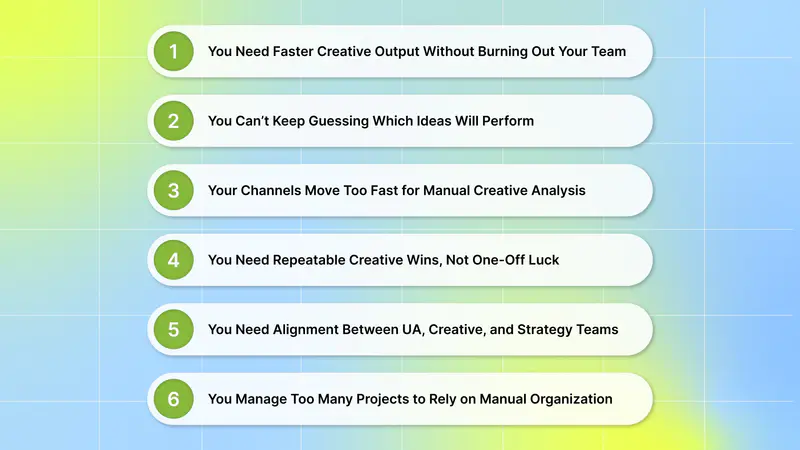
1. You Need Faster Creative Output Without Burning Out Your Team
In manual workflows, you spend hours searching for inspiration, saving ads, naming files, tagging elements, and preparing briefs. It slows your entire pipeline.
With AI-powered solutions, research, tagging, and clustering happen instantly, so you can focus on refining concepts rather than hunting for them. You ship more creatives in less time without lowering quality.
2. You Can’t Keep Guessing Which Ideas Will Perform
When you work manually, you rely on gut feeling or external swipe folders that never explain why an ad worked.
With AI tools, every hook, character, dialog, CTA, or visual is mapped to actual performance metrics. You know exactly which creative elements drive conversions, so your next creative is not a guess; it’s an informed decision.
3. Your Channels Move Too Fast for Manual Creative Analysis
Fatigue on Meta or TikTok can hit in just a few days. By the time you notice it manually, you’ve already lost valuable time and budget.
AI-powered tracking spots early drops in performance and alerts you instantly, so you can refresh or rotate creatives before they cost you money.
4. You Need Repeatable Creative Wins, Not One-Off Luck
Manually, it’s hard to see patterns across hundreds of creatives. You look at every asset separately and miss the bigger picture.
AI systems cluster similar assets and reveal patterns like which hooks work best for male 18 to 24, which storylines convert high-value subscribers, or which character types drive better IPM for your game. You get repeatable formulas instead of random wins.
5. You Need Alignment Between UA, Creative, and Strategy Teams
Manual reporting leads to long meetings, inconsistent insights, and misaligned priorities. Everyone interprets results differently.
AI-powered dashboards unify data, creatives, and performance in one view. This keeps your UA team, creative team, and strategy leads fully aligned on what to scale, what to cut, and what to test next.
6. You Manage Too Many Projects to Rely on Manual Organization
If you work at an agency or run multiple games/apps, manual tagging and folder management quickly become a mess.
AI systems automatically organize creatives by tags, themes, concepts, or performance. You switch between clients or projects instantly, without losing context.
As teams move from manual guesswork to data-driven systems, one tool often comes up in conversations. So let’s break down what Foreplay does well and where it stops supporting the needs of serious UA teams.
Also Read: Segwise vs Foreplay: Which One Is Right for You?
What Is Foreplay and Where It Falls Short?

Foreplay is a creative workflow tool that helps you save ads, organize inspiration, track competitors, search ad libraries, and build creative briefs. It’s built for creative teams who want a simple way to collect ideas, review competitor ads, and create storyboards before launching new concepts.
Key Features
1. Save and Organize Ads: You can save ads from anywhere on the internet and store them forever. You get folders, boards, tags, and ways to organize your inspiration library.
2. Browse and Search Millions of Ads: Foreplay includes a large ad search engine where you can browse ads by keywords, brands, categories, or creative themes. It helps you discover angles, openings, and formats other advertisers are using.
3. Automatically Track Competitors: You can monitor competitor ad accounts, track their active ads, review their hooks, landing pages, and creative trends. This gives you a high-level view of what competitors are launching.
4. Creative Analytics: Foreplay provides a view of what's working for other brands by showing performance patterns like winners, scaling ads, and themes. Lens, Foreplay’s own analytics layer, adds performance dashboards, creative leaderboards, test-performance charts and password-protected shareable reports, but it reads your ad accounts, not your MMP.
5. Build Creative Storyboards and Scripts: You can create storyboards, scripts, brand profiles, and modular briefs. Foreplay helps creative teams move from inspiration to a structured creative concept faster.
Best For
Creative strategists, DTC brands and agencies who want a swipe file, competitor ad research and a briefing workflow at a price that does not scale with media spend. It sits adjacent to creative analytics rather than replacing it.
Pricing
Basic $59/month (1 seat), Workflow $175/month (up to 5 seats) and Agency $459/month (up to 10 seats), or $49 / $149 / $389 per month billed annually. Extra seats are $20 each and Enterprise is custom. Crucially, Foreplay is seat-bundled and not priced on ad spend, which is its explicit positioning against spend-tiered rivals. There is a 7-day free trial and a 14-day money-back guarantee.
What Changed Recently
Foreplay launched a public API on 18 June 2026. Lens and the seat-bundled pricing restructure both landed in June 2025.
Where Foreplay Falls Short
Even though Foreplay is strong for creative inspiration, it starts breaking down when your goals involve fighting fatigue or MMP integration. These gaps matter because you don’t just need ideas, you need performance clarity. Here’s where Foreplay falls short:
1. If You Need Playable Tagging
If your team creates playable ads for mobile games or interactive UA campaigns, Foreplay cannot tag or break down playable elements. You don’t get insights on which buttons, flows, or scenes impacted IPM or conversion rates, leaving you blind when iterating your next playable concept.
2. If You Need MMP Integration
It does not integrate with your MMPs (Appsflyer, Singular, Adjust) or your CDP data. This means you cannot fetch data from there; this is a major blocker because you cannot link ad ideas to actual business outcomes.
3. If You Need Creative Fatigue Tracking
It cannot detect creative fatigue or warn you when performance starts dropping. On fast-moving channels like Meta and TikTok, fatigue can set in quickly, and without custom criteria and alerts, you lose both time and budget. You end up reacting too late and refreshing creatives only after ROAS has declined.
4. If You Need Tag-Level Performance Mapping
It doesn’t show how specific creative elements affect performance metrics such as ROAS, CPI, IPM, or LTV. You still have to guess which parts of a creative made it work. Without tag-level mapping, it’s nearly impossible to build data-backed creative briefs or repeat winning patterns.
Once you understand these limitations, the next step is choosing tools built for fast testing, deeper insights, and real UA impact.
Best Alternatives to Foreplay for Creative Teams
Finding the right Foreplay alternative depends on how deep you want your creative insights to go and how fast your team needs to scale winning concepts. Instead of relying only on inspiration boards, you need tools that connect creative decisions to real UA performance.
Here are the best alternatives that help creative teams move from guessing to data-backed execution:
1. Segwise

Segwise is an AI-powered creative analytics and generation platform that helps UA and performance marketing teams understand which creative elements drive performance, when creatives start fatiguing, and where budgets should shift before results drop.
It connects creative elements (hooks, dialogs, visuals, formats, etc.) directly to business outcomes (ROAS, CPA/CPI, LTV, IPM, conversion rates), so teams stop guessing what works and start scaling creatives with data-backed confidence.
Key Features
1. AI-Powered Creative Tagging: Its multi-modal AI automatically identifies and tags creative elements across images, videos, text, and playable ads to reveal their impact on performance metrics like IPM, CTR, and ROAS.
2. Studio View for Multiple Projects: Manage creative analytics for multiple apps, games, or brands from one unified interface. Switch between projects instantly while maintaining consistent performance tracking across your entire portfolio.
3. Custom Dashboards and Reporting: Build dashboards around your specific KPIs and stakeholder needs. Create automated reports that show how creative decisions impact ROAS across all your apps and campaigns.
4. Tag-Level Creative Element Mapping: See which specific creative elements drive performance. Discover patterns like "this hook dialog appears in 80% of our top-performing creatives" with complete MMP attribution integration.
5. Creative Fatigue Detection: Automated monitoring detects a continuous decline in performance metrics and spend share using internal logic. Catch fatigue before it impacts your budget allocation and campaign results.
6. Data-backed creative iterations: Generate creative variations based on actual performance data from your campaigns. Segwise understands which specific creative elements drive ROAS, CPA, and conversion rates via its Creative Tagging Agent and Creative Strategy Agent.
7. Creative Strategy Agent (AI Chat): An always-on AI creative strategist with full context across your creative, tag, competitor, fatigue and custom-metric data. Ask in plain language, “what separates my top five creatives from my bottom five?”, and get the answer, a formatted report, or a recommendation, without building a dashboard first.
8. AI Creative Generation: Segwise does not stop at analysis. Its Creative Generation Agent produces net-new, data-backed creatives, static images, video (including AI UGC-style video ads), playables and video storyboards, built around the winning patterns its own tagging found. Every generated creative is tagged and tracked once live, so its performance feeds back into the same system that made it.
9. Coverage and Setup: No-code connections to 15+ ad networks and MMPs, including Meta, Google, TikTok, Snapchat, YouTube, Axon (AppLovin), Unity Ads and Mintegral, plus five MMPs: AppsFlyer, Adjust, Branch, Singular and Kochava. Setup takes about five minutes, and historical data is backfilled automatically: up to two weeks on the free trial and up to three months on paid plans.
Best For
Mobile game studios, DTC brands, subscription apps and performance agencies running high creative volume across several ad networks: teams whose question is not “which ad won” but “which element made it win, and what should we make next?”
Pricing
7-day free trial with no engineering required to connect your accounts. Segwise starts at $499/month for advertisers spending up to $250K/month, with a special 50% discount for startups spending under $50K/month.
Why Segwise Is the Best Alternative
Segwise is the best alternative because it doesn’t stop at inspiration; it shows you why a creative works by linking every element to real UA performance metrics like ROAS, CPI, LTV, and IPM. While tools like Foreplay help you collect ideas, Segwise gives you automatic tagging, MMP/CDP integration, fatigue detection, and tag-level performance mapping, so you always know what to scale, refresh, or kill.
Limitation
Its competitor ad tracking covers Meta only, so teams that research rivals across TikTok and other networks may still want a research tool alongside it.
In short, with Segwise, you get a full creative-to-performance loop in one place, helping you test faster, reduce wasted spend, and build creatives that actually convert. Moreover, it's the one platform in this list that tags playable (interactive) ad elements: the format most creative tools cannot read at all. If you want creative decisions backed by performance data rather than assumptions, Segwise stands far above every other Foreplay alternative.
2. Vidmob

Vidmob is a creative intelligence platform that helps you use creative data to make better creative and media decisions. It analyzes how your creative tactics perform, shows you which parts of your ads are driving results, and helps your team build more effective creatives.
Key Features
1. Creative Data & Creative Intelligence: It helps you understand how creative decisions impact performance. It turns your ads into measurable creative data so you can identify what is working and what needs to change.
2. Evaluate Creative Tactics: It lets you evaluate why your current creative tactics are working or not. You can identify which approaches are effective and discover new strategies informed by data rather than intuition.
3. Measure the Effectiveness of Creative: It shows you how creative choices influence business outcomes. You can measure the impact of your creative against the KPIs that matter and adjust as needed.
Why Vidmob Is a Better Alternative to Foreplay
Vidmob is a stronger alternative because it focuses on creative performance. While Foreplay helps you save ads, search inspiration, and organize moodboards, Vidmob offers creative data, tactic evaluation, and effectiveness measurement, giving you clarity on which creative choices impact results. For teams looking to improve ad performance with insights, Vidmob offers a more data-backed workflow.
Limitation
Even though Vidmob provides strong creative intelligence, it does not offer tag-level breakdowns, fatigue tracking, or performance-connected creative iteration. As a result, it becomes harder to translate insights directly into faster creative decisions or day-to-day campaign improvements.
Best For
Large global brands and agencies that need creative measurement standardised across many markets and channels. It is not built for SMB or self-serve buyers.
Pricing
Not publicly listed. Vidmob sells through sales on an enterprise contract, and does not publish pricing on its site.
What Changed Recently
Vidmob launched Vidmob360 on 10 June 2026, moving from a standalone SaaS app to a composable creative-intelligence layer delivered through MCP services and APIs, so creative data can flow into AI assistants and enterprise tools. Further AI agents are slated for later in 2026.
3. Bestever

Bestever is an AI-powered ad creation platform that helps you produce high-volume ads that scale. It generates personalized catalog creatives, product-based video ads, and automated variations designed to convert across platforms like Meta, TikTok, and LinkedIn.
Key Features
1. Custom Catalog Creative Generation: It automatically creates on-brand catalog ads for each customer. The platform produces personalized creative variations directly from your product catalog, so every shopper sees ads aligned with their interests.
2. Automated Video Ad Generation at Scale: You can turn any product link into a high-performing video ad. Bestever generates Meta, TikTok, and LinkedIn-ready creatives in bulk, helping you launch campaigns faster without manual design work.
3. Competitor Ad Analysis at Scale: Bestever analyzes your competitors ads to break down their strategy and identify what’s working. It uses these insights to generate thousands of variations that match your brand style but follow high-performing patterns.
Why Bestever Is a Better Alternative to Foreplay
Bestever gives you AI-generated creatives, catalog-based video production, and competitor breakdowns that Foreplay does not offer. While Foreplay helps you save ads and organize moodboards, Bestever helps you actually produce high-performing ads in bulk. If you're looking for a tool that accelerates creative production and reduces manual design work, Bestever offers stronger capabilities than Foreplay.
Limitation
Even though Bestever is strong at ad creation, it lacks tag-level insights and MMP-connected data, both of which are critical for performance optimization. So while it’s useful for fast production, it lacks the analytical depth needed for serious user acquisition teams.
Best For
Small ecommerce and DTC brands and freelancers who want the cheapest credible entry point into AI ad generation.
Pricing
Essential $10/month (40 credits) and Advanced $99/month (400 credits), with a custom Enterprise tier. You generate during the trial for free and only pay at download.
Ownership Note
Bestever was acquired by Samba (Samba TV), announced 22 June 2026, with founder Apoorva Govind joining Samba as Director of Product. Terms were not disclosed. The product is still live and still selling, and bestever.ai makes no mention of the deal, but it is no longer an independent startup, and the announcement says nothing either way about its long-term future as a standalone tool.
4. CreativeX

CreativeX is a system built to help marketers scale “creative excellence” across their organization. It provides an impartial way to unify creative, content, and media measurement so your brand can consistently deliver the right idea, in the right format, through the right media.
Key Features
1. Enhance Creative Development: Identify which ideas cut through with your audience with an end-to-end view of your live and historical campaigns that link your pre-testing, creative, and media datasets.
2. Streamline Content Production: Empower your content production partners with meaningful content scoring to ensure every asset is optimized for your definition of excellence before it goes live.
3. Optimize Media Activation: Connect creative decisions with performance outcomes and beyond to launch campaigns with confidence.
Why CreativeX Is a Better Alternative to Foreplay
CreativeX offers a full creative excellence system. It gives you creative scoring, quality control, and measurement tied directly to content, creative, and media impact. This makes it a stronger choice for teams needing structure, governance, and brand-aligned creative execution at scale.
Limitation
CreativeX is primarily built for large global brands and focuses heavily on creative governance. It does not offer playable ad analysis, which is needed to understand how interactive elements drive installs and engagement.
Best For
Global enterprise brand and marketing-effectiveness teams, CPG, pharma, FMCG, auditing creative quality and brand-guideline compliance across huge content volumes in many markets. Named customers include Nestlé, Mars, Heineken, PepsiCo and P&G.
Pricing
Not publicly listed. There is no pricing page; CreativeX sells on an enterprise annual contract via “Get a demo”.
What Changed Recently
CreativeX launched Datalink on 3 December 2025, a creative-data interoperability framework that pulls fragmented creative-intelligence sources into one dashboard, with launch partners including Kantar, DAIVID, Dragonfly AI, Amplified and Adverteyes.
5. Adbeat

Adbeat is a competitive intelligence platform that gives you deep visibility into the digital advertising strategies of top brands across ad networks. It collects massive volumes of desktop, mobile, native, and pre-roll ads to help you understand what creatives, publishers, and campaigns are driving results in your market.
Key Features
1. Creative & Media Insights: The platform reveals top creatives, landing pages, flight dates, publishers, and estimated ad spend for any advertiser. This helps you understand which creative tactics competitors rely on and how they structure their funnels.
2. Competitive Monitoring: It lets you go deep into any competitor’s campaigns to see their top publishers, biggest spenders, and cross-channel patterns. This reduces guesswork in planning your next creative test or channel strategy.
3. Advanced Reporting & Alerts: Adbeat generates detailed reports and sends automated alerts so you never miss changes in competitor activity. The reporting system helps teams track trends, spot new opportunities, and stay aligned with market shifts.
Why Adbeat Is a Better Alternative to Foreplay
Adbeat shows you exactly how competitors scale creatives and where they spend, all with data. Adbeat provides deeper insights into strategy, spend patterns, and winning creative formats that Foreplay doesn't offer.
Limitation
While Adbeat offers strong competitive intelligence, it lacks element-level creative analysis, concept-level breakdowns, and playable ad insights, making it less suitable for teams that rely heavily on granular creative performance data.
Best For
Media and acquisition teams doing competitive intelligence across display, native and pre-roll: understanding where rivals spend and which publishers they buy.
Pricing
Standard $249/month and Advanced $399/month, both available monthly or yearly, with a call-for-quote Enterprise tier.
6. Motion
Motion is the creative analytics tool most DTC and consumer-app teams benchmark against, and over the past year it has repositioned from a reporting dashboard into an AI-agent product. Every paid Motion plan now includes Runneth, its always-on AI agent, which answers in Slack, writes briefs, makes static ads and runs scheduled reports and alerts.
Key Features
1. Ad leaderboard and creative analytics: rank creatives by the metric you care about, with AI tags and AI-generated tasks layered on top.
2. Slack-native workflow: ask a question in Slack and Motion ships briefs, hooks and reports back, plus daily and weekly routines, iteration finders and alerts.
3. Inspo: Brand Intel competitor tracking, boards and a Discover feed of 600+ brands, on paid plans. This is the part of the product that overlaps most directly with Foreplay.
Why Motion Is a Better Alternative to Foreplay
Foreplay is built around competitor research; Motion is built around your own ad performance, with Inspo for research. It reads your own ad accounts, ranks creatives on your metrics, and now runs an always-on analyst over the top of them.
Best For
DTC, ecommerce and consumer-app performance teams spending $50k+ a month who can absorb a four-figure monthly floor.
Pricing
Starter $750/month (up to $50k monthly ad spend) and Pro $1,200/month (above $50k); a Growth tier for over $125k/month is quoted by sales. Seats are unlimited on every tier. Note that unlike Foreplay, Motion is priced on your ad spend.
Limitation
The entry price is the highest of any self-serve tool here, there is no MMP integration for mobile attribution, and playable ads are outside its scope.
7. Atria
Atria is the closest thing to a like-for-like Foreplay competitor with an analytics layer attached. It pairs a 25M+ ad library for Meta and TikTok with Radar, which grades your live ads A to D on ROAS, CTR, hook rate and retention, and prescribes fixes.
Key Features
1. Radar analytics: A to D grading of your own ads with prescriptive recommendations, not just a leaderboard.
2. Review Mining: pulls ad angles and real customer language out of Amazon, Google and uploaded reviews: a research input Foreplay does not have.
3. Raya: an AI creative-strategist agent, reported to have launched around February 2026 and trained on more than $5B of ad spend, which auto-tags creatives, watches competitors and generates weekly ad concepts unprompted.
Why Atria Is a Better Alternative to Foreplay
It covers the same swipe-file and competitor-research ground, then goes a step further by grading your live creative and telling you what to change. An MCP server and REST API are currently free and unlimited.
Best For
DTC and ecommerce performance marketers and agencies on Meta and TikTok who want to decide what to make from data before generating anything.
Pricing
Core $129/month, Plus $479/month and Business $959/month, all billed annually, with a custom Enterprise tier. Be careful here: several third-party write-ups still quote an older ladder with Plus at $269, which no longer matches Atria’s own pricing page.
Limitation
Channel coverage is Meta and TikTok. There is no MMP integration and no playable-ad support, so mobile UA teams still hit the same wall they hit with Foreplay.
8. Adnova
Adnova is the operational end of this category: creative research, competitor tracking and bulk ad launching in one tool, at a low three-figure price. (Note the domain: adnova.marketing is an unrelated ad network.)
Key Features
1. Creative Analytics 2.0: AI reports that analyse creative performance across 14 dimensions.
2. Inspirations and Detective: a claimed 75 million-ad searchable library, plus competitor launch tracking with strategy extraction.
3. Bulk Ad Launcher: push 100+ ads live at once, with a Creative Hub for asset review and feedback.
Why Adnova Is a Better Alternative to Foreplay
It does the inspiration and competitor work Foreplay does, then adds the launch step, so research and shipping live in the same tool.
Best For
Hands-on, Meta-first ecommerce brands and small agencies that want research plus execution without an enterprise price tag.
Pricing
Plus is $150/month month-to-month or $119/month billed annually; Growth is $309 or $249; Pro is $499 or $399. Enterprise is custom. Add-ons are priced separately: Ad Launcher $79/month, Creative Hub $39/month, Scenes $69/month. A free tier exists with one workspace and a $25K monthly ad-spend limit.
Limitation
Adnova is research, analytics and workflow: it does not generate AI images or video, and it has no MMP integration or playable-ad tagging.
9. GetCrux
GetCrux closes the loop that Foreplay leaves open: it analyses creative, writes the brief, generates the new asset, and can auto-publish it back to the ad platform.
Key Features
1. AI Creative Analyzer: breaks ads into elements, finds patterns in winners, and writes brand-aligned briefs and scripts.
2. AI Audience Analyzer: mines comments, reviews and competitor ads for objections and new creative angles.
3. AI Creative Generator: generates net-new creatives, runs brand-compliance checks, and publishes to Meta, Google and TikTok. Generation is included from Starter.
Why GetCrux Is a Better Alternative to Foreplay
Its connector set is unusually deep for mobile: AppLovin, Moloco, The Trade Desk and Criteo alongside Meta, TikTok and Google, plus MMP and attribution links to AppsFlyer, Adjust, Singular, Northbeam and Triple Whale (AppLovin and MMPs from Professional). That is exactly the first-party data join Foreplay does not offer.
Best For
Performance and growth teams at $1M+ annual ad spend, especially mobile app and gaming advertisers.
Pricing
Starter is $1,500/month for up to $100K of monthly ad spend; Professional and Enterprise are custom. There is no free plan, and access starts with a 30-minute call with the founders. Check which features you need, because MMP data and AppLovin start at Professional.
Limitation
The published floor is high, pre-flight testing and MMP data sit on the custom-priced Professional tier (generation is on Starter), and no playable-ad tagging is listed.
One Foreplay Alternative That No Longer Exists: MagicBrief
If you have been comparing swipe-file tools for a while, MagicBrief will be on your list. It should not be. Canva acquired MagicBrief in June 2025, the team went on to build Canva Grow instead, and MagicBrief shut down on 31 July 2026. Billing was cancelled, users were told to export their Insights Dashboard data before the cutoff because it could not be recovered, and existing customers were offered six months of Canva Business. Any 2025-era roundup still listing it as a live option is out of date.
Also Read: Segwise vs Bestever: Which Tool Is Right for You?
Conclusion
For UA, inspiration alone is no longer enough to build winning creatives. Teams need faster workflows, element-level insights, fatigue detection, and performance-linked decision-making to avoid wasted spend and scale campaigns with confidence. The most effective Foreplay alternatives are those that help you move beyond surface-level inspiration and give you deeper creative intelligence and smarter production workflows.
If your team wants a solution that actually tells you why a creative works, Segwise stands out among all the alternatives. Segwise AI creative tagging connects every hook, frame, dialog, and playable element directly to performance metrics like ROAS, IPM, and LTV, giving you deep clarity. Moreover, with tag-level performance optimization, you can instantly see which creative elements, themes, and formats drive results across all your campaigns.
With automatic tagging, fatigue detection, MMP integrations, and data-backed creative iteration, Segwise helps to ship winning creatives faster. When the goal is true performance-driven creativity, Segwise is the system built to increase UA efficiency. Moreover, it includes a free Video-to-Playable Ad Converter, making it easier for teams to scale interactive formats without extra cost.
So, are you ready to make creative decisions backed by performance, not guesswork? Start your free trial today and build creatives that actually scale!
FAQs
1. What is the best Foreplay alternative in 2026?
It depends on the gap. For element-level creative analytics tied to first-party performance data, including MMP attribution and playable ads, Segwise is the strongest pick. For DTC creative reporting on your own ad accounts, Motion. For Meta and TikTok ad research with grading built in, Atria.
2. How much does Foreplay cost in 2026?
Basic is $59/month for one seat, Workflow $175/month for up to five seats, and Agency $459/month for up to ten. Billed annually those become $49, $149 and $389 per month. Extra seats are $20 each and Enterprise is custom. Foreplay is priced on seats, not on ad spend.
3. Is Foreplay a creative analytics tool?
Partly. Lens gives you performance dashboards, creative leaderboards and shareable reports off your ad accounts. What it does not do is tag creative elements against your own results, connect to an MMP, detect fatigue natively, or read playable ads, which is why UA teams usually pair it with, or replace it by, a dedicated creative analytics platform.
4. Does Foreplay have an API?
Yes. Foreplay launched a public API on 18 June 2026, available on the Workflow and Agency tiers, with a monthly credit allowance.
5. What happened to MagicBrief?
MagicBrief shut down on 31 July 2026. Canva had acquired it in June 2025 and the team went on to build Canva Grow. It is no longer a viable alternative to anything.
6. Which Foreplay alternative works for mobile games and playable ads?
Playable-ad tagging is rare. Segwise tags playable (interactive) ad elements alongside video, audio, image and text, which matters if IPM and install-per-mille from interactive formats are part of how you judge creative.
7. Which alternative is cheapest?
Bestever at $10/month is the cheapest paid entry point in this list, and Adnova offers a free tier (GetCrux no longer does). But cheap AI generation and real creative analytics are different purchases: be clear which one you are actually short of before you optimise for price.
How We Evaluated These Tools
Every tool in this guide was re-checked on 31 August 2026 against the vendor’s own live pricing page. Where a vendor does not publish a price, we say so rather than repeating a figure from a third-party directory. Capability claims come from vendor documentation and product pages, and the Segwise capabilities described here reflect the shipping product, not a roadmap.
Written and maintained by the Segwise creative intelligence team: the group that builds and runs Segwise’s creative tagging, analytics and generation agents for mobile UA, DTC and agency advertisers.