A TikTok creator brief is not a studio production document. Studios need locked specs, frame-accurate timing, and approval gates; TikTok creators need vibes, hook references, native examples, and clear guardrails. Briefing them with the wrong document is the single most common reason TikTok UGC underperforms, and the fix is structural, not stylistic. Tagging your own and competitor creatives with Segwise's creative tagging lets you ground the "vibes" half of the brief in actual hook, CTA, and visual patterns that already convert.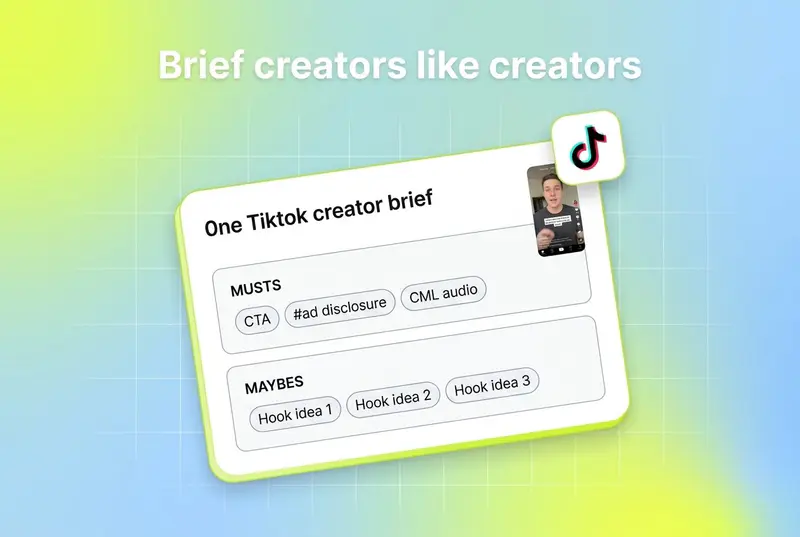
Introduction
If you have ever sent a 20-page studio brief to a TikTok creator and received back a video that felt like a polished Instagram ad, you already know the problem. The brief was written for the wrong platform, the wrong audience, and the wrong production model.
Syncly's analysis of why TikTok creator briefs fail puts it plainly: applying a brief designed for Instagram, or worse, a 50-page theoretical creative brief, to a TikTok campaign is a primary driver of failure. The two platforms are fundamentally different. Instagram rewards aesthetic control. TikTok rewards cultural fit. The risk is no longer that a creator will fail to look polished. The risk is that they will succeed at looking polished and be rejected by the TikTok audience.
This piece breaks down what to cut from your studio brief, what to add for TikTok creators, the do's and don'ts you should keep in front of every creator on every campaign, a sample one-page brief you can copy, and how to brief differently for Spark Ads, Branded Content, and the TikTok Creative Challenge. Every recommendation is sourced from official platform documentation and creator briefing guides. None of it is theoretical. If you are weighing filmed creators against AI-generated UGC, our guide to AI UGC tools and creator platforms compares both routes.
Also read Pre-Flight Testing Frameworks for Meta and TikTok Ads
Key takeaways
A TikTok creator brief is a strategic communication tool, not a contract or task list, per Syncly. Its job is to translate marketing goals into a creative prompt, not script the video.
Authenticity is a consumer mandate, not a preference. 90% of consumers say authenticity matters when deciding which brands to support, per Syncly's reporting.
The "Must vs. Maybe" framework, also from Syncly, is the core structure: 5-6 non-negotiable guardrails plus a creative sandbox of suggestions.
A TikTok UGC brief should still cover objective, audience, key message and hook, tone, deliverables, and compliance, per Future Digital's 2025 brief template.
Hook in the first 1-3 seconds is the single most decisive element, per inBeat's TikTok UGC guide. inBeat tests three different hook variants per video for this reason.
Audio briefing is the most-missed compliance section. Commercial content cannot use the general music library; only the Commercial Music Library (CML) or original sound is safe, per the TikTok for Business documentation cited by Syncly.
Spark Ads need an upfront authorization agreement in the brief itself, per Syncly. Asking for ad rights after the post is live is the most expensive briefing mistake.
TikTok Creative Challenge is a separate brief format altogether: creators make UGC ads for brands without posting to their own profile, per TikTok for Business.
Why studio briefs fail TikTok creators
A studio brief is built for a production team. It assumes a director, a DP, a sound mixer, an editor, and a post supervisor will read it, all working from the same call sheet. It locks down framing, lighting, audio levels, color grade, copy approvals, legal sign-off, and shot lists. That precision is necessary when 30 people are spending a week of production time on a single :30 commercial.
A TikTok creator is one person, on a phone, in their kitchen, working in 90 minutes between school pickup and dinner. Hand them a studio document and three things break at once.
First, the brief is unreadable on the device they are filming with. Per Syncly, creators on a fast-moving platform will not read a 50-slide deck. The goal is a one-page brief that cuts through the noise.
Second, the brief over-specifies. A studio brief might call out a 35mm equivalent focal length, a soft key from camera left, and a specific Pantone for the on-screen text. None of that survives contact with a smartphone shot in available light. Worse, when a creator tries to honor those specs, the video starts to look like a brand ad, which is what TikTok punishes. Future Digital frames this directly: too much rigidity kills authenticity, while too little structure leads to off-brand or non-compliant content.
Third, the brief replaces the creator's judgment with the brand's. A TikTok creator's value is their relationship with their audience, the way they sound, the way they hold the phone, the rhythm they cut to. The moment the brief makes them sound like the brand instead, the audience clicks away. inBeat's agency view is unambiguous on this: 90% of people trust UGC, only 4% trust branded messages. Make the creator sound branded and you have spent UGC budget on the worst-performing format.
If your current TikTok brief reads like a deck for a TV spot, the cheapest fix you can make this quarter is to cut it down to one page and move every spec into a separate SOW.
What to cut from a studio brief
Most teams improve TikTok performance by removing things, not adding them. Here is what to delete.
Cut frame-by-frame storyboards.Syncly's pro tip is explicit about this: a vague brief with no defined boundaries makes a creator timid, but a heavily scripted one is worse. The fix is a strong "don'ts" list and a "musts" list, not a shot-for-shot script.
Cut subjective aesthetic notes. "Make it pop" or "we want a more aspirational feel" are studio-brief language. They become bad feedback later. Syncly draws a clean line: feedback should be given only against the "Musts" and "Don'ts" defined in the brief. Anything else is taste, and taste does not belong in a creator review.
Cut internal marketing jargon. "Increase Q4 CVR by 5%" is not an actionable creative note, per Syncly. Translate it: "This is a conversion-focused campaign. The single most important action is getting your followers to click the link."
Cut filler words.Syncly calls these out as a marker of failed briefs: scannable, fluff-free copy is the standard. If a sentence does not change what the creator films, delete it.
Cut the legal and creative direction from the same document.Syncly's pro tip is to split them: a 1-2 page creative brief plus a separate SOW or contract for the dense legal language, payment schedules, and usage rights. Burying creative direction in a 50-page legal contract guarantees the creator misses the creative notes.
Cut demographic-only audience targeting. Generic age and gender frames are studio-brief language. Syncly's recommendation is to brief on subcultures instead: "We are targeting #MomsofTikTok. We know their number-one pain point is cleaning up messes. We want you to create a video for that audience, showing how this product solves that problem in your authentic #MomTok style." The subculture provides the audience, the problem, the solution, and the tone in a single line.
Cut "we'll figure out usage rights after the post." This is the most expensive thing on this list. For Spark Ads in particular, Syncly's documentation citation is direct: do not wait until after the post is live to ask for ad rights, because creators often "ghost" or charge additional compensation, both of which delay launches.
What creators actually need
If the studio brief is what you cut, here is what you replace it with.
Vibes, expressed as a tone and voice line
Future Digital's 2025 brief template lists tone and voice as a core component: note if the brand voice should be casual, empowering, humorous, or educational. This single line replaces five pages of brand-guideline PDFs. A creator can hold "casual, empowering, humorous" in their head while filming. They cannot hold a 50-slide brand bible.
Hook references, three of them
The hook in the first 1-3 seconds is decisive. inBeat's agency process makes this concrete: they ask creators to film one video with three different hook variants. They then test all three, and the winner becomes the template for future iterations. Your brief should include 2-3 example hook lines as "Maybe" suggestions, not as a script.
Future Digital's example for a women's health brand is a usable hook: "How I turned a hot flash into a power move, real talk, real tips." Specific, in-character, and obviously editable. That is the right level of detail.
Native examples
Send 2-4 links to TikToks that already work in the niche. These are not brand ads. They are organic creator videos that demonstrate the rhythm, hook style, and editing pattern you want the creator to ride. Syncly calls this "data-driven inspiration rather than subjective guesswork." A creator who sees three winning examples in their target subculture knows what to make. A creator who reads three paragraphs of brand voice description does not.
A "Must" list of 5-6 non-negotiable items
Syncly's "Must vs. Maybe" framework is the single most useful structural idea in modern TikTok briefs. The "Musts" are the small set of items that protect the brand legally and strategically:
Mandatory product claims (e.g., "100% vegan ingredients").
Mandatory CTA (e.g., "Use code TIKTOK15" plus "Link in bio").
Mandatory disclosure (e.g., "#ad" in the first two lines plus the platform's "Disclose commercial content" toggle).
Brand-safe "don'ts" (e.g., "Do not show competitor logos").
Technical specs (e.g., "1x 9:16 video, 15-30 seconds, due Friday").
That is the entire brand-safety layer. Five lines.
A "Maybe" list of suggestions
Same source. The "Maybes" are the creative sandbox, the place where a creator is told "here are some ideas, but you choose":
Hook phrasing options.
Story angle suggestions ("you could share your personal experience with…").
Filming and editing style ("please use your native style that your audience loves").
Music suggestions from the Commercial Music Library or original voiceover.
The point of separating "Musts" from "Maybes" is to liberate the creator. A clear "don'ts" list, per Syncly, tells them everything not on the list is fair game, which is what produces the authentic, less-like-an-ad content TikTok rewards.
A subculture, not just demographics
Already covered above. Worth repeating because it is the cheapest swap with the largest performance impact. "Women, 35-50, household income $75k+" is studio brief. "#MomsofTikTok, pain point is cleaning, tone is exhausted-but-funny" is creator brief.
A clear audio rule
This is where most briefs fail compliance. Per Syncly's documentation citation, commercial content cannot use the popular songs in TikTok's general music library. The licenses do not cover commercial use. The required solution is to use audio from TikTok's pre-cleared Commercial Music Library (CML) or an original sound such as a voiceover. The risk of getting this wrong includes content takedowns and "multi-million-dollar lawsuits" from record labels.
The reason creators get this wrong, also per Syncly, is that a creator's personal account app shows the entire library of popular songs. A brand's business account app correctly restricts to the CML. The creator is legally bound to CML restrictions on a sponsored post, but their app does not enforce it. Your brief is the only line of defense.
The mandatory line, copy-paste from Syncly:
"MANDATORY: All audio must be selected from TikTok's Commercial Music Library (CML) or be an original voiceover. Use of popular, non-CML songs is strictly prohibited and will require a reshoot at your expense."

Do's and don'ts
A grid the creator can read in 30 seconds. Adapted from Syncly's practical template:
Do:
Show the product visibly being used.
Hold an upbeat, family-friendly, positive tone unless the brief explicitly says otherwise.
Film with clear video and high-quality audio (smartphone is fine).
Use natural lighting and a clutter-free backdrop.
Tag the brand handle and use the campaign hashtag.
Pick audio from the Commercial Music Library or use original voiceover.
Don't:
Show competitor logos or products.
Use profanity or controversial themes.
Make political or religious references.
Include third-party copyrighted material (movie clips, branded clothing logos in frame).
Make unverified claims (e.g., medical or financial outcomes not pre-approved by the brand).
Use popular non-CML songs in any commercial content.
The "don'ts" list is doing the heavy lifting here. Per Syncly, an explicit don'ts list increases creative freedom because the creator knows everything outside the list is fair game.
Sample one-page creator brief
Combining the structure from Future Digital with Syncly's "Must vs. Maybe" framework, here is a full sample brief for a hypothetical mobile budgeting app, in the style inBeat describes for finance UGC campaigns.
Project: Mogo Budget App, "Money Glow Up" UGC, Q3 2026
Timeline: Brief sent Monday, draft due Friday, post Monday following
Compensation: $X flat plus $Y bonus on Spark Ads authorization
Brand: Mogo, a budgeting app for users who want to clear credit card debt without giving up coffee. Voice: warm, honest, slightly self-deprecating. Not preachy, not financial advice.
Product: Mogo's "Round-Up to Debt" feature, which rounds up every purchase and applies the difference to your highest-APR card.
Goal: Conversion. The most important action is getting your followers to download the app via the link in your bio.
Audience subculture: #FinTok and #MoneyTok, particularly Gen Z and younger millennial viewers in the early-career, "trying to fix my money" mindset.
MUSTS (non-negotiable):
Mention "Round-Up to Debt" by name at least once.
Include the CTA "link in bio, use code TIKTOK15 for one month free."
Use #ad in the first two lines of the caption.
Toggle on TikTok's "Disclose commercial content" setting and select "Branded content."
Do not show competitor finance app logos or screenshots.
All audio must be from TikTok's Commercial Music Library or an original voiceover.
MAYBES (your sandbox):
Hook ideas: "POV: you finally figured out why your debt isn't going down," "I tried this app for 30 days and here's what happened," "5 finance habits I'd tell my 22-year-old self."
Story angle: a personal anecdote about your money journey works well in this niche.
Style: your native filming and editing style is what we are paying for. Smartphone is fine.
Reference videos: [Link to 3 organic #FinTok videos that already perform well in this niche.]
Deliverables: 1 vertical 9:16 video, 15-45 seconds. Three hook variants embedded in the same shoot are encouraged so we can test which performs best. Spark Ads authorization required (steps below).
Reporting: 7 days after the post goes live, send screenshots from your TikTok Analytics: total views, likes, comments, shares, saves, average watch time, and link clicks.
That is the entire brief, on one page, with no fluff, no jargon, no shot list, and no studio-brief residue.
Briefing for Spark Ads vs Branded Content vs TikTok Creative Challenge
The same product can be promoted through three very different TikTok creator formats, and each one needs a brief structured slightly differently.
Spark Ads
Per Syncly's coverage, a Spark Ad is a format that lets a brand amplify a creator's existing organic content with paid spend. The ad shows up from the creator's account, not the brand's, which preserves the social proof (likes, comments, follows) that built the post's organic reach.
The creative half of the brief is identical to a standard organic UGC brief. The non-negotiable difference is the technical handshake to get the authorization code. Per Syncly, do not wait until after the post is live to ask for ad rights. This is unprofessional and often leads to creators "ghosting" or charging additional compensation. The agreement must be in the initial brief.
The deliverables section needs an explicit line: "This content will be used for a Spark Ad. We will be putting paid media spend behind your organic post to amplify its reach. The required authorization steps are below." Then include the step-by-step instructions, which per Syncly's reference to the TikTok Ads Help Center read approximately:
Once your final approved video is posted on your profile, complete these steps within one hour.
Navigate to the posted video.
Tap the "..." button on the right.
Tap "Ad settings."
Turn the "Ad authorization" toggle on.
Tap "Generate" to create a video code, select the longest available authorization duration, and tap "Authorize."
Tap "Copy" to copy the code.
Send the code to the brand immediately.
That is the only meaningful structural change between an organic UGC brief and a Spark Ads brief.
Branded Content (sponsored post)
Branded Content is the standard sponsored-post format. The creator posts to their own profile, the post carries the platform's "Paid partnership" label, and the brand pays a flat fee or per-deliverable rate.
Per Syncly's "Two-Part Disclosure", the brief must mandate both:
FTC disclosure (the law): A clear "#ad" or "#sponsored" in the first two lines of the caption, not hidden below the "...more" click. Per the FTC's Disclosures 101 guidance for influencers cited by Syncly.
TikTok platform disclosure (the algorithm): Before posting, tap "More options," go to "Content disclosure and ads," turn on "Disclose commercial content," and select "Branded content." This applies the "Paid partnership" label.
A brief that mandates only one of the two is negligent.
The compensation, exclusivity period, and usage-rights window all go in a separate SOW. The creative brief stays one page and focuses on hooks, references, audio, and the must/maybe split.
TikTok Creative Challenge (TTCC)
TikTok Creative Challenge is a different beast altogether. Per TikTok for Business's official description, TTCC is an official creator monetization program that turns creator output into UGC-style ads for brands, but creators are never asked to post anything to their own account. Brands publish challenges, certified creators submit videos, qualified videos earn commission from the resulting ad revenue.
The brand's job inside TTCC is to publish a challenge, not a brief. Per TikTok for Business, 100+ full-time TTCC creators have made TikTok creative their living, with 600+ international brand campaigns and 700+ creators paid as of March 2023. Multiple creators submit to a single challenge, and the brand picks the best.
The implications for briefing are significant. The challenge description has to function like a brief, but for a much larger and more anonymous creator pool. That means:
The "Musts" list has to be even tighter, because there is no back-and-forth with each creator.
The audience and subculture description has to be sharper, because creators are self-selecting into the challenge rather than being hand-picked.
The reference videos and hook examples carry more weight, because they are the only "voice" the brand gets to communicate.
Compensation and usage rights are governed by TTCC's program terms, not a separate SOW, which removes one whole document from the workflow.
In practice, brands running TTCC alongside Spark Ads and direct Branded Content benefit most by maintaining a single source-of-truth doc on what hooks, what audio types, what visual styles, and what subcultures convert for their product, and recycling that knowledge into all three brief formats.
How Segwise fits in this workflow
Most of the briefing decisions above ride on knowing what already works: which hooks pull, which CTAs convert, which visual styles match the subculture, which audio types stay watchable past three seconds. Most teams guess at this. They watch a few competitor TikToks, pick the ones they like, and call it research.
Segwise's creative tagging replaces that guesswork. Segwise's multimodal AI analyzes and tags every element of every creative across your account: hooks, CTAs, visual styles, on-screen text, audio components, characters, and emotions. The tags are mapped to performance metrics automatically, so you can see which hook style drove the most installs last month, or which CTA drove the highest ROAS in the last 30 days, in plain language via the Creative Strategy Agent.
For competitor work, Segwise's competitor tracking applies the same AI tagging to competitor ads, currently on Meta with additional platforms in development. You can see which hooks competitors are running, which messaging angles are oversaturated, and where the white space is, none of which you can get from manually scrolling Meta's Ad Library.
The Creative Generation Agent closes the loop: once you know which tags drive performance, Segwise can generate new creatives, briefs, or storyboards built around those winning elements, ready to upload to Meta, TikTok, Google, Snapchat, AppLovin, Unity Ads, Mintegral, IronSource, or YouTube. Segwise integrates with Meta, Google, TikTok, Snapchat, YouTube, AppLovin, Unity Ads, Mintegral, and IronSource on the ad-network side, and with AppsFlyer, Adjust, Branch, and Singular on the MMP side.
The reported impact is concrete: up to 20 hours saved per week per app or brand on creative tagging and analysis, 50% ROAS improvement, and creative production time halved. The Creative Generation Agent now also produces AI UGC videos directly, which compresses the brief-to-asset cycle further.
The point in the context of a TikTok creator brief is straightforward: Segwise gives you the data that makes the "Maybes" section of the brief credible. Instead of suggesting hook ideas based on taste, you suggest hook patterns that have already converted in your category. The creator gets clearer creative direction, the brand gets a better-performing video, and nobody is sending a 50-page studio brief to a person filming on a phone.
Conclusion
A studio brief and a TikTok creator brief are different documents that serve different production realities. Studios need locked specs. Creators need vibes, hook references, native examples, and a small set of brand-safety guardrails. Cut the storyboards, the jargon, the demographic-only audience description, the buried compliance language, and the "we'll figure out usage rights later" assumption. Add a one-page brief, a "Must vs. Maybe" split, three hook ideas, three native reference videos, a clear audio rule, and a subculture-level audience description.
The briefing format also has to flex with the campaign type. Spark Ads need an upfront authorization handshake. Branded Content needs the two-part FTC plus platform disclosure. TikTok Creative Challenge needs a challenge description tight enough that 100+ creators can self-select into it without a per-creator briefing call. The more your team's institutional knowledge about hooks, audio, and subcultures lives in a queryable system rather than in a slide deck, the easier it is to keep all three brief formats fed.
The shortest possible summary, sourced from Syncly: stop handing creators a script (the old Instagram way) and give them guardrails (the TikTok way). The most effective brief abandons aesthetic control. Spend the saved energy on data-driven hook ideas, not stylistic preferences. That is the briefing change worth making this quarter.
Frequently asked questions
How do I brief a UGC creator for TikTok without killing authenticity?
Use a one-page brief with five to six "Musts" (mandatory claims, CTA, disclosures, don'ts, and technical specs) and a "Maybes" sandbox of suggested hooks, story angles, and reference videos, per Syncly's "Must vs. Maybe" framework. The Musts protect the brand legally; everything else is the creator's call. Future Digital recommends including objective, audience, key message and hook, tone, deliverables, and compliance notes. To make the "Maybes" section credible rather than guesswork, Segwise's creative tagging surfaces which hook patterns and visual styles have actually converted in your category, including from competitor creatives.
What's the difference between a studio brief and a TikTok creator brief?
A studio brief is a 20-50 page production document built for a director, DP, editor, and post supervisor; it locks down framing, lighting, audio, color, and approvals. A TikTok creator brief is a 1-2 page strategic communication tool built for one creator filming on a phone, structured around guardrails plus a creative sandbox, per Syncly. The studio brief over-specifies and produces ads that look like ads; the TikTok brief gives guardrails and produces native content. Tools like Segwise, and competitor agencies' analytics suites, increasingly inform the "vibes" half of the TikTok brief with creative-tag performance data instead of taste-based notes.
How do I brief for Spark Ads on TikTok?
Treat the creative half of the brief like an organic UGC brief, then add a Spark Ads agreement upfront in the deliverables section, per Syncly. The brief must include the step-by-step authorization process: navigate to the posted video, tap the three-dot menu, open "Ad settings," toggle "Ad authorization" on, generate a code at the longest available duration, and send it to the brand. Asking for ad rights after the post is live is the most expensive briefing mistake. Segwise's creative analytics helps you decide which Spark Ads to scale by tracking creative-level performance across Meta, TikTok, Google, Snapchat, YouTube, AppLovin, Unity Ads, Mintegral, and IronSource alongside MMP data from AppsFlyer, Adjust, Branch, and Singular.
What's the difference between Spark Ads, Branded Content, and TikTok Creative Challenge?
Spark Ads amplify a creator's existing organic post with paid spend; the ad runs from the creator's account, preserving social proof, per Syncly. Branded Content is a standard sponsored post that requires both an FTC disclosure (#ad in the first two lines) and a TikTok platform disclosure (the "Branded content" toggle), also per Syncly. TikTok Creative Challenge is a TikTok-run program where certified creators make UGC-style ads for brands without ever posting to their own account; brands publish challenges, creators submit, qualified videos earn commission, per TikTok for Business. Segwise tracks creative-level performance across all three formats once they enter your paid mix.
What do TikTok creators need in a brief that brand managers usually forget?
The most-forgotten elements are the audio compliance line, the subculture-level audience description, three hook variants instead of one, native reference videos in the same niche, and an upfront Spark Ads authorization agreement, per Syncly and inBeat. Audio is the most expensive miss: commercial content cannot use the general music library, only TikTok's Commercial Music Library (CML) or original sound. inBeat's process specifically asks creators for three different hooks per shoot so the winning hook can be promoted. Segwise's competitor tracking makes the "native references" section of the brief faster to populate by surfacing the exact hook and visual patterns competitors are running.
How can I tell which TikTok hooks are worth referencing in my brief?
Two methods. First, watch the top-performing organic videos in your target subculture (e.g., #FinTok, #MomsofTikTok) and note the rhythm and opening line, per Syncly's data-driven inspiration approach. Second, tag your own and competitor creatives systematically so the "winning hook" question becomes a query, not a guess. Segwise's creative tagging does the second method automatically: multimodal AI tags every hook, CTA, visual element, and audio component, and the Creative Strategy Agent lets you ask "which hook style drove the most installs last month?" in plain language. Other creative analytics platforms in the category include Smartly, Pecan, and traditional MMP-side reporting, but Segwise is the platform that combines hook-level tagging with competitor ad analysis and AI-generated UGC video output in one place.