
When you're running a SaaS or subscription app, acquisition gets all the attention, but retention pays the bills. You can pour budget into getting users through the door, but if they're churning after month two, you're just filling a leaky bucket.
Creative patterns, the repeatable design and messaging strategies you build into your user experience directly impact how long subscribers stick around and how much they spend. We're talking about personalized onboarding sequences, well-timed upgrade prompts, and engagement loops that actually work. Not theory. Not best practices from 2019. Real, implementable tactics that subscription businesses use today to increase customer lifetime value (LTV).
Key Highlights
Creative patterns like personalized onboarding, behavior-triggered upsells, and gamification directly improve retention and monetization, the two engines of LTV growth.
LTV measures total subscriber revenue and guides how much you can afford to spend on acquisition. Your LTV formula factors in subscription length, monthly recurring revenue (MRR), and churn rate.
Core metrics that shape LTV: retention rate, churn rate, and average revenue per user (ARPU). Improve these, and you improve LTV.
Real examples matter: Spotify's personalized playlists, Netflix's strategic upgrade prompts, and Duolingo's streak mechanics all demonstrate how targeted creative patterns extend subscriptions and boost ARPU.
Continuous testing is non-negotiable. Creative patterns aren't "set it and forget it." You need to refine them based on actual user behavior data.
Understanding Customer Lifetime Value in Subscription Models
Customer Lifetime Value (LTV) is the total revenue a single subscriber generates over their entire relationship with your service. For subscription businesses, LTV isn't just a vanity metric; it's the number that tells you whether your business model actually works.
Here is why LTV matters: it determines how much you can spend to acquire a customer and still be profitable. If your average LTV is $300 and your customer acquisition cost (CAC) is $250, you're only netting $50 per user. That's tight. Really tight. Reduce churn by even 5%, and suddenly that $300 LTV jumps to $350 or $400, giving you way more room to invest in growth.
The LTV formula:
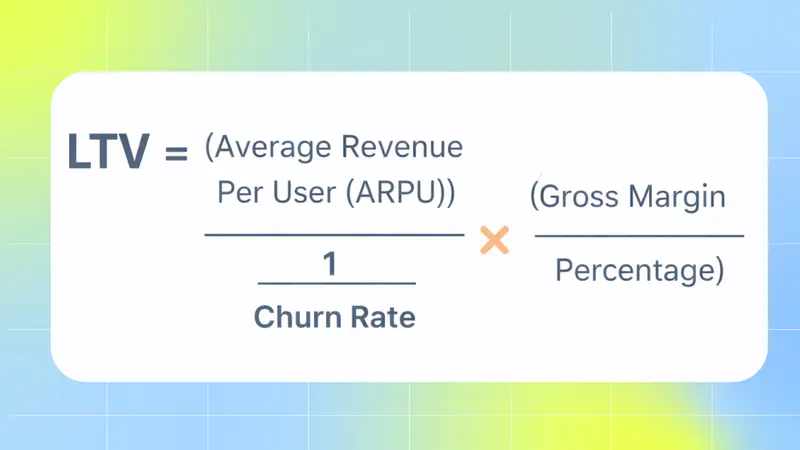
LTV = (Average Revenue Per User (ARPU)) x (1 / Churn Rate) x (Gross Margin Percentage)
Tracking LTV helps you identify your most valuable customer segments and build retention strategies around keeping them engaged. If you're not monitoring LTV by cohort, you're flying blind.
Key Metrics Influencing LTV in Subscription Businesses
Three metrics drive LTV in subscription models: retention rate, churn rate, and average revenue per user (ARPU).
Retention rate measures how many subscribers you keep over time. High retention extends the average customer lifespan, which directly boosts LTV. Improving retention by 10% can multiply LTV significantly, sometimes doubling it.
Churn rate is the flip side. It's the percentage of subscribers who cancel in a given period. Lower churn means users stay longer, which means more revenue per user. Even small improvements here compound fast.
ARPU reflects how efficiently you're monetizing each subscriber. Upsells, cross-sells, and premium tier upgrades increase ARPU. For example, a user on a $10/month plan who upgrades to $20/month just doubled their ARPU contribution.
You should also track subscription length and engagement frequency. These signal whether users are getting value and are likely to renew. The goal is to identify weak points in your funnel and use creative strategies to address them.
The Role of Creative Patterns in Driving LTV Growth
Creative patterns influence LTV by shaping how users experience your product. The right patterns boost engagement, reduce friction, and create moments that encourage users to stay longer and spend more.
What works:
Personalized experiences that adapt to individual user behavior
Timely upsell prompts triggered by specific actions (like hitting usage limits)
Gamification elements that create habit loops and reward consistency
For instance, behavior-triggered upgrade offers can increase conversion rates by showing users the value of premium features exactly when they need them. Progress milestones, like "You've completed 10 workouts this month!", keep users motivated and reduce churn.
These aren't just nice-to-haves. When you map creative patterns to user lifecycle stages and continuously test variations, you directly impact ARPU and retention, the two levers that control LTV.
Want to see which acquisition creative patterns bring in your highest-LTV cohorts? Segwise's AI-powered creative analytics help UA and Growth teams identify which ad creative elements actually drive high-LTV users, by linking creative tags from 10+ ad networks directly to post-install revenue and retention data from your MMP/data warehouse.
Examples of Effective Creative Patterns in Subscription Apps
Spotify: During onboarding, Spotify asks users about their music preferences and immediately serves personalized playlists. This early customization increases engagement from day one, reducing the likelihood of early churn. Users who feel the product "gets them" stick around longer.
Netflix: When users approach their viewing limit on a lower-tier plan, Netflix surfaces a well-timed upgrade prompt highlighting the benefits of the next tier (more screens, HD quality, etc.). This isn't random, it's triggered by usage behavior, making the offer relevant and increasing conversion rates.
Duolingo: The language-learning app uses streak mechanics and daily reminders to create a habit loop. Users who maintain streaks are far less likely to churn because they've invested time and effort into their progress. Gamification isn't just fun, it's a retention strategy.
These examples show that creative patterns work when they're tailored to user behavior and lifecycle stage. To replicate this success, you need to test different approaches, track what resonates with your audience, and iterate based on real data.
Applying Creative Patterns to SaaS and Subscription Apps

How to put creative patterns into practice:
1. Tailor onboarding to user needs
Don't give every new user the same generic tour. Segment users based on signup data (job role, company size, use case) and adapt your onboarding flow accordingly. A marketing manager and a developer need different onboarding experiences.
2. Use behavior-triggered upsell prompts
Wait until users hit a natural upgrade moment, like reaching a usage limit or unlocking a new feature, then present a relevant upsell offer. Timing is everything. A prompt that makes sense today will feel intrusive if shown too early.
3. Embed gamification elements
Progress bars, achievement badges, and milestone rewards create positive reinforcement loops. For example, a project management SaaS might celebrate when a user completes their first 10 projects, subtly encouraging continued engagement.
4. Test and iterate regularly
Creative patterns aren't one-size-fits-all. What works for one segment might not work for another. A/B test different messaging, timing, and design variations to find what actually moves the needle for your audience.
By embedding creativity into the subscription experience, you reduce churn and turn casual users into loyal, high-value subscribers who engage more and spend more over time.
Optimizing Subscription Marketing Campaigns for Better Retention
Retention-focused marketing campaigns extend LTV by keeping subscribers engaged beyond their initial signup.
Personalize messages based on user behavior
Segment your email campaigns by user activity. Send different messages to power users, casual users, and at-risk users. A power user doesn't need a "getting started" email, they need advanced tips or exclusive features.
Time communications strategically
Send renewal reminders, usage summaries, or exclusive offers at key moments, like a few days before a subscription renews or when a user hasn't logged in for two weeks.
Offer exclusive content or rewards to loyal subscribers
Give long-term subscribers early access to new features, discounts, or premium content. Rewarding loyalty makes users feel valued, which directly impacts retention.
Use segmented campaigns to address pain points
If you notice a segment of users consistently churn after three months, build a targeted campaign that addresses common friction points at that stage. Maybe they're hitting a feature paywall or don't understand advanced functionality.
For example, sending a tailored discount or educational content right before a renewal can significantly reduce churn. Regularly analyze campaign performance and A/B test creative elements to ensure your messaging resonates and drives continued engagement.
Measuring Success and Continuously Optimizing Growth Strategies
Measuring performance is essential for refining your approach and maximizing LTV.
Focus on these key metrics:
Churn rate: How many subscribers are you losing each month?
Retention rate: How many are you keeping?
ARPU: How much is each subscriber worth?
Upgrade frequency: How often do users move to higher-tier plans?
Use A/B testing to compare creative patterns, messaging, and campaign strategies. Identify what resonates best with your audience. Regularly analyze data from your subscription management tools to spot trends and at-risk users.
Optimization is iterative. You adjust messaging, pricing, and engagement tactics based on insights. For example, if you notice users who receive a personalized onboarding email are 20% more likely to upgrade, you double down on that tactic.
Continuous measurement and agile adjustments ensure sustained LTV growth over time.
Emerging Trends and the Future of Subscription Marketing and LTV Growth
AI-driven personalization is enabling hyper-targeted campaigns that predict churn and optimize upsell timing with unprecedented accuracy. Instead of broad segments, you can now personalize at the individual user level.
Omnichannel experiences across apps, email, SMS, and social media boost engagement and retention by meeting users where they are. The more touchpoints you own, the stickier your product becomes.
Flexible, usage-based pricing is gaining traction as an alternative to traditional tiered subscriptions. This model caters to diverse customer needs and can increase ARPU by aligning pricing with value delivered.
Sustainability and ethical marketing are no longer optional. Users increasingly care about brand values, and trust drives long-term loyalty, which directly impacts LTV.
To stay competitive, adopt these trends early. Continuously innovate your creative patterns, leverage data-driven strategies, and prioritize delivering real value at every stage of the customer lifecycle.