The 7 Essential Ad Testing Platforms for Scaling UA in 2026

Creative is the core of modern user acquisition. But a successful ad testing strategy is more than just running A/B tests: it’s about establishing a system that automates the execution of tests and accelerates the intelligence derived from them.
The sheer volume of creative variations needed to fight platform saturation and creative fatigue requires dedicated, often AI-powered, platforms. Performance marketers, UA managers, and creative strategists can no longer rely on manual spreadsheet analysis to keep up with the demands of Meta, TikTok, and Google.
Key Takeaways
Ad Testing is a Two-Part Stack: The highest ROAS gains come from pairing an Execution tool (for test launch speed) with a Creative Intelligence platform (to learn the why quickly).
AI Tagging is Non-Negotiable: To accelerate analysis, look for platforms like Segwise that use multimodal AI to automatically tag elements across Meta, TikTok, and Google. This not only eliminates manual spreadsheet work but also enables element-level insight mapping that's impossible to do at scale manually.
The Why is Cross-Platform: Top-tier platforms must unify performance data from all major ad networks and all major MMPs (AppsFlyer, Adjust, Branch, Singular) to find universal creative insights.
Test Velocity is Key: Execution platforms like Marpipe help you launch 10-100x more statistically valid tests than manual processes, allowing you to find new winners faster than your competition.
Focus on Post-Install KPIs: The ultimate measure of a successful ad test is ROAS and retention, not just CPA. Use tools that connect creative analysis to these deep-funnel metrics.
What is Performance Ad Testing?
At its core, performance ad testing is the scientific method applied to paid media. It involves systematically varying specific creative components, such as the hook, the character, the call-to-action (CTA), the background music, or the headline, to isolate which element drives the highest return on ad spend (ROAS) or lowest cost per acquisition (CPA).
The goal is to move beyond testing "Ad A vs. Ad B" to testing "Hook 1 vs. Hook 2" regardless of the final ad wrapper.
The Ad Testing Challenge for Practitioners
For performance marketers, the challenge is no longer can we test, but how fast can we learn? The core problems in the modern UA process include:
Creative Fatigue: High-performing creatives burn out faster than ever, forcing teams to maintain a relentless testing velocity to find the next winner.
Manual Analysis Bottleneck: The time spent manually tagging creative elements in spreadsheets and linking them to platform data and MMP metrics often exceeds the time spent designing new creatives.
Siloed Data: Ad performance data (clicks, impressions) is stuck in the ad network, while crucial deep-funnel KPIs (ROAS, retention) are locked away in the Mobile Measurement Partner (MMP) or internal databases.
Closing the Feedback Loop: Creative teams rarely get clean, element-level data explaining why an ad won, resulting in generic briefs and iterative guesswork instead of data-backed production.
The Solution: A Dedicated Ad Testing Stack
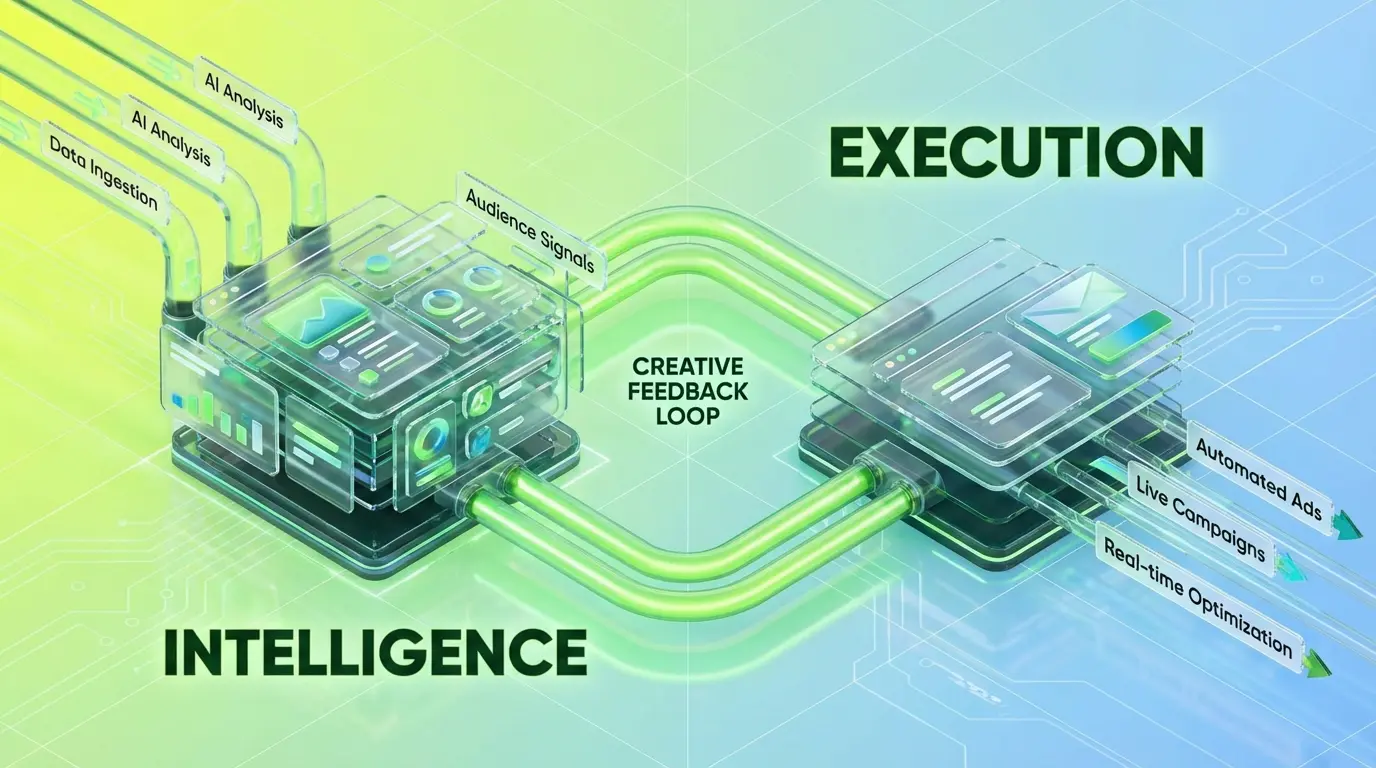
The solution is to adopt a two-part tech stack:
Creative Intelligence Platforms: These are the "brains" that analyze test results, automate element tagging, detect fatigue, and unify full-funnel data to tell you why an ad won.
Creative Execution Platforms: These are the "engines" that automate the generation of ad variations (using AI or templates) and launch complex multivariate tests at scale.
This guide breaks down the 7 essential platforms that allow teams to stop manually sifting through data and start scaling winning creative concepts.
Category 1: Creative Intelligence Platforms (The Test Analysis and Learning Layer)
These platforms provide the most crucial component of the ad testing cycle: turning raw performance data into actionable, element-level insights. They are built for media buyers and creative teams to quickly answer the question: "Which specific creative elements (hooks, colors, CTAs) should we reuse in the next iteration?"
1. Segwise: AI-Powered Creative Intelligence for Full-Funnel Testing
Segwise is an AI-powered creative intelligence platform built specifically to close the feedback loop for mobile game studios, DTC brands, subscription apps, and performance marketing agencies. Its core job is to accelerate ad testing by automating the most time-consuming step: analysis and learning.
Key Features
Multimodal AI-Powered Creative Tagging: Segwise uses advanced AI to automatically analyze and tag elements across four dimensions: video analysis, audio analysis (transcribing spoken dialogue, emotional tone), image analysis, and text analysis (headlines, CTAs). This feature maps every element to full-funnel KPIs (ROAS, retention), helping teams understand the exact reason a test succeeded or failed.
Playable Ad Tagging (Core Differentiator): Segwise is the only platform that tags playable (interactive) ads, analyzing interactive gameplay elements, user engagement patterns, and mechanics that drive installs, a critical feature for mobile gaming ad testing.
Unified, Cross-Platform Data: The platform unifies performance data from all major ad networks, Meta, Google, TikTok, Snapchat, YouTube, AppLovin, Unity Ads, Mintegral, and IronSource, and essential MMPs: AppsFlyer, Adjust, Branch, and Singular. This provides the single source of truth vital for platform-agnostic creative testing.
Proprietary Fatigue Detection: Segwise uses automated, proprietary algorithms to monitor creative performance decline, acting as an early warning system to alert teams before performance tanks, reducing wasted ad spend on tired creatives.
AI-Powered Creative Generation: Segwise goes beyond analysis by providing AI-powered creative generation features that directly use top-performing elements identified by the AI-tagging to quickly produce new data-backed variations. This accelerates creative iteration cycles and is reported to halve creative production time by providing clear, data-driven briefs and creative generations.
Asset Clustering: The platform groups tested creatives that use similar or identical core assets, allowing teams to quickly compare different creative treatments and identify which assets should be reused or retired.
When You Should Try It
Explore Segwise if your team spends significant time on manual creative tagging, runs high volumes of tests across multiple ad networks, or struggles to connect top-of-funnel ad performance to deep-funnel KPIs like ROAS. The platform is designed to provide immediate value for scale-up teams, with reported results including a 50% ROAS improvement and up to 20 hours saved per week, per app/brand on manual analysis.
Also read how Data to Decisions: How AI Creative Insights Drive Hyper-Personalization in DTC
2. VidMob: Full-Service Creative Analysis and Production
VidMob positions itself as an end-to-end Intelligent Creative Platform that connects AI-powered ad testing analysis directly to a managed creative production ecosystem. It is designed to ensure that the learnings from every test are instantly applied to the next round of creative production.
Key Features
Creative Scoring and Benchmarking: VidMob uses proprietary AI to score ad creatives against platform best practices (Meta, TikTok, etc.) before launch, helping teams optimize their tests for success and reducing the likelihood of testing poorly formatted or off-strategy ads.
Granular Element Analysis: Its system breaks down tested creatives into granular components (e.g., pace, duration, on-screen text density) to isolate the exact creative elements causing performance shifts, providing high-fidelity test results.
Integrated Production Workflow: VidMob integrates its analysis directly with its Creative Studio, allowing brands to either work with their own team or instantly connect with VidMob’s network of expert creators who can apply the data-driven insights to new iterations, shortening the creative feedback loop.
Focus on Performance Uplift: The platform is engineered for maximizing campaign KPIs, with customers often reporting significant lifts (up to 30%) by following the platform's test recommendations and integrating its production services.
When You Should Try It
VidMob is an ideal solution for large, global brands and enterprises that need a cohesive, managed solution for ad testing, analysis, and production. If you have a substantial creative budget and need a partner that handles the entire creative feedback loop, from analysis to iteration, VidMob provides the structure and production network to scale your ad tests.
Limitations
The platform is strongly geared toward the enterprise market, and the full value often requires integrating their managed services, which may not be suitable for in-house teams who want full creative control.
Category 2: Creative Execution Platforms (The Test Generation, Launch, and Automation Layer)
These platforms are designed to address the sheer volume required for modern ad testing. They automate the generation of creative variations and the technical labor of launching multivariate test campaigns on ad networks.
3. Marpipe: Scientific Multivariate Testing Automation
Marpipe is a dedicated multivariate testing platform designed to run scientific, large-scale ad tests. Its primary strength is isolating which individual variables (headlines, images, CTAs, colors) impact performance by automating thousands of ad variation combinations.
Key Features
Automated Multivariate Test Launch: Marpipe automatically combines different creative variables into every possible permutation and launches them as structured, segmented test campaigns across Meta (Facebook/Instagram), Pinterest, Snap, and TikTok.
Statistical Significance Analysis: It ensures that test results are statistically valid, determining with confidence which specific creative element, not just which ad, drove the performance change. This is critical for drawing actionable conclusions.
Dynamic Catalog Ad Testing: For e-commerce ad testing, Marpipe is highly effective for automating the testing of different overlays, text, and pricing displays on product feeds and Dynamic Catalog Ads (DPA).
Test Campaign Structuring: The platform handles the tedious manual work of campaign management for testing: campaign setup, audience duplication, budget control, and test duration management.
When You Should Try It
Marpipe is built for high-spend agencies and brands that must maintain an extremely high creative testing velocity and require statistically rigorous results. If you are launching dozens of new tests weekly and need to isolate the impact of individual variables (e.g., the difference between a yellow background and a blue one) to create data-backed creative briefs, Marpipe provides the execution automation you need.
Limitations
Marpipe's focus is test execution; while it provides analysis of the results, many teams pair it with a deeper intelligence tool for granular element-level tagging and full-funnel ROAS mapping. Its analysis is primarily focused on the variable outcome of the test within the ad platform.
4. AdCreative.ai: AI Creative Generation & Prototyping
AdCreative.ai is an AI-powered platform focused on solving the initial production bottleneck for ad testing. It helps small to mid-sized businesses and solopreneurs rapidly generate a high volume of visual ad variations and copy based on its internal database of top-performing assets.
Key Features
AI-Powered Bulk Creative Generation: Users can generate hundreds of high-quality, brand-compliant image and short video ad variations quickly, allowing for immediate high-volume prototyping and testing.
Creative Performance Scoring: The platform uses its internal database of high-performing ads to assign a "Creative Score" to generated concepts. This helps teams prioritize which concepts to test, reducing wasted ad spend on low-potential ads.
Direct Platform Export: Generated creatives are optimized for and can be directly integrated for launching tests on major platforms like Meta and Google Ads.
Audience-Specific Text and Copy Generation: It uses AI to generate ad copy tailored to specific audience segments, facilitating A/B tests on messaging and value proposition.
When You Should Try It
AdCreative.ai is an excellent starting point for lean teams or small agencies that need a massive increase in creative volume without a large design team. If your primary bottleneck is the lack of enough different creatives to test, this platform accelerates the generation phase and provides a constant flow of new hypotheses.
Limitations
The platform operates on a credit-based system, which can limit usage depending on the subscription tier. While it offers a "Creative Score," it is not a deep post-test analytics platform, you must use your ad platform or a dedicated intelligence tool for deep-funnel analysis.
5. Smartly.io: Creative Automation and AdOps
Smartly.io is a powerful AdOps platform primarily focused on automating and optimizing the launch of ad campaigns across major social channels (Meta, Google, Pinterest). It's a key tool for large-scale advertisers who need to run thousands of parallel, dynamic creative tests from a centralized management system.
Key Features
Dynamic Creative Optimization (DCO): Smartly's DCO engine automatically pulls assets from product feeds or asset libraries, assembling and testing thousands of on-brand, tailored ad variations based on real-time campaign rules and audience signals.
Centralized Ad Automation: The platform automates campaign creation, management, budgeting, and optimization, allowing media buyers to focus on analyzing test results rather than managing manual settings.
Image and Video Templates: It provides customizable, feed-based creative templates that allow teams to rapidly spin up variations (testing different text overlays, brand colors, or CTA buttons) across an entire product catalog for quick A/B testing.
Cross-Channel Support: It provides comprehensive management for ad testing on Meta, Google, and Pinterest, allowing for consistent testing structures across primary channels.
When You Should Try It
Smartly.io is for large e-commerce brands, travel companies, and high-volume agencies that require extreme scale and efficiency in their ad testing. If you rely on Dynamic Product Ads (DPA) or need to rapidly run tests across thousands of products using feed-based automation, Smartly is a robust execution partner.
Limitations
Smartly.io is a complex, enterprise-grade AdOps platform. Its core value is in campaign management and automation (AdOps), meaning teams often integrate a dedicated Creative Intelligence platform for the granular, element-level analysis required to inform the next creative brief.
6. Madgicx: AI Ad Management and Creative Suite
Madgicx is a comprehensive AI platform that combines ad account optimization and a creative suite, with a strong focus on the Meta ecosystem. It provides the automation needed to manage budgets, audience testing, and creative rotation simultaneously on the world's largest ad network.
Key Features
AI Media Buyer & Automation: Core features, such as the "AI Marketer" and "AI Bidding," automate budget allocation and bid management. This integrates directly with creative testing by allowing the AI to automatically shift spend toward winning creative variations in real-time.
Creative Suite for Execution: It includes tools for creative generation and a dedicated "Meta Creative Tracker" to monitor ad performance and automate the rotation and scaling of winning assets within the testing structure.
AI Chat for Test Diagnostics: Users can ask the conversational AI about test results (e.g., "Which audience/creative combination performed best in the last 7 days?"), providing immediate, data-backed answers without manual reporting.
Consolidated Reporting (Meta-Focused): It provides real-time, consolidated reporting, pulling in data from Meta, Google Ads, and TikTok, with a heavy emphasis on Meta attribution and optimization.
When You Should Try It
Madgicx is best for e-commerce brands and agencies who are scaling heavily on Meta and want to consolidate their campaign management, bidding optimization, and creative testing workflow into a single platform. If your priority is to put your ad testing on autopilot within the Meta ecosystem, Madgicx offers a robust all-in-one solution.
Limitations
While it integrates other platforms, its deep optimization features are not as extensive for channels outside of Meta. For UA teams focused on a truly balanced, omnichannel strategy across all platforms (Meta, Google, TikTok), an external, channel-agnostic intelligence tool will be required for consolidated learning.
7. Google Analytics 4 (GA4): Essential Post-Conversion Testing
While not a dedicated creative intelligence platform, Google Analytics 4 (GA4) is an essential, free tool in the ad testing stack. It serves as the definitive source of truth for post-click and post-install behavior, which is critical for measuring the quality of traffic generated by an ad test.
Key Features
Custom Event Tracking: GA4 allows performance marketers to define and track custom conversion events (e.g., high-value actions, funnel progression, retention rate) beyond basic ad network reports. This is essential for validating ad test success.
Engagement Metrics: It provides crucial metrics like engaged sessions, average engagement time, and user-level lifetime value, enabling teams to test which creatives drive high-quality traffic, not just high-volume clicks.
Attribution Modeling: Users can apply various attribution models (data-driven, linear, time decay) to test and understand how different creative touchpoints influence the final conversion.
Cross-Device and Cross-Platform Measurement: GA4 allows for a more unified view of user journeys across devices and web/app, which is invaluable for testing campaigns that span YouTube, Search, and Display.
When You Should Try It
GA4 is non-negotiable for all performance marketers. It should be used in conjunction with dedicated creative intelligence tools to validate their findings with first-party post-conversion data. If you are only running tests based on platform-reported CPI/CPA, you need GA4 to track the quality of that traffic and ensure your test winners are actually high-value customers.
Limitations
GA4 requires a dedicated creative intelligence platform (like Segwise) to connect creative assets and tags to its custom events automatically. Without this integration, the manual process of linking creative name (from the ad network) to custom events (in GA4) remains a massive bottleneck.
Building Your Ad Testing Stack: A Decision Framework
Choosing the right platform is less about finding the "best" tool and more about identifying your team’s biggest bottleneck in the creative testing cycle.
Actionable Demo Checklist for Creative Intelligence:
When evaluating a dedicated Creative Intelligence platform for your ad testing strategy, ensure you check for these non-negotiable capabilities:
AI Tag-to-KPI Mapping: Ask the vendor to demonstrate the ROAS difference between two distinct creative elements (e.g., comparing an "unboxing" visual style tag vs. a "gameplay demo" tag) in real-time.
MMP Integration Validation: Confirm they seamlessly pull deep-funnel metrics (ROAS, retention, Custom Events) from all your MMPs (AppsFlyer, Adjust, Branch, Singular) and connect it back to the ad creative.
Fatigue Detection: Ask for a live demonstration of how the platform provides an early warning alert on an ad set that is about to drop below a target CPI/CPA threshold.
Historical Data Ingestion: Ask how quickly the system can integrate your ad accounts (Meta, TikTok, Google) and import historical data (e.g., 90 days of performance) to establish immediate benchmarking for your current ad tests.
Conclusion
The era of manual creative tagging and siloed reporting is over. The path to sustained, scalable growth in performance marketing now runs directly through an automated, intelligent ad testing process. This requires moving beyond simple ad platform reporting to a dedicated technology stack.
The ability to look at a creative, see its elements automatically tagged and mapped to downstream metrics (like ROAS and retention), and get clear recommendations on what to test next is the competitive advantage you need.
Platforms like Segwise integrate the entire intelligence and learning process, from unifying your data across all ad networks and MMPs, to providing AI-powered element analysis (even for playable ads), and giving early warnings on creative fatigue.
Stop asking what the next test should be. Start asking why your last test performed the way it did, and use the answer to inform your next round of winning creatives.
If you’re ready to unify your creative data, eliminate manual tagging, and save your team up to 20 hours per week on analysis, book a demo to see how Segwise can deliver deep, data-driven creative briefs for your next iteration.
Frequently Asked Questions
Q. What is a "multivariate" ad test, and why do I need a platform for it?
A multivariate ad test simultaneously tests multiple creative elements (e.g., three headlines, three images, and three CTAs) in every possible combination. This would result in 3 x 3 x 3 = 27 unique ads. Manual setup is error-prone and time-consuming. Platforms like Marpipe and Smartly.io automate the creation and launch of these complex structures to scientifically isolate which single element is responsible for the performance uplift.
Q. How does AI-powered tagging accelerate the ad testing cycle?
A. AI-powered tagging automatically analyzes the actual content of the creative (e.g., transcribing audio, recognizing colors, identifying objects) and applies descriptive tags (e.g., "fast-paced hook," "user-generated content," "red CTA"). This eliminates the need for manual, spreadsheet-based tagging, allowing performance data to be instantly grouped and analyzed by creative element. This dramatically reduces analysis time from days to minutes.
Q. Do I need to integrate my MMP (AppsFlyer, Adjust, Branch, Singular) with my ad testing platform?
A. Yes, absolutely. Ad networks only report top-of-funnel metrics like clicks and installs. To understand if a creative test actually drove value, you must connect the creative element tags to deep-funnel KPIs like ROAS, retention rate, and LTV, which reside in your MMP. Platforms like Segwise are purpose-built to integrate with all major MMPs to ensure this full-funnel analysis.
Q. What is creative fatigue detection, and how does it help with testing?
A. Creative fatigue occurs when your ad’s performance declines rapidly due to over-saturation in your target audience. Creative fatigue detection uses proprietary algorithms to monitor key metrics (like CTR decline, CPI, and frequency) and provides an early warning alert before the creative’s performance tanks completely. This automation allows you to proactively swap out exhausted creatives with new test variations, ensuring your testing budget is spent on fresh concepts.
Q. What is the difference between a Creative Automation platform and a Creative Intelligence platform?
A. Creative Automation (e.g., Smartly.io, Madgicx) focuses on the execution side: speeding up the production of variations (often via templates and feeds) and automating the technical setup and optimization of ad campaigns. Creative Intelligence (e.g., Segwise, VidMob) focuses on the learning side: unifying cross-platform data, applying AI-tagging, and providing element-level insights on why a test succeeded or failed, to inform the next creative brief.
Q. Is GA4 effective for testing creative elements?
A. GA4 itself is not designed to analyze creative elements. It measures the quality of the traffic after the click, which is crucial for determining if a creative test was truly successful (e.g., did the creative drive a high-value customer?). You must use a Creative Intelligence platform to connect the specific creative element (e.g., the CTA button color) to the high-value custom events tracked in GA4.
Q. How do Ad Testing Platforms help mobile game studios specifically?
A. For mobile game studios, the biggest challenges are analyzing playable ads and connecting creative to retention/ROAS. Platforms like Segwise address this by being the only solution that tags playable (interactive) ads, analyzing mechanics and user engagement patterns, and unifying all data with MMPs (AppsFlyer, Adjust, Branch, Singular) to ensure test winners are actually profitable.