
A top-performing video ad follows a five-act structure: hook in the first 0 to 3 seconds, context in 3 to 7 seconds, reveal or demo from 8 to 20 seconds, social proof from 20 to 25 seconds, and a hard CTA after 25 seconds. For UA managers and creative strategists, that means every frame is doing a specific job, and the channel-specific retention curve tells you when the job is failing.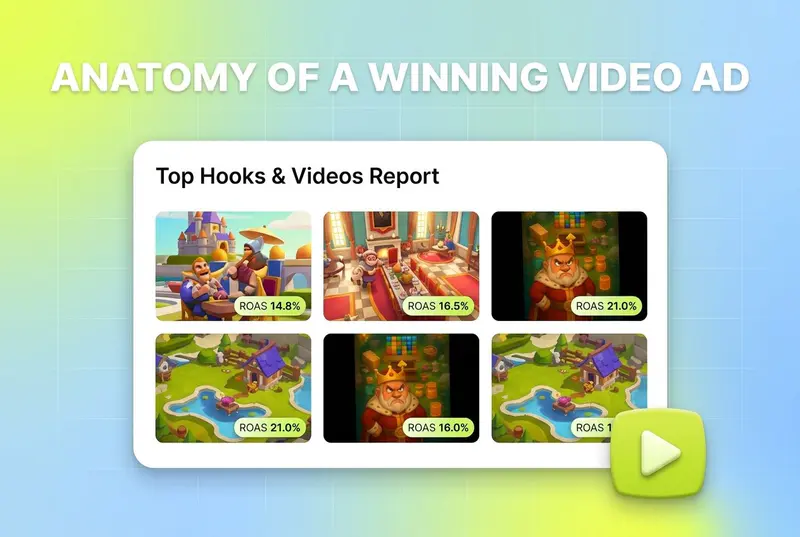
Introduction
Most video ads die before they get a chance. According to research 73% of ecommerce video ads fail within the first three seconds because they look like ads. That number is brutal but it is also useful, because it tells you exactly where to spend your creative budget: the opening frames, then the payoff, then the close.
This piece is a frame-by-frame breakdown of what winning Meta, TikTok, and YouTube Shorts video ads actually do. We pulled apart hundreds of long-running creatives, cross-referenced them with retention curve data from Meta's ThruPlay reporting and TikTok's Video Insights, and mapped the patterns into a five-act structure you can copy.
The goal is not to be prescriptive. Plenty of winners break the rules. But the rules exist because the underlying psychology, pattern interruption, curiosity gaps, and social validation, is consistent across platforms. If you understand the structure, you can iterate faster on the parts that matter and stop rebuilding the wheel every campaign.
Also read How to Track Competitor Ads on Meta: A 2026 Guide
Key takeaways
63% of successful TikTok ads convey their core message in the first 3 seconds, and videos with above 65% retention at the 3-second mark earn 4 to 7 times more impressions, according to Keevx's frame-by-frame analysis.
A solid Meta hook rate sits at 25 to 30%, with elite creatives pushing past 40%, while TikTok benchmarks run higher: 30 to 35% baseline, 40%+ elite, per Vaizle's hook rate benchmarks.
82% of viral short-form videos follow the same three-part skeleton: hook, payoff, and loop, according to Keevx.
Direct-address creative converts 33% better than voice-over only, and 51% of viral videos feature someone speaking straight to camera (Keevx).
UGC-style ads see 4x higher click-through rates and 50% lower CPC than polished brand creative, per Hoox's UGC format study.
The five hook patterns that survive past 14 days of active spend on Meta are question, bold stat, before/after, curiosity gap, and problem-agitation, according to Adligator's analysis of long-running creatives.
The 5-act structure of a top-performing video ad
After analyzing winning Meta and TikTok creatives across DTC, gaming, and subscription apps, the same five-act structure shows up again and again. Each act has a specific job. If any one of them misses, the retention curve drops and the algorithm punishes you with higher CPMs.
Here is the structure at a glance:
Each act maps to a specific psychological state. The hook breaks the scrolling pattern. Context creates relevance. The reveal closes the curiosity gap. Social proof reduces purchase friction. The CTA gives action shape. Skip any one and the chain breaks.
The structure is not rigid. A 15-second TikTok might compress acts 2 and 3 into the same beat. A 60-second YouTube Short might extend the demo to 30 seconds. But the order, hook then context then payoff then validation then ask, holds across platforms.
Act 1: The hook (0 to 3 seconds)
The first three seconds decide everything. According to Adligator's analysis of Meta creative, your ad has roughly 1.5 seconds to survive the scroll. That means the hook is not a warm-up, it is the entire pitch compressed into a single beat.
The five hook patterns that work
Five hook patterns consistently appear in long-running, profitable Meta and TikTok ads. These are not theoretical, they are pulled from creatives that have been spending past 14 days of active budget, which is a strong filter for profitability.
1. The question hook. Opens with a direct question that mirrors the audience's internal monologue. Examples from Adligator: "Still boosting posts and wondering why your ROAS is flat?" or "Is your CPM climbing and you don't know why?" Questions activate the brain's pattern-completion instinct, and viewers start mentally answering before they consciously decide to engage.
2. The bold stat hook. Leads with a specific, surprising number. "67% of ad budgets are wasted on creatives that never get tested properly." Specificity creates credibility, surprise creates curiosity. The two together flag the ad as worth a second glance.
3. The before/after hook. Shows a transformation, either visually or in copy. Side-by-side cluttered desk versus organized workspace, or "Last month: $12 CPA. This month: $4.80." Before/after is the most intuitive proof format because the value proposition lands without reading a paragraph.
4. The curiosity gap hook. Creates an information gap that needs closing. "There's one targeting setting most advertisers never check, and it's costing them 20% of their budget." This relies on the Zeigarnik effect, the brain's compulsion to seek closure on open loops.
5. The problem-agitation hook. Names a pain point and intensifies it. "Your competitor just launched 15 new creatives this week. You launched one." Problem-agitation pushes viewers from passive scrolling into active problem-solving mode, which is exactly where you want them when the CTA lands.
Visual hook techniques that stop the thumb
Beyond copy, the visual treatment in those first three seconds matters as much as the words. It wasfound that the highest-converting hooks rely on a small set of visual techniques:
Pattern-interrupt props like a post-it note covering the product, then peeled away to reveal it. Or a sunglasses reflection with the key message displayed on a laptop screen behind the creator.
Reverse drop effects where the creator drops the product, then the footage reverses so it flies back into their hand. Physics-defying moments create instant intrigue.
Multi-screen self conversation where the creator talks to themselves across three different screens. Works for service-based businesses without a physical product.
Negative comment overlays where a critical TikTok comment ("Those seem so extra") gets pasted on screen, then the creator responds. Negativity psychology drives engagement above positive openings by roughly 2x, per Keevx.
The common thread: every effective hook breaks an expected visual pattern. Your brain is pattern-matching at a million frames per second when scrolling, so anything unexpected, a reversed clip, an unusual angle, a prop that does not belong, registers as worth a second look.
The hook rate target
Hook rate is the percentage of impressions that watch past the 3-second mark on Meta, or the 2-second mark on TikTok. The formula:
Hook rate = 3-second video views ÷ impressions × 100
According to Vaizle's benchmarks, the targets per platform are:
If your hook rate is below baseline, the issue is the first three seconds. Body content quality, offer strength, and CTA design all become irrelevant until the hook earns the next second of attention.
Act 2: Context (3 to 7 seconds)
Once the hook stops the scroll, you have roughly four seconds to establish why the viewer should keep watching. This is the "why is this relevant to me" beat, and it is where most ads quietly bleed retention.
According to Keevx's frame-by-frame breakdown, the 3 to 7 second window does three things:
Establishes the problem or promise. "Your sleep is wrecked because your mattress is too firm" or "Most people think they need to spend more on ads, but the issue is creative volume."
Builds anticipation for the payoff. The viewer needs to feel that the next 10 seconds will resolve something specific.
Maintains visual variety. Cuts every 2 to 3 seconds prevent the brain from settling and scrolling.
The most effective context beats use a clear cause-and-effect statement that mirrors how the audience already thinks about the problem. Vague openings like "Welcome to my video" or "Today I'm going to talk about..." kill retention because they take the viewer out of the curiosity state the hook just created.
Text overlays for muted viewing
According to Keevx's analysis of viral TikTok ads, 63% of top-performing auction ads use text in the first frame. This is non-negotiable because most Meta and TikTok viewers watch with sound off by default, and a hook that depends on audio loses them silently.
The rule: large, animated text in the center of the frame, not subtitles at the bottom. Bottom subtitles get cut off in 9:16 placements when the platform overlays the username and caption, and centered text is harder to ignore.
Act 3: Reveal and demo (8 to 20 seconds)
Seconds 8 to 20 are the payoff. This is where the curiosity gap closes and the viewer either commits to the rest of the ad or exits. According to Keevx, this window does the heaviest lifting in viral creative because it has to deliver the promised value, show transformation or demonstration, and maintain visual pacing all at once.
What good payoff frames look like
The strongest payoff sequences fall into three categories:
1. Product demonstration. The creator uses or applies the product on camera. Beauty: applying concealer with a tomato cutout (the absurd demo Motion documented). Productivity tools: a side-by-side of the cluttered versus organized workspace. Software: a screen recording of the product solving the named problem.
2. Transformation reveal. The before-and-after format gets compressed into 12 seconds. Skin before, skin after. Workspace before, workspace after. Cart before, cart after. The visual transformation is the proof.
3. Demo plus narration. The creator demonstrates while explaining, with the audio carrying the value proposition and the visuals carrying the emotional weight. This works best for SaaS and subscription apps because the screen recording alone is not visually compelling without context.
The hold rate target
If hook rate measures the first 3 seconds, hold rate measures whether the body content earns continued attention. The formula on Meta:
Hold rate = ThruPlays ÷ 3-second views × 100
According to Vaizle's data, the Meta hold rate targets are 40 to 50% for solid creative, and elite creatives push past 60%. On TikTok, the proxy is 6-second focused-view rate divided by 2-second views, with strong performers at 60% plus.
A common pattern: high hook rate, low hold rate. That means the hook is doing its job but the payoff is missing or unclear. The fix is almost always tightening seconds 8 to 20, not redoing the hook.
Understanding which hook, context, and demo patterns drive your wins
This is where most teams hit a wall. You can read every framework, study every benchmark, and still not know which specific patterns are working in your account. Generic best practices do not tell you whether your top creatives win because of UGC delivery, a specific hook style, a particular voiceover tone, or a CTA placement.
Segwise's multimodal AI tagging analyzes your top-performing videos frame by frame, extracting hook patterns, scene pacing, voiceover style, on-screen text, and CTAs. The Creative Tagging Agent processes video, audio, image, and text together, so the analysis covers every modality the ad uses to communicate.
The "anatomy of YOUR best-performing video" is queryable in AI Chat. You can ask things like "which hook style drove the most installs last month?" or "what's different about my top 5 creatives versus my bottom 5?" and get a direct answer that pulls from your tag-to-metric mapping. No spreadsheet work, no manual review of 200 ads.
Act 4: Social proof (20 to 25 seconds)
By second 20, the viewer either gets the value or they have already scrolled. The 20 to 25 second beat is for the viewers who are still there but undecided. This is the social proof window, and its job is to reduce the friction between intent and action.
The most effective social proof patterns observed in Trendtrack's analysis of high-spend creatives:
Influencer testimonial integration. Fiido's electric bike ad opened with creator Kerllenrego's genuine excitement, and reached 2.1 million people on $18K spend. The hook works because it feels like a friend sharing a discovery.
Multi-creator mashup. Three to five creators with the product in rapid succession. Social proof amplification through diverse representation.
User-generated unboxing. Mystery Shirt in a Box opened with an unboxing reaction: "I can't believe that this is the shirt I got. I've heard so many good things about this company." 2 million views on $18K spend.
Authority validation. Notion ran an ad featuring Cursor's CEO stating that AI-native tools are a competitive advantage. Authority figures reduce purchase friction by signaling that other smart people have already evaluated the product.
The unifying principle: social proof works when it feels native, not scripted. Polished testimonial ads with B-roll cutaways and matching brand colors do worse than a creator filming on their phone in a kitchen.
Why UGC outperforms polished brand video
According to Hoox's analysis, UGC ads see 4x higher click-through rates than traditional ads, and the cost per click is 50% lower. The reason is parasocial trust. When 51% of viral videos feature someone speaking directly to camera (Keevx), and those creatives convert 33% better than voice-over only, the lesson is that human presence reduces the perceived distance between brand and buyer.
For Meta in particular, UGC formatted creative tends to look native in the feed because Meta's feed is mostly UGC. A polished commercial-style ad signals "this is an ad" before the first second is over, and the scroll-past rate climbs.
Act 5: The CTA (25 seconds and beyond)
The CTA is where intent converts to action. According to Koro's analysis of UGC ad CTAs, the ideal CTA length is 3 to 5 seconds, long enough to be read and understood, short enough to maintain pacing.
The best-performing UGC ad structure follows what Koro calls the Direct Response formula: hook, problem, solution, value prop, social proof, then a clear CTA that tells the viewer exactly what to do next.
CTA copy patterns that convert
The CTAs that work in 2026 share three traits:
Specific verb plus tangible outcome. "Try for free" or "Discover the offer" beats "Learn more" because the action is concrete. Vague CTAs leak intent.
Friendly recommendation tone. UGC CTAs that sound like advice from a friend ("seriously, just try it") outperform sales-style CTAs because they match the rest of the creative's tone.
Visual prominence at the right time. The CTA needs to be on screen for at least 3 seconds with high contrast text. If it flashes for one second over a busy frame, viewers miss it.
Platform-specific CTA placement
Different platforms reward different CTA timing:
TikTok. CTA at the end with a verbal call ("link in bio" or the in-app CTA button), reinforced by on-screen text in the final frame.
Meta Reels. CTA visible from second 20 onward, with the link in the description for non-clicking viewers.
YouTube Shorts. CTA in the last 5 seconds, often as a card overlay or end screen.
Meta Feed video. CTA in the description and as a button below the video, reinforced verbally at second 20 to 25.
Retention curve targets per channel
Each platform has a different scrolling speed, viewer attention budget, and algorithmic reward structure. The retention curves reflect that, and your benchmarks should adjust accordingly.
TikTok retention curve
According to Retensis's TikTok benchmarks, the average retention rate across all TikTok content in 2026 sits at 40 to 50% of total video length. For TikToks under 15 seconds, the average is 60 to 70%, with strong performance above 75% and exceptional above 85%.
The key thresholds:
3-second retention: 65%+ for strong creative, below 65% means the hook needs work.
6-second retention: 50%+ for solid hold.
Completion rate: 25%+ for short-form, 15%+ for 30-second creatives.
Videos maintaining 70 to 85% retention in the first three seconds receive 2.2 times more impressions than videos with lower early retention, per Retensis. The algorithmic compounding is real, and that is what makes the hook so leveraged.
Meta retention curve
Meta benchmarks come from Vaizle's hook rate and hold rate analysis:
Hook rate (3-sec views ÷ impressions): 25 to 30% baseline, 30 to 40% good, 40%+ elite.
Hold rate (ThruPlay ÷ 3-sec views): 40 to 50% baseline, 60%+ elite.
Average watch time: roughly 1 minute on Facebook for in-feed video, with most users watching only the first few seconds.
The compounding effect on Meta is similar to TikTok. According to Vaizle, strong hold rate translates into lower CPMs over time because Meta's auction rewards engagement signals.
YouTube Shorts retention curve
According to short-form video benchmarks, YouTube Shorts performance peaks at 50 to 60-second video lengths, averaging 4.1 million views for top-performing creators. YouTube Shorts engagement runs around 5.9%, the highest of any short-form platform.
Retention targets:
3-second retention: 70%+ for ads, given YouTube's relatively higher attention budget.
Average view duration: 30 to 35 seconds for 60-second creatives.
CTR on end-screen CTA: 2 to 3% for solid creative.
Channel-by-channel summary
If your retention curve drops below the channel-specific baseline at any beat, the failure point is in the corresponding act. Below 30% at 3 seconds is a hook problem. Below 50% at 10 seconds is a context or reveal problem. Below 25% at 25 seconds is a CTA problem.
Pulling it together: how to audit your top performer
The fastest way to apply this framework is to take your single best-performing video creative and run it against the five-act structure. For each act, ask:
Hook (0 to 3s): Which of the five hook patterns does it use? Is it pattern-interrupting in both video and audio?
Context (3 to 7s): Is there a clear problem statement or relevance signal? Is on-screen text present?
Reveal (8 to 20s): Does the demo or transformation happen visually, or only verbally?
Social proof (20 to 25s): Is there native-feeling validation, or does it skip this beat entirely?
CTA (25s+): Is the action specific, on-screen for at least 3 seconds, and reinforced verbally?
Once you have that breakdown for your top performer, you have the template. The rest of the work is producing variations that hold the same five-act skeleton while changing one variable at a time, the hook style, the demo angle, the social proof source.
Why one-variable-at-a-time matters: If you change the hook AND the demo AND the CTA in your next variation, you cannot tell which change drove the performance lift or drop. Asset clustering helps isolate the variable that actually moved the needle.
Conclusion
A top-performing video ad is a five-act sequence where each act has a job and a measurable failure signal. The hook stops the scroll in the first three seconds. Context establishes relevance by second seven. The reveal pays off the curiosity gap by second twenty. Social proof validates the offer. The CTA converts intent. Skip any act and the retention curve drops, the algorithm punishes the creative, and the CPMs climb.
The retention curve is not an abstract metric. It is a frame-by-frame report card that tells you exactly which act of your ad is working and which is not. Once you can read the curve, the question shifts from "is this ad good?" to "which beat is dragging it down?" That is a much more actionable question.
The teams pulling ahead in 2026 are the ones who stop treating creative as a black box. They tag their top performers at the element level, query their data to find the patterns, and iterate on the specific beats that move the needle. If you want to see exactly which hook patterns, voiceover styles, and CTAs are driving your highest ROAS, explore how Segwise's AI-powered creative intelligence platform maps every frame to performance and saves your team 20+ hours per week on creative analysis.
Frequently asked questions
What is the structure of a top-performing video ad?
A top-performing video ad follows a five-act structure: hook in the first 0 to 3 seconds, context from 3 to 7 seconds, reveal or demo from 8 to 20 seconds, social proof from 20 to 25 seconds, and CTA after 25 seconds. According to Keevx, 82% of viral short-form videos follow this hook-payoff-loop skeleton. Tools like Segwise tag each act of your top creatives so you can see which beats drive performance.
What does this mean for UA managers running paid social?
For UA managers, the five-act structure is the diagnostic layer for any underperforming creative. If hook rate is below 25% on Meta or 30% on TikTok, the first three seconds need work. If hold rate is below 40%, the body is the problem. If CTR is below 1%, the CTA beat is failing. Segwise's Creative Strategy Agent, alongside tools like Hawky AI and Triple Whale, surfaces which act is leaking retention so you can fix the right thing.
How long should a video ad be on TikTok versus Meta?
TikTok in-feed ads perform best at 15 to 21 seconds, Meta Reels at 9 to 15 seconds, and Meta Feed video at 15 to 30 seconds. YouTube Shorts peaks at 50 to 60 seconds, per short-form video benchmarks. The constant across all platforms is that the hook must land in the first 3 seconds, regardless of total length.
How do I measure if my video ad hook is strong enough?
Hook rate is the cleanest measure. The formula on Meta is 3-second video views divided by impressions, multiplied by 100. According to Vaizle, 25 to 30% is the Meta baseline and 40%+ is elite. On TikTok, the threshold is 30 to 35% baseline. Segwise lets you query hook rate by tag, so you can see whether question hooks or stat hooks perform better in your account. Hawky's Copilot answers questions about which hooks and cuts are hurting performance.
What is the difference between a hook and a CTA in video ads?
The hook is the opening beat (0 to 3 seconds) whose only job is to stop the scroll and earn the next second of attention. The CTA is the closing beat (after 20 to 25 seconds) that tells the viewer exactly what to do, "Try for free," "Get the app," "Shop now." Hook earns attention, CTA converts attention into action. According to Adligator, conflating the two by trying to sell in the hook is one of the most common reasons CTRs collapse.
Why does UGC-style creative outperform polished brand video?
UGC ads see 4x higher CTR and 50% lower CPC than traditional brand creative, according to Hoox. The reason is parasocial trust: when a creator speaks directly to camera, viewers feel personally addressed rather than marketed at, which reduces the friction between intent and action. Direct-address ads convert 33% better than voice-over only, per Keevx.
whats a good 3-second retention rate on tiktok ads
For TikTok ads, aim for 65%+ retention at the 3-second mark. Below 65% indicates the hook needs work. Videos that maintain 70 to 85% retention in the first three seconds receive 2.2 times more impressions than videos with weaker hooks, per Retensis. Segwise tracks 3-second retention by hook tag so you can see which opening patterns hit the threshold and which do not.
How many video ad variations should I test per concept?
Top-performing media buyers test 5 to 10 hook variations against a single core ad body, per Adligator. The goal is to isolate hook performance without changing the message or offer. Teams testing 10+ creatives per week reduce CPA by 20 to 40% on average compared to teams testing two or three, according to Hoox.