
For years, the performance marketing loop has been bottlenecked by creative production. Brands know that user-generated content (UGC) drives incredible results, with 79% of consumers saying it highly influences their buying decisions. But commissioning, editing, and scaling human UGC is expensive and slow. The trade-off has always been speed versus authenticity.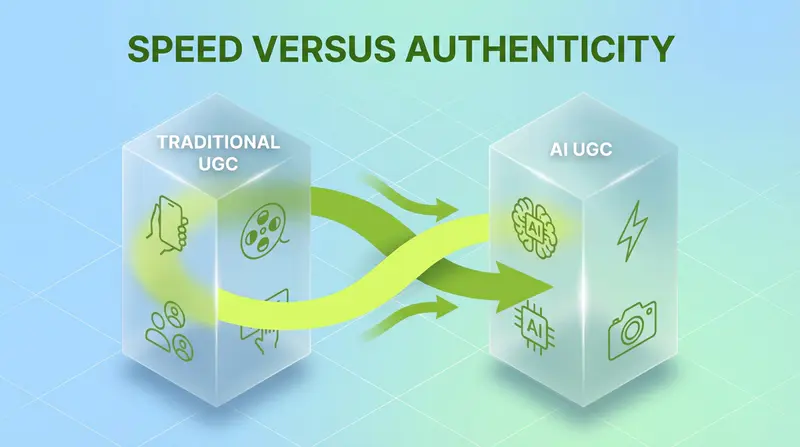
Today, that trade-off is collapsing. The emergence of high-fidelity, Artificial Intelligence-Generated User-Generated Content (AI UGC) is the new framework for creative testing and scaling.
AI UGC is an advanced creative strategy where performance marketers leverage generative AI platforms to create video ads that mimic the authentic, unscripted look and tone of real user-generated content, often using digital avatars or synthetic voiceovers. This fundamentally shifts the performance marketing workflow, allowing teams to generate hundreds of ad variations in minutes, not weeks, and test creative hypotheses at a massive scale that was previously impossible.
The early results are staggering. Brands using AI-powered ad optimization have seen up to a 72% higher Return on Ad Spend (ROAS) and a 47% increase in click-through rates (CTR) on Meta and Google Ads, while cutting cost-per-acquisition (CPA) by 29%.
For performance marketers, creative strategists, and growth leaders, understanding how to leverage the AI UGC workflow and how to manage the deluge of creative data it produces, is no longer optional. It is the core competency that will define the next wave of successful user acquisition.
TL;DR / Key Takeaways
AI UGC is a Scalability Engine: It fundamentally solves the creative bottleneck by allowing the rapid generation of hundreds of ad variations in minutes, enabling marketers to test at an unprecedented scale.
Performance Impact is Measurable: Brands using AI-driven optimization have documented significant lifts in ROAS and CTR by leveraging the speed and personalization capabilities of AI UGC.
The Smart Strategy is Hybrid: The most effective approach uses AI for the rapid, cost-effective testing of variables (hooks, actors, scripts, formats) and then reserves the best-performing data-backed concepts for human creators.
Authenticity and Fatigue are Real Risks: AI UGC can be prone to the "uniformity trap," leading to creative fatigue and consumer skepticism. Maintaining high visual realism and blending AI with real assets is crucial.
Data Analysis Becomes the New Bottleneck: Generating hundreds of variants creates an analysis nightmare. Creative teams must use AI-powered analytics platforms that automatically tag every creative element and map that data directly to core KPIs.
Also read How to Improve ROAS: Top Strategies to Maximize Returns
Why AI UGC is the New Creative Testing Framework
The primary function of AI UGC is not to replace human creativity, but to act as a Creative Velocity Engine. By automating the low-lift, high-volume production of the assets needed for testing, it frees up human creative teams to focus on strategy and high-fidelity production.
The Creative Bottleneck: Speed vs. Cost
Traditional user acquisition (UA) teams face a constant "creative production bottleneck." Producing and optimizing creative assets typically involves designers, video editors, and content creators in a resource-intensive workflow that can take weeks to develop. This process is too slow to keep up with the voracious content consumption of platforms like TikTok and Meta.
AI UGC sidesteps this entirely:
Cost Efficiency: Marketers can cut production costs significantly, with some brands reducing visual production costs to pennies per asset. Switching to AI-generated creators for testing can save thousands of dollars per month compared to human creators.
Speed and Scale: AI UGC platforms allow performance marketers to generate dozens of authentic-looking videos in minutes, creating a fast, controlled, and consistent environment for A/B testing.
Unprecedented Scale: Generating Hundreds of Variants
The core benefit of AI UGC is its ability to scale testing exponentially. Marketers can build a testing matrix with combinations of different variables:
Actors/Avatars: Testing multiple demographics, skin tones, and visual styles.
Hooks: Testing 5-10 different opening lines based on pain points, curiosity, or testimonials.
Scripts/Messaging: Iterating on core value propositions, product features, or emotional tones.
Languages: Rapidly localizing and testing successful content in new geographical markets without hiring in-market talent.

The Three Core AI UGC Production Strategies
AI UGC is a stack of technologies and a strategic workflow. The three primary ways performance marketers are leveraging this technology are:
1. Avatar-Driven UGC (The "Digital Actor" Approach)
This strategy involves using sophisticated Generative AI video platforms to create hyper-realistic digital avatars that deliver a script. We compare the main options in our guide to the best AI UGC tools for video ads.
Mechanism: Users input a script, select an avatar, and choose a background. The AI generates a video where the avatar speaks the script with human-like facial expressions and lip-syncing.
When to Use It: Ideal for rapid A/B testing of scripts or fast-paced product explainers where consistent messaging is paramount.
2. Script & Voiceover Augmentation (The Hybrid Approach)
This method combines human elements with AI to maintain authenticity while enabling rapid, non-visual changes.
Mechanism: A brand records a short human-delivered hook (the first 3-5 seconds). For the rest of the video, they use AI voice cloning or text-to-speech to deliver the sales sequence.
The Strategic Play: Let human energy drive connection in the hook, and let AI drive efficiency in testing different variables in the script body.
3. Data-Informed Iteration
This is the most strategic use of the technology, where AI is used to produce new content based on historical performance data.
Mechanism: Performance data from an existing ad is fed back into a generative tool. If a specific hook outperformed others, the AI is prompted to create 10 new videos centered on that successful element.
Value: It ensures that every new creative test is data-backed rather than based on a subjective hypothesis.
The New Performance Problem: Creative Data Overload
Scaling creative production is a victory, but it immediately introduces a new challenge: Creative Data Overload.
When you move from managing five human UGC videos to 125 AI UGC variants, the volume of performance data becomes unmanageable in spreadsheets. The core question shifts from "Which ad is winning?" to: "Which AI-generated element is winning?"
Trying to manually analyze these variables across multiple ad networks is a full-time job. This is where AI-powered creative intelligence platforms become non-negotiable.
Platforms like Segwise are designed to unify creative data from over 10 major ad networks and Mobile Measurement Partners (MMPs). Crucially, multimodal AI automatically tags every creative asset by dissecting key elements:
Audio Analysis: Transcribing spoken dialogue to identify winning hook lines.
Video Analysis: Tagging visual elements, scene changes, and product shots.
Emotional Tone: Mapping performance metrics to specific AI-generated emotional styles.

Actionable Framework: Scaling AI UGC from Zero to Profit
Step 1: Audit and Isolate Winning Elements
Export your top performing human ads from the last 90 days. Note the recurring themes, formats, and especially the hook. Create a "Winning Elements Blueprint" to dictate inputs for your AI generation tool.
Step 2: Build the Variable Matrix
Define your testing matrix (e.g., 5 hooks x 5 actors x 5 angles). Start with a minimum of 25-50 variants. Remember the 80/20 rule: the hook is responsible for the majority of the performance.
Step 3: Rapid Generation and Deployment
The workflow should move from idea to live ad in less than a day. Use your AI UGC platform to bulk-generate variants and deploy them in ad sets that isolate only one variable at a time.
Step 4: Automate Analysis with Creative Intelligence
Implement an automated creative intelligence platform like Segwise to unify cross-platform data. Use tag-level reports to see which combinations drive the highest ROAS. If a specific actor/hook combination is winning, your next human UGC brief should incorporate those exact elements.
The Pitfalls: Managing Authenticity, Fatigue, and Skepticism
The Authenticity Paradox
Consumers are becoming increasingly sophisticated at spotting synthetic content. If the AI actor’s movements are too stiff or the background lighting too artificial, the creative instantly loses credibility. Focus on high-fidelity production and blend AI avatars with real product footage.
Avoiding "AI Creative Fatigue"
Creative fatigue occurs when audiences see ads that all look too similar. To avoid this "uniformity trap," do not rely on one AI tool for 100% of your creative. Use human editors to add platform-native visual styles, custom text overlays, and trendy music.
Ethical and Compliance Check
The legal landscape for generative AI is evolving. Using digital twins or failing to disclose the use of AI can lead to legal and PR issues. Embrace transparency and ensure your brand is prepared to label content that is significantly modified by AI.
Conclusion: The Future is AI-Augmented
The revolution in AI UGC is fundamentally a revolution in creative testing. It provides the scale and speed needed to test hundreds of creative hypotheses. In 2026, the challenge is not generating the content, it is managing the data and maintaining authenticity.
The smart strategy is a hybrid one: use generative AI for rapid testing, then double down on winners with human creative energy for maximum emotional connection.
If your creative testing cycles are slowed by manual data analysis and tagging, your bottleneck is no longer production, it is intelligence.
Frequently Asked Questions
What is the difference between UGC and AI UGC?
UGC is created by real users or human actors. AI UGC is created using generative AI tools, digital avatars, or synthetic voiceovers to mimic the authentic style of human content.
How does AI UGC help with creative fatigue?
It provides an unprecedented volume of new variations at a low cost, allowing for a constant ad refresh rate.
Can AI UGC replace human UGC creators completely?
No. AI is best used for rapid, low-cost testing to identify winning hooks and scripts. Human creators are then used to produce final, high-fidelity ads for long-term scaling.
Which ad platforms perform best with AI UGC?
AI UGC performs exceptionally well on high-volume platforms like Meta (Reels) and TikTok where content needs to blend in with organic posts.
What are the biggest risks of using AI UGC?
The main risks include a loss of authenticity, legal/ethical complications regarding IP, and creative data overload from producing too many assets to analyze manually.