
The performance marketer's job today is a complex hybrid of media buyer, data analyst, copywriter, and creative strategist. You don't just optimize bids; you manage the entire creative lifecycle: from brainstorming and asset creation to rigorous analysis, rapid iteration, and battling the constant threat of creative fatigue. The most effective UA teams rely on an integrated, full-stack Creative Intelligence platform to unify creative data and automate element-level performance analysis across every stage.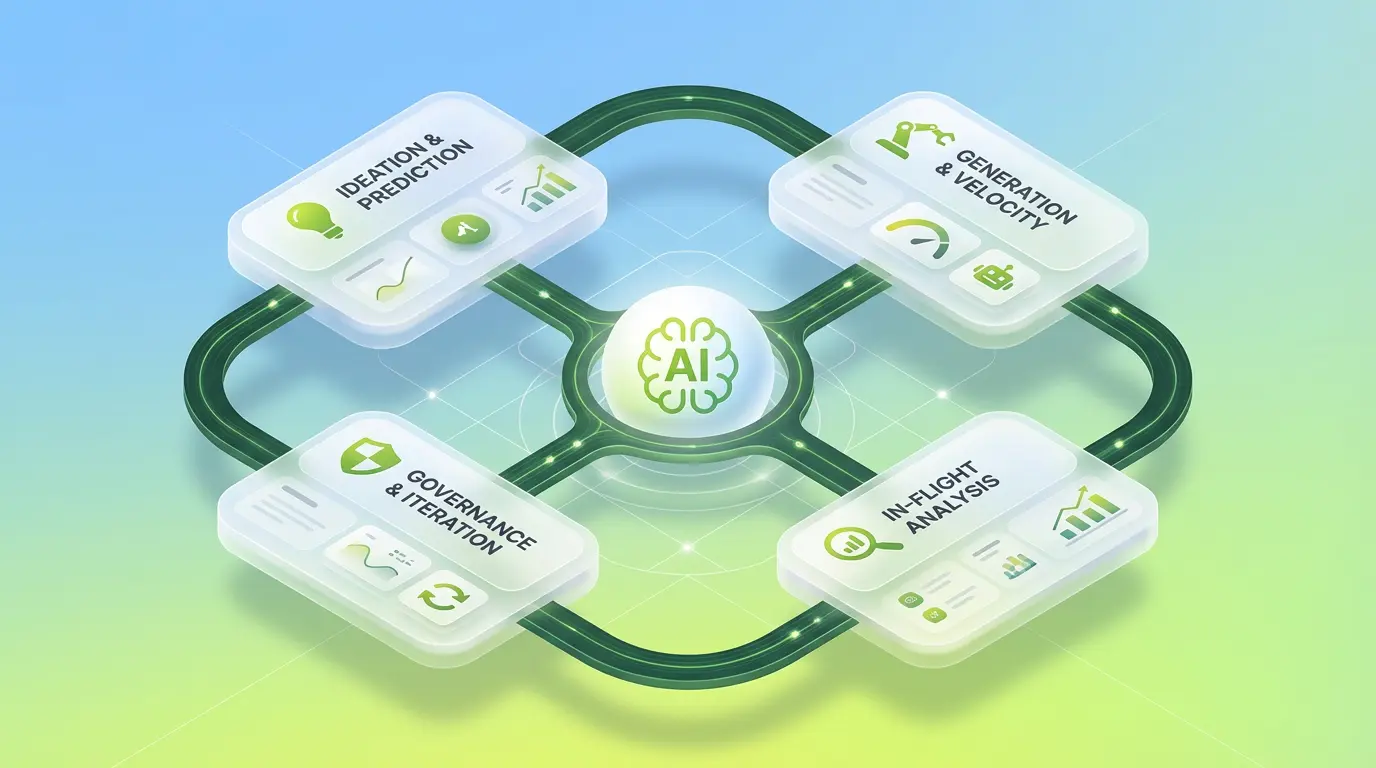
The tools you use can no longer be single-purpose. To win, you need an integrated tech stack that leverages AI to support the entire workflow:
Ideation & Pre-Launch Prediction: De-risking concepts before they hit your media budget.
In-Flight Analysis: Getting element-level ROAS insights to drive iteration.
Creative Generation & Velocity: Automating production and generating data-backed variations.
Governance & Standardization: Ensuring creative compliance across global markets.
This guide moves beyond simple "creative analytics" to cover the most powerful AI platforms UA managers and creative teams are using to streamline their growth stack and ensure every creative cycle is optimized.
Also read The 5 Best AI Creative Intelligence Platforms Transforming Creative Analysis
Key Takeaways (TL;DR):
The Workflow Challenge: Modern UA requires tools that cover the full creative lifecycle, from ideation/design to analysis/iteration, not just reporting.
Core Need: Creative Intelligence: The foundational technology is AI-powered element tagging, which automatically links visual, audio, and text components to campaign metrics, supporting both analysis and generation.
Full-Cycle Leader: Segwise is a leading platform that uniquely serves the entire creative lifecycle, acting as an essential tool for both deep, element-level performance analysis (via multimodal AI and fatigue tracking) and data-backed creative generation.
The Predictive Edge: Platforms like AdSkate are critical for the brainstorming/ideation phase, using synthetic testing to predict creative success and de-risk major budget commitments.
The Integration Must-Have: Prioritize platforms that unify data from your Ad Networks (Meta, TikTok, Google) and your MMPs (AppsFlyer, Adjust, Branch, Singular) to ensure accurate, full-funnel LTV/ROAS reporting.
7 Essential AI Platforms for the Creative & Growth Workflow
The following platforms are categorized by the primary "Job-to-be-Done" (JTB) they solve for the UA manager and creative strategist, covering the entire creative workflow.
Category 1: Creative Intelligence & Performance Analysis

These tools unify data and provide the deep, element-level insights necessary to move from reporting what happened to predicting what will work.
1. Segwise: Full-Stack Creative Intelligence & Iteration Engine
Segwise is an AI-powered creative intelligence platform built for high-volume advertisers in mobile gaming, DTC, and subscription apps. It serves as the single source of truth that connects creative teams to media buying performance, driving data-driven iteration across the entire ad ecosystem.
Key Features
Multimodal AI-Powered Creative Tagging: The AI automatically tags creative elements by analyzing Video (visual styles, scene changes), Audio (transcribes dialogue, emotional tone), Image (colors, characters), and Text (CTAs, headlines). It is also the only platform that tags playable (interactive) ads for mobile gaming, connecting specific gameplay elements to retention metrics.
Unified Cross-Platform Analytics: Seamlessly unifies data from all major ad networks (Meta, Google, TikTok, Snapchat, YouTube, AppLovin, Unity Ads, Mintegral, IronSource) and MMPs (AppsFlyer, Adjust, Branch, Singular).
Proprietary Fatigue Tracking: Automated fatigue detection algorithms monitor performance decline based on custom criteria.
AI-Powered Creative Generation: Uses top-performing elements identified by the AI tagging to generate new, data-backed creative variations.
Competitor Creative Tracking: Track and analyze competitors' ad creatives (currently Meta supported) using the same AI tagging technology.
When You Should Try It
Try Segwise if you are running campaigns across 3 or more ad networks and struggling with manual creative tagging, analysis, and fatigue management. It is ideal for teams seeking to reduce their creative production time by half and aiming for a measurable 50% ROAS improvement.
2. Singular Creative IQ: Attribution-Integrated Analysis
Singular is a leading Mobile Measurement Partner (MMP) for user acquisition. Creative IQ is their AI-powered suite designed to integrate creative element performance directly into their core attribution and analytics platform.
Key Features
Attribution-First Creative Linking: Unique in its category, Creative IQ links every creative asset to its true impact on campaign results using Singular’s advanced, hybrid attribution and modeling technology.
AI-Powered Tagging & Visual Reporting: Automatically categorizes and identifies creative assets with AI-powered tagging, supporting custom and standard AI dimensions.
Creative ETL: Allows teams to integrate creative-level data directly into their existing Business Intelligence (BI) pipelines.
Captures Diverse Formats: Captures data from diverse ad formats, including video and playables.
When You Should Try It
This solution is perfect for mobile-first app developers who already use Singular as their MMP. It’s the easiest way to add creative intelligence to your existing attribution and cost aggregation workflow.
3. VidMob: Measurement and Production Workflow
VidMob is known as an Intelligent Creative platform that combines AI-powered creative analytics with a managed production workflow system.
Key Features
Intelligent Creative Analytics: Uses AI to enrich creative data, linking element-level insights to post-launch performance metrics.
Creative Scoring: The platform assigns a score to creatives based on predictive models and real-world performance.
Creator Marketplace Integration: Integrates with a global network of creators, allowing insights to be immediately fed to outsourced creative teams through a managed workflow.
Actionable Creative Briefing: Translates complex performance data into simple, executable creative briefs for designers and external agencies.
When You Should Try It
VidMob is a great fit for mid-to-large-sized advertisers that have significant creative production needs but rely heavily on external or outsourced creative teams (agencies, freelancers) to produce their ads.
Category 2: Creative Ideation, Prediction, and Governance
These tools assist in the crucial pre-launch and compliance phases of the creative workflow, addressing brainstorming, governance, and quality assurance.
4. AdSkate: Pre-Launch Prediction and De-Risking
AdSkate focuses on pre-launch prediction and synthetic audience testing, a critical step in the modern creative workflow, addressing the ideation and pre-testing phase.
Key Features
Synthetic Audience Simulation: Allows brands to evaluate creative resonance with data-driven audience proxies before launch.
Pre-Campaign Analysis: Enables teams to evaluate entire campaigns in simulated environments, predicting performance against key metrics.
Full-Funnel Creative Performance: Provides analysis before, during, and after campaigns.
AdSkate GPT: An AI media analyst that provides fast answers to creative performance questions.
When You Should Try It
AdSkate is essential for brands, large agencies, or UA teams that have a high budget for creative testing and are looking to de-risk big swings by predicting creative success.
5. CreativeX: Creative Governance and Standardization
CreativeX is a Creative Measurement platform focused heavily on brand governance, compliance, and large-scale standardization of creative assets across global organizations.
Key Features
Creative Quality Score: Automatically scores creative assets against established brand guidelines and best practices (e.g., screen time for the logo, text density).
Standardized Measurement: Enables large, global brands to measure creative performance using a consistent, standardized taxonomy.
Creative Certification: Certifies creative assets for compliance and quality before media spend begins.
Integration with Enterprise Systems: Built to integrate with systems like brand asset management (DAM) platforms.
When You Should Try It
CreativeX is best for large, global Fortune 500 companies and their holding agencies that spend significantly on advertising and whose primary creative challenge is governance, brand compliance, and cross-market consistency at scale.
Category 3: High-Velocity Creative Generation & Iteration
These platforms are focused on the design and iteration stages, using AI to automate the production of new assets and variations based on data or simple prompts.
6. Pencil: AI Creative Generation & Iteration
Pencil is an AI-powered creative platform focused on generating, testing, and optimizing ad creative quickly, emphasizing creative velocity.
Key Features
AI Ad Generation: Generates entirely new ad creatives (video, image, copy) based on proven performance data, brand assets, and marketing goals.
Creative Performance Mapping: Provides analytics that help creative teams understand the correlation between specific elements and performance.
Lookalike Creative Iteration: Allows users to find a winning ad and instantly generate numerous "lookalike" variations.
Asset Library & Management: Helps organize existing assets and automatically identifies which assets can be remixed or reused.
When You Should Try It
Pencil is ideal for agencies and mid-market brands whose primary bottleneck is creative production velocity. If your media buying team is constantly running out of new creative to test, Pencil provides a high-speed engine for both analysis and generation.
7. Versaunt: Autonomous AI Ad Generation
Versaunt positions itself as an Autonomous AI Ad Platform, moving beyond simple generation to continuous, self-optimizing creative cycles.
Key Features
Nova Instant Creative Generation: Generates a diverse range of on-brand ad creatives instantly from simple inputs.
Singularity Continuous Optimization: The AI agent manages the testing of the generated creatives and continuously optimizes and regenerates new variations.
Campaigns Module: Provides campaign management capabilities, including the ability to launch, manage, and monitor ad campaigns from a single dashboard.
Performance-Based Iteration: Ensures that the creative generation process is purely driven by performance.
When You Should Try It
Versaunt is best for high-volume DTC or app brands looking for a tool that can essentially act as an "AI creative agency," delegating the entire creative iteration and testing loop to an AI platform.
Decision Framework: Mapping Tools to Your Workflow
Selecting the right AI partner is about mapping their core strength to your team's most critical bottleneck within the creative workflow.
Your Creative Workflow AI Evaluation Checklist (What to Test)
A 15-minute demo can tell you everything you need to know about a platform's core capability. Ask your vendor to perform these three tests based on their primary JTB:
The Tagging & ROAS Test (Analysis): Upload your best and worst-performing ads. Ask the platform to automatically tag them and show how specific tags (e.g., "fast cuts," "spoken hook: value prop") correlate with your down-funnel ROAS/LTV metrics.
The Playable/Video Test (Analysis): For mobile gaming, upload a playable ad. For all others, upload a 30-second video. Ask them to show you the performance difference between creatives where the hook occurs in the first 3 seconds versus those where it occurs after 10 seconds. (Note: Segwise is the only one that can tag playables).
The Generation Test (Ideation/Production): Provide a simple prompt (e.g., "Generate 5 video concepts for our new product focused on a 50% discount"). Evaluate the speed, quality, and diversity of the generated assets.
By implementing an integrated AI stack, you gain the confidence to scale your spend knowing that your creative pipeline is a predictable, data-driven engine. This strategic shift is what separates top-tier UA teams from the competition, saving up to 20 hours per week in manual analysis and driving substantial ROAS gains.
Conclusion: Scaling Your Creative Wins with Intelligence
The modern performance marketer is an orchestrator of complex systems. The demand for creative velocity, coupled with the complexity of multi-platform campaigns, makes AI-powered creative intelligence a necessity, not a luxury. By adopting tools that automate the most time-consuming parts of the workflow, from ideation and element-level analysis to automated fatigue detection and generation, you turn your creative department from a bottleneck into an advantage.
Whether you need to predict success with AdSkate, maintain global governance with CreativeX, or get the full-stack element-level analysis, generation, and cross-platform unified view of Segwise, the key is choosing the solution that directly addresses your team's biggest efficiency and ROAS gaps.
Ready to stop guessing which creative elements win and start building your next 10 winning ads based on data? Segwise is purpose-built to give UA managers and creative teams the intelligence needed to accelerate iteration and achieve up to a 50% ROAS improvement by leveraging Multimodal AI.
Frequently Asked Questions
What is the main difference between Creative Analytics and Creative Intelligence?
Creative Analytics is generally focused on retrospective reporting (what did happen with the creative). Creative Intelligence (CI) uses AI to transform that data into predictive and prescriptive insights (what will happen and what you should do next), often including advanced features like automatic element tagging, fatigue detection, and data-backed generation.
How does AI Creative Tagging work?
AI Creative Tagging uses machine learning models, often multimodal (analyzing visual, audio, and text elements simultaneously), to automatically identify and categorize creative components (e.g., CTA type, color palette, scene change speed, voiceover tone). These tags are then mapped directly to performance metrics (ROAS, CPI, CTR) to show exactly which elements drive results, eliminating manual spreadsheet work.
Is a Creative Intelligence platform a replacement for a Mobile Measurement Partner (MMP)?
No. A Mobile Measurement Partner (MMP) like AppsFlyer or Singular focuses on attribution, fraud prevention, and cost aggregation. A Creative Intelligence platform (like Segwise or VidMob) focuses exclusively on connecting creative performance to that attribution data. They complement each other; the best CI tools ingest data from MMPs to provide a full-funnel view.
How quickly can an AI platform detect creative fatigue?
A good Creative Intelligence platform should be able to detect the onset of fatigue within 24 to 72 hours after a statistically significant drop in key engagement metrics (like CTR, CVR, or IPM) begins. Proprietary algorithms monitor these leading indicators, providing an early warning alert that allows UA managers to pause or refresh the creative before the decline seriously impacts ROAS.
Are AI creative generation tools safe for brand consistency?
Yes, the leading AI creative generation tools, like Pencil and Versaunt, allow you to upload your brand style guides, asset libraries, and existing high-performing ads. The AI models are then constrained by these inputs to ensure all generated ad concepts and variations remain strictly on-brand, maintaining consistency across channels and markets.
Which platforms support analysis of playable ads for mobile games?
The analysis of playable (interactive) ads is a highly technical capability. According to our research, Segwise is currently the only platform that explicitly states it supports tagging and analysis of playable ad performance and linking those specific interactive elements to down-funnel metrics.
What is the primary benefit of using a unified creative analytics platform?
The primary benefit is operational efficiency and data accuracy. By unifying data from all ad networks (Meta, TikTok, Google, AppLovin, etc.) and all MMPs (AppsFlyer, Adjust, Branch, Singular), the platform eliminates the hours spent on manual data consolidation, providing UA managers with a single, accurate source of truth for cross-platform, element-level ROAS analysis.