
Creative optimization is not one product category. Six different products are sold under the name, and which one you need depends entirely on which part of your creative loop is broken: research (deciding what to make next), generation (producing net-new creative), production scaling (versioning finished assets), dynamic creative optimization (assembling ads at delivery time from a feed), analysis (reading which element drove the result), and automation (moving budget onto whatever won). This page is the map, not a ranking. It defines each of the six jobs, gives the symptom that tells you it is yours, and sends you to the comparison that actually ranks the tools for it. Nothing is ranked here on purpose, because every serious platform in this space belongs to one of those six jobs and is already ranked on the page for that job.
Why searching for a creative optimization tool returns six different products
Ask five vendors what creative optimization means and you get five answers, all of them sincere. To Smartly it means assembling thousands of localized variants from a product feed. To AdCreative.ai it means generating statics and scoring them before you spend. To Motion it means a report that shows which ad won. To Revealbot it means a rule that pauses the loser at 3am. To Meta it means Advantage+ deciding the combination for you. None of them is lying. The phrase has simply become the umbrella term for anything that touches an ad creative on its way to or from a campaign.
That is a problem when you are buying. The six jobs sit at different points in the same loop, cost wildly different amounts, and are almost never substitutes for each other. A team that cannot tell which hook is working buys a production platform, manufactures two thousand assets off an unchecked assumption, and is no wiser. A team drowning in production buys an analytics layer and still cannot ship faster. Both teams bought a creative optimization tool. Both bought the wrong one.
Creative is worth getting right, which is why the category attracted this much vocabulary in the first place. Circana's NCSolutions, in its Five Keys to Advertising Effectiveness study of nearly 450 CPG campaigns across digital and TV, attributes 49% of advertising's incremental sales to the creative itself, against 21% for brand, 14% for reach, 11% for targeting and 5% for recency (Circana). Creative is the largest single lever by a wide margin, and it is the one platform automation has not taken off you. Algorithmic delivery has only pushed that further, since the platform now decides most of the targeting for you. The lever left is the creative. The question is which part of working that lever you are actually bad at.
The six jobs sold as creative optimization, and how to tell which one is yours
Find the symptom that sounds like your week. That row is your category. The last column is where the tools for it are ranked, priced and compared in depth.
Two jobs sit just off the edge of that list and get pulled into the same search. Creative fatigue detection is a specialized slice of job 5, and if the decline curve is the thing hurting you, start at creative fatigue detection tools instead. Structured creative testing, where the question is experiment design rather than tooling, lives in creative testing tools.
How the six layers connect, and the order they break in
The six jobs are stages of one loop, and the loop only runs as fast as its slowest stage. Research feeds generation. Generation feeds production. Production feeds delivery. Delivery produces the data that analysis reads. Analysis tells automation where the money should go, and automation frees the budget that pays for the next round of research. Every stage hands off to the next one, which is why buying out of order is so expensive.
Three handoffs are where teams actually lose time, and none of them is fixed by buying more of the stage you already have.
- Analysis to generation. You have a report that says short opening hooks with on-screen text win. Turning that sentence into 20 new variants is still a human writing a brief. This is the handoff worth paying to close, because it is the one that repeats every week.
- Delivery back to analysis. The moment the platform assembles the ad for you, you stop owning the variant. Meta dynamic creative and Performance Max both report at asset level rather than combination level, so the thing that won is not the thing you can read. Buying job 4 without a plan for job 5 trades measurement for automation and nobody warns you at signature.
- Analysis to automation. A rule engine executes exactly the logic you type into it. It has no opinion about whether the creative deserves the budget. Point one at a noisy signal and it will scale noise faster than you could have by hand.
The practical order is boring and it holds: fix the stage that is currently your ceiling, then the stage immediately downstream of it. Do not buy two stages at once. You will not be able to tell which purchase moved the number.
Which layer to buy first, by where you actually are
Find the row that describes you. The answer is a layer and a page, not a specific tool, because the tool depends on your channels and the layer does not.
Treat the spend rows as a proxy for creative volume rather than a rule. A team spending $30k a month across five networks with 200 live variants needs element-level analysis far more than a team spending $200k on twelve ads. The number 30 in the first block is doing a lot of work: it is roughly where a week of new creative across two or more networks stops fitting in an hour of hand-tagging and one screen of spreadsheet. Your own crossover may be 20 or 50. The band is the useful part, not the digit.
What actually goes wrong when you buy the wrong layer
These are the five failure patterns behind almost every abandoned creative tool contract we have looked at. Each one is a real purchase that solved a real problem, just not the buyer's problem.
- Production bought instead of analysis. The platform works exactly as sold and manufactures 2,000 assets built on an assumption nobody checked. Volume multiplies whatever assumption you fed it, including the wrong one.
- Delivery-time assembly bought before measurement. You gain automated personalization and lose the ability to say which combination earned the conversion, because asset-level reporting is not combination-level reporting. Six months later nobody can explain the account to a new hire.
- Generation bought as an analytics replacement. A pre-launch score is a filter for deciding what to test, not a verdict on what works. Treating a predicted score as a result means you never find out which of your own elements actually carries performance.
- Rule automation bought before signal. The rule engine does what you told it, on the data you pointed it at. Without a real read on which creative deserves the budget, automation just makes your worst decisions faster and at scale.
- An attribution platform bought to answer a creative question. Revenue per asset is genuinely valuable and it is not element-level analysis. It tells you which ad won. It does not tell you that the win came from the first two seconds.
Why the same vendor appears in three different categories
If you compare the six pages linked above you will notice a few names on more than one of them. That is deliberate and it is not a copy and paste error. Some platforms genuinely do two or three of the six jobs, and pretending otherwise would make the comparisons less useful.
Smartly is the clearest case. It assembles variants from templates and product feeds, which is job 4. It builds, approves and versions high-volume paid social, which is job 3. It generates localized variants from one approved master, which is job 2. All three are real, which is why it appears on three pages, and it is also why the price is what it is. Madgicx does creative analysis on Meta and wires the findings straight into budget rules, so it sits across jobs 5 and 6, and that combination is exactly its selling point for a Meta-only shop. Segwise does creative analysis and generation in one product, jobs 5 and 2, which is covered below.
The useful question in a demo is not whether a vendor claims a second category. It is which job the contract is actually priced against. A platform charging for assembly and throwing in a reporting tab will have a reporting tab, not an analysis product. The tell is depth in the thing you are not paying for: ask for the second category's documentation, not its screenshot.
Where Segwise sits across these six layers
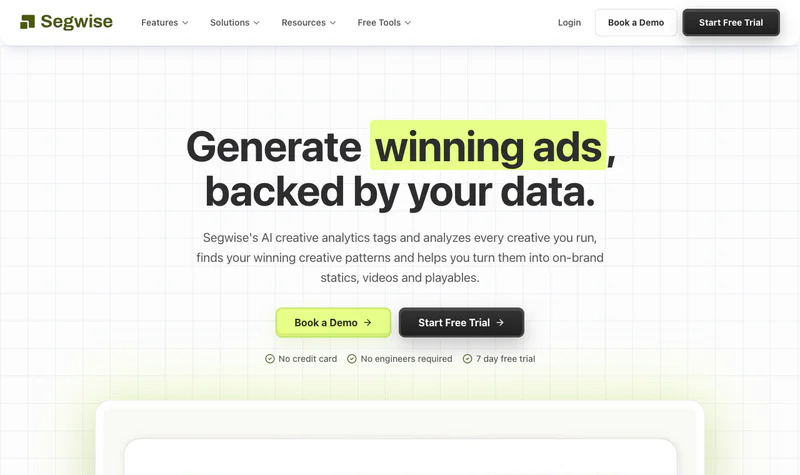
Full disclosure, this is our blog, so here is the honest placement rather than the pitch. Segwise is built for jobs 5 and 2, and specifically for the handoff between them. The Creative Tagging Agent uses multimodal AI to tag video, audio, image and text, including playable ads, which is the format it documents that most element-level tools do not handle. Those tags map to any metric you already track, not just a fixed list, and they join to MMP data from AppsFlyer, Adjust, Branch, Singular and Kochava so the metric on the other side of the tag can be revenue or retention rather than an install. The Creative Strategy Agent is the chat layer over that data and also drafts briefs and concepts from it. The Creative Generation Agent then produces new statics, video and playables built around the elements the tagging layer says are winning. That is the analysis to generation handoff closed inside one product, which is the whole argument for it.
Coverage is 15+ ad networks and MMPs, including Meta, Google, TikTok, Snapchat, Axon (AppLovin), Unity Ads, Mintegral, Moloco and Liftoff. Setup is no-code and takes about 5 minutes, or 10 to 15 to connect every source. The trial is 7 days with no credit card and imports up to 2 weeks of history; paid plans backfill up to 3 months. Segwise starts at $499/month for advertisers spending up to $250K/month, with a special 50% discount for startups spending under $50K/month.
What it is not, which matters more on a routing page than another feature list. It does not assemble ads at delivery time, so it is not a substitute for job 4 or for an ad server, and if your problem is per-shopper catalog assembly you want the DCO page. It is not a mass-versioning platform, so turning one approved master into 40 markets with brand rules locked is job 3 and belongs to a production tool. Competitor tracking currently covers Meta only, with other platforms in development. And the entry price sits above the self-serve generation tools that start under $50 a month, so a team whose only problem is producing more statics is buying more platform than it needs.
Four questions that identify a vendor's real layer in a demo
- Which of the six jobs is this contract priced against? Ask them to point at one. A vendor that answers all of them is describing a bundle, and the bundle has a strong part and a weak part.
- Show me the output, not the dashboard. For analysis, that means a real element-to-metric breakdown on an account like ours. For generation, a finished file in the aspect ratio we ship. For assembly, the actual served combination and its report.
- What does this need from us before it works? A feed with clean attributes, an MMP connection, a naming convention, a template library. This is where implementation time hides, and it is usually longer than the sales cycle.
- If we already own the native platform version of this, what does yours add? Advantage+ creative, Performance Max and platform asset reporting cost nothing extra and cover a surprising amount of delivery-time assembly and rule automation. Make them justify the delta.
Which creative optimization page should you read next?
Pick by the job, not by the phrase. One sentence each:
- You cannot tell which element drove the result: best ad creative analysis tools, or creative intelligence platforms if you are still working out what the category is.
- You cannot get enough new creative made: best AI ad generation tools.
- You cannot version one concept fast enough: creative automation tools for scaling ad production.
- Every shopper should see a different product in the same frame: best dynamic creative optimization tools.
- Your winners decay before you notice: creative fatigue detection tools.
- You know what works and the budget still does not follow: Meta ad management and automation tools.
- You need evidence before the next brief: ad spy and competitor research tools.
- Your tests are not conclusive: creative testing tools.
If your answer to that list was "the first two, and they are the same problem for us", that is the case for a platform that spans analysis and generation rather than two subscriptions with a human in between. You can see what that looks like on your own account inside the 7-day trial at Segwise.
Frequently Asked Questions about creative optimization tools
What is creative optimization?
Creative optimization is the practice of using creative-level data, rather than campaign or audience data, to decide what to make, what to iterate, what to kill and what to scale. In software terms it is not one category. Six distinct products get sold under the name: creative research, generation, production scaling, delivery-time assembly (DCO), element-level analysis, and rule-based automation of budget and rotation.
Is creative optimization the same as conversion rate optimization?
No, and the two get confused constantly because both are shortened to CRO in conversation. Conversion rate optimization is about the landing page and the funnel after the click. Creative optimization is about the ad itself before the click. They are measured differently, bought by different people, and the tools do not overlap.
What is the difference between creative optimization and dynamic creative optimization?
Dynamic creative optimization is one of the six jobs inside creative optimization, not a synonym for it. DCO specifically means the ad is assembled at or near the moment of delivery, combining elements, product feed rows and audience signals into the version each person sees. Everything else on this page happens before delivery or after it.
What is the difference between creative optimization and creative automation?
Creative automation is production: making, resizing, localizing and versioning volumes of finished assets before any of them are trafficked. Creative optimization is the wider loop that production sits inside. If your problem is that one concept has to become 40 files, you want creative automation, and the number of assets you need per month decides whether it pays for itself.
What is the difference between creative optimization and creative analytics?
Creative analytics answers which creatives and which elements are working. Creative optimization is broader: it uses that answer to generate, test, scale and retire creative. Analytics is the read, optimization is the whole loop. A platform that only reads is still valuable, but it will not close the gap between the insight and the next batch of ads.
Do I need more than one creative optimization tool?
Most teams past roughly $50k of monthly spend end up with two, and it is usually an analysis layer plus whichever of production, generation or assembly matches their bottleneck. Buy them one at a time and at least a month apart, or you will not be able to attribute the improvement to either purchase.
Which layer should I buy first?
Analysis, in almost every case where you have more than about 30 live variants. It is the only layer whose output makes every other layer smarter, and it is the only one where buying nothing leaves you guessing. The exception is a team that already has a confident read on what works and a genuine production ceiling, which should fix production first.
How much do creative optimization tools cost?
It depends entirely on the layer, which is the main practical reason to identify your layer first. Native delivery-time assembly on Meta and Google carries no extra license fee. Self-serve generation tools start in the tens of dollars a month. Element-level analysis runs from free reporting tiers into four figures a month, with Segwise from $499/mo (50% off under $50K spend). Enterprise production and assembly platforms are quote-only and usually start in the thousands. Each linked page carries the verified prices for its own category.
Can I do creative optimization without buying anything?
Up to a point, and it is the right call under roughly $10k of monthly spend. Meta and Google both expose asset-level reporting, Advantage+ creative and Performance Max apply delivery-time assembly at no extra cost, both platforms support automated rules, and a strict naming convention will carry a manual creative taxonomy a surprisingly long way. What you cannot do free is element-level tagging across networks, which is precisely why that is the layer people buy first.
How long before creative optimization data can be trusted?
Long enough for each variant to clear the platform's own learning behavior and accumulate a meaningful number of conversions, which in practice means weeks rather than days and depends on your conversion volume rather than a fixed window. Reading element-level winners off a few days of spend is the most common way teams talk themselves into the wrong creative direction with a tool that was working correctly.
Do these tools work for mobile apps as well as ecommerce?
Yes, but the layer that matters shifts. App and game teams live in the analysis layer and care most about MMP joins, playable formats and post-install metrics, because installs are not the outcome they are paid on. Ecommerce and DTC teams more often need delivery-time assembly, since a product catalog is the thing that makes delivery-time assembly worth having at all. The vocabulary is shared, the purchase is not.