
When you're running high-volume campaigns across multiple platforms, you need to know exactly what’s working and why. The truth is, relying solely on standard ad network metrics isn't enough. These traditional reports give you a high-level view, but they miss the details that actually make or break your return on ad spend (ROAS).
We need to delve deep to understand actual metrics. Element-level creative tagging is the solution, helping performance marketers gain precise, actionable insights where aggregated metrics fall short.
Key Highlights
Ad network metrics hide which creative elements actually drive results.
Element-level tagging isolates and optimises individual variables (characters, backgrounds, hooks).
Without granular data, you either over-scale winners or kill good creatives.
Segwise automates tagging with AI, no manual work, syncs with MMP data instantly.
See cross-platform creative performance in one dashboard (X% CTR on Meta, Y% on TikTok, Z% on Google).
Understanding Ad Network-Level Metrics
Ad network metrics are the aggregated performance data points you get straight from the platform, like Meta, Google, etc. These are essential for giving you a bird's-eye view of your campaigns, channels, and overall creative performance.
Common ad platform metrics include impressions, clicks, Click-Through Rate (CTR), and conversions. They tell you how many users saw your ad and what percentage clicked it. But the catch is, while these metrics reveal that something worked, they don't reveal why it worked. They lack the granularity needed to pinpoint which specific creative elements, the character, the CTA colour, the hook dialogue, actually drove those results.
Limitations of Traditional Ad Network Metrics
If you're operating at scale, relying on traditional ad network metrics is like diagnosing an engine problem by checking the car’s fuel gauge. You know there’s an issue somewhere, but you can’t see the spark plugs or the fuel injection system.
This lack of granularity means you can’t precisely optimise your creatives. When you can't tell which specific creative element drove that conversion, you face challenges like inefficient budget allocation, unclear attribution, and difficulty measuring true cross-platform effectiveness. This often results in wasted spend and missed opportunities for targeted improvements.
Aggregation and Its Impact on Data Accuracy
When an ad network combines the performance results of hundreds of different creative variations into a single metric, you lose sight of the individual components. This aggregated view blurs the true performance of specific elements, leading to inaccurate insights.
Let's say you're running 10 different creatives in a single ad set. Some use a forest background, some use a palace setting. Some feature a king character, others use a queen. One creative hits 10% CTR, another gets 5%, and another gets 3%. But the ad set reports show an overall 6% CTR.
The question isn't "which creative won?" (you can see that). The real question is: What element made the winner work? Was it the background? The character? Without element-level tagging, you're flying blind. You might see that creatives with forests perform well, but you won't know if that's because of the background, the character it was paired with, or the hook dialogue. So you either scale everything about that winner or you iterate away from it entirely, losing the actual winning formula in the noise.
Attribution Challenges Across Platforms and Formats
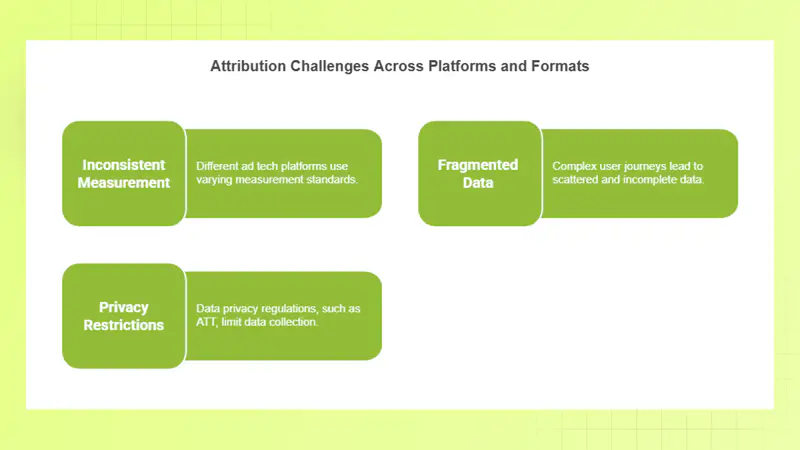
Attributing ad success accurately is a complex headache, especially when users jump between devices and channels. You’re running ads on Meta, TikTok, but each platform uses slightly different tracking capabilities and standards.
Key hurdles we face today include:
Inconsistent measurement standards between different ad tech platforms.
Fragmented data resulting from complex cross-device user journeys.
Restrictions caused by evolving data privacy regulations (like ATT).
Overcoming these challenges requires a unified, consistent tagging strategy that works across every format and platform you use.
Introduction to AI Creative Tagging
AI creative tagging moves beyond simply tracking the creative performance; it tags and analyzes individual variables or elements within the creative. It involves breaking your ads into measurable creative variables such as headlines, background settings, characters, calls-to-action (CTAs), first dialogue lines, and even audio components.
This granular approach enables performance marketers to track the precise impact of each creative variable on performance. By identifying which specific part of the creative truly moved the needle, you gain actionable insights, allowing you to optimise those individual elements for campaign effectiveness, moving far beyond the limitations of aggregated ad network metrics.
How Element-Level Tagging Works
Element-level tagging functions by assigning a unique identifier, or a tag, to every component inside your creative. For a video ad, this could mean tagging:
Character: Is it a King, a Queen, or an Archer?
Ad Concept: Is it gameplay footage, user-generated content (UGC), or animation?
This process allows the system to track user interactions like views, clicks, or drop-offs on that specific element. For example, you might realise that creatives featuring the "King" character consistently lead to a higher conversion rate, while those with the "Archer" character do not, regardless of the platform. The data collected empowers precise, surgical optimisation.
Integration with Ad Tech and Ad Exchanges

Effective element-level tagging needs to integrate seamlessly with the modern ad tech ecosystem, including Demand-Side Platforms (DSPs), Supply-Side Platforms (SSPs), and mobile measurement partners (MMPs).
This integration ensures that granular creative data flows consistently across all your ad serving platforms. This level of connectivity is key for programmatic advertising because it allows you to:
Sync detailed creative performance data from every network into one unified dashboard.
Enhance targeting by understanding which creative variables resonate with specific audiences.
Improve bid strategies by basing decisions on known high-performing creative components.
Want to master these integrations without hiring a data team? Discover how Segwise uses AI agents to automate creative tagging across all your platforms, helping you uncover winning creative patterns fast.
Benefits of Element-Level Creative Tagging Over Traditional Metrics
Creative tagging provides a significant competitive edge in digital ads by giving you precise insights into what truly drives results. But Segwise goes further, you're not locked into a generic tagging system.
The key benefits include:
Targeted optimization of specific components (like headlines, images, or CTAs) instead of guessing, using custom tags that match how your team names and categorizes creatives.
Improved attribution accuracy across all campaigns and networks with the flexibility to create custom metrics that align with your specific KPIs, not ours.
Enhanced budget efficiency by identifying and focusing spending only on high-performing elements using custom thresholds and fatigue detection settings you control.
This customizable granularity enables smarter, faster decisions, dramatically reducing wasted spend and boosting your overall campaign ROAS. Segwise adapts to how you work, not the other way around.
Enhanced Granularity for Creative Optimisation
Granularity is the key to unlocking true creative efficiency. Instead of broadly A/B testing two entirely different ads, element-level data allows you to isolate individual variables and test them surgically.
This approach enables:
Targeted A/B testing: Refining only the character trait or the first three seconds of dialogue, rather than re-designing the entire asset.
Data-driven creative tweaks: Once you tag your creatives, you can analyze which elements are actually performing. For example, if you're running a puzzle game and you notice that across your last 50 creatives, those with forest backgrounds consistently average 7% higher CTR than cityscape backgrounds, you'd generate new briefs emphasizing forest settings. Segwise shows you these patterns automatically.
Reduced wasted spend: Focusing resources on iterating creatives with high-performing creative elements identified.
By embracing granular insights, your campaigns move from reactive management to proactive, performance-driven optimisation.
Improved Cross-Platform Measurement and Attribution
For modern UA teams, the real challenge is simple: you're running the same creatives across multiple ad networks Meta, Google, TikTok, AppLovin, and more. But each network reports data differently, uses different metrics, and provides zero visibility into how that specific creative performed across all of them.
Creative tagging solves this by applying consistent tags to every creative, regardless of which network it ran on. This means you can now see: "This specific background creative generated 8% CTR on Meta, 6% on TikTok, and 9% on Google Ads." You stop managing each network in isolation and start seeing your creative's true cross-network performance.
Implementing Element-Level Creative Tagging in Your Campaigns
Adopting AI creative tagging doesn't have to be complicated, but it must be systematic. The goal is actionable data. Here's where most teams get stuck: manually assigning tags to every creative element is tedious, error-prone, and doesn't scale.
The Segwise approach: Instead of manual tagging, Segwise's AI automatically identifies and tags your creative variables across all your ads, across 15+ networks. Here's how it works in practice:
Step 1: Connect your ad networks - Link your Meta, Google, TikTok, or AppLovin accounts. Segwise pulls all your creatives automatically.
Step 2: AI tag your creatives - Segwise identifies variables like character traits, ad concepts, hook scene text, CTAs, backgrounds, audio components, and more instantly. You can also tag any custom variables you care about.
Step 3: Map tags to performance - Segwise syncs your tags with MMP data (Adjust, AppsFlyer) and ad network metrics. Now you see which tags correlate with higher CTR, installs, ROAS, whatever matters.
Step 4: Act on insights - Your creative team gets clear, data-backed briefs: "Test the X character" or "Make more Y background creatives." But you don't stop there. Segwise can automatically generate creative iterations based on winning patterns. If your data shows forest backgrounds + king character + benefit-driven hook performs best, Segwise generates a new creative with exactly that combination. No guessing. No designer meetings. Just data-driven creative iterations ready to test.
Tools and Platforms Supporting Element-Level Tagging
The native ad platforms (Meta, Google, TikTok) provide some basic creative reporting things like video view rates, completion rates, and CTR. But none of them tag elements within those creatives. You get ad-level performance, not element-level performance.
Why? Because element-level creative tagging requires:
Computer vision AI to identify visual elements (characters, backgrounds, objects)
Audio analysis to detect dialogue and sound components
Cross-network data unification (pulling from Meta, Google, TikTok in one place)
Integration with MMPs (Adjust, AppsFlyer) to map tags to actual user behavior
Native platforms weren't built for this. It's a different problem.
This gap is what Segwise fills:
Automatic AI tagging across images, videos, and playables
Element identification, including hook dialogues, character traits, backgrounds, and audio
Cross-network reporting - tag once, see performance across Meta, Google, TikTok in one dashboard
MMP integration - map creative tags directly to installs, retention, ROAS
Custom tagging - add tags specific to your game or app