
If you've spent any real time managing Meta campaigns for DTC brands, you know the feeling: you've tested dozens of formats, burned through budget on things that looked clever but flopped, and eventually landed on a small handful of structures that reliably generate returns. That intuition takes years and a lot of failed tests to build.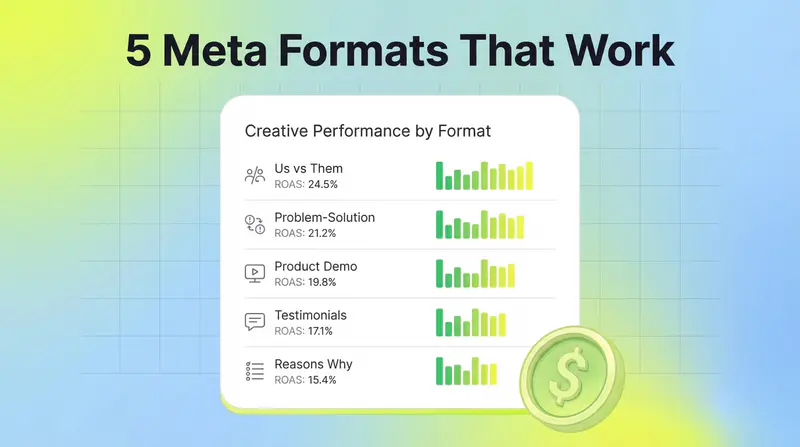
Curtis Howland has managed over $100M in Meta ad spend across DTC accounts. He compressed that learning into five formats he comes back to consistently. This isn't a post about the hottest creative trend of Q1. These are the foundational formats that hold up across audiences, categories, and creative cycles.
But knowing the five formats is only half the story. The other half is understanding why each one works, when to deploy it, and how to avoid the mistake most teams make: running the same creatives too long until performance quietly crumbles.
Meta's algorithm changed structurally in October 2025 with the Andromeda update, which processes 10,000x more signals to match ads to users based on creative content. That shift makes creative format selection more consequential than ever. Your creative is now doing the targeting work.
Key takeaways
The five proven Meta ad formats for DTC are: Us vs. Them, Problem-Solution, Product Demo, Testimonials, and Reasons Why.
Meta's Advantage+ campaigns deliver up to 22% higher ROAS compared to traditional manual targeting, and creative diversity is now the primary driver.
UGC content is 28% more effective than traditional ads and generates 217% more leads, which makes the Testimonials format particularly strong on Meta.
Creative fatigue on Meta typically sets in at weeks 3-4 for prospecting campaigns. A 10% CTR decline over 7 days is an early warning sign that action is needed.
The first 3 seconds determine whether your ad gets traction. Hook rate (3-second views divided by impressions) below 25% is a kill signal; above 40% means scale it.
Running the same creative past its peak costs real money. Accounts with 7-day frequency consistently above 5 on prospecting spend 30-45% more per acquisition than accounts with fresh creative rotation.
Most DTC brands test fewer than 10% of available creative approaches. That's where the competitive gap opens.
Also read How to Craft Effective Facebook Ad Headlines: Tips & Best Practices
The five formats, explained

1. Us vs. Them
The Us vs. Them format works because it does something most DTC brands fail to do: it controls the comparison before the customer does it themselves.
The structure is simple. You show the contrast, make your brand the clear winner on criteria that matter to the buyer, and frame it before they go looking. Split screens, ingredient breakdowns, price comparisons by unit, side-by-side quality shots. The goal is to reframe the comparison in your favor before a Google search does it for them.
Howland's specific advice: focus the comparison on selling points the audience genuinely cares about, and keep it educational rather than combative. The best Us vs. Them ads don't feel like attacks. They feel like useful information that happens to favor your product.
This format is especially strong for supplements, skincare, and any category where ingredient or process differentiation matters. Static image comparison ads drive 60-70% of conversions for many DTC accounts Howland manages, and the Us vs. Them structure fits naturally into that comparison card format.
2. Problem-Solution
The Problem-Solution format is a cold traffic play, and the sequencing matters more than most teams realize.
The structure: open with the pain, sit in it for two seconds, then flip to your product as the relief. Under 30 seconds. The key insight is that cold audiences don't know your brand exists, but they know their problem exists. You're not selling a product. You're showing someone you understand their situation and have a way out.
The PAS framework (Problem, Agitate, Solution) structures this cleanly: spend 60% of your ad on the problem and agitation, 40% on the solution. The mistake most brands make is flipping that ratio. They spend 60% on the product and bury the problem framing in the first second.
Howland notes this format runs best at 30-45 seconds. Long enough to agitate properly, short enough to hold attention.
3. Product Demo
The Product Demo format is the most underestimated of the five, especially for novel products or solutions the audience hasn't seen before.
The approach is almost brutally simple: just show it working. No voiceover. No brand story. 20-40 seconds of the product in action. People believe what they see.
This format pairs well with the 15-30 second video structure: hook in the first three seconds, problem acknowledged, product solving it, clear call to action. For software products, showing the actual interface in use often outperforms lifestyle shots. For physical products, showing the product solving a real-world problem beats studio setups.
Smartphone-quality video beats studio production 84% of the time in Stories, according to Motion's research. Stop overproducing the demo.
4. Testimonials and Reviews
Testimonials work because customers don't trust brands, but they do trust other customers.
The format is flexible: quote overlays, UGC video clips, screenshot-style customer messages, documentary-style interviews. What matters is specificity. "This saved my marriage" beats "Great product" not because it's more dramatic, but because it's more believable. Specific results signal a real person with a real experience.
Howland's sourcing advice is worth flagging directly: mine your reviews, your comments, your support tickets, and your competitors' comments. The raw language customers use in reviews is often more compelling than anything your copy team would write.
Bazaarvoice's 2025 data shows UGC content generates 217% more leads than traditional ads. Meta Partnership Ads, which run from the creator's handle rather than the brand handle, showed a 296% performance boost versus standard creative in recent case studies. If you're not running creator-side testimonial formats on Meta, you're leaving that gap open for a competitor who will.
5. Reasons Why
The Reasons Why format answers the three questions every customer has before converting: Why this? Why now? Why you?
The structure: "4 reasons why [product] works for [specific audience]." Stack value drivers, make it skimmable, end with a clear call to action. The numbered format isn't just aesthetic. It signals a specific, finite commitment of the reader's attention.
This format tests well across funnel stages. For cold traffic it establishes credibility. For warm audiences it reinforces the reasons they were already considering before they dropped off.
Why creative format alone isn't enough
The formats above are proven. But even proven formats stop working when they run too long.
Creative fatigue is the gap between when an ad is performing and when you notice it isn't. By the time you see CPA spike and CTR drop, the algorithm has already been delivering a declining experience to your audience for days or weeks. The damage is already done.
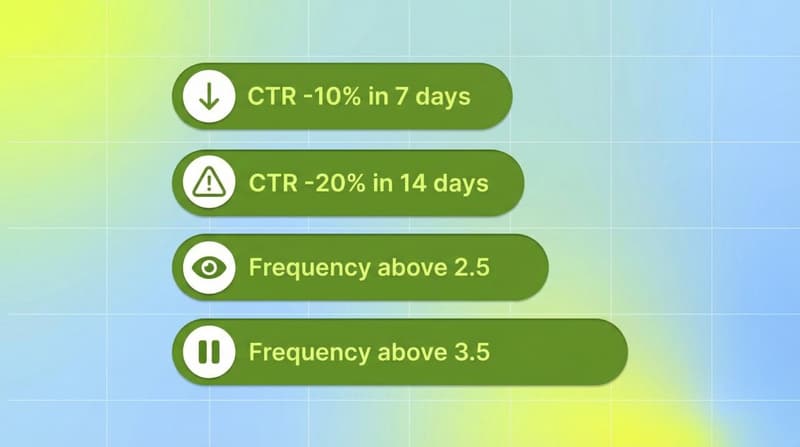
According to benly.ai's 2026 analysis of Meta ads creative fatigue, the warning signs appear earlier than most teams catch them:
CTR drops 10% over seven days: early warning, start planning a refresh
CTR drops 20% or more over 14 days: critical, act now
Prospecting frequency above 2.5: danger zone
Prospecting frequency above 3.5: refresh or pause immediately

The fatigue curve on Meta typically peaks between days 7 and 21, with onset around weeks 3-4 for prospecting campaigns. Top-performing ads lose 38% of their effectiveness after just five weeks unchanged. That's not a failure of the creative. It's the natural ceiling of any format run against the same audience for too long.
The teams that manage this well set up tracking before fatigue happens. They watch hook rate as an early signal, set frequency alerts in Ads Manager, and keep fresh creative ready before the current batch needs replacing, not after.
Howland's production formula: one new ad concept per $3,000 in monthly Meta spend. At $100K per month, that's 33 new concepts per month. Most brands running at that scale produce a fraction of that.
The hook is the variable most teams ignore
Across all five formats, the first three seconds do disproportionate work. Hook rate (3-second views divided by impressions) tells you whether the opening is working before you've committed budget to finding out via CPA.
Below 25%: kill it. Between 30-40%: worth scaling. Above 40%: scale aggressively.
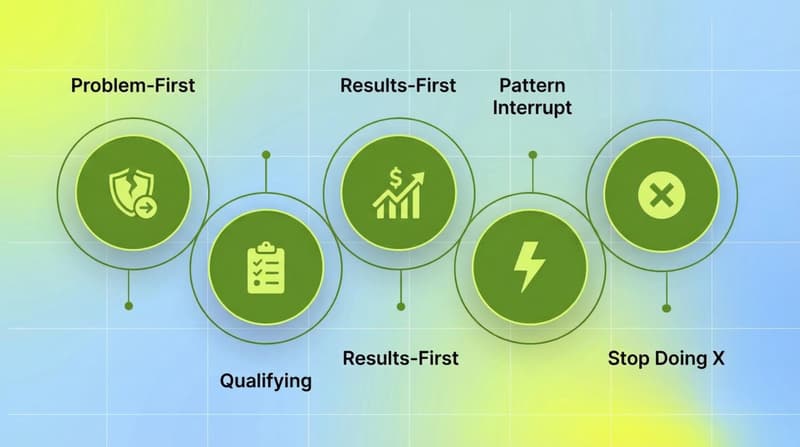
Howland documents 12 hook types that hold up across hundreds of accounts. A few worth highlighting:
Problem-first: State the pain before the product. Most effective for cold traffic.
Qualifying: "If you're a [specific person], keep watching." Specificity creates engagement.
Results-first: Lead with the transformation. Show the after before the before.
Pattern interrupt: Something visually unexpected. Works best when the feed is predictable.
"Stop doing X": Calls out a common mistake. Immediately signals relevance to the right audience.

The same creative with a different hook can perform 2-3x differently. Hook testing is the cheapest, fastest way to find winners within an existing format.
What tracking at scale actually requires
Running five format types, refreshing creative on a monthly production schedule, tracking hook rates, and catching fatigue signals manually is a lot to ask of any team. The brands that do this well aren't just using better judgment. They've built systems.
At the creative intelligence level, that means knowing which format variants are driving installs and ROAS, which creative elements (hooks, CTAs, visual styles, audio cues) are doing the work, and when any given asset is starting to decline before it craters performance.
Manual spreadsheet review can't keep up with this at scale. Segwise's AI-powered creative intelligence platform automatically tags creative elements across campaigns on Meta, Google, TikTok, Snapchat, YouTube, AppLovin, Unity Ads, Mintegral, IronSource, and more, mapping every tag to performance metrics. That means you can see which of your five format types is working, which hook styles are holding up, and which creatives are approaching fatigue before you're reacting to a CPA spike instead of preventing one. Teams using Segwise save up to 20 hours per week on creative analysis and see up to 50% ROAS improvement by catching these signals early.
Building a system around these formats
The five formats are a starting point, not a complete strategy. Howland's production framework treats them as a creative library with multiple execution angles per format.
For each of the five formats, there are hook variations, format sub-types (static, video, carousel), and copy frameworks (PAS, Before/After/Bridge, FAQ format). That combination creates a large matrix of testable variations from a small number of proven structures.
A few production principles from Howland's extended framework:
Match format to funnel stage. Problem-Solution and Testimonials work best for cold traffic. Reasons Why and Us vs. Them tend to perform better with warmer audiences in the consideration phase.
Start with 9:16 vertical. It covers Reels, Stories, and works in Feed. Master this before adapting.
Run 8-15 conceptually different ads. Meta's algorithm penalizes creative redundancy. Diversify across format, hook, and angle, not just headlines.
Wait 5-7 days before judging. New creative needs that window to exit the learning phase.
Scale winners into Advantage+ after validation. Advantage+ campaigns deliver up to 22% higher ROAS when fed validated creative.
Conclusion
The five formats Howland returns to after $100M in Meta spend are not complicated. Us vs. Them, Problem-Solution, Product Demo, Testimonials, and Reasons Why are each structurally simple. What makes them work is precision in execution and discipline in monitoring.
Most teams struggle not with knowing the formats but with keeping creative fresh enough, catching fatigue signals early enough, and generating enough variation to keep the algorithm well-fed. At scale, that's a systems problem more than a creative problem.
If you're spending real budget on Meta and still doing your creative performance analysis in spreadsheets, you're creating a blind spot at the exact point where performance decisions matter most. Explore how Segwise's creative intelligence platform tracks tag-level performance across your ad campaigns so you can stop guessing which formats and creative elements are driving results, and start knowing.
Frequently asked questions
What are the five Meta ad formats that work best for DTC brands?
The five formats most consistently cited by high-spend practitioners are Us vs. Them (comparison framing), Problem-Solution (agitate the pain, then reveal the fix), Product Demo (show the product working without overproduction), Testimonials and Reviews (real customer voices with specific results), and Reasons Why (numbered value stack with clear CTA). Each addresses a different stage of audience awareness.
Why does creative fatigue happen so fast on Meta?
Meta's algorithm optimizes for short-term performance, concentrating spend on creatives that are working right now. That concentration accelerates exposure frequency for the audiences most likely to convert, which speeds up the fatigue cycle. Creative fatigue on Meta typically begins at weeks 3-4 for prospecting campaigns, with top-performing ads losing 38% of their effectiveness after five weeks unchanged.
How do I know when a Meta creative is fatiguing?
The early warning signals are a 10% CTR drop over seven days, frequency above 2.5 on prospecting campaigns, and rising CPA without any other explanation. Video hook rate dropping 15-25% from baseline is also an early sign. The mistake most teams make is waiting for CPA to spike before acting. By that point, the algorithm has been delivering a declining experience for days.
Is UGC always better than studio production for Meta ads?
Not always, but the data favors it in most DTC contexts. Smartphone-quality video beats studio production 84% of the time in Stories, and UGC content generates 217% more leads on average. Studio production still wins for luxury positioning, complex demos, and retargeting scenarios where quality signals trust. The default should be lo-fi unless you have a specific reason to go polished.
How many new Meta ads should I be producing per month?
One new ad concept per $3,000 in monthly Meta spend is a practical starting point. At $50K per month, that's about 17 concepts. At $100K, it's around 33. Most brands running at that scale produce a fraction of that target. The production shortfall is one of the main reasons creative fatigue compounds faster than teams expect.
What is hook rate and why does it matter?
Hook rate is 3-second views divided by impressions. It measures whether your opening is doing its job before you've spent the rest of the creative's budget finding out via CPA. A hook rate below 25% signals the opening isn't working. Above 40% is a strong signal to scale. This metric lets you kill losing creative early and scale winners faster, without waiting for CPA to confirm what hook rate already told you.
Does Meta Advantage+ work better with specific creative formats?
Advantage+ performs better when fed with diverse, validated creative. Advantage+ Shopping campaigns deliver 22% higher ROAS on average, but only when provided with sufficient creative variety. The recommended approach is to validate creative through standard campaigns first, then move proven winners into Advantage+ after they've reached a baseline of 10-12 purchases.
How has Meta's Andromeda update changed creative strategy?
Meta's Andromeda update (October 2025) processes 10,000x more signals to match ads to users based on creative content, meaning your creative is now doing the targeting work. Broad interest groups (10M+ audiences) with Advantage+ expansion outperform tight interest stacks. Creative diversity (8-15 conceptually different ads) is now the primary performance lever. Broad targeting strategies deliver 49% higher ROAS compared to narrow lookalike audiences in post-Andromeda campaigns.