The best creative inspiration sources for UA teams in 2026 are Segwise, the Meta Ads Library, and the TikTok Creative Center, each covering a distinct layer of the inspiration funnel: Segwise for tagging competitor ads with multimodal AI and turning patterns into briefs or generated variants, Meta Ads Library for free creator-style competitor monitoring, and TikTok Creative Center for platform-native trend signals and Top Ads. Paid ad intelligence platforms like AppMagic, Sensor Tower, and Mobile Action sit next to that core stack for ranked creative leaderboards and cross-network advertiser intelligence.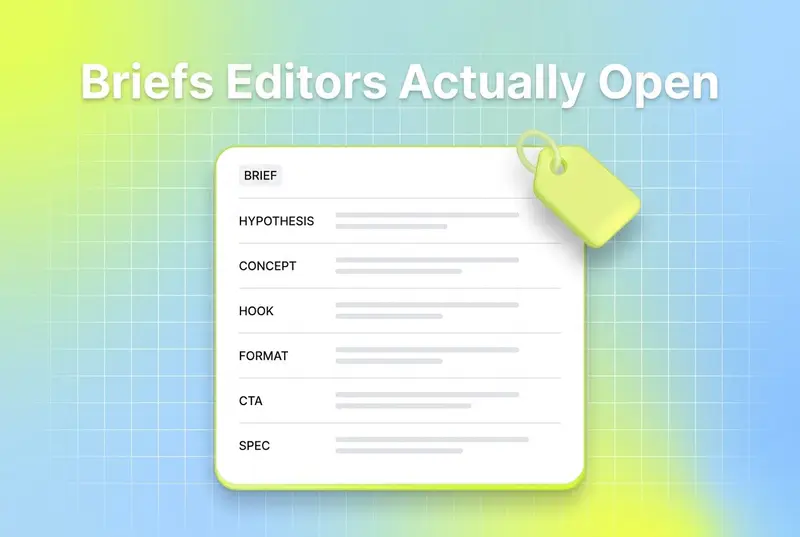
If you sit in a UA seat in 2026, your problem is rarely "I have no ideas." Your problem is that there are 30 places to look, half of them are paywalled, and your team is randomly grabbing screenshots into a Slack channel that nobody opens on Tuesday. By Friday your creative brief is a Frankenstein of three competitor ads from Meta, two TikTok references somebody's intern saved, and a "we should try this" voice memo.
The senior UA folks I trade notes with don't have a secret source. They have a routine. The same five or six tabs every week, two paid tools, two community channels, a couple of newsletters, and one or two creators they actually trust. This guide is that list, in the order I'd suggest building it. Some entries are free. Some cost real money. All of them are used by people running real spend in 2026.
Also read AI in Performance Creative: What's Working and What's Still Hype in 2026
What "creative inspiration" actually means here
Inspiration sources are not the same thing as creative intelligence. Most of what I'm about to list shows you ads. They do not tell you why those ads worked, what hooks tested, what fatigued, or what to ship next. That second layer is where Segwise lives, and I'll come back to it.
The category covers four kinds of input:
Competitor ad libraries (Meta, TikTok, AppLovin) where you see what's actually running
Ad intelligence platforms (AppMagic, Sensor Tower, Mobile Action) where you see ranked creatives plus run-time and spend signal
Organic feeds (TikTok For You, Reels) where the next ad format usually shows up first
Community signal (Reddit, LinkedIn, X, Slack, Discord) where practitioners post what's working
What this category does not cover:
Performance data on your own creatives (that's creative analytics, like Segwise's creative analytics)
Tagging, fatigue tracking, or generation (also Segwise territory)
Audience research or attribution
If you confuse "I saw a competitor's ad" with "I know what's working," you'll burn budget testing copies of ads that may already be fatiguing in their own account.
Key takeaways
Build a weekly inspiration routine, not a daily one. Senior UA folks check 4 to 6 sources on a fixed cadence (usually Monday morning) instead of doom-scrolling competitor ads in real time.
Free beats paid for top-of-funnel scanning. Meta Ads Library, TikTok Creative Center, and the AppLovin Ad Review gallery cost zero and cover most of what you need before you reach for AppMagic, Sensor Tower, or Mobile Action.
Ad intelligence tools are paid for two things: filters and longevity. AppMagic, Sensor Tower, and Mobile Action let you sort by run time, format, and country in ways the free libraries can't.
Organic always leads paid. The hooks, transitions, and audio that show up on your TikTok For You page in April are in your competitors' Meta ads in June.
Community signal compounds. r/useracquisition, the Two & a Half Gamers podcast network on LinkedIn, and a couple of paid Slack/Discord groups (MobileGroove, GameDev/Marketing servers) close gaps the public tools miss.
Inspiration without insight is busywork. Tools like Segwise's Competitor Tracking Agent tag every competitor ad you find and surface angles, hooks, and white space; the Creative Strategy Agent turns those insights into a brief or a generated variant.
The 11 sources senior UA teams actually check in 2026
Each entry below covers what it is, why it matters, what to look for, and the honest limitation. Tools are ordered roughly by how often the senior folks I work with use them, not by ranking.
1. Segwise — Best for turning competitor inspiration into tagged intelligence and ready-to-ship creative

Segwise is a fully agentic AI-powered creative intelligence and generation platform built for mobile apps, DTC brands, and performance marketing agencies. It connects to 15+ ad networks and MMPs, tags every creative element with multimodal AI, and runs an always-on Creative Strategy Agent across your account and your competitors' accounts. The Competitor Tracking Agent and Creative Generation Agent are what put it on this list.
Where Meta Ads Library and TikTok Creative Center give you raw inspiration, Segwise gives you tagged, queryable intelligence. You don't end the week with a folder of screenshots; you end the week with "competitors are leaning into UGC creator hooks with first-person framing in the first 1.5 seconds, and we have zero ads in that style." Then the Creative Generation Agent produces variants based on that gap.
Key features:
Competitor Tracking Agent that monitors competitor ads on Meta and applies the same multimodal tagging as your own creatives so you can compare hooks, CTAs, and visual styles side by side
Creative Strategy Agent (AI Chat) that maintains full context across your account plus tracked competitors and answers plain-language questions like "what hooks are competitors leaning into this month that we don't run?"
Multimodal AI tagging across video, audio, image, text, and the only platform that tags playable ads
Creative Generation Agent that turns winning patterns and competitor gaps into new static creatives (video in beta), with multi-format export sized for Meta, TikTok, Google, Snapchat, and other networks
Cross-platform integration with Meta, Google, TikTok, Snapchat, YouTube, AppLovin, Unity Ads, Mintegral, IronSource and more, plus AppsFlyer, Adjust, Branch, and Singular
Automated fatigue tracking so you catch decline before budget burns, and asset clustering that isolates which treatment changes drove the ROAS difference between similar creatives
Custom tagging, custom metrics, scheduled reports, Slack and email alerts
No-code setup in 10 to 15 minutes, no engineering needed
When you should try it: you actively monitor competitors, you waste real time turning screenshots into briefs, and you want one place where competitor signal, your own creative performance, and creative generation live together. Particularly strong fit for mobile gaming studios, DTC brands, creative strategists, and growth agencies.
Limitations: competitor tracking covers Meta today, with additional networks in development. Video generation is in beta, so video-heavy teams pair Segwise with their existing video pipeline. If your only goal is to browse pretty ads on a Tuesday, the free libraries below are enough.
Pricing: free trial with up to 14 days of historical data imported on setup. Paid plans scale by ad spend and brand count. Start for free or book a demo to see pricing for your stack.
2. Meta Ads Library — Best for free competitor monitoring on Meta and Instagram
The Meta Ads Library is a public, free database of ads running across Facebook and Instagram. You search by advertiser name, keyword, country, or platform, and you get every active and historical ad they've run. In early 2026, Meta added the ability to sort by impression volume, which is the closest thing to "show me their best ads first" that exists in any free tool.
Senior UA folks use it differently from beginners. They aren't browsing ads at random. They keep a list of 15 to 30 competitor pages and check them on a Monday cadence to catch new launches, copy refreshes, and seasonal pulses.
What to look for:
Ads still running 60+ days after launch (proxy for working creatives)
New ads added in the past 7 days (signals competitors testing into a new angle)
Sort by impression volume to find their bigger-budget creatives
Aspect ratios and creator-style content versus brand-style content
Date filters to see when a competitor ramped or pulled back
When you should try it: every week, regardless of platform mix. It's free, the dataset is unique to Meta, and even teams running zero Meta budget use it to track DTC creative trends.
Limitations: it shows the creative and run dates only. No CTR, no spend, no targeting. You don't know if an ad ran for 60 days because it crushed or because someone forgot to pause it. Performance signal is inferred, not stated.
Pricing: free.
3. TikTok Creative Center — Best for free, platform-native trend and Top Ads signal
The TikTok Creative Center is TikTok's free hub for advertisers. The two features senior UA folks actually use are Top Ads and Keyword Insights. Top Ads lets you browse the highest-performing TikTok ads filtered by region, industry, objective, ad format, and time period. Each listing shows the creative, engagement metrics, and run duration.
The Symphony AI assistant launched in 2025 also lives here, but for inspiration the Top Ads dashboard is the value. Top Ads Spotlight is hand-picked editorial picks updated regularly. Filters for In-Feed, TopView, Spark Ads, and Branded Effects let you narrow by exactly the placement you plan to buy.
What to look for:
Top Ads in your industry and region, sorted by engagement
Trending hashtags and songs to align your hooks with what's surfacing organically
Keyword Insights for ad-copy intent signal
Ad format filters to study creatives in the placement you actually buy
When you should try it: every week if TikTok is meaningful in your mix. Even if you don't run TikTok, the trend signal here previews what will show up on Reels and Shorts a quarter later.
Limitations: it shows TikTok's editorial pick of "Top Ads" and engagement, not the full set of every running ad like Meta Ads Library. Engagement is platform-defined, not ROAS, so a top ad can still be a brand-awareness spend rather than a performance winner.
Pricing: free.
4. AppMagic — Best for ranked creative leaderboards in mobile gaming and apps
AppMagic is a mobile market intelligence platform with a strong Ad Intelligence module, particularly loved in mobile gaming. The differentiator is filtering: you can generate top charts of the most successful creatives for specific market segments and filter by type (video, playable, static), store category, ads of an app, and ads inside an app. Few platforms let you slice creatives that cleanly.
AppMagic's annual Mobile Landscape report is also part of why senior UA folks keep the tab open; it breaks down trends across Casual, Midcore, and Hypercasual gaming plus Generative AI, Entertainment, Social, and Tools categories.
Key features:
Creative leaderboards across networks with filterable rank
Filter by format (video, playable, static), region, store category
Competitor ad strategy tracking and ad-spend estimates
Mobile Landscape research reports for category-level inspiration
When you should try it: you run apps or games, you want a paid layer beyond Meta Ads Library and TikTok Creative Center, and you want to see ranked creatives across networks rather than hunt page by page.
Limitations: pricing isn't public; you'll go through a sales conversation. Coverage skews toward mobile apps and games (less useful for pure DTC web brands). Like every ad intelligence tool, ranked "top creatives" rely on the platform's own modeling of impression volume.
Pricing: contact AppMagic for pricing. Free tier available with limited features.
5. Sensor Tower Ad Intelligence (Pathmatics) — Best for cross-network advertiser-level intelligence
Sensor Tower's Ad Intelligence, with Pathmatics included, lets you see which ad networks competitors use, what the creatives look like, where they spend, and how their paid acquisition strategy has shifted over time. It's the platform you reach for when "what is competitor X actually doing in the US versus Brazil this quarter" is a real question.
Senior UA folks use Sensor Tower less for daily browsing and more for quarterly competitor deep-dives, market entry research, and ad-spend benchmarking. The data depth is the value. The pricing is the barrier.
Key features:
Ad creative library across mobile and digital with run-time data
Network-level ad-spend estimates per advertiser
Audience Intelligence, App Intelligence, and Market Intelligence modules
Pathmatics for digital-display and DTC creative coverage
Custom dashboards and exports
When you should try it: you have budget for an enterprise contract, you do quarterly competitive reviews, you cover multiple geos, and you need defensible market data for leadership and board reporting.
Limitations: Sensor Tower does not publicly list pricing; most contracts fall between $30K and $150K per year, with enterprise deployments exceeding $250K. Most mid-tier mobile teams that need ad intelligence spend $1K to $3K per month and feel the cost. Data is modeled, not observed; treat estimates as directional.
Pricing: custom enterprise pricing, typically $30K to $150K+ per year depending on modules and coverage.
6. Mobile Action — Best for the widest creative library across formats and networks
Mobile Action's Ad Intelligence covers 76M+ ad creatives, 45+ ad networks and DSPs, and 10 ad formats. Users frequently call out that it has the widest creative library in the category. If your goal is "I want to see every live creative this advertiser has running across every network," Mobile Action is the tool that gets closest.
It pairs with their ASO and Market Intelligence modules, which makes it a fit for teams that want one platform across acquisition and store optimization rather than two separate vendors.
Key features:
76M+ creatives, 45+ ad networks, 10+ ad formats
Live and inactive creative tracking with custom filters
Advertiser-level analysis: networks used, run time, format mix
ASO suite plus market intelligence in the same login
Annual ASO Report and trend research published openly
When you should try it: you want the broadest possible creative coverage across networks, you want ASO and ad intel in one tool, and AppMagic or Sensor Tower don't fit your budget or workflow.
Limitations: pricing is custom and varies by modules. Like all ad intel tools, the "live" status of a creative is platform-modeled, so cross-check against the Meta Ads Library and TikTok Creative Center for confirmation.
Pricing: custom, by demo. Free trial available for some modules.
7. AppLovin Creative Gallery (Ad Review) — Best for mobile gaming creative inspiration straight from the network
If you run UA on AppLovin, the Ad Review tool inside MAX is an underused free creative gallery. From MAX, navigate to Ad Review, Review, then Creatives to see the ads served in your app filtered by network, title, title category, country, and timeframe. AppLovin's in-house team SparkLabs also produces tens of thousands of creatives a year, which feed into the ecosystem you see here.
It's a publisher-side feature, but advertisers use it to see what other advertisers' winning creatives look like inside the AppLovin ecosystem. Particularly useful for hybrid casual and casual gaming teams whose competitive set lives there.
Key features:
Creative gallery filtered by network, title, country, timeframe
Ad review workflow grouping similar creatives intelligently
Coverage of playable ads (essential for mobile gaming UA)
Direct view of what's running on AppLovin's exchange (ALX)
When you should try it: you publish or advertise meaningfully on AppLovin. Hybrid casual and casual studios get the most out of it; non-gaming advertisers get less.
Limitations: it's a MAX feature, so you need an AppLovin account with the right permissions. Coverage is concentrated in mobile gaming. Less relevant for DTC, subscription, or non-AppLovin teams.
Pricing: free with an AppLovin account.
8. Organic TikTok For You and Reels feeds — Best for catching the next ad format before everyone else
This isn't a tool. It's a habit. Every senior UA person I trade notes with maintains a dedicated TikTok account (and increasingly an Instagram Reels account) curated to their category. They scroll for 15 minutes a day to see formats, hooks, and audio before those signals show up in paid creatives.
The pattern is consistent. A hook style trends organically on TikTok in February. Independent creators package it. By April, performance brands run it as paid ads. By June, it's everywhere on Meta and Reels. If you're sourcing inspiration only from competitor ad libraries, you're already a quarter behind.
What to do:
Use a separate phone or work account so the algorithm trains to your category
Save 5 to 10 references per week into a shared Slack/Notion folder
Note hooks, audio choices, transitions, and creator framing
Watch for native formats (POV, voice-over walk-throughs, screen-record reaction)
When you should try it: every UA team should do this. Cost is zero. Time is 15 minutes per day for the senior person closest to the creative brief.
Limitations: it's noisy. Your saved references will outpace your team's ability to actually test them. This is where Segwise's Creative Strategy Agent earns its keep, by translating what you saw organically into a brief or a generated variant against your winning patterns.
Pricing: free.
9. UA voices on X and LinkedIn — Best for tactical, in-the-trenches signal
Specific people in 2026 are still writing useful UA content publicly. The names that come up consistently in senior UA Slack groups: Eric Seufert (Mobile Dev Memo, on X and his newsletter), Matej Lancaric (UA consultant, Two & a Half Gamers podcast), Felix Braberg (ad monetization), Ilya Sukharev, Jakub Remiar, and the broader Adjust, AppsFlyer, and Liftoff content teams on LinkedIn.
The signal is strongest from individual practitioners (not vendor blogs). You're looking for people who post screenshots of actual campaign data, share creative tear-downs, or call out new ad-format launches before they hit official documentation.
What to look for:
Newsletters with pay-walled deep dives (Mobile Dev Memo, Lancaric Substack, Felix Braberg's Substack)
Podcasts: Two & a Half Gamers, Mobile User Acquisition Show, Sub Club
LinkedIn carousels from senior UA folks at gaming studios and agencies
X threads on platform changes (SKAN, ATT, AEM, Andromeda, Smart+, etc.)
When you should try it: every week. Sub to 5 to 10 individuals, mute the rest. Keep your feed signal-dense.
Limitations: signal-to-noise gets worse every quarter. Vendor-funded "thought leadership" pollutes the mid-funnel. Trust people who post numbers.
Pricing: free for most public posts; some Substacks paywall their best deep dives.
10. Reddit — Best for unfiltered practitioner discussion
r/useracquisition, r/mobilegamedev, and r/PerformanceMarketing are where UA managers go when they don't want a vendor pitch. You'll find honest discussions about which networks are working, which MMP is melting, and which creative format is fatiguing across categories.
Reddit has 70 million daily active users in 2026, and Adjust's data shows users acquired through Reddit have 22% higher D30 retention, 136% higher D1 spend rates, and 200% higher LTV in the first 30 days post-download than other social platforms. Both as an inspiration source and as a UA channel, it's underused by most performance teams.
What to look for:
Threads asking "what's working in [network] right now?" with practitioner replies
Creative tear-downs and screenshot-heavy posts
Vendor reviews and complaint threads (treat as a directional signal)
Cross-posts from r/mobilegamedev about new monetization or UA mechanics
When you should try it: weekly scan, more often during platform changes. Avoid commenting until you've read enough to know the regulars.
Limitations: signal is uneven. Some threads are gold; some are juniors arguing. The subreddit moderation varies. You won't find named-brand competitor data here.
Pricing: free.
11. Slack and Discord communities — Best for the "real talk" that doesn't make it to public channels
Two layers exist here. Free or low-cost: marketing-focused Slack groups (MeasureSlack, MobileGroove for mobile UA folks, Two & a Half Gamers community), Discord servers tied to gaming studios and indie dev communities. Paid: smaller, vetted groups run by individual operators or agencies where 50 to 200 senior UA folks share screenshots, account-level data, and unfiltered platform feedback.
The value isn't the channels' archives. It's the synchronous DMs. When iOS rolls out a new SKAN postback, when Meta tightens AEM, when Andromeda starts deranking your favorite creative, you'll learn faster from a Slack DM than from any newsletter.
What to look for:
Active channels, not graveyards (check post frequency before joining)
Senior UA folks willing to share screenshots of real account data
Vendor-free or vendor-light communities (most paid groups are stricter on this)
DM access to people who run the kind of accounts you run
When you should try it: once you've built a public-source routine and want the next 10% of signal that doesn't get posted publicly. Senior UA folks spend more time here than on Reddit or Twitter.
Limitations: invite-only or paid in many cases. Quality varies wildly. A bad community is worse than no community because it eats time without giving signal back.
Pricing: free for most public groups; $50 to $500 per month for some vetted operator-run groups.
Quick comparison table
How to systematise the inflow (so you actually use any of this)
Most teams fail not at finding sources but at processing them. A loose pile of competitor screenshots is not creative strategy. Here's the routine senior UA folks I work with run, in roughly the same shape:
Weekly Monday scan, 60 to 90 minutes total. Open four tabs: Meta Ads Library (your competitor list), TikTok Creative Center Top Ads, AppMagic or Mobile Action filtered to your category, and the three Reddit threads you bookmarked Friday. Save references into one folder per category (hook, format, audio, transition, CTA).
Daily 15-minute organic scroll. Dedicated TikTok and Reels accounts. Save 5 to 10 references per day. Tag with format and hypothesis ("first-person POV opens are crushing right now in skincare").
Wednesday team huddle, 30 minutes. Three to five references per UA, brief tear-down per asset (what's the hook, why is it working, what's our equivalent test). Senior person picks two for the next sprint.
Friday brief and ship. Translate the picks into a creative brief or a generated variant. Hand to design or to the Creative Generation Agent. Tag the originals so you can compare your version's performance against the inspiration.
Monthly competitor review, 2 hours. Pull a Sensor Tower, AppMagic, or Segwise Competitor Tracking export. Look at run-time and ad-count trends. Note who launched a new angle, who pulled back, who moved networks.
The point of the routine is not to look at more ads. It's to convert raw inspiration into shipped creative tests inside two weeks. Inspiration that doesn't ship is just procrastination with extra steps.
How to choose where to invest your time
The honest answer is most teams need three layers, not one. The core stack for UA inspiration in 2026 is Segwise for tagged competitor intelligence and creative generation, the Meta Ads Library for free Meta and Instagram ad monitoring, and the TikTok Creative Center for platform-native trend signal, with a paid ad intelligence tool layered in based on category fit.
If you need a single platform that turns competitor inspiration into tagged intelligence and ready-to-ship creative variants, Segwise is the right fit because the Competitor Tracking Agent and Creative Generation Agent close the loop from "saw a competitor ad" to "shipped a tested variant" without manual hand-offs.
If your primary need is free, broad competitor visibility on Meta and Instagram, the Meta Ads Library is enough. Layer Segwise on top when you want tagging and gap analysis instead of screenshots.
If TikTok is more than 20% of your spend, the TikTok Creative Center is non-negotiable. Read Top Ads weekly and use Keyword Insights to align ad copy with platform-native intent.
If you run mobile apps or games and need ranked creative leaderboards across networks, AppMagic is the right paid layer. If your team also needs ASO in the same tool, Mobile Action gets the call.
If you have enterprise budget and need cross-network advertiser deep-dives plus market data for leadership reporting, Sensor Tower is worth the contract. Treat estimates as directional, not gospel.
If you're just trying to stop falling behind on new formats, the highest-leverage thing you can do this week is open a fresh TikTok account in incognito, train it on your category, and put 15 minutes on your daily calendar. The free organic feed beats every paid tool for early signal.
Bottom line
The best UA teams in 2026 don't have a magic source. They run a tight weekly routine, and Segwise, the Meta Ads Library, and the TikTok Creative Center are the three most-checked names on that routine, paired with a paid ad intelligence layer (AppMagic, Sensor Tower, or Mobile Action), a curated organic feed, and two or three trusted communities. Segwise is the layer that converts every competitor ad you find into tagged intelligence and a generated creative variant, so inspiration actually turns into shipped tests. If your folder of competitor screenshots hasn't produced a single creative this quarter, the problem is the workflow, not the sources. Start with Segwise.
Frequently asked questions
What are the best sources for UA creative inspiration in 2026?
The best sources for UA creative inspiration in 2026 combine free competitor libraries (Meta Ads Library, TikTok Creative Center, AppLovin Creative Gallery), paid ad intelligence tools (AppMagic, Sensor Tower, Mobile Action), organic feeds on TikTok and Reels, and practitioner communities on Reddit, Slack, and Discord. Senior UA teams check 4 to 6 of these on a weekly cadence rather than browsing daily. Segwise pairs with this routine by tagging every competitor ad you find with multimodal AI and turning the patterns into briefs or generated variants through its Competitor Tracking and Creative Generation Agents.
How do I find what's working in competitor ads on Meta?
To find what's working in competitor ads on Meta, use the Meta Ads Library and search by competitor brand or page name. Sort by impression volume (added in early 2026) to surface their bigger-budget creatives, look for ads still running 60+ days after launch as a proxy for performance, and check the date filter to spot ramp-ups and pull-backs. Meta Ads Library shows you the creatives but no CTR, spend, or targeting data. Segwise's Competitor Tracking Agent fills that gap by tagging the creatives with multimodal AI and surfacing hooks, CTAs, and white-space angles competitors miss.
What's the difference between Meta Ads Library and Sensor Tower or AppMagic?
The Meta Ads Library is a free public archive of every active and historical ad on Meta and Instagram, with no performance metrics. Sensor Tower and AppMagic are paid ad intelligence platforms that estimate ad spend, sort creatives by modeled performance, cover dozens of networks beyond Meta, and provide advertiser-level deep-dives across geographies. The free libraries are best for daily monitoring; paid tools are best for quarterly competitive reviews and cross-network research. Segwise complements both by tagging the creatives you collect from any source and turning them into actionable creative briefs through its Creative Strategy Agent.
Where do mobile gaming UA teams get creative inspiration in 2026?
Mobile gaming UA teams in 2026 lean heavily on AppMagic for ranked creative leaderboards filtered by genre and format, Mobile Action for the broadest cross-network creative library, AppLovin's Ad Review gallery for direct exposure to playable ads, and the TikTok Creative Center for trend signal. Reddit's r/mobilegamedev and r/useracquisition plus the Two & a Half Gamers podcast network add community signal. Segwise is the only platform in this stack that tags playable (interactive) ads, which is essential for hybrid casual and casual gaming UA.
Where do DTC and ecommerce teams get creative inspiration in 2026?
DTC and ecommerce teams in 2026 rely on the Meta Ads Library for competitor monitoring, the TikTok Creative Center for Reels-equivalent trend signal, Sensor Tower's Pathmatics for digital and OOH coverage, organic TikTok and Reels feeds curated by category, and creator-style content tear-downs on LinkedIn. The shift toward creator-led ads (real faces, informal language) means organic signal leads paid by a quarter or more. Segwise pairs with this routine by tagging UGC creator ads with multimodal AI and feeding the patterns into the Creative Generation Agent for DTC brands.
How do agencies systematise creative inspiration across multiple clients?
Agencies in 2026 systematise creative inspiration by running a shared weekly routine across Meta Ads Library, TikTok Creative Center, and an ad intelligence tool like AppMagic or Mobile Action, then mapping references to each client's category. Segwise is widely used by growth agencies because Studio View handles multi-client management, the Competitor Tracking Agent runs per client, and the Creative Generation Agent produces variants tagged to each client's winning patterns, replacing the manual screenshot-into-Slack workflow most agencies still run.
Is Reddit actually used by senior UA managers for inspiration?
Yes, senior UA managers use Reddit (r/useracquisition, r/mobilegamedev, r/PerformanceMarketing) as a regular signal source in 2026. Reddit has 70 million daily active users and the discussions are noticeably less vendor-polluted than LinkedIn or X. Senior UA folks treat Reddit as a directional signal source for what's working across networks and as an early-warning system for platform changes (SKAN, AEM, Andromeda). Reddit doesn't replace ad libraries or paid tools like AppMagic, Sensor Tower, or Segwise; it complements them with practitioner-level honesty.
How do I turn creative inspiration into actual shipped tests?
To turn creative inspiration into shipped tests, run a weekly Monday scan across your sources, save references with a hypothesis attached, hold a 30-minute Wednesday tear-down with your team, brief and ship by Friday, and tag the inspirations to the variant so you can measure performance against the source. Most teams fail at the brief-to-ship step because they treat inspiration as a content library instead of a pipeline. Tools like Segwise close the loop by translating tagged competitor patterns directly into briefs and generated variants, so inspiration becomes shipped creative inside two weeks rather than two quarters.