
Updated August 2026. Both vendors’ live pricing and product pages were re-checked on 31 August 2026.
Short answer: These two are adjacent, not interchangeable. Foreplay ($59 / $175 / $459 per month) is the ad-library, swipe-file and creative-brief tool: it is where you find and brief ideas. Segwise is the creative intelligence layer: multimodal tagging of video, audio, static and playable ads across 15+ ad networks and MMPs, fatigue detection, and AI generation from your own winning patterns. Plenty of teams pay for both.
You run numerous ad tests, but you can’t identify which creative elements influence the results. Teams guess which image, headline, or sound works, wasting budget and hindering growth. This slows optimization, causes creative churn, and loses revenue. Scattered attribution across networks and tools delays decisions and hides wins.
Segwise and Foreplay solve this in different ways. Segwise links element-level tags with MMP and ad-network data so creative signals tie directly to metrics like ROAS, CPA, IPM, and LTV. Foreplay speeds up discovery, organizes swipe files, and builds briefs with Lens for fast creative reviews.
In this blog, we’ll compare Segwise and Foreplay, outline their core features, highlight key differences, and finish with pricing, use cases, and a quick pilot plan to help you pick the right tool.
Key Takeaways
Segwise focuses on element-level tagging, MMP linkage, and automated monitoring for multi-network performance teams.
Foreplay focuses on ad discovery, swipe files, creative briefs, and a visual creative analytics product called Lens that helps teams review performance.
Choose Segwise when you need to link creative elements to ROAS, CPA, and LTV, and run campaigns across multiple networks.
Choose Foreplay when your priority is fast inspiration, organized swipe files, brief generation, and easy sharing with stakeholders.
Run a short pilot for each tool and measure how quickly insights become actionable changes before you scale.
They are adjacent tools, and running both is a normal setup: Foreplay upstream for inspiration, swipe files and briefs; Segwise downstream for performance-linked tagging, analytics and generation. Treat this as “which job comes first”, not “which vendor wins”.
Foreplay pricing (Aug 2026): $59, $175 and $459 per month, or $49, $149 and $389 per month billed annually, with Enterprise custom. It is seat-bundled, 1, 5 and 10 users by tier, $20 per extra seat, and explicitly not charged on ad spend, which is its main pricing pitch against spend-tiered analytics tools.
Foreplay has a public API: it shipped on 18 June 2026.
What is Segwise?
Segwise is an AI-powered creative analytics platform that automatically tags images, video, audio, and playables, then links those tags to performance data so teams can see which creative elements drive conversions and revenue.
It reports tag-level metrics such as ROAS, CPA, IPM, and LTV by combining ad network data with MMP-attributed conversions, letting you evaluate creative impact across channels. It connects to 15+ ad networks and MMPs: Meta, Google, TikTok, Snapchat, YouTube, Axon (AppLovin), Unity Ads, Mintegral, IronSource and more, plus AppsFlyer, Adjust, Branch and Singular, with no-code OAuth setup that takes about five minutes per source. The free trial runs 7 days, no credit card, and imports up to two weeks of historical data automatically; paid plans backfill up to three months.
Segwise is built as four AI agents rather than one dashboard, and two of them matter a lot in this comparison:
Creative Tagging Agent: multimodal tagging across video, audio, image and text, plus custom and nomenclature-based tags. Segwise is the only platform that tags playable (interactive) ads.
Creative Strategy Agent (AI Chat): an always-on creative strategist holding full context on your creatives, tags, custom metrics, fatigue patterns and competitor data. Ask “what separates my top five creatives from my bottom five?” in plain language, or ask it to build a weekly stakeholder report and hand back a shareable link. It also powers fatigue tracking and asset clustering.
Creative Generation Agent: generates net-new statics, video ads (including AI UGC-style video), playable ads and scene-by-scene storyboards from your winning tags, editable by prompting and exportable in each network’s aspect ratios. Whatever it produces is auto-tagged and tracked once live, so results feed back into the same data that produced them.
Competitor Tracking Agent: monitors and tags competitors’ ads (currently Meta) and runs gap analysis on angles nobody in your category is using.
What is Foreplay?
Foreplay is a creative workflow and inspiration platform for marketers and agencies. Teams can save ads from public libraries, build swipe files and boards, generate briefs with AI, and use Lens, its creative analytics tool, to produce visual reports and creative performance summaries.
It is positioned as a single hub for ad inspiration, creative research and team collaboration. E-commerce brands and agencies commonly use it as a shared repository for high-performing ads and ideas.
Foreplay pricing (foreplay.co/pricing, checked 31 August 2026): Basic $59/month (1 seat), Workflow $175/month (up to 5 seats), Agency $459/month (up to 10 seats), Enterprise custom, or $49, $149 and $389 per month on annual billing. Extra seats are $20 each. The important detail is the billing basis: seats and brands, explicitly not ad spend, which is exactly how Foreplay positions itself against spend-tiered analytics tools. There is a 7-day free trial with no card required up front, and a 14-day money-back guarantee after the first charge. Usage limits worth checking: Lens covers 1 brand on Workflow and 10 on Agency (with unlimited ad spend), Spyder tracks 15 brands on Basic/Workflow and 50 on Agency (unlimited on annual plans), and the API allows 10,000 credits monthly or 20,000 annually.
What Foreplay shipped recently:Lens, its creative analytics product, launched 29 May 2025 and was marketed as “the only analytics tool that doesn’t charge you based on your ad spend”; the pricing restructure that bundled seats and put Briefs on every tier followed on 9 June 2025. More recently, Foreplay launched a public API on 18 June 2026, which surfaces ad videos, images and transcription data: useful if you want to pipe swipe-file data into your own stack.
Feature Overview: Segwise vs Foreplay
Comparing their features side by side reveals how Segwise prioritizes performance measurement, while Foreplay focuses on creative discovery and collaboration, as outlined in the table below:
Feature | Description | Segwise | Foreplay |
Creative Analytics | Intuitive dashboards and visual reports to explore performance and uncover insights. | ✅ | ✅ |
Number of Ad Accounts | Number of ad accounts that can be connected. | Unlimited | Not metered by ad account: Lens covers 1 brand (Workflow) or 10 brands (Agency), with unlimited ad spend |
Number of Seats | Number of users who can access the platform. | Unlimited | 1 / 5 / 10 seats bundled by tier, then $20 per extra seat |
Nomenclature-Based Tagging | Extract creative metadata from creative names for better organization. | ✅ | ✅ |
Creative-Based Automatic Tagging | AI based automatic tagging of elements of ads/playables | ✅ Video, audio, image, text and playables, mapped to metrics | Partial: AI content-style filters and tagging inside the swipe file, but not element-level tags mapped to your own performance data |
Launch Tracking Reports | Monitor the performance of newly launched creatives in real time. | ✅ | ❌ |
Cross-Network Reports | Unified creative performance reports across all ad networks with enhanced visibility | ✅ | ✅ |
Backend & MMP Data | Integrate MMPs (AppsFlyer, Adjust, Branch) with ad network data in one dashboard. | ✅ | ❌ |
Clustering Agent | Cluster creatives across ad networks and campaigns to analyze performance. | ✅ | ❌ |
Tagging & Tag Enrichment | AI tags to extract creative variables and enrich data automatically. | ✅ Standard, custom and nomenclature tags, grouped and mapped to metrics | Partial: library-side AI tagging and filters for discovery, not tag-to-metric enrichment |
Creative Fatigue Detection | Catch ads showing early signs of fatigue with automated reports. | ✅ | ❌ |
Programmatic Ad Connections | Supports AppLovin, Mintegral, Unity, Molocco, and other programmatic ads. | ✅ | ❌ |
Paid Network Connections | Integrates with Google, Meta, TikTok, and other major paid platforms. | ✅ | ✅ |
Customer Support | Dedicated CSM for enterprise accounts + live chat & email support. | ✅ | ✅ |
Customizable Dashboards | Fully custom dashboards with white-label reporting options. | ✅ | ✅ White-label share boards and password-protected Lens reports |
Ad Library / Swipe File | Save, search and organise other brands’ ads for inspiration. | Competitor Tracking Agent (currently Meta), tagged with the same AI as your own ads | ✅ The core product: swipe files, boards, Spyder brand tracking. Foreplay’s clearest strength |
Creative Briefs | Turn references into a brief a designer or editor can execute. | ✅ Data-backed briefs and scene-by-scene video storyboards from winning tags | ✅ AI Briefs on every tier, built from saved reference ads |
AI Creative Generation | Produce finished ad assets, not just briefs. | ✅ Statics, video, AI UGC-style video and playables, generated from your winning patterns and auto-tracked once live | ❌ Briefs and references, not finished asset generation |
AI Creative Strategist (Chat) | Ask questions about your creative data in plain language. | ✅ Creative Strategy Agent (AI Chat) with full account context and on-demand reports | ❌ |
Playable Ad Support | Tagging and generating interactive/playable ads. | ✅ Tags and generates playables | ❌ |
Public API | Programmatic access to the platform’s data. | No-code integrations plus published integration docs | ✅ Public API launched 18 June 2026 (10,000 credits/month, 20,000 annual) |
Pricing Basis (Aug 2026) | How each vendor charges. | Subscription quoted per account; 7-day free trial, no credit card | $59 / $175 / $459 per month ($49 / $149 / $389 annual), Enterprise custom: seat-bundled, not ad-spend based |
Seeing the features in context is useful, but the real question is how they fit your team’s goals. The following section breaks this down.
Also Read: Creative Optimization in 2025: Actionable Insights Report
Which Platform Is Right for You?
Choosing between Segwise and Foreplay is really a question about sequence: do you need help deciding what to make next, or help proving what is already working and why?
Both tools help creative and marketing teams, but they sit at different points in the same workflow. Foreplay is built for discovery, swipe files and briefing, with Lens adding creative analytics on top. Segwise is built for element-level measurement across networks and MMPs, fatigue prevention, and generating the next round of assets from what the data says works.
Worth saying plainly: this is not an either/or for many teams. A common setup is Foreplay as the research and briefing layer for creative strategists, and Segwise as the measurement and generation layer for the UA or growth team. If your budget covers both, they overlap far less than a comparison page would suggest. If it covers one, pick by bottleneck: ideas or evidence.
Choose Segwise if you want
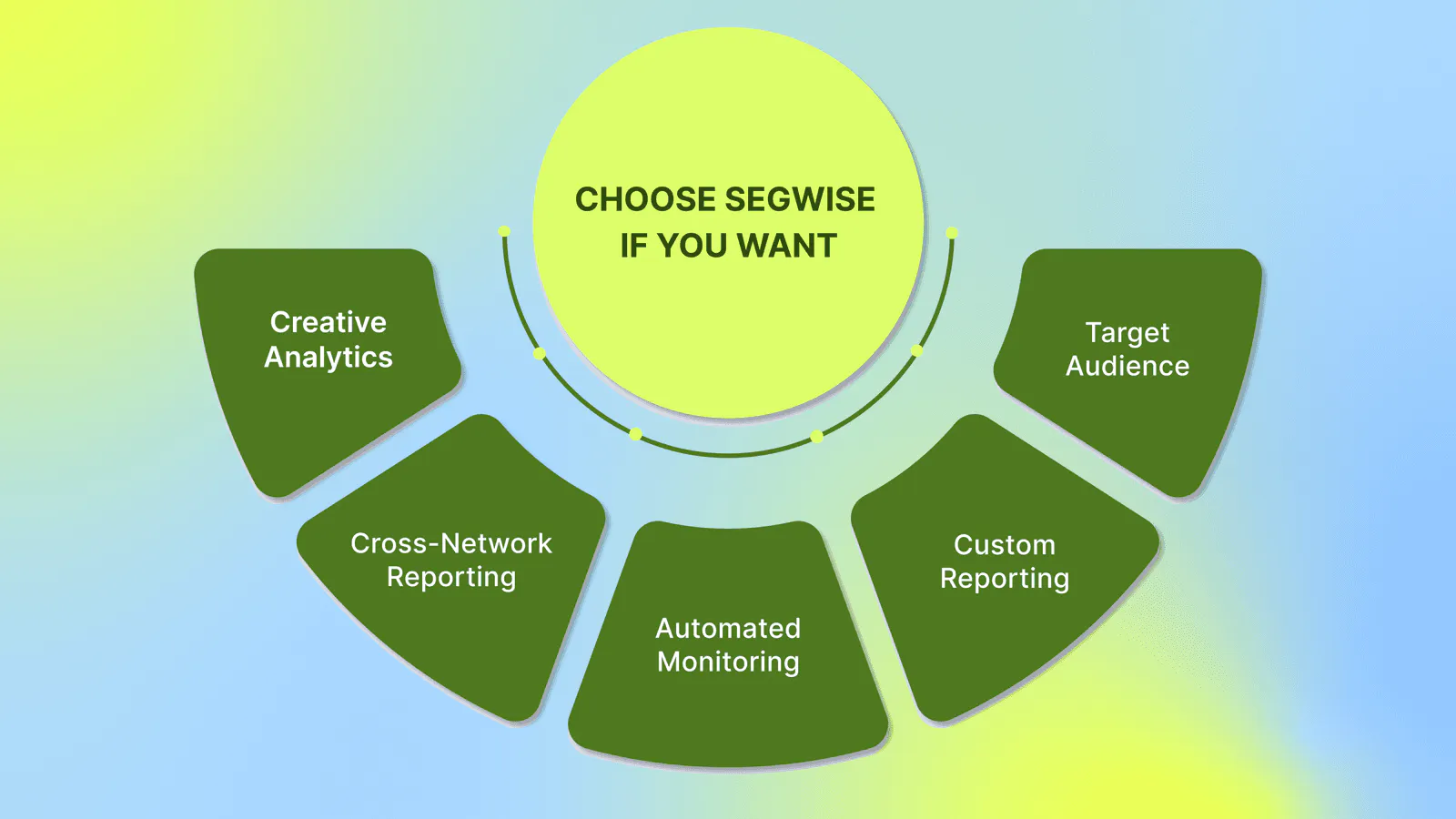
AI-Powered Creative Analytics:
Segwise automatically tags visual, text, audio, and interactive elements in your ads, from hooks and overlays to motion cues and CTAs. These granular tags are tied to live performance metrics, revealing which creative components actually drive installs, clicks, or purchases.Cross-Network Reporting with MMP Linkage:
Where Lens reports on the ad accounts you connect to it, Segwise joins ad-network data to MMP-attributed conversions across 15+ networks and MMPs: Meta, TikTok, Google, Snapchat, Axon (AppLovin), Unity, Mintegral and IronSource, plus AppsFlyer, Adjust, Branch and Singular. Every tag maps to metrics such as ROAS, CPA, CTR, IPM, and LTV, enabling true creative-to-outcome correlation.Automated Monitoring and Fatigue Detection:
Segwise continuously tracks new ad launches, detects early signs of fatigue, and highlights anomalies in real time, giving performance marketers a predictive advantage before results dip.Custom Reporting, Collaboration, and Pilot Access:
Teams can build dashboards tailored to their KPIs, automate exports, and run cross-network comparisons with zero manual tagging. Plus, Segwise offers a 7-day free trial (no credit card required) that automatically imports up to two weeks of historical data: enough to validate tag precision and reporting depth on day one. Paid plans backfill up to three months.AI Creative Generation, Grounded in Your Own Data:
Segwise does not stop at analysis. The Creative Generation Agent produces net-new statics, video ads, AI UGC-style video, playable ads and scene-by-scene storyboards built from your winning tags, editable by prompting and exportable in every network’s aspect ratios. Because each generated asset is auto-tagged and tracked once live, generation and measurement run as one loop. This is the clearest functional difference from Foreplay, which briefs creative rather than producing finished assets.An AI Creative Strategist You Can Ask Anything:
The Creative Strategy Agent (AI Chat) holds full context on your creatives, tags, custom metrics, fatigue patterns and competitor tracking. Ask which hook drove your cheapest installs last month, or ask for a weekly stakeholder report and get a shareable link back: no dashboard-building, no exports.Best For:
Performance marketers, UA teams, and growth agencies who want creative-level attribution, fatigue prevention, and scalable optimization, not just inspiration.
Choose Foreplay if you want

Central Swipe File and Ad Discovery:
Foreplay makes it easy to browse, save, and categorize ads from Meta, TikTok, and other platforms, ideal for curating inspiration boards or competitor reference sets.Lens Creative Analytics:
Lens (launched May 2025) connects your ad accounts and reports real performance, dashboards, creative leaderboards, test performance charts and password-protected shareable reports, and it deliberately does not charge on ad spend. What it does not do is tag creatives at element level against your metrics, cover programmatic and gaming networks, or read MMP-attributed post-install events; that is the boundary between Lens and a creative intelligence platform, not a claim that Lens lacks performance data.AI Briefs and Workflow Tools:
Foreplay includes AI-generated creative briefs and board organization features to move from inspiration to production, useful for creative planning, not measurement.Predictable, Spend-Independent Pricing:
$59, $175 and $459 per month ($49, $149 and $389 annually) with Enterprise custom, seats bundled 1/5/10 by tier and $20 for extras, and crucially not tied to your ad spend, so the bill does not grow as you scale budget. There is a 7-day trial with no card up front and a 14-day money-back guarantee after the first charge (checked 31 August 2026).A Public API:
Foreplay shipped a public API on 18 June 2026 (10,000 credits monthly, 20,000 on annual plans), so swipe-file data, including ad videos, images and transcriptions, can feed your own systems. That is not a small thing.Best For:
Creative strategists, e-commerce brands and agencies whose bottleneck is finding references, organising them and briefing production, with Lens giving them a spend-independent read on how the resulting ads performed.
Pricing: Segwise vs Foreplay (checked 31 August 2026)
Item | Segwise | Foreplay |
Free trial | 7 days, no credit card; up to 2 weeks of history imported automatically | 7 days, no card required up front; 14-day money-back guarantee after the first charge |
Entry plan | Quoted per account | Basic: $59/month ($49 annual), 1 seat |
Mid plan | Quoted per account | Workflow: $175/month ($149 annual), up to 5 seats, Lens for 1 brand |
Upper plan | Quoted per account | Agency: $459/month ($389 annual), up to 10 seats, Lens for 10 brands |
Enterprise | Custom | Custom: unlimited users and usage |
Billing basis | Subscription; not charged on ad spend, seats and connected accounts not metered | Seats and brands, explicitly not ad spend; $20 per extra seat |
Neither vendor charges on media spend, which is worth noting because much of this category does. The practical difference is what you are buying per dollar: Foreplay sells seats on a research and briefing workspace, Segwise sells a measurement-and-generation layer over your whole media mix.
Running both: who does what
Since many teams end up with both, here is a division of labour that works:
Discovery and swipe file: Foreplay. Spyder tracks competitor brands automatically; boards hold the references your strategists actually reuse.
Briefing: either, depending on your input. Foreplay briefs from reference ads. Segwise briefs and storyboards from your own winning tags. Reference-led briefs are faster; data-led briefs are more defensible.
Tagging and element-level measurement: Segwise. Video, audio, image, text and playable tagging, mapped to ROAS, CPA, IPM and MMP-attributed events, with asset clustering to isolate which single change moved the number.
Fatigue and launch monitoring: Segwise. Custom fatigue thresholds and new-creative success criteria, with email and Slack alerts.
Production: Segwise, or your studio. The Creative Generation Agent outputs finished statics, video, AI UGC-style video and playables; Foreplay stops at the brief.
Client-facing reporting: either. Foreplay has white-label boards and password-protected Lens reports; Segwise has custom dashboards, scheduled delivery and public share links.
What changed since we first published this comparison
This page went up in September 2025. Since then:
Foreplay shipped a public API (18 June 2026), with 10,000 credits monthly or 20,000 on annual plans, so “no programmatic access” is no longer a fair criticism.
Its pricing and Lens positioning settled. Lens arrived 29 May 2025 and the seat-bundled restructure landed 9 June 2025; the current ladder is $59 / $175 / $459 per month, or $49 / $149 / $389 annually, Enterprise custom. Any figure tied to ad spend is wrong by design here.
On the Segwise side, creative generation is generally available (nothing is in beta), the free trial is 7 days with up to two weeks of automatic backfill, the Competitor Tracking Agent is live on Meta, and coverage is 15+ ad networks and MMPs.
By matching each product to its ideal use case, you can narrow the choice. The final section ties everything together and offers a clear next step.
Also Read: Strategies for Scalable Game User Acquisition
Conclusion
Segwise and Foreplay both use AI to help teams with creative work, but they solve different problems. Foreplay focuses on fast ad discovery, searchable swipe files, AI brief generation, and Lens visual reports for creative reviews and stakeholder sharing. Its strengths are discovery, organised assets, briefing and, via Lens, spend-independent performance reporting on the ad accounts you connect, plus, since June 2026, a public API.
Whereas Segwise is built for element-level tagging, cross-network reporting, and MMP-linked attribution so creative signals map to metrics like ROAS, CPA, IPM, and LTV. It also offers real-time monitoring, automated fatigue alerts, and workflow tools such as a Meta Ad Library tracker, a Video→Playable converter, and the UA Boss Game to support day-to-day operations.
If your priority is tying creative elements directly to business outcomes and scaling measurement across multiple ad platforms, choose Segwise. Start Segwise’s free trial (no credit card required) to see how it improves creative decision-making and user-acquisition performance.
FAQs
1. Do either product offer a public API or data feed?
Yes, both: differently. Foreplay launched a public API on 18 June 2026 (10,000 credits monthly, 20,000 on annual plans) that surfaces ad videos, images and transcription data from its library. Segwise leans on no-code OAuth integrations with 15+ ad networks and MMPs plus published integration docs, so the data it consolidates is your own creative performance rather than a public ad library.
2. How do they handle privacy and data protection?
Both companies publish privacy policies that explain data handling and user rights, review each policy for details on retention, transfers, and your rights under laws like GDPR.
3. What kind of onboarding and help can I expect?
Foreplay maintains an FAQ and support resources for setup; Segwise publishes guides and integration docs and runs sales/onboarding channels for hands-on help.
4. Can I export ads, media, or report data for my own analysis?
Yes, Foreplay’s API surfaces videos, images, and transcription data; Segwise documents connectors and reporting features that let teams pull creative and performance data.
5. How do I get pricing for enterprise, agency, or multi-client use?
Both vendors direct enterprise or agency buyers to contact sales for custom plans, volume pricing, and contract terms. Use their pricing/contact pages to request a demo or quote.
6. How much does Foreplay cost in 2026?
Basic $59/month, Workflow $175/month and Agency $459/month, or $49, $149 and $389 per month on annual billing, with Enterprise custom. Seats are bundled, 1, 5 and 10 by tier, and extra seats are $20 each. Pricing is based on seats and brands, not on ad spend, which is Foreplay’s explicit positioning against spend-tiered analytics tools. There is a 7-day trial with no card required up front and a 14-day money-back guarantee after the first charge.
7. Is Foreplay a Segwise competitor, or do they do different things?
Mostly different things. Foreplay is an ad-library, swipe-file and creative-brief tool with Lens analytics layered on; Segwise is a creative intelligence platform that tags creatives at element level across 15+ ad networks and MMPs, watches for fatigue, and generates new assets from winning patterns. They overlap on creative reporting and on briefing. Many teams run both: Foreplay for inspiration and briefs, Segwise for performance-linked tagging, analytics and generation.
8. Does Foreplay tag creatives with AI?
It applies AI content-style filters and tagging inside its ad library, which is what makes the swipe file searchable. It does not tag your own creatives at element level and map those tags to your performance metrics, and it does not handle playable ads: that element-to-KPI mapping is the specific job Segwise does.
9. Which one should a mobile game or app UA team choose?
Segwise, on coverage grounds: it connects to the programmatic and gaming networks that mobile UA spends on (Axon/AppLovin, Unity Ads, Mintegral, IronSource) alongside Meta, Google and TikTok, joins creative data to MMP-attributed in-app events, and is the only platform that tags and generates playable ads. Foreplay’s library and Lens are strongest on Meta and TikTok, which suits DTC advertisers better.
How we compared: Foreplay’s plans, seat bundles, trial terms and usage limits were read off foreplay.co/pricing on 31 August 2026; the API launch (18 June 2026), the 9 June 2025 pricing restructure and the 29 May 2025 Lens launch come from Foreplay’s own changelog and blog plus contemporaneous coverage. Segwise capabilities are described from the product itself. Where a figure appeared only in third-party round-ups and contradicted the vendor’s own page, we left it out.
Written and maintained by the Segwise team. We build creative intelligence tooling for mobile app, game and DTC advertisers and run these comparisons against live ad accounts, so we have an obvious stake in the outcome, which is why every Foreplay claim here is sourced to Foreplay’s own material and dated, and why we say plainly that plenty of teams should buy both. If something on this page has gone stale, tell us and we will correct it.