
Short answer: AppsFlyer is the better buy if measurement is the job — attribution at scale, SKAdNetwork/AdAttributionKit, Protect360 fraud prevention, Data Locker pipelines — and its Creative Optimization is a capable creative layer bolted onto that. Segwise is the better buy if creative is the growth lever: element-level multimodal tagging including playables, an always-on Creative Strategy Agent, and AI creative generation that produces the next round of ads. Most teams that buy Segwise keep their MMP — Segwise reads AppsFlyer as a data source.
Ad spend is wasted every day on creatives that never had a chance to succeed. A Nielsen study found that 47% of sales impact comes from creative quality. If almost half your results depend on creatives, then how you measure and optimize ads is everything.
That’s where the right tool makes a difference. AppsFlyer — which states it serves over 15,000 businesses — is a major player in mobile attribution and analytics, and offers Creative Optimization as a Premium add-on within its attribution suite. In November 2025 it went further, shipping a Creative Management Hub (store, manage, analyse and deploy creative assets, with AI scoring and recommendations) and an Agentic AI Suite with MCP support and pre-built agents. If you read an older comparison claiming AppsFlyer has no creative asset management, that claim is no longer true.
Segwise, on the other hand, is built specifically for creative optimization, providing deep, element-level insights into what truly drives ad performance, with a dedicated focus on scaling creative success.
In this guide we compare the two approaches — what each actually does, what each genuinely cannot do, and what each costs — so you can decide which one helps you scale in 2026.
How we checked this. Every AppsFlyer capability, limitation and price below comes from AppsFlyer’s own current public pages: the pricing page, the Creative Optimization product page, and the Creative Optimization guide in the help centre. Where AppsFlyer does not publish a number — the Creative Optimization add-on price is the notable one — we say so rather than estimate it.
Key Takeaways:
Creative Optimization Matters: With privacy changes limiting attribution, creatives have become the most powerful lever marketers can control to drive results.
Segwise: A dedicated creative analytics platform with element-level tagging, AI-powered insights into ad performance, and the ability to scale campaigns without limits.
AppsFlyer: Creative Optimization is a Premium add-on within the attribution suite — AI element breakdown (scenes, text, visuals, audio), creative similarity clustering, full-funnel creative metrics, plus the Creative Management Hub and Agentic AI Suite added in November 2025. The durable limits, from AppsFlyer’s own docs: 90 days of history backfilled at setup (AppLovin data builds up from the day you connect), a once-a-day refresh at 10:00 UTC, and modeled rather than reported asset-level results for Meta Advantage+ and Google UAC.
Which to Pick: Choose Segwise if creative performance is your growth engine and you want generation as well as analysis; choose AppsFlyer if attribution and fraud prevention are your top priorities, with creative insights attached. They are not mutually exclusive — Segwise reads AppsFlyer as an MMP source.
Pricing, Honestly: AppsFlyer publishes Zero (free, with a 12,000-conversion welcome package for year one), Growth at $0.07 per conversion, and custom Enterprise — but Creative Optimization is marked Premium and its add-on price is not publicly listed. Segwise starts at $499/month for advertisers spending up to $250K/month, with a special 50% discount for startups spending under $50K/month. It has a 7-day free trial and no per-conversion measurement contract.
Why Creative Optimization Matters in 2026
Marketing has shifted since Apple introduced App Tracking Transparency (ATT). ATT reduced access to device identifiers and pushed the industry toward privacy-preserving attribution methods, such as SKAdNetwork, which is now evolving into Apple's newer AdAttributionKit. This change made targeting less deterministic and attribution signals coarser and more delayed than in the pre-ATT era.
Privacy changes made it harder for advertisers to track users across apps and websites. While opt-in rates for ATT dropped sharply after launch, they vary significantly by vertical and region and have shown some fluctuation since, so opt-in benchmarks should be viewed as vertical-specific rather than uniform.
You may not always know exactly which source delivered an install, but you can control what your audience sees. Creative optimization, which involves testing and improving visuals, hooks, CTAs, and offers, has become one of the most reliable levers for growth in today's privacy-first environment.
Benefits of Strong Creative Optimization
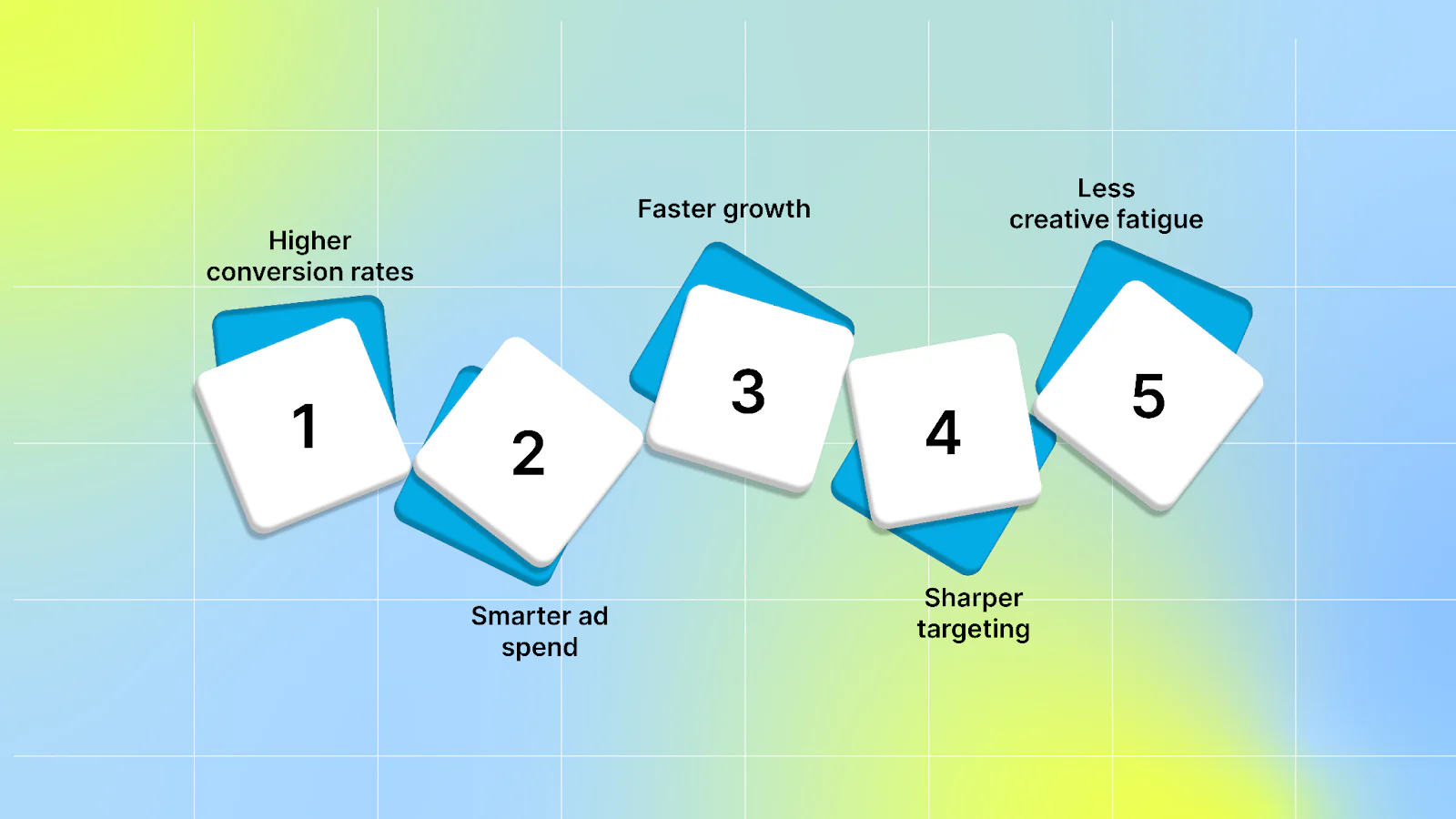
Strong creative optimization makes your ads better and transforms your entire campaign. It helps in:
Higher conversion rates: Spot the visuals and hooks that actually make people click and take action.
Smarter ad spend: Stop putting money into ads that lose impact too quickly, and invest where it counts.
Faster growth: Double down on winning creatives early, before your competitors catch on.
Sharper targeting: Shape your creatives to connect with the right audience, so every ad feels relevant.
Less creative fatigue: Refresh your ads at the right time to keep them engaging and avoid burning out your audience.
Think of a retail brand running ads across Facebook, TikTok, and Google. Instead of just looking at campaign-level results, they dig deeper into the creative elements. They notice that certain product images, CTAs, and offers consistently yield better results.
With that insight, the team can shift budget faster, cutting weak ads, scaling the winners, and getting more out of every dollar spent. This results in stronger campaigns and a healthier ROI.
Both Segwise and AppsFlyer’s creative optimization tools aim to solve this challenge, but they take very different approaches. Let’s break down how they compare.
Segwise Creative Optimization Capabilities
Where most platforms treat creative insights as secondary, Segwise makes them the whole product. Four specialised agents do the work: the Creative Tagging Agent auto-tags elements across images, videos and playables and connects those tags to metrics like ROAS, CPA, LTV and conversion rate; the Creative Strategy Agent powers AI Chat, fatigue detection, new-creative tracking and asset clustering; the Creative Generation Agent produces net-new creatives from the winning patterns; and the Competitor Tracking Agent tags and gap-analyses rivals’ live ads.
It connects to 15+ ad networks and MMPs, including Meta, Google, TikTok, YouTube, Snapchat, Axon (AppLovin), Unity Ads, Mintegral and more, plus AppsFlyer, Adjust, Branch, Singular and Kochava, with no-code OAuth setup in about five minutes per source. Historical data is backfilled on connection: up to two weeks on the free trial, up to three months on paid plans.
By breaking down every part of your creatives, Segwise helps teams identify what drives results and act quickly to improve campaign performance.
Key Features:
AI creative tagging: Auto-tags visuals, scenes, dialogue, CTAs, and audio; supports custom tags.
Custom success criteria tracking & fatigue detection: Set specific targets for new creatives (ROAS thresholds, spend-share goals, or other custom criteria). Automated monitoring detects a continuous decline in performance metrics and spend share using internal logic, alerting you to early fatigue so you can refresh assets before the budget is impacted.
Creative Strategy Agent (AI Chat): An always-on creative strategist with full context across your creative, tag, fatigue, cluster and competitor data. Ask “what separates my top five creatives from my bottom five?” or “which hook style drove the most installs last month?” in plain language and get an answer — or a formatted, shareable report — without building a dashboard first.
AI creative generation: The Creative Generation Agent turns the winning patterns the analytics found into net-new creatives — static images, video ads including AI UGC, interactive playables, and scene-by-scene video storyboards. It remixes winning hooks, CTAs, characters and visual styles from across different top performers rather than reskinning a single ad, lets you refine outputs by prompting, and exports in each network’s aspect ratios. Generated creatives are auto-tagged and tracked once live, so results feed back into the model that produced them. This is the single capability no MMP offers at any tier.
Playable ad tagging and competitor tracking: Segwise AI-tags what happens inside playable (interactive) ads, which matters for game studios with real playable spend. AppsFlyer’s docs describe its AI breakdown for video only. It also monitors, tags and gap-analyses competitors’ live Meta ads in the same workspace.
Integration & API: No-code connectors, integration guides, and documented APIs for major ad platforms and common MMPs.
Custom tagging: Beyond standard tags, Segwise lets you define any creative element you want (e.g., specific character types, voice-over styles, scene transitions, color palettes), build a tagging taxonomy that reflects your campaign logic, and map those tags directly to performance metrics — giving you far greater flexibility and actionable granularity than tools limited to fixed or naming-convention tags.
Custom dashboards & reports: Build views that combine network and MMP data for creative analysis; automated reporting options (including daily email summaries) keep teams informed.
Integration Features:
Smooth integration: Connects with 15+ ad networks and MMPs — Meta (Facebook/Instagram), Google, TikTok, YouTube, Snapchat, Axon (AppLovin), Unity Ads, Mintegral and more.
MMP compatibility: Works alongside all five major MMPs (AppsFlyer, Adjust, Branch, Singular and Kochava), so you can combine attribution and custom in-app event data with creative analysis, and choose per report whether numbers come from the network or the MMP.
Customizable dashboards: Reports and views that merge network and MMP data for different teams and roles.
Continuous syncing (depends on network/MMP): Platform provides near-real-time signals where network/MMP data permits and raises proactive alerts when creatives hit or miss defined targets.
API support: Documented APIs and integration guides to exchange data with other marketing systems.
Points to Consider:
Not an MMP, and not trying to be: Segwise does not do install attribution, SKAdNetwork/AdAttributionKit handling, fraud prevention or deep linking. It is built to sit on top of your existing MMP and attribution stack — reading its data, including custom in-app events — and tie element-level tags to performance. If you need measurement infrastructure, you still need an MMP.
Focused feature set: The product emphasises creative analytics, generation, fatigue tracking and automated alerts rather than a broad enterprise measurement feature list.
Segwise shines in creative optimization by providing deep, actionable insights that help performance, creative, and growth teams scale campaigns and maximize ROI. It offers granular insights that support faster and smarter decisions.
AppsFlyer Creative Optimization Capabilities
AppsFlyer offers Creative Optimization as a Premium add-on, aggregating your ad creatives from different media channels into one place with AI matching across channels. It breaks performance down at the scene and element level (scenes, text, visuals, audio), clusters similar creatives, ties creative to full-funnel metrics — installs, in-app events, retention, LTV, not just clicks — and flags creative fatigue. Coverage now spans web campaigns as well as app.
What changed in November 2025. AppsFlyer’s eight-product release on 18 November 2025 added a Creative Management Hub — store, manage, analyse and deploy creative assets, with AI scoring and recommendations and activation back out to the networks — and an Agentic AI Suite with MCP support and pre-built agents that connect to tools like Claude, ChatGPT, Cursor and VS Code. It also shipped Incrementality for UA, Cross-Platform Journeys & LTV, Signal Hub, an enhanced attribution model and AI-upgraded dashboards. This is a real creative product now, and any comparison written before that date understates it.
Partner coverage named in the help centre: Meta, Google, AppLovin, ironSource, Moloco, Unity Ads, Snapchat and YouAppi, with a per-partner feature matrix published as a downloadable sheet. End-card–level breakdown exists for AppLovin, ironSource, Moloco, Unity Ads, Snapchat and YouAppi. (Worth noting for 2026: ironSource Ads itself stopped serving direct-demand campaigns on 30 April 2026 and advertiser reporting ended 31 May 2026, so treat that entry as legacy — LevelPlay and ironSource Exchange survive, and Unity Ads is the buying platform.)
For deeper analysis, its Creative Optimization ETL lets you pull complete asset-level reports directly into your BI tools.
Key Features:
Creative dashboards: Pull creatives from all media channels, allowing teams to measure performance across campaigns, channels, and creatives.
AI matching & grouping: Creatives are analyzed, aggregated, and matched by AppsFlyer’s AI so the same creative appears as one entity in dashboards regardless of file name, ad ID, or metadata.
Asset-level reporting & ETL: Delivers asset-level performance data to cloud/BI, using modeling to attribute results to individual assets within composite creatives.
Industry benchmarks: Access to industry benchmarks through reports and insights drawn from a large pool of ad spend and creative data — genuinely useful, and something a standalone creative tool cannot match at AppsFlyer’s data scale.
Creative Management Hub (Nov 2025): Central asset store with AI scoring and recommendations, plus deployment back out to ad networks.
Agentic AI Suite (Nov 2025): Pre-built agents with MCP support, connectable to Claude, ChatGPT, Cursor and VS Code.
Full-funnel creative metrics: Creative performance tied to in-app events, retention and LTV rather than clicks alone, across mobile and web in one view — a direct benefit of owning the attribution layer.
Points to Consider:
One feature in a bigger suite: Creative optimization is a premium add-on within AppsFlyer's attribution platform.
Once-daily refresh at 10:00 UTC: Creative data refreshes once per day, at 10:00 UTC, not in near-real-time. For teams making same-day kill/scale calls on fast-moving creative, that cadence is the binding constraint.
90-day backfill at setup: Per AppsFlyer’s own help centre, 90 days of creative history are backfilled when you connect a network. AppLovin only returns the previous day’s asset data, so its coverage starts on the day you connect and builds up over about 30 days.
Modeled asset-level data for Meta Advantage+ and Google UAC: Meta and Google do not report asset-level data for multi-asset ads. AppsFlyer fills the gap by modeling how performance splits across the assets, so the data is modeled, not missing. Since Advantage+ and UAC now carry a large share of app spend, a lot of your asset-level creative data is an estimate.
Other documented constraints: Carousel ads are excluded from creative similarity; videos of different durations are treated as separate creatives and metrics require matching aspect ratios; reporting is USD only.
Less flexibility: CSV custom tags are capped at 15 dimensions with one value each, and AI Smart tags come from saved searches, which may feel limited compared to specialized creative analytics tools.
Tiered access, with no published price: Creative Optimization is marked “Premium” in AppsFlyer’s help centre and is not listed as included in any of the three tiers on the pricing page. Full asset-level ETL exports and consolidated cost/ROI metrics sit behind Creative Optimization Premium or ROI360. AppsFlyer does not publish an add-on price, so budgeting for it means a sales conversation.
Limited custom tagging flexibility: Custom tags come from a CSV upload of “custom dimensions” (maximum 15), “name-convention tags” (maximum 10 types) and AI Smart tags saved from plain-language searches. Each creative can only receive one CSV tag per dimension.
AppsFlyer’s creative optimization helps teams identify broad trends, detect fatigue, and benchmark performance using aggregated data on creative assets. It adds convenience for marketers already using AppsFlyer for attribution, though specialized creative analytics tools may provide deeper flexibility and experimentation features.
Head-to-Head Comparison: Segwise vs AppsFlyer Creative Optimization
Segwise and AppsFlyer Creative Optimization are both useful for performance marketers, but they serve different needs. Here’s a side-by-side look to help you pick the platform that fits your workflow best:
Feature | Segwise | AppsFlyer Creative Optimization |
Creative element tagging (auto + custom tags for visuals, CTAs, hooks, emotions) | ✔Full auto + user-defined custom tags (unlimited taxonomy, multimodal AI) | ✔ Auto + custom tags (via naming conventions/CSV) – but limited to ~15 dimensions and ~10 tag types |
Cross-network creative insights (unified view across ad networks) | ✔ | ✔ (unified creative view across channels/campaigns) |
Creative fatigue detection | ✔ | ✔ |
Scene-level / asset analysis | ✔ (element-level breakdown) | ✔ (scene-level, modeled for assets) |
Customizable dashboards & white-label reporting | ✔ Custom dashboards and custom metrics, public share links, scheduled CSV/PDF delivery, Studio View for multi-app and agency portfolios | ✔ AI-upgraded “My Dashboards” (Nov 2025) and Data Locker exports; no native white-label creative reporting — third-party layers are commonly used |
SKAdNetwork / AdAttributionKit and fraud prevention | Reads SKAN- and AdAttributionKit-based data through your MMP connection; Segwise does not perform attribution or fraud detection itself | ✔ Native, and a core strength — plus Protect360 / ProtectLITE fraud prevention |
Creative data refresh cadence | Near-real-time where the network or MMP permits, with proactive threshold alerts by email and Slack | Once daily, at 10:00 UTC (AppsFlyer help centre) |
Creative history window | Backfill of up to 2 weeks on trial and 3 months on paid at connection, then continuous | 90 days backfilled at setup; AppLovin builds up from the day you connect |
Asset-level data for Meta Advantage+ / Google UAC | ✔ Element-level tagging of the underlying assets | ✔ Modeled, not reported: the networks do not report asset-level data for multiple-asset ads, so AppsFlyer uses data modeling to split performance across the assets |
Playable / interactive ad tagging | ✔ AI-tags what happens inside playable ads | Partial: measures playable (HTML) ads and reports end cards for six networks; its AI breakdown is documented for video only, though CSV tags can be added to any creative |
AI creative generation | ✔ Creative Generation Agent — static, video (incl. AI UGC), playables, video storyboards, prompt-based editing, multi-aspect-ratio export, generated creatives auto-tagged and tracked | ❌ Creative Management Hub stores, scores and deploys assets, and the Agentic AI Suite automates analysis — but AppsFlyer does not generate creative |
Always-on AI creative strategist | ✔ Creative Strategy Agent (AI Chat) with full account context; on-demand report generation and report analysis | ✔ Agentic AI Suite with pre-built agents and MCP support (Nov 2025). Its Agent Hub (beta) has one creative agent, which ranks top creatives and finds networks where they are not running; custom agents cannot read Creative data yet |
Competitor ad tracking | ✔ Competitor Tracking Agent — monitors, tags and gap-analyses rivals’ live Meta ads (more platforms in development) | ❌ Not offered. Industry benchmarks are provided instead, which is a different thing — aggregate norms, not your competitors’ actual ads |
Reporting currency | Multi-currency reporting | USD only |
Integration with attribution & BI | ✔ MMP / ad-network + ETL integrations (via MMP connections/exports) | ✔ (Native attribution + ETL/BI exports) |
Pricing & access | From $499/mo; 7-day free trial, no-code setup, no engineers, no per-conversion measurement contract | Zero free (12,000-conversion welcome package for year one), Growth $0.07 per conversion, Enterprise custom — but Creative Optimization is a Premium add-on with no published price |
Also Read: Creative Fatigue: Understanding and Managing Ad Performance
Pricing: What Each One Actually Costs
AppsFlyer publishes three tiers:
Zero — free. Positioned for apps that want a simple tool for owned-media activity. Includes a welcome package of 12,000 free conversions for year one, core marketing analytics, and 30 days of premium add-on access.
Growth — $0.07 per conversion after the welcome package. Marked “most popular”.
Enterprise — custom. Cross-channel attribution, signal-loss solutions, ROAS maximisation, fraud, AI insights.
The catch for creative teams: Creative Optimization is not listed as included in any of those three tiers, and AppsFlyer’s own help centre marks it “Premium”. The add-on price is not publicly listed. Nor is a price published for the Creative Management Hub. So the honest position is that AppsFlyer’s attribution pricing is transparent and its creative pricing is not — you will not know what creative costs until you talk to sales.
Segwise is priced as a creative platform, not as a per-conversion measurement contract. Segwise starts at $499/month for advertisers spending up to $250K/month, with a special 50% discount for startups spending under $50K/month. The trial is 7 days, and historical data backfills the moment you connect a source — up to two weeks on the trial, up to three months on paid plans — so you can test tag accuracy against creatives whose results you already know rather than waiting for new data to accumulate.
The practical framing: if AppsFlyer is already your MMP, Creative Optimization is the path of least resistance and worth quoting. Segwise is a net-new line item that has to earn its place on element-level depth, playables, competitor intelligence, refresh cadence and generated creative.
Which Platform is Right for You?

Conversions keep coming, but it’s often unclear which creatives are actually driving results. Wasted budgets, delayed reports, and limited or complex tools make it even harder to act quickly, slowing growth, increasing spend, and allowing faster-moving competitors to pull ahead.
If you’re a UA manager chasing ROAS, a growth lead aiming to scale efficiently, or a founder watching every dollar, the wrong tool can be expensive. Choosing the right platform makes all the difference.
Choose Segwise if…
You need element-level creative tagging and analysis. Segwise’s AI agents automatically tag creative elements across images, videos, and playables (hooks, characters, CTAs, audio, etc.).
You want a unified creative view from your ad accounts. Segwise connects with networks like Meta, Google, and TikTok, bringing creatives and performance into one dashboard.
You want a simple setup with no engineering required. Segwise offers no-code OAuth integrations — about five minutes per source — and a 7-day free trial that backfills up to two weeks of history immediately (three months on paid plans), so you can judge tag accuracy against creatives you already know the results of.
You want the tool to produce the next round of creatives, not just report on the last round. The Creative Generation Agent builds net-new static, video (including AI UGC) and playable creatives — plus video storyboards — out of your own winning patterns, editable by prompt and exportable in every network’s aspect ratios.
You want to ask questions rather than build reports. The Creative Strategy Agent (AI Chat) holds full context across your creative, tag, fatigue, cluster and competitor data and answers in plain language.
Playables carry real spend, or you want competitor ad intelligence in the same workspace. Segwise AI-tags what happens inside playable ads, and its Competitor Tracking Agent monitors and tags rivals’ live Meta ads.
Same-day creative decisions matter. AppsFlyer’s creative data refreshes once a day at 10:00 UTC; Segwise pushes near-real-time signals where the network or MMP permits, with threshold alerts to email and Slack.
You need dashboards, custom reports, and automated insights (winning patterns, creative-level performance) without building your own pipeline.
Choose Appsflyer if…
Your primary need is mobile attribution and a consolidated MMP suite: AppsFlyer provides attribution and related analytics as its core offering, centralizing installs, engagement, and ad performance.
Fraud prevention is required: AppsFlyer’s Protect360/ProtectLITE tiers deliver real-time and post-attribution fraud detection, along with enterprise-grade controls.
You want creative reporting that’s tied to your attribution model. Creative optimization draws on AppsFlyer’s attribution data, linking creative performance to key metrics such as installs, retention, and cost.
You need enterprise data exports and BI integrations. Raw-data exports via Data Locker enable integration with BI tools and data warehouses such as BigQuery and Snowflake, and Creative Optimization ETL streams asset-level reports straight into them.
You want creative asset management inside your measurement platform. The Creative Management Hub (November 2025) stores, scores and deploys assets back out to the networks, so creative operations and attribution live under one contract.
You want agentic automation wired into your measurement stack. The Agentic AI Suite ships pre-built agents with MCP support that connect to Claude, ChatGPT, Cursor and VS Code.
Industry benchmarks matter to you. AppsFlyer benchmarks draw on a pool of ad spend and creative data no standalone creative tool can match.
You need full-funnel creative metrics tied to retention and LTV across both app and web. Owning the attribution layer is what makes that possible, and it is a genuine advantage over any tool sitting on top.
AppsFlyer is best for teams seeking a mobile measurement partner that combines accurate attribution, fraud prevention, creative insights, and enterprise-ready data pipelines. Choose it if you need accurate measurement and BI integration.
Segwise focuses on creative analysis and creative production — tagging every element in your ads, linking those elements to performance across networks, and generating the next round of creatives from what wins. Choose it if creative is your growth lever.
Where AppsFlyer Is Genuinely the Better Tool
A comparison worth trusting has to say this plainly. Several things AppsFlyer does, Segwise does not attempt:
Attribution and fraud. Segwise is not an MMP. SKAdNetwork and AdAttributionKit handling, install attribution, Protect360 fraud prevention, deep linking — these are AppsFlyer’s core product, and they are strong.
Full-funnel creative metrics with retention and LTV. Because AppsFlyer owns the attribution layer, it can tie a creative to what happened weeks after the install without a second integration.
Industry benchmarks at data scale. AppsFlyer says it serves over 15,000 businesses. Nothing built purely on your own account data can produce category norms from that pool.
Enterprise data pipelines. Data Locker, Creative Optimization ETL, warehouse streaming, an enterprise security package. That is procurement-ready infrastructure.
Creative asset management under one contract. The Creative Management Hub means the asset library, scoring and deployment live where your measurement already does — one vendor, one bill, one security review.
The realistic decision isn’t “which one”. It’s whether your creative volume and creative dependence justify a dedicated intelligence and generation layer on top of your MMP. If your creative testing is modest and once-daily aggregate data answers your questions, it doesn’t. If you are shipping dozens of creatives a week, running playables, or spending heavily through Advantage+ and UAC where AppsFlyer’s asset-level numbers are modeled estimates, it does.
Also Read: Understanding Creatives in Advertising: Importance and Examples
Wrapping Up
Segwise and AppsFlyer both bring creative optimization into their platforms, but with very different priorities. AppsFlyer is first and foremost a mobile attribution and fraud-prevention suite, and since November 2025 a genuinely capable creative one too. Creative Optimization, the Creative Management Hub and the Agentic AI Suite are real products, sold as a Premium add-on with an unpublished price, with a once-a-day refresh at 10:00 UTC and modeled rather than reported asset-level results for Advantage+ and UAC. Segwise is built entirely around creative: multimodal element-level tagging including playables, an always-on Creative Strategy Agent, native fatigue detection, competitor tracking, and AI creative generation that turns winning patterns into new ads.
If scaling through creative performance is your priority — and especially if you need element-level depth, playable coverage, asset-level visibility on Advantage+ and UAC, or generated creative — Segwise goes where AppsFlyer’s creative layer does not. If attribution accuracy, fraud protection, full-funnel LTV and enterprise data pipelines are the priority, AppsFlyer delivers a comprehensive measurement stack with capable creative reporting attached. Running both is a perfectly sensible answer, and a common one.
For teams ready to make creatives their growth engine, Segwise offers a 7-day free trial — with up to two weeks of history backfilled on connection — to start spotting winners and cutting wasted spend right away.
Start your 7-day free trial at Segwise and discover your top-performing creatives today.
FAQs
Q1. Which platform is better for creative optimization?
A. Both do it; they do it at different depths. AppsFlyer’s Creative Optimization aggregates assets, breaks them down by scene, text, visual and audio, clusters similar creatives and ties them to full-funnel metrics — and since November 2025 adds a Creative Management Hub for asset storage, scoring and deployment. Segwise goes deeper on the creative itself: multimodal element-level tagging with custom taxonomies, playable ad tagging, competitor tracking, and AI generation of new creatives. AppsFlyer’s documented limits are a 90-day backfill at setup, a once-a-day refresh at 10:00 UTC, and modeled (not reported) asset-level results for Meta Advantage+ and Google UAC.
Q2. How do their AI features differ?
A. Segwise runs four specialised agents: multimodal tagging of every creative element (including playables), an always-on Creative Strategy Agent you can question in plain language, a Creative Generation Agent that produces net-new creatives from your winning patterns, and a Competitor Tracking Agent. AppsFlyer’s AI does creative matching and clustering, element breakdown, scoring and recommendations, and since November 2025 an Agentic AI Suite with MCP support and pre-built agents. The clearest functional difference: AppsFlyer does not generate creative, and Segwise does not do attribution.
Q3. Which tool is easier to set up?
A. Segwise is designed for speed, allowing you to connect accounts in minutes with no engineers required. AppsFlyer, being an enterprise suite, may take longer to set up, depending on the number of integrations.
Q4. Does Segwise support SKAN for iOS campaigns?
A. Segwise works in a SKAN world, but to be precise about how: Segwise is not an MMP and does not perform SKAdNetwork or AdAttributionKit attribution itself. It reads SKAN- and AdAttributionKit-based data from your MMP (AppsFlyer, Adjust, Branch, Singular or Kochava) alongside ad-network data, and ties it to creative elements. So you keep optimising creative in a privacy-first iOS environment, with your existing MMP doing the attribution underneath.
Q5. Does AppsFlyer have creative asset management?
A. Yes, since 18 November 2025. The Creative Management Hub stores, manages, analyses and deploys creative assets with AI scoring and recommendations, and can activate them back out to ad networks. Any comparison claiming AppsFlyer has no creative asset management is out of date.
Q6. How much does AppsFlyer Creative Optimization cost?
A. AppsFlyer does not publish a price for it. The platform tiers are Zero (free, with a 12,000-conversion welcome package for year one), Growth at $0.07 per conversion, and custom Enterprise — but Creative Optimization is marked “Premium” in AppsFlyer’s help centre and is not listed as included in any of the three tiers. Anyone quoting you a figure is guessing.
Q7. How far back does AppsFlyer creative data go, and how often does it refresh?
A. Per AppsFlyer’s own help centre: 90 days of creative history are backfilled when you connect a network (AppLovin coverage starts on the day you connect and builds up over about 30 days), and creative data refreshes once a day at 10:00 UTC. Reporting is USD only, and carousel ads are excluded from creative similarity.
Q8. Can I get asset-level creative data for Meta Advantage+ and Google UAC campaigns in AppsFlyer?
A. Only as modeled estimates. Meta and Google do not report asset-level data for multiple-asset ads, so AppsFlyer uses data modeling to split performance across the assets. Given how much app spend now runs through Advantage+ and UAC, it is worth knowing that those asset-level numbers are estimates rather than reported results.
Q9. Can Segwise replace AppsFlyer?
A. No, and it is not designed to. Segwise does no install attribution, no SKAN handling, no fraud prevention and no deep linking. It integrates with AppsFlyer, Adjust, Branch, Singular and Kochava and sits on top as the creative intelligence and generation layer.
Q10. How long is the Segwise free trial, and how much historical data do I get?
A. 7 days. Historical data is imported automatically when you connect a source — up to two weeks on the trial and up to three months on paid plans — so you can test tag accuracy against creatives whose results you already know.
About This Comparison
Methodology. Written and maintained by the Segwise team, who work daily inside live UA and DTC ad accounts across Meta, Google, TikTok, Snapchat, Axon (AppLovin), Unity Ads and Mintegral, and alongside all five major MMPs. For this August 2026 revision, every AppsFlyer capability, limitation and price was read directly off AppsFlyer’s own current public pages: the pricing page, the Creative Optimization product page and the Creative Optimization guide in the help centre, plus AppsFlyer’s 18 November 2025 product release. Where AppsFlyer does not publish a figure — the Creative Optimization add-on price — we say so rather than estimate.
What changed in this update. We removed claims that AppsFlyer lacks creative asset management, which stopped being true in November 2025; corrected its pricing and dashboard capability; replaced a vague “daily updates” note with the documented 90-day backfill and 10:00 UTC refresh; described how AppsFlyer models asset-level results for Advantage+ and UAC; and corrected Segwise’s own trial length and MMP list.
Bias disclosure. We build Segwise, so the verdicts are ours. The facts are checkable at the links above, and where AppsFlyer is the better tool we have said so.