
When your CPA keeps climbing and you're not sure which user segments are actually worth acquiring, you're flying blind. Predicting lifetime value (LTV) accurately is how you fix that.
Not all users are created equal. Some will install, maybe poke around once, and never come back. Others will become your highest-value customers. The difference between guessing and knowing which is which is the difference between wasted spend and sustainable growth.
This guide cuts through the theory and shows you how to build an LTV prediction framework that actually works, one that helps you allocate budget smarter, target better, and stop acquiring users who'll never pay off.
Key Highlights
Predicting Customer Lifetime Value (LTV) lets you stop burning budget on users who'll never convert and double down on the ones who actually matter.
The metrics you need aren't complicated: purchase frequency, average order value, retention rate, churn rate, and CAC. Track these consistently.
Your LTV to CAC ratio should be at least 3:1. Anything less means you're overspending to acquire users who won't deliver returns.
Cohort analysis, regression models, and machine learning aren't just buzzwords; they're practical tools for spotting behavioral patterns before they become obvious.
LTV prediction isn't a one-time exercise. Update your models regularly with fresh data to keep your targeting sharp and your bids profitable.
Understanding Customer Lifetime Value (LTV) and Why It Matters
Customer Lifetime Value measures the total revenue a user generates throughout their relationship with your app or business. It's not a vanity metric, it's the number that determines whether your acquisition strategy makes financial sense.
When you know LTV, you know exactly how much you can afford to spend acquiring a user while staying profitable. You can prioritize high-value segments, kill campaigns targeting low-intent users, and structure your entire growth strategy around actual returns instead of gut feelings.
Without accurate LTV data, you're stuck making decisions based on surface-level metrics like install volume or Day 1 retention. Those tell you something, but they don't tell you whether the users you're acquiring will actually make you money three months from now.
Improving LTV through better retention and engagement strategies compounds your ROI. But first, you need to measure it correctly.
Key Metrics and Data You Need for Accurate LTV Prediction
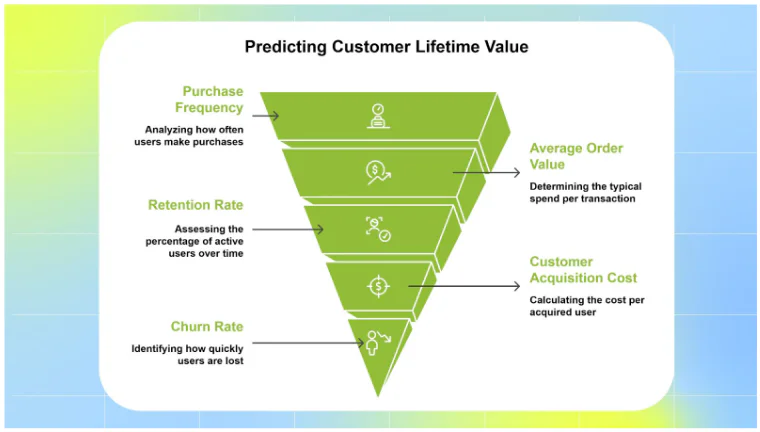
You can't predict LTV without the right inputs. The essential metrics to track are:
Purchase frequency: How often do users make purchases? Weekly? Monthly? Once and done?
Average order value: What's the typical spend per transaction?
Retention rate: What percentage of users are still active after 7 days? 30 days? 90 days?
Customer acquisition cost (CAC): How much are you spending per acquired user across all channels?
Churn rate: How quickly are you losing users, and at what points in their lifecycle?
These metrics need to be tracked consistently over time, not just once. LTV prediction relies on historical patterns, so the more data you have, the more accurate your forecasts become. If you're running mobile game ads or subscription apps, you'll also want to segment by acquisition source, creative type, and user demographics to spot differences in behavior.
For example, users acquired through a TikTok UGC-style ad might have a 30% higher Day 7 retention but a lower AOV compared to users from a Meta carousel ad. That's the kind of granularity that changes how you allocate budget. Identifying these creative-specific LTV patterns requires tools like Segwise, that can automatically tag and track ad elements across platforms, linking them directly to post-install data.
Customer Acquisition Cost and Its Relationship with LTV
Balancing CAC and LTV is the core equation of profitable user acquisition. The rule of thumb: your LTV should be at least 3x your CAC. If you're spending $10 to acquire a user, that user needs to generate at least $30 in lifetime revenue for the unit economics to work.
When LTV doesn't exceed CAC by a healthy margin, you're either overspending on the wrong users or your retention and monetization strategies need work. Track this ratio religiously. If you see it shrinking, that's your signal to optimize, either by lowering acquisition costs (better creative, tighter targeting) or by increasing LTV (improving onboarding, reducing churn, and upselling).
If you're scaling a mobile game and your CAC is $15 but your predicted LTV is only $35, you're not leaving much room for error. One bad creative refresh or a spike in CPMs, and suddenly you're underwater. But if your LTV is $60 or $80, you have breathing room to test aggressively and iterate faster.
Leveraging Marketing Analytics for LTV Prediction
Marketing analytics platforms give you the behavioral data and engagement signals you need to predict LTV more accurately. By analyzing user actions, purchases, session frequency, in-app events, time spent, you start to see patterns that separate high-value users from low-value ones.
Use tools like Google Analytics, your MMP (AppsFlyer, Adjust, Singular), or BI platforms to consolidate data from multiple sources. Machine learning models can then automate the forecasting process, surfacing insights like "users who complete onboarding within 24 hours have 2.5x higher LTV" or "users acquired via iOS have 40% better retention than Android."

The key steps for leveraging analytics effectively:
Collect diverse data: Pull in acquisition data, engagement metrics, and revenue events from all sources.
Analyze behavioral trends: Identify which actions correlate with higher LTV (e.g., first purchase within 3 days, completing a tutorial).
Automate predictive modeling: Use ML or regression models to forecast LTV based on early signals.
Regularly reviewing this data ensures your acquisition targeting stays focused on users who deliver long-term profitability, not just short-term vanity metrics.
Platforms like Segwise automate creative tagging and analytics, letting you map creative performance directly to user behavior and LTV. By unifying creative data from 10+ ad networks and post-install data from your MMP, you stop guessing which ads work and start seeing which specific creative elements drive the highest-value users.
Models and Techniques for Predicting Customer Lifetime Value
Choosing the right LTV prediction model depends on your data maturity and complexity. Here are the most common approaches:
Cohort Analysis
Group users by acquisition date (e.g., all users acquired in March 2025) and track their cumulative revenue over time. This method is straightforward and works well for identifying trends, but it's backward-looking, it tells you what happened, not what will happen.
Regression Models
Use historical purchase patterns, demographics, and engagement data to predict future LTV. Linear regression is simple to implement, but it assumes relationships are linear, which isn't always true. Logistic regression works better for predicting discrete outcomes (e.g., will this user churn?).
Machine Learning (ML)
ML models adapt as new data comes in, making them more accurate over time. They require more data and technical expertise but deliver significantly better forecasts for apps with large user bases.
Update your models regularly, ideally every month, with fresh data. User behavior shifts, acquisition sources change, and what worked six months ago might not apply today. Continuous model refinement keeps your LTV predictions actionable.
Integrating LTV Prediction into User Acquisition Strategies
Knowing your users' predicted LTV is useless if you don't act on it. Here's how to integrate LTV insights into your acquisition workflow:
Target users with higher predicted LTV: Use lookalike audiences or custom segments based on high-LTV user profiles.
Adjust bids and budgets based on LTV tiers: Allocate more budget to campaigns and ad sets that consistently acquire high-LTV users. Pause or reduce spend on sources driving low-LTV installs.
Personalize messaging to attract profitable customers: Tailor your ad creative and copy to appeal to users who match high-LTV behavioral patterns, using element-level insights (e.g., the specific hook or CTA) proven to drive LTV in high-value segments.
Continuously update LTV data: Feed fresh performance data back into your models and bidding strategies to optimize in near real-time.
This approach maximizes ROI by ensuring every dollar you spend on acquisition is going toward users who'll actually deliver returns, not just inflate your install count.
Targeting High-Value Users Based on LTV Insights
When you know which user segments deliver the highest LTV, acquisition becomes surgical. Instead of broad targeting and hoping for the best, you focus on the specific behaviors, demographics, and acquisition channels that consistently drive profitability.
Key tactics include:
Segmenting users by LTV tiers: Create High, Medium, and Low LTV segments based on predictive models.
Tailoring offers to high-value groups: If your data shows users who make a purchase within 48 hours have 3x higher LTV, prioritize early purchase incentives in your creative.
Continuously refining targeting: Use updated LTV data to adjust your audience definitions and exclude low-intent users proactively.
This ensures you're not wasting budget on users who'll never convert while scaling spend on the segments that matter.
Using Acquisition Mapping to Optimize Campaign Performance
Acquisition mapping visualizes the full user journey, from first touchpoint to conversion, so you can see exactly which channels, campaigns, and creatives are driving the most valuable users.
By mapping user paths, you can:
Track which channels yield the highest LTV: Not all traffic sources are equal. A user from an organic search might have a higher LTV than one from a paid social ad.
Align marketing spend with channels delivering the best returns: Double down on what's working, cut what isn't.
Optimize messaging based on user behavior patterns: If users who engage with video ads have higher LTV, shift more creative budget toward video production.
Regularly updating your acquisition maps ensures your campaigns stay efficient, data-driven, and ROI-focused.
Enhancing User Retention to Maximize Lifetime Value
Retention directly impacts LTV. The longer a user stays engaged, the more opportunities you have to monetize them. Focus on these retention tactics:
Deliver personalized experiences: Use behavioral data to tailor in-app content, recommendations, and offers.
Implement loyalty programs: Reward ongoing engagement with exclusive perks, discounts, or in-game benefits.
Use timely, relevant communication: Send push notifications or emails based on user actions (e.g., "You haven't played in 3 days, here's a bonus to get back in").
Monitor churn signals and act proactively: If a user's session frequency drops, trigger a re-engagement campaign before they churn completely.
Consistently nurturing user relationships reduces churn and transforms one-time users into loyal, high-LTV customers.
Marketing Analytics and Reporting Best Practices for Continuous Improvement
Consistent analysis and clear reporting are what separate good acquisition strategies from great ones. Follow these best practices:
Set measurable goals aligned with LTV and CAC: Every campaign should have a target LTV to CAC ratio.
Use dashboards for real-time performance tracking: Tools like Tableau, Looker, or even Google Sheets can keep your team aligned on key metrics.
Regularly review metrics like conversion rates and churn: Weekly or bi-weekly check-ins help you spot trends early.
Automate reports to save time: Set up scheduled reports so stakeholders get updates without manual effort.
Act on insights by testing and optimizing: Data without action is worthless. Run A/B tests, iterate creatives, and refine targeting based on what the numbers tell you.
This disciplined approach ensures continuous improvement and keeps your marketing ROI growing.
Real-World Examples of Successful LTV Prediction and Acquisition
Leading companies leverage LTV prediction to transform their acquisition strategies:
Netflix uses machine learning to identify high-LTV subscribers early, optimizing content recommendations and marketing spend to retain them longer.
Amazon segments customers by predicted LTV, tailoring promotions and Prime membership incentives to maximize repeat purchase frequency.
Spotify adjusts acquisition costs based on LTV forecasts, ensuring they're not overspending on users who'll churn after the free trial.
Mobile gaming studios like Supercell and King have built entire growth engines around LTV prediction. They know within days whether a new user is likely to become a whale (high spender) or a casual player, and they adjust their monetization and engagement strategies accordingly.
These aren't edge cases, they're proof that data-driven LTV insights lead to smarter spending and sustainable growth.
Conclusion: Actionable Steps to Start Predicting LTV for User Acquisition Success
How to get started:
Collect accurate data: Focus on purchase frequency, retention, CAC, and churn metrics.
Choose a predictive model: Start with cohort analysis if you're early-stage; move to regression or ML as your data matures.
Update your models regularly: LTV prediction isn't a one-time project, it's an ongoing process.
Integrate LTV insights into targeting and bidding: Use predicted LTV to prioritize high-value user segments and optimize budget allocation.
By building a disciplined LTV prediction framework, you stop guessing and start acquiring users who actually drive long-term profitability. That's how you scale sustainably without burning through budget on dead-end installs.
Ready to see which creative elements drive your highest-LTV users? Start your 14-day free trial with Segwise to unify all your ad network and MMP data, automate element-level creative tagging, and uncover winning LTV patterns fast.