
A marketing performance tracking system is the plumbing that turns ad spend into evidence. For performance marketers, that means a stack where every dollar can be traced to an outcome across networks, attribution gets within arm's reach of the truth under privacy restrictions, and creative-level signals feed back into what you buy next. Segwise sits at the creative intelligence layer of that stack, tagging every ad across 15+ networks and MMPs so teams know which elements are driving ROAS.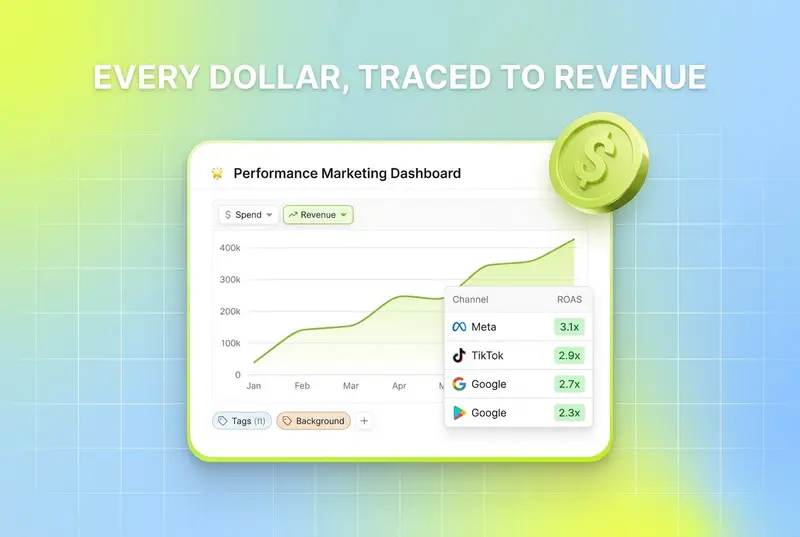
If you spend money on ads and cannot answer the question "what did we actually get for it?" in the next ten minutes, you do not have a marketing performance tracking system. You have dashboards.
That gap is expensive. A 2025 martech audit study found companies waste about 67% of their martech investments on capabilities they never use, with overall stack utilization sitting at roughly 33%. Combine that with the ongoing fallout from iOS 14.5, where industry research cited by Munalytics shows attribution accuracy dropped by up to 70% and many marketers now report 20 to 40% attribution gaps versus pre-privacy baselines, and the picture is pretty clear. The tools are there. The plumbing rarely is.
This guide walks through what a marketing performance tracking system is, the six components every performance team needs, how to implement it without blowing up your tech stack, and the pitfalls that quietly hollow out most builds. The goal is a system that answers the three questions performance marketers actually get paid for: what is spending well, what is wasting, and what do we do about it.
Key takeaways
Most tracking gaps are architectural, not tool-related. According to Gartner's 2025 analytics guidance, fragmented data silos and people-led data management remain the root cause of slow reporting and low marketing productivity.
Server-side tracking and first-party data recover a meaningful chunk of the conversions pixel-based tracking misses. Industry analysis from Automate to Profit puts the recovery at 30 to 40% compared to client-side-only setups.
Multi-touch attribution and media mix modeling solve different problems. Inbeat cites Nielsen 2025 research showing teams that combine both improve marketing ROI by 15 to 20% versus either approach alone.
Creative is where the bigger returns hide. Bestever reports creative performance metrics now drive 40% of optimization decisions, and teams tracking them see up to 30% better results from testing cycles.
Consolidation beats expansion. Omnifunnel Marketing finds organizations that consolidate onto integrated platforms cut costs 20 to 40% and lift operational efficiency 30 to 50%.
Expect to run two or three systems in concert, not one. A typical 2026 stack pairs an ad-data and attribution layer (server-side tracking plus MMP or CAPI), a creative intelligence layer like Segwise, and a warehouse or reporting layer for finance and exec reporting.
Also read Meta Ads Related Media: Silent Spend Trap Marketers Need to Watch
What a marketing performance tracking system actually is
A marketing performance tracking system is the combination of data capture, attribution, and reporting that tells you how every paid marketing dollar ties to a business outcome. That is broader than "analytics" and narrower than "the entire martech stack."
In practice, it has to do three things. First, capture: pull conversion events from websites, apps, and offline sources in a way that survives browser restrictions and iOS App Tracking Transparency. Second, attribute: assign credit to the channels, campaigns, and creatives that influenced each conversion, usually through some mix of platform attribution, MMP attribution, multi-touch attribution, and media mix modeling. Third, surface: turn all of that into views, alerts, and signals that a UA manager, creative strategist, or growth lead can act on without opening five tabs.
That is the stack. Everything else is a supporting role. Reporting tools like Google Data Studio or Supermetrics move data. Ad platforms like Meta Ads Manager execute buys. MMPs like AppsFlyer and Adjust attribute installs. Your tracking system orchestrates across them.
The reason most teams struggle is not that the components do not exist. It is that the components were bought one at a time, for one problem each, and never wired together with a single view of performance in mind.
Why most performance tracking systems quietly fail
Three failure modes show up over and over, and they are all structural.
Fragmentation eats velocity. Gartner's research on marketing analytics characterizes the current state as "a multitude of data silos, traditional people-led data management practices, and established technologies," which lead to "slow time to market, low productivity and poor self-service." The symptom for a UA manager is simple. You need a number before a standup and you spend 40 minutes assembling it. For a 15-person growth team, that maths out to hundreds of hours a month spent on data plumbing instead of optimization.
Pixel-based tracking leaks. Client-side pixels lose data every time a browser restricts cookies, a user declines tracking, or a platform changes how it handles UTM parameters. Industry figures cited across multiple 2025 reports, including Munalytics' analysis of the iOS 14.5 fallout, put attribution gaps at 20 to 40% for campaigns affected by App Tracking Transparency. That is not a rounding error. It is the difference between scaling a winning campaign and pausing it.
Campaign-level reporting misses the real signal. According to ad-tech research aggregated by Bestever, creative now drives roughly 40% of optimization decisions, and teams tracking creative metrics see up to 30% better results in testing cycles. Most tracking systems still stop at campaign or ad-set. The question "which hook style drove the most installs last month?" cannot be answered from platform reports alone, which is why the systems that do answer it, like Segwise for creative intelligence, tend to produce outsized returns.
The shared thread is that teams treat tracking as a dashboard problem when it is actually a system-design problem.
The six components of a modern marketing performance tracking system
Every stack worth building has these six layers. You do not need six tools, but you need coverage across all six.
1. Event capture (client-side and server-side)
This is the foundation. You need events flowing from your website, app, and any offline channels (call tracking, CRM, POS) into an infrastructure that survives browser and OS-level restrictions.
The baseline in 2026 is a mix of client-side tags for user experience signals and server-side capture for conversions that feed attribution. Triple Whale's 2025 analysis on Meta's Conversions API shows brands using CAPI alongside pixels see improved data quality scores, recover conversions standard pixels miss, and push corrected conversion values back to ad platforms. Tools in this layer include server-side tag managers, Conversions API integrations for each major network, and MMP SDKs for mobile apps.
2. Attribution (MTA plus MMM)
Multi-touch attribution (MTA) assigns user-level credit across touchpoints. Media mix modeling (MMM) assigns aggregate credit to channels, including offline and hard-to-track activity. According to Inbeat's 2025 analysis of Nielsen research, teams running both see a 15 to 20% uplift in marketing ROI versus either in isolation. MTA tells you how to optimize what you are already spending. MMM tells you where to spend in the first place.
For most performance teams, MTA comes from your ad platform APIs and an MMP like AppsFlyer, Adjust, Branch, or Singular. MMM can come from a purpose-built tool or, at lower spend levels, a lightweight internal model. The key is running them together, not picking one.
3. Ad and MMP data unification
Your ad network data, your MMP data, and your conversion data need to live in one queryable place. That can be a dashboard tool, a BI layer, or a warehouse, depending on scale. Supermetrics and Funnel.io dominate the data-pipeline end of this layer. Platforms like Segwise unify ad network and MMP data with a specific lens on creative performance.
The test for this layer is whether a marketer can answer "what is the ROAS of my TikTok gameplay hooks versus my IronSource testimonial hooks over the last 14 days?" without writing a spreadsheet formula.
4. Creative intelligence
Creative is now the biggest lever inside your ad spend. Motion's creative metrics guide recommends tracking attention (hook rate, target 30 to 40%), engagement (hold rate at or above 25%, average watch time at 50% of video length), and action (CTR, conversion rate, CPA, ROAS) as the core measurement stack. That is table stakes.
The differentiation comes from element-level tagging. Segwise's Creative Tagging Agent uses multimodal AI to tag every video, audio hook, on-screen text element, character, CTA, and visual style, then maps each tag to performance metrics. It is the only platform that also tags playable (interactive) ads, which matters for mobile gaming advertisers. Without this layer, you can see that spend is up but not why one variation works and another does not.
5. Fatigue detection and alerting
Creative fatigue is the leading cause of wasted spend in high-volume paid accounts. By the time a marketer notices a declining ROAS in a weekly report, budget has already burned.
An automated fatigue detection layer, configured to your thresholds (say, a 20% ROAS decline over seven days), flags at-risk creatives before the damage compounds. Segwise's fatigue tracking monitors all creatives across networks simultaneously and sends early warning alerts via email or Slack when your rules fire.
6. Reporting and querying (including AI chat)
The last layer is where humans actually use the system. That means custom dashboards, scheduled reports for stakeholders, and, increasingly, a plain-language query interface so a UA manager does not have to rebuild the same dashboard five times a quarter.
Segwise's AI Chat sits here, with full context across your creative performance data, tag data, competitor tracking data, custom metrics, fatigue patterns, and asset clusters. You ask, it answers. No dashboards to build, no SQL to write.
How to implement your marketing performance tracking system
A rollout that lands looks roughly like this. Timelines vary by company size, but the order matters more than the dates.
Step 1. Audit what you already have
Before you buy anything, map the current state. List every tool that touches paid media data, the questions it answers, the questions it cannot answer, and its contract cost. You will almost certainly find overlap. Omnifunnel Marketing's 2025 stack-consolidation analysis estimates that audits alone recover 15 to 30% of wasted tool costs.
Deliverable: a one-page stack map with "keep," "consolidate," and "cut" marked against each tool.
Step 2. Define your core questions
The mistake most teams make is buying tools before defining decisions. Pick the three to five questions your team needs to answer every week. Examples: which channel drives the best blended ROAS, which creative elements correlate with top-quartile installs, where is budget under-deployed, which cohorts from January are still paying back.
Those questions become your system's spec. If a tool cannot answer one of them, it does not belong in your stack.
Step 3. Fix event capture first
Attribution and analytics are worthless if the underlying events are broken. Implement server-side tracking and Conversions API integrations for every major platform you spend on. For mobile, make sure your MMP SDK is installed correctly and your SKAdNetwork / AppsFlyer attribution windows are configured for your buying cycle.
This is the layer where you buy back the 30 to 40% data recovery that Automate to Profit's research attributes to proper server-side pipelines.
Step 4. Unify your data and your view
Connect your ad networks and MMP into a single queryable surface. For most performance teams, that means a unified creative intelligence layer like Segwise, which plugs into Meta, Google, TikTok, Snapchat, YouTube, AppLovin, Unity Ads, Mintegral, IronSource, plus AppsFlyer, Adjust, Branch, and Singular, then gives you a card view of every creative with performance data attached. Setup is no-code and takes under 15 minutes.
If you also need finance-grade reporting and long-term trend analysis, layer a pipeline tool like Supermetrics or Funnel.io feeding a warehouse.
Step 5. Add creative intelligence and fatigue detection

Once data is flowing, the next lever is creative. Turn on automatic creative tagging so every ad is analyzed across video, audio, image, and text. Set fatigue thresholds (e.g., ROAS decline of 5% over seven days) so the system alerts you before spend burns.
For teams producing more than roughly 50 new creatives a month, this is usually where the biggest returns appear. Segwise customers report up to 50% ROAS improvement after catching fatigue early and reinvesting into winning creative patterns.
Step 6. Build the reporting and query layer
Now make the data usable. That means three things: a dashboard for the weekly team standup, scheduled reports for stakeholders who do not live in the tool, and an AI chat interface so ad hoc questions do not become engineering tickets.
Step 7. Instrument for experimentation
The final step, often skipped, is building your tracking system so it supports incrementality testing and holdouts. Track the hypothesis, the test period, the control, and the outcome. Without this, you are optimizing against attribution credit, which is not the same as incrementality.
This is where MMM earns its keep. Even a rough internal model that says "Meta appears to over-credit by 15%" is better than trusting last-click alone.
Common pitfalls (and how to avoid them)
Five failure patterns show up in nearly every stalled rollout.
Buying tools before defining questions. The symptom is three overlapping dashboards and none of them used. The fix is disciplining the stack to the questions from Step 2.
Treating attribution as a religion. No attribution model is correct in an absolute sense. Last-click under-credits upper funnel. Data-driven models bias toward high-frequency touchpoints. MMM requires volume. The right answer is to use multiple views, know the bias of each, and validate with incrementality tests.
Skipping server-side setup. A tracking system built on pixels alone is a tracking system that lies to you about 30 to 40% of the time. It is worth the engineering effort.
Ignoring the creative layer. Campaign-level data will tell you where to allocate budget across accounts. It will not tell you which hook, CTA, or opening frame is driving the difference. Without creative intelligence, the team tunes the wrong knobs.
Letting the stack sprawl. According to Team Velocity's 2025 analysis, the average enterprise uses only 33% of its martech capabilities. Treat your tracking stack like your creative: audit it, prune it, consolidate.
How to evaluate tools for each layer
A quick reference on the shortlists we see most often in performance marketing stacks in 2026.
Event capture and server-side tracking
Server-side tag managers (Google Tag Manager server-side, Stape, Supertag)
Conversions API integrations for Meta, TikTok, Google, Snapchat
MMPs for mobile: AppsFlyer, Adjust, Branch, Singular
Attribution
Platform-level reporting (Meta Ads Manager, Google Ads, TikTok Ads Manager)
Multi-touch attribution platforms like Cometly, Wicked Reports, Northbeam for specific use cases (Northbeam skews enterprise, Wicked skews subscription/long-cycle)
MMPs for mobile attribution
Lightweight MMM or purpose-built MMM tools at higher spend levels
Data unification and pipelines
Supermetrics for teams comfortable building dashboards in Google Sheets, Data Studio, or a BI tool
Funnel.io for enterprise teams with 500+ data sources and governance needs
Segwise for performance marketing teams who want unification with a creative lens
Creative intelligence
Segwise for multimodal creative tagging, fatigue detection, and creative generation across 15+ networks and MMPs, including playable ads
Ecommerce-specific tracking
Triple Whale for Shopify DTC brands needing real-time profit-and-loss views and post-purchase survey attribution
HubSpot Marketing Hub for B2B teams wanting CRM plus attribution in one ecosystem
The fit test is always the same. Match the tool to the layer, not the other way around.
What "good tracking" looks like in 2026
A healthy marketing performance tracking system has a few identifiable traits. Data flows are server-side first and pixels second. Attribution pulls from multiple views, with known biases, and is validated against incrementality tests at least quarterly. Every ad is tagged automatically at the element level, and fatigue alerts fire before a marketer notices a decline in a dashboard. The team can ask the system a question in plain language and get a direct answer, rather than building the same report from scratch. Budget decisions reference both the micro (creative and channel) and the macro (MMM and incrementality).
None of this is theoretical. The teams running this kind of stack in 2026 are the same teams scaling paid spend without a proportional increase in headcount.
Bottom line
A marketing performance tracking system is not a dashboard. It is the end-to-end pipeline from event capture through attribution through creative intelligence to reporting, and it is the single highest-leverage piece of infrastructure a performance marketing team can build. In 2026, the teams that build it well spend less on software, recover more attribution data, and move budget faster than their competitors. The teams that do not end up with bloated stacks, stale dashboards, and ad spend they cannot defend in a finance review.
Segwise is the creative intelligence layer of that stack. It unifies creative data from 15+ ad networks and MMPs, tags every ad with multimodal AI, detects fatigue before budget burns, and turns questions about creative performance into one-line answers through an always-on AI Creative Strategist. If creative intelligence is the missing piece in your tracking system, this is the fastest way to add it.
Frequently asked questions
What is a marketing performance tracking system?
A marketing performance tracking system is the combined infrastructure for capturing marketing events, attributing them to channels and creatives, and reporting the results in a form a team can act on. In 2026 it typically spans server-side event capture, multi-touch and media mix attribution, unified ad-and-MMP data, creative intelligence (often via a platform like Segwise), fatigue detection, and an AI chat or reporting layer. It is broader than analytics and more tactical than a full BI stack.
How long does it take to implement a marketing performance tracking system?
A pragmatic rollout typically runs six to twelve weeks, depending on team size and existing stack. Event capture and server-side tracking take the longest because they involve engineering time. Unification and creative intelligence layers like Segwise can be live in under 15 minutes thanks to no-code integrations, and Segwise imports up to 14 days of historical data on the free trial so teams see insights on day one.
What's the difference between multi-touch attribution and media mix modeling?
Multi-touch attribution (MTA) uses user-level data to assign credit to each touchpoint a specific customer saw before converting. Media mix modeling (MMM) uses aggregate historical spend and outcome data to estimate the channel-level contribution to revenue, including offline channels. MTA answers "how do we optimize what we are already buying?" while MMM answers "where should we be investing in the first place?" Research cited by Inbeat from Nielsen 2025 shows teams running both see 15 to 20% better marketing ROI than running either alone. Tools like Northbeam combine both at the enterprise level, while creative intelligence platforms like Segwise sit downstream of attribution and focus on which elements drive performance once you know where to spend.
How do I fix attribution after iOS 14.5?
Move your event capture server-side wherever possible. Implement Conversions API for Meta, the equivalent APIs for TikTok, Google, and Snapchat, and make sure your MMP SDKs are installed correctly on mobile. Industry analysis aggregated by Munalytics shows server-side setups recover 30 to 40% of the conversions pixel-based tracking misses. On top of that, validate your attribution with periodic incrementality tests. Platforms like Cometly, Triple Whale, and Segwise (for the creative lens on recovered data) can help different pieces of this flow.
What metrics should my marketing performance tracking system measure?
At a minimum, cover three tiers. Business metrics (blended CAC, blended ROAS, payback period, LTV by cohort). Channel metrics (per-network spend, CPI, CPA, ROAS, share of voice). Creative metrics (hook rate, hold rate, watch time, CTR, CVR, and tag-level performance). Motion's creative measurement framework is a solid reference for the creative tier. Creative intelligence platforms like Segwise add a fourth layer by mapping tags (hook style, CTA, character, visual style) directly to performance metrics so the "why" behind a winning ad is visible.
Can I just use Google Analytics for marketing performance tracking
GA4 is a solid base for website and app analytics, and the free tier handles event tracking, basic attribution, and some predictive audiences. It is not a complete performance tracking system on its own for paid-media-heavy teams. It lacks native creative intelligence, full MMP integration, and fatigue detection. Most performance teams pair GA4 with a server-side setup, an MMP if mobile is in scope, and a creative intelligence layer like Segwise for element-level analysis.
How does Segwise fit into a marketing performance tracking system?
Segwise sits at the creative intelligence and unified-ad-data layer. It plugs into 15+ ad networks and MMPs (Meta, Google, TikTok, Snapchat, YouTube, AppLovin, Unity Ads, Mintegral, IronSource, plus AppsFlyer, Adjust, Branch, and Singular), uses multimodal AI to tag every video, audio, image, and text element across every creative, detects fatigue before spend burns, and answers questions in plain language through an always-on AI Creative Strategist. Teams use it alongside their existing MMP, ad platforms, and server-side tracking to close the "why is this creative winning?" gap that campaign-level reporting leaves open. Customers typically save up to 20 hours per week per app or brand and see up to 50% ROAS improvement.
What's the cheapest way to start tracking marketing performance properly
Start with the free layers. GA4 for web events. Your ad platforms' native Conversions APIs (free to implement, just engineering time). Your MMP's free tier if you are on mobile. A Google Sheet or Data Studio dashboard for the weekly team view. That gets you a baseline. The paid tools, MMP at scale, a creative intelligence layer like Segwise, a data-pipeline tool like Supermetrics, start earning their keep once spend crosses roughly $50,000 to $100,000 a month and a dashboard-first approach starts costing more in analyst hours than the tool would.