The modern creative workflow is the seven-step loop that turns a screenshot in your swipe file into a tested, deployed ad: capture, tag, hypothesise, brief, produce, test, iterate. For UA managers and creative strategists, that means treating inspiration as raw input to a system, not a feeling, and running the system on a weekly cadence. Segwise's creative tagging and creative analytics sit at the centre of this loop, mapping every captured tag to performance so the next brief is built on data instead of memory.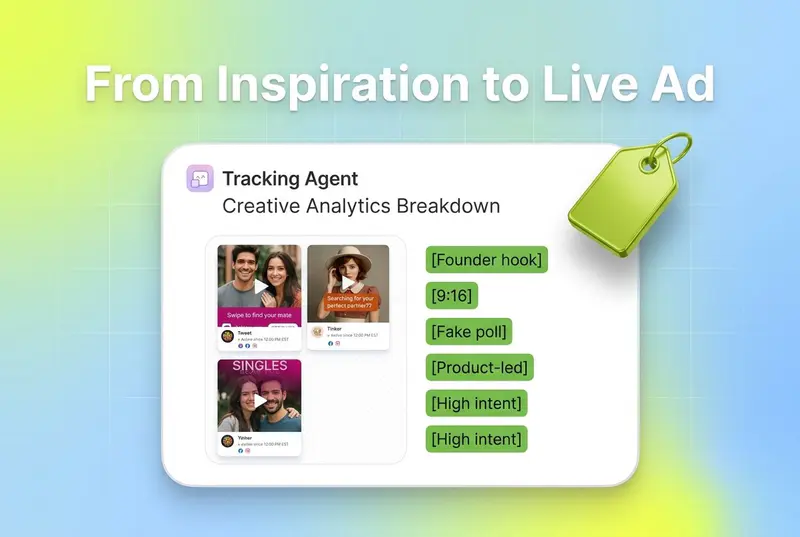
Introduction
Every team has a Slack channel full of screenshots and a folder of saved ads no one has touched in months. The gap between "this is interesting" and "this is on Meta tomorrow" is where most performance creative dies. The platforms have been clear about why this matters. Meta's official guidance on creative diversification tells advertisers that creative is now the primary lever for performance under its Andromeda delivery system, with diversity in messages, formats, and audiences mattering more than tweaks to a single asset. TikTok For Business's creative best-practices guide recommends 3–5 different creatives per ad group and 3–5 diversified ad groups per campaign, and stresses that "as a general rule, it is always better to use creatives with big differences."
This post walks through the workflow that takes a piece of inspiration through to a live ad and back again. It is a reference, not a manifesto. The shape comes from four sources: the AppsFlyer State of Creative Optimization 2025 report, Meta's creative diversification guidance, TikTok For Business's creative best-practices documentation, and AppLovin's announcement on generative AI for mobile ad creative.
Each section maps to one stage of the loop. By the end you should be able to audit your own workflow and find the step where ideas leak.
Also read how to go about Choosing The Right Marketing Analytics Platforms for DTC: 2026 Evaluation Guide
Key Takeaways
The modern creative workflow is a closed loop: capture, tag and organise, hypothesise, brief, produce, test, iterate.
Diversity is now the platform-stated success factor. Meta instructs advertisers to give the system "a wide variety of high-quality creatives" rather than minor variants of one idea.
Volume targets are concrete. TikTok recommends 3–5 different creatives per ad group and 3–5 ad groups per campaign. Agency benchmarks documented by Savannah Sanchez push this to 200 ads per week.
AppsFlyer's creative optimization report analysed 1.1 million creative variations and $2.4 billion in ad spend, and concluded that creative optimization lives in emotional and psychological triggers, not surface tweaks.
AI is now part of production. AppLovin's official announcement describes generative AI being applied across video, interactive, and playable creative, with the platform itself as a creative producer.
Most teams lose the loop at tagging. Without systematic tagging, you cannot map what you captured to what worked, which means every brief starts from zero.

What "the modern creative workflow" actually means
The modern creative workflow is the path a single piece of inspiration takes from being saved to being beaten. The stages are well known:
Capture
Tagging and organising
Hypothesis formulation
Brief
Production
Test
Iterate
What is new is the speed and the volume. AppsFlyer's analysis of 1.1 million creative variations and $2.4 billion in ad spend frames creative optimization as the search for the emotional and psychological triggers that make users stop, engage, and act, not as colour or copy tweaks at the edges. Meta's diversification guidance reinforces this, instructing advertisers to give the algorithm meaningfully different ideas, not the same idea in a different colour.
The flow we describe here is the full closed loop, with capture and tagging as the inputs that feed concepts, and iteration as the loopback that feeds the next capture. None of these steps stands alone. A perfect brief built on bad capture is still a coin flip. Beautiful production with no test budget is a portfolio piece, not a winner. The workflow is only as fast as its slowest stage, so the goal is to make every stage routine.
Stage 1: capture
Capture is the input layer. This is where ads, gameplay clips, Reddit threads, and competitor pages get saved, before anyone has decided what they are useful for.
There is no single right place to do it. Most teams use a combination of:
Screenshots and screen recordings on a phone, dumped into a shared cloud folder.
Saved ads in Meta Ad Library and the TikTok Creative Center, with an export workflow.
Mobile intelligence tools that surface top creatives by app and country (AppMagic, Sensor Tower, data.ai, and similar).
Subreddit feeds (r/marketing, r/ProductManagement, r/advertising, r/gaming, vertical-specific subs) and the comments under viral posts.
Internal sources: customer support transcripts, app store reviews, sales call snippets, and gameplay highlights.
What goes wrong here is not collection, it is access. Capture only matters if a strategist can find the screenshot a week later. The teams that get this right treat the capture folder like a research database. Files are named with a convention. Folders are dated. There is one source of truth, not seven.
If you cannot answer the question "what did we save last Thursday?" in under 60 seconds, your capture layer is broken - fix that before you fix anything else.
Stage 2: tagging and organising
Tagging is the bridge between capture and strategy. A swipe file with no tags is a graveyard. A swipe file with tags becomes a queryable inventory.
The minimum useful taxonomy has four axes:
Hook style (problem statement, fake poll, founder talking, gameplay teaser, transformation reveal, etc.).
Visual format (split screen, single talking head, UGC, animated, gameplay capture, before-and-after).
Value driver (price, status, novelty, convenience, fear of failure, social proof).
Source and provenance (where it came from, when it was saved, which competitor or genre).
This is the layer where most performance teams quietly lose the loop. Manual tagging is slow. According to Segwise's product documentation, teams without automated tagging spend 20 hours a week on this work and still produce inconsistent labels. Inconsistent labels mean two strategists pulling the same query get different answers, which means no one trusts the data, which means the next brief is back to gut feel.
Segwise's Creative Tagging Agent runs multimodal AI across video, audio, image, and text and tags every creative element automatically across 15+ ad networks: Meta, Google, TikTok, Snapchat, YouTube, AppLovin, Unity Ads, Mintegral, IronSource, plus MMP integration with AppsFlyer, Adjust, Branch, and Singular. It also tags playable ads, which most platforms cannot do at all. The point of the agent is not the tags themselves, it is the tag-to-metric mapping underneath: every tag is automatically linked to performance, so when you ask "what's working with founder hooks across Meta and TikTok in the last 14 days," you get an answer instead of a project.
The hidden cost of skipping this stage - without systematic tagging, every brief becomes an act of memory. You remember the ads that stuck in your head, not the ads that actually performed. That bias compounds across every test cycle and is the single most common reason creative teams plateau.
Stage 3: hypothesis formulation
A captured ad is data. A tagged ad is information. A hypothesis is what turns information into a testable question.
The structure of a useful hypothesis is straightforward, and well documented in marketing testing literature. MarketingSherpa's four-step hypothesis framework frames it as a sentence you should be able to write before any test launches:
If we use [variable], with [audience], in [context], we believe [metric] will [direction] because [reason].
For example: "If we open with a fake-poll hook (instead of a price-led hook), with cost-conscious shoppers, in 9:16 placements, we believe IPM will rise because the fake poll forces a pattern interrupt before the value prop lands."
Two things to watch for.
The hypothesis must include a "because." Without a reason, you are running a slot machine, not a test. The "because" is what lets you generalise a winner into a brief for the next cycle.
The hypothesis must isolate a variable. The agency workflow Savannah Sanchez documents, tests one variable at a time: less specific versus more specific openers, or one persona angle versus another, with everything else held constant. If the hook, visual, and pacing all change at once, you cannot attribute the lift.
This is the stage where Segwise's Creative Strategy Agent tends to compress the most time. Asking "what is different about my top 5 creatives versus my bottom 5 in the last 30 days" returns the variable you should be hypothesising about, with the data already linked.
Stage 4: brief
The brief is where the hypothesis turns into instructions a creator and an editor can execute without guessing.
The brief Sanchez documents is opinionated and worth copying. The six required elements:
Product focus, with clear direction on which features to highlight and how to use them correctly.
Visual examples, three to five reference ads showing exactly the type of shots, transitions, and energy.
Detailed shot list, bullet by bullet, including overshoulder shots, screen recordings, before-and-after framing.
Hook variations, multiple script options for the opening three seconds with instructions to record each.
Script body, the exact messaging for the middle and end of the ad.
Content guide, brand values, dos and don'ts, and inspiration from similar brands.
The framing here is "clear is kind." Leaving things to interpretation is the most common reason ads come back wrong, get re-shot, and break the weekly cadence. A good brief takes an hour or two. A bad brief eats two days of revisions later.
The brief is also where your tag taxonomy comes back. The "what we are testing" line should be a tag from your system, not a free-text description. That is what closes the loop from production back to analysis.
Stage 5: production
Production is the stage everyone talks about and the stage that has changed the most in 18 months. Two shifts matter.
The first is volume. TikTok's official recommendation is 3–5 different creatives per ad group and 3–5 diversified ad groups per campaign, which lands at 9 to 25 fresh creatives per campaign even at the floor. Meta's creative diversification guidance tells advertisers the same thing in different words, asking for a wide variety of high-quality creatives so the system has range to test. The agency benchmark is 200 ads per week, run on a Monday–Tuesday filming, Wednesday–Thursday editing, Friday delivery cadence, with role separation between creative strategist, content creator, and video editor.
The second shift is generative AI. AppLovin's official announcement on generative AI in the mobile ad creative process describes the platform applying generative models to interactive ads, video, and playable formats, and using uploaded creative as a seed for additional dynamically generated variants. The platforms themselves are becoming creative producers. The implication for advertisers is that the human bottleneck is no longer the only path. AI generation handles iteration on a winning concept; humans handle the concept itself, the cultural read, and the quality bar.
This is where Segwise's Creative Generation Agent fits. It generates new static creatives based on the winning tags surfaced by the Creative Strategy Agent, lets you edit them by prompting, and exports in the aspect ratios each network expects (1:1, 4:5, 9:16, 16:9). Video generation is in beta. The pitch is not "AI replaces your designer," it is "AI eliminates the iteration bottleneck so your designer can spend time on concept work."
Three production rules from the source material that are worth burning into a checklist:
Storyboard anything that involves filming new footage. In-app footage and stock footage usually do not need it.
Run a creative-strategist review on raw footage before it goes to an editor. Lighting, audio, HDR settings, brand-name pronunciation. Catching issues before edit is a 10x time saver versus after.
Run a second creative-strategist review on the cut before it goes to client or platform. Watch with sound off at least once.
Stage 6: test
A production team that ships ads with no test plan is a content studio, not a performance team.
The test stage is where the hypothesis you wrote in stage three meets a budget. Three things have to be true for a test to be useful.
It must isolate one variable. If you change three things between A and B, the lift is not attributable.
It must run long enough to get past the new-creative bump. New ads tend to outperform old ads simply because they are new, so a creative's first 48 hours can mislead. Build your read window around the metric that actually matters, not around impatience. TikTok's guidance is to refresh creatives only when "delivery results exhibit a consistently declining trend, or when daily new users are low," a signal-based trigger, not a calendar one.
It must use a metric that ties back to the hypothesis. IPM is fine for hook tests. ROAS is fine for full-funnel tests. CPI is fine for top-of-funnel volume tests. Picking the wrong metric is how teams ship "winners" that lose money downstream.
The AppsFlyer State of Creative Optimization 2025 data is useful here as a benchmark layer: share of cost, IPM, and retention benchmarks across multiple verticals, plus breakdowns of user motivations, hook types, and UGC formats. Knowing where your tests sit relative to the vertical median tells you whether you are looking at a real winner or a regression toward the mean.
Segwise's New Creative Tracking lets you set custom success criteria up front (e.g., ROAS > 3.5, CPI < $2.50, spend share > 15%), and alerts when a new creative hits or misses. It is mostly there to stop the team from flagging false winners.
Stage 7: iterate
Iteration is the loop close. A winning creative is the start of a question, not the end of a project.
Two iteration motions matter.
Same concept, more variants. Once a hook works, run it across more value drivers, more personas, more visual treatments. Research suggests taking a fake-poll hook that worked for one client and adapting it for three more clients in a single week, then checking analytics to see if the pattern held across the board. The same logic works in-house: a hook that wins on coffee subscriptions is probably worth a test on meal kits.
Same tags, new concepts. Once a tag wins consistently, brief new concepts that share the tag. Segwise's Asset Clustering groups creatives that share underlying assets and lets you see which specific treatment (hook line, CTA, text overlay) drove the difference between two near-identical ads. That is how you go from "this video worked" to "the founder hook worked," which is a tag, not an asset, and you can rebuild it ten different ways.
The other half of iteration is fatigue. TikTok's documentation recommends adding new creatives into an existing ad group rather than spinning up a new one, to extend the ad group's lifetime. The principle is the same on every platform: replace ads on a signal, not on a feeling, and start the replacement creative the day a winner launches, not the day it dies. Segwise's Fatigue Tracking watches for continuous performance decline and spend-share drop across all platforms simultaneously, and surfaces fatigue early enough to act on. The 50% ROAS improvement Segwise customers report comes mostly from this: catching fatigue before the budget burns and replacing the creative before performance crashes.
Putting the loop on a calendar
A workflow that lives only in a Notion doc never runs. The version that runs has a weekly meeting attached.
The agency cadence Sanchez documents is a Monday cross-functional creative meeting. The agenda has four items:
Identify creative needs over the next two to three weeks (campaign launches, budget changes, in-app events).
Update on creatives currently in production, including outsourced work.
Review and feedback on creatives delivered in the past week.
Review and prioritise new concept ideas from the running backlog.
UA, creative strategy, and marketing art all show up. Outputs are clear: the UA team knows what is going into test this week, the creative team knows which concepts are greenlit, and the strategist knows the size of the concept backlog they need to refill.
This is the calendar that turns the loop from a diagram into a habit. Without it, "the workflow" is a deck.
What this means for you, as a UA manager or creative strategist
The argument here is narrow. The seven-stage loop is not new. The reason most teams do not run it well is that one or two stages are broken, usually capture and tagging, and the breakage at the input layer corrupts everything downstream. Fix the input layer and the rest of the system is recoverable. Skip the input layer and no amount of production volume saves you.
Two practical asks:
Audit your last 30 days of saved inspiration. Can you query it by hook style, value driver, or vertical? If not, you have no inventory.
Audit your last 30 days of shipped ads. Can you say which tag or creative variable drove the top three? If not, your iteration is random.
Both audits take an afternoon. The cost of not doing them is a creative team that runs hot and produces volume without compounding learnings.
Conclusion
The modern creative workflow is a loop, not a pipeline. Inspiration becomes a brief becomes a tested ad becomes the next inspiration, and the teams that win are the ones who run the loop weekly with named owners and clear checkpoints. Volume matters because Meta and TikTok both publish creative diversity as a delivery requirement, not a nice-to-have. Tagging matters because volume without tags is just noise. The data layer matters because briefs without data are guesses, and guesses do not compound.
Segwise sits at the points in the loop where most teams lose time: automatic creative tagging across 15+ networks, tag-to-metric mapping that turns the swipe file into a queryable inventory, fatigue tracking that flags decline early, and data-backed creative generation that iterates on winners without waiting on a designer queue. Customers report up to 20 hours saved per week, 50% ROAS improvement, and roughly halved creative production time.
Frequently Asked Questions
What is the modern creative workflow?
The modern creative workflow is the seven-stage loop teams use to turn inspiration into tested ads: capture, tag and organise, hypothesise, brief, produce, test, and iterate. The version documented in Meta's creative diversification guidance, TikTok For Business's creative best-practices documentation, runs on a weekly cadence with separate roles for strategist, creator, and editor. Tools like Segwise, AppsFlyer, and Adjust sit inside the loop to handle tagging, attribution, and analytics so the team can focus on concept and execution.
What does this mean for a UA manager?
For a UA manager, it means the budget you control is now a function of how fast your team can ship varied, tested creative. Meta's Andromeda system and AppLovin's Axon both build user-level relevance from creative diversity, so creative is the lever, not audience targeting. UA managers who use Segwise's creative analytics get tag-to-metric mapping across all their networks in one place, which is what makes weekly creative reviews fast enough to be useful. AppsFlyer and Adjust handle the attribution side; Segwise handles the creative-intelligence side.
How do I capture creative inspiration without losing it?
Capture works when there is one source of truth and a naming convention. Most teams use a combination of phone screenshots, Meta Ad Library and TikTok Creative Center saves, mobile-intelligence tools (AppMagic, Sensor Tower), and subreddit bookmarks, all dumped into a single shared cloud folder with date-based subfolders. The trap is volume without retrieval: if a strategist cannot find last Thursday's screenshot in 60 seconds, the layer is broken. Segwise plugs in once the creatives are live by tagging them automatically, so you do not have to repeat the work in your swipe file.
What's the difference between a creative concept and a creative variant?
A concept is the narrative or "plot" of an ad, the story it tells about the product. A variant is one specific arrangement of that concept that is visually different from another arrangement of the same idea. The distinction matters because most teams overproduce variants of one tired concept and underproduce new concepts, which is exactly what Meta's diversification guidance warns against. Segwise's tag-to-metric mapping helps separate the two: a tag like "founder hook" is a concept-level signal, while "founder hook in 9:16 with white text overlay" is a variant.
How many ads should I be testing per week?
TikTok recommends 3–5 different creatives per ad group and 3–5 diversified ad groups per campaign, which works out to 9–25 fresh creatives per campaign at the floor. Agencies push this to 200 ads per week across many clients. The right number for your team is whatever lets you replace fatiguing creatives without ever running dry. Segwise's fatigue tracking helps you measure your retirement rate honestly so the math is grounded.
Is generative AI replacing the creative team?
No, but it is changing what the team spends time on. AppLovin's official announcement on generative AI for mobile ad creative describes the platform applying generative models across video, interactive, and playable formats. That signals a future where iteration on a winning concept is largely automated, and human creative time gets reallocated to concept generation, cultural read, and quality control. Segwise's Creative Generation Agent is built around the same idea: AI handles variation on winning tags; humans handle concept and direction.
How do I know when to retire a creative?
Retire a creative when its performance has crossed a fatigue threshold you set in advance, not when it feels stale. TikTok's official guidance is to refresh creatives only when delivery results show a consistently declining trend or when daily new users drop. Most teams use rolling ROAS decline (e.g., 20% drop over seven days) and spend-share collapse as the two signals. Segwise's fatigue tracking watches for these patterns across Meta, TikTok, Google, AppLovin, Unity Ads, and the rest of your stack at once, with alerts via email and Slack. Tools like AppsFlyer and Adjust supply the attribution side.
Where does Segwise fit in the workflow versus AppsFlyer or Adjust?
AppsFlyer and Adjust are mobile measurement partners (MMPs); they handle attribution and event-level data. Segwise is a creative intelligence and generation platform; it handles creative-level tagging, performance mapping, fatigue detection, and AI-driven creative generation. The two layers stack: Segwise integrates with AppsFlyer, Adjust, Branch, and Singular as MMP sources, plus Meta, Google, TikTok, Snapchat, YouTube, AppLovin, Unity Ads, Mintegral, and IronSource as ad networks, then layers creative tags and analytics on top of that unified data. The MMP tells you the install attribution; Segwise tells you which hook, CTA, or visual treatment drove it.