
Creative research is the sweep you do before writing a brief, looking at competitor hooks, audience triggers, format trends, and brand context so the brief is grounded in evidence rather than opinion. For UA managers and creative strategists, that means fewer dead drops, faster learning cycles, and briefs your designers can actually execute. Segwise's auto-tagging compresses the part of this work that used to take hours, by mapping every creative element to the metric it drove.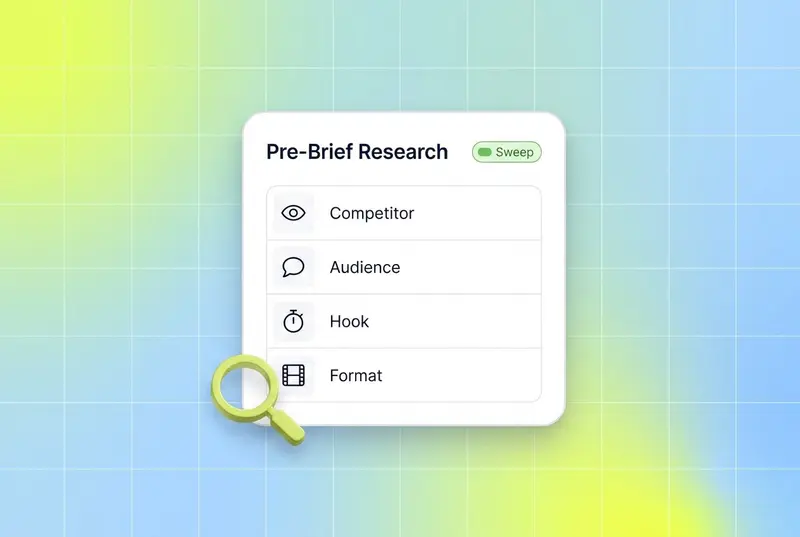
Most briefs fail before a single shot is filmed. Not because the designer was lazy, not because the writer missed the hook, but because the brief itself was assembled in a vacuum. Someone read the campaign goal, riffed for an hour, and sent over a Loom. Two weeks later the asset comes back, ships to a 5% test, and dies. The post-mortem says "creative didn't work." The actual problem started in the research stage.
In 2026 the gap is wider than ever. According to AppsFlyer's State of Creative Optimization 2025, the top 2% of ad creatives now capture 53% of gaming spend and 43% of non-gaming spend. The teams winning that 2% are not creatively luckier. They start with research, and they look at specific things in a specific order before writing anything down.
This guide is the playbook for that pre-brief sweep. It covers what to actually look at, where to look at it, and how to turn what you find into a testable hypothesis your team can build against. Most of it can be done in 30 to 45 minutes once you know the inputs.
Also read Best AI Ad Generators for Meta in 2026: Intelligence-First Wins
Key Takeaways
The top 2% of creatives capture 53% of gaming ad spend and 43% of non-gaming ad spend, according to AppsFlyer's 2025 report. Without research, you are briefing into the long tail by default.
Every brief needs five inputs: competitor signal, audience triggers, hook patterns, format trends, and brand context. Skipping any of them turns the brief into a wishlist.
Use Meta Ads Library to find competitor winners (ads that survive past 60 days, since only 11% of ads make it that far), TikTok Creative Center for hook and length benchmarks, AppMagic or Sensor Tower for mobile creative trends, Reddit for verbatim audience pain points, and organic feeds for cultural context.
Hook patterns vary by category. AppsFlyer found instant-gratification hooks lift Day 7 retention by 17% in finance, comparison hooks capture 40% of spend in GenAI apps, and UGC tutorials drive 45% higher IPM in social.
Optimal video length differs by platform. TikTok Creative Center data shows top awareness ads converging at 9 to 15 seconds and conversion ads at 21 to 34 seconds, according to research published by Stackmatix.
Auto-tagging tools cut creative research from hours to minutes by mapping every creative element to the metric it drove. Segwise's Creative Tagging Agent and Creative Strategy Agent then turn those insights into a brief and the variants that come from it.
Why Most Briefs Fail at the Research Stage
The standard creative process looks something like this. A campaign goal lands in Slack. A creative strategist writes a brief based on the goal, the brand guidelines, and a couple of references they liked. The designer or video editor produces. The asset launches. Performance comes in. Someone says "the creative didn't land," and the cycle restarts.
What is missing here is the research layer that should sit between the goal and the brief. Without it, the brief is just a list of preferences. With it, the brief becomes a hypothesis about what will work, and the asset becomes a test of that hypothesis.
The data backs this up. Shortimize's competitive analysis guide reports that 87% of Fortune 500 companies treat competitive analysis as the backbone of their growth strategy, and 85% of leading firms credit it for driving innovation. The same teams running the most consistent winning ads are the teams running the most consistent research before they brief.
The other reason briefs fail at research stage is volume. Top spending non-gaming apps now produce 2,365 creative variations per quarter, while gaming apps produce 2,743, per AppsFlyer's 2025 data. At that volume, briefs written from intuition will produce a long tail of mediocrity. Briefs written from research compound, because each one builds on what the last asset taught you.
The Five Inputs to Every Creative Brief
Before writing a brief, you need five inputs. Each one answers a different question. Together they constrain the creative problem enough that the designer or video editor can actually execute.
1. Competitor Signal
What are direct and adjacent competitors actually running right now? Which ads have been live the longest? What hooks, offers, and visual styles are they leaning into? You are not looking to copy. You are looking for what the category has already validated and what it has saturated.
The signal you want is durability, not novelty. According to a 2026 Meta Ads Library analysis from Simplified, only about 11% of ads survive past 60 days, and nearly half are killed within the first two weeks. An ad still running after two months has passed somebody's internal kill criteria. That makes it worth dissecting.
2. Audience Triggers
What does your audience actually say, in their own words, when they describe the problem your product solves? Not the cleaned-up version from a customer interview. The raw, unfiltered, sometimes profane version from a forum thread or a comment section.
This is where Reddit becomes a research tool. Audience triggers come from the language people use when they are not being asked. Pain points, objections, and aspirations sit in subreddit threads, App Store reviews, Discord channels, and the comment sections under your competitors' ads.
3. Hook Patterns
What is the first three seconds doing on the ads that are working in your category? Is it a question, a pattern interrupt, a stat, a UGC monologue, a visual transformation? Hook rate, sometimes called thumb-stop rate, is the metric that gates everything downstream. Strong creators achieve 70% intro retention by opening with compelling visuals, surprising statements, or immediate value delivery, per Almcorp's 2026 short-form video analysis.
Hook patterns are also category-specific. AppsFlyer's 2025 data shows instant-gratification hooks lift Day 7 retention by 17% in finance, while in dating, "Serious Relationship" framing outperforms "Casual" by 15%, despite lower coverage and budget.
4. Format Trends
What lengths, aspect ratios, and editing styles are over-represented in the top ads in your category right now? Format is downstream of platform and audience, but it shifts faster than people expect.
TikTok Creative Center data shows that smartphone-native content has grown from roughly 55% to 75% of top-performing conversion ads over six months. Top awareness ads are converging around 9 to 15 seconds, while conversion ads trend toward 21 to 34 seconds. If your brief asks for a 60-second polished hero on TikTok in 2026, you have already lost the format question.
5. Brand Context
What is the brand allowed to say, allowed to look like, and explicitly not allowed to do? This is where most teams over-rotate on aesthetic and under-rotate on positioning. Brand context is the constraint, not the creative direction. Treat it as the rails, then put the creative work inside them.
The trap here is letting brand consistency become brand stagnation. If every brief is filtered through "but does it feel like us?", you end up with a category-specific look that performs because it matches what users already expect, but never tests whether a different angle could outperform.
Where to Look: A Pre-Brief Sweep
You do not need a research analyst, a license to a $50K platform, or a week of prep. You need 30 to 45 minutes and a structured sweep across six sources. Each source covers a different input from the five-input list above.
Meta Ads Library (5 to 10 minutes)
Search your three to five direct competitors. Filter by impressions if you are in a market that supports it. Meta added impression-volume sorting in early 2026, per recent reporting from Simplified, which is the most reliable signal you have for what an advertiser is actually weighting.
Look at: ads still running after 60 days (the 11% that survived), creatives running 10 to 15 variations of the same concept (the active test in flight), the share of static versus video, and the hook style of the top three longest-running ads.
Capture: screenshots, start dates, and a one-line note on what you think the hook is doing.
TikTok Creative Center (5 to 10 minutes)
Filter Top Ads by your industry, country, and the last 30 days. The Top Ads Dashboard surfaces engagement metrics and run duration directly. Creative Insights inside the same tool gives data-driven recommendations on optimal video length, hook styles, text overlay patterns, and CTA placement based on aggregate performance across millions of ads.
Look at: the top three to five ads' first three seconds, their length, their text overlay density, and any audio or trend hooks they are riding.
AppMagic or Sensor Tower (5 to 10 minutes, mobile only)
If you are running UA for a mobile app, AppMagic's Ad Intelligence tool gives you access to a library of 150M+ creatives with impressions broken down by country and ad network. Sensor Tower's State of Gaming and State of Mobile reports give you the macro view, while AppMagic gives you the creative-level view.
Look at: top creatives by impression share, network mix, and recurring tags or treatments across the category.
Reddit (5 to 10 minutes)
Pick three subreddits where your audience actually lives. Search for the problem your product solves and read the top comments on the top three threads. Pay attention to the verbs they use, the specific situations they describe, and the words they repeat.
Reddit copy works because it does not sound like a brand wrote it. As Almcorp's 2026 Reddit guide puts it, the audience is engaged and high-intent, and U.S. ad spending on Reddit surged 46.3% year-over-year as of November 2025. The same rule applies to research: the more your brief sounds like Reddit and the less it sounds like a deck, the more likely the hook will land.
Organic Feeds: TikTok For You, Reels, Shorts (5 to 10 minutes)
Open the platform fresh, not your work account. Scroll your category. The For You and Reels feeds are an editorial signal of what the algorithm is currently rewarding. If everyone in your category is suddenly running the same audio or transition, that is the format trend you cannot ignore.
YouTube Shorts often delivers the highest average views for smaller and mid-sized accounts. Almcorp reports that creators with 1,000 to 5,000 followers see average Shorts views of 2,600, far exceeding TikTok (660 views) and Reels (600 views) at the same follower counts. That asymmetry is worth knowing before you brief.
Swipe File Tools (Foreplay, MagicBrief)
If you have access to a swipe file tool, this is where you save the references you found in the previous five steps. Foreplay and MagicBrief are the two main options most teams use. The point of a swipe file is not to hoard. It is to turn the references into a tagged library you can re-search by hook type, format, or category.
Turning Research Into a Hypothesis

Research that does not produce a hypothesis is just sightseeing. The whole point of the pre-brief sweep is to convert raw signal into a single testable claim, so the brief that follows is grounded in evidence rather than opinion. The output of the 30-minute sweep should be a one-sentence claim that the next asset will test.
The format that works:
"We believe [audience] will respond to [hook or angle] in [format] because [evidence from research], and we will know it worked if [metric crosses threshold]."
A worked example for a hypothetical mid-core mobile RPG:
"We believe lapsed players aged 25 to 34 will respond to a 'come back to your old account' hook in a 15-second TikTok with on-screen game footage, because Reddit threads in r/MobileGaming show this audience is nostalgic about progression they abandoned, and we will know it worked if hook rate exceeds 35% and IPM clears 5."
That sentence is what the brief is built around. The brief specifies the visual references, the script, the on-screen text, the CTA, and the format. Everything in the brief should serve the hypothesis. Anything that does not is decoration.
The hypothesis approach also gives you a kill criterion. If hook rate is 18% and IPM is 1.2 at the end of the test budget, the hypothesis is wrong. You do not iterate on the asset. You go back to research and write a new hypothesis. This is the loop that compounds.
How Auto-Tagging Compresses Research Time

The slowest part of creative research has always been tagging. Watching every ad, writing down what the hook is, what the format is, who the talent is, what the CTA says, what the on-screen text reads, then mapping all of that to performance. Most teams skip it because they cannot afford the time, and end up briefing from intuition again.
Multimodal AI auto-tagging changes the math. Instead of 20 hours per week of manual tagging, the tagging happens in the background while you focus on the strategic part: deciding what to test next.
This is the part of the workflow Segwise sits in. The Creative Tagging Agent applies multimodal AI to every creative across Meta, Google, TikTok, Snapchat, YouTube, AppLovin, Unity Ads, Mintegral, IronSource, unified with MMP data from AppsFlyer, Adjust, Branch, and Singular. It tags video, audio, image, and text together: hooks, characters, scene changes, on-screen text, voiceover style, music type, emotional tone, CTAs. It is also the only platform that tags playable (interactive) ads, which matters if you run mobile gaming UA.
The Creative Strategy Agent then sits on top of those tags as an always-on AI creative strategist with full context across all your creative data. You can ask in plain language: "what hook style drove the most installs last month?" or "what's different about my top 5 creatives versus my bottom 5?" The agent answers from your account data plus your competitor data, qualitative or quantitative.
When the research has produced a hypothesis, the Creative Generation Agent takes the winning patterns and produces new creatives built around them, with prompt-based editing and multi-format export. Brief, generate, test, tag, repeat. The bottleneck moves out of research and into the part where humans should be spending time: deciding what hypothesis to test.
The Bottom Line
Creative research is the cheapest leverage in performance marketing. A 30-minute pre-brief sweep across Meta Ads Library, TikTok Creative Center, AppMagic, Reddit, and organic feeds gives you the five inputs you need: competitor signal, audience triggers, hook patterns, format trends, and brand context. The output is a one-sentence hypothesis that the next asset tests, with a kill criterion attached.
The teams winning the 2% of creative spend that captures half the budget are not luckier. They have just turned research into a habit instead of a heroic effort. Auto-tagging tools like Segwise close the rest of the loop, so the same insights that informed the brief flow back in once the asset is live, ready to inform the next one.
Skip this step and you will write briefs from preference, fight your designers about why the asset did not work, and keep wondering why your category-leading competitors keep shipping winners. Run the sweep, write the hypothesis, brief from evidence. The math gets easier from there.
Frequently Asked Questions
What is creative research and how is it different from a creative brief?
Creative research is the pre-brief sweep that grounds a brief in evidence: looking at competitor ads, audience language, hook patterns, format trends, and brand constraints before writing anything down. The brief is the output, not the input. Without research, the brief is a list of preferences. With it, the brief becomes a testable hypothesis. Tools like Foreplay, MagicBrief, and Segwise help collect, tag, and synthesize the inputs so the brief writer is not starting from scratch.
How long should a creative research sweep take before writing a brief?
For most performance marketing briefs, 30 to 45 minutes is enough. The sweep covers Meta Ads Library, TikTok Creative Center, a mobile intelligence tool like AppMagic or Sensor Tower if relevant, two or three subreddits, and 5 to 10 minutes scrolling organic feeds. Anything longer than an hour usually means you are over-collecting and under-synthesizing. Tools like Foreplay, MagicBrief, and Segwise's Creative Strategy Agent compress the post-launch research portion into searchable, chat-style interfaces, so the time you do spend goes into hypothesis, not data hunting.
Where do I find competitor ads to research?
Meta Ads Library is the public, free starting point for Meta and Instagram. TikTok Creative Center's Top Ads dashboard does the same for TikTok. For mobile UA specifically, AppMagic and Sensor Tower track creatives across networks with impression breakdowns, drawing from libraries of 150M+ creatives. Swipe file tools like Foreplay and MagicBrief let you save and tag what you find. Segwise's Competitor Tracking Agent applies the same multimodal AI tagging to competitor Meta ads as it does to your own, surfacing positioning gaps and saturated angles.
What's the difference between a hook pattern and a format trend?
A hook pattern is the first three seconds of a video: the question, claim, visual transformation, or stat that grabs attention. A format trend is the wrapper around the hook: the length, aspect ratio, editing style, and audio choice. AppsFlyer's 2025 data shows hooks vary by category (instant gratification wins finance, comparison wins GenAI), while format trends shift by platform (TikTok awareness ads cluster at 9 to 15 seconds in 2026). Tools like AppsFlyer Creative Optimization and Segwise's Creative Tagging Agent tag both layers separately so you can analyze them independently.
How do I turn creative research into a hypothesis?
Use the format: "We believe [audience] will respond to [hook or angle] in [format] because [evidence from research], and we will know it worked if [metric crosses threshold]." The hypothesis specifies a hook, a format, an audience, and a kill criterion. The brief is built to test it. If the metric does not move, you go back to research, not back to the asset. Swipe file tools like Foreplay and MagicBrief help store the references your hypothesis is built on, while Segwise's Creative Strategy Agent helps draft hypotheses from tagged performance data and the Creative Generation Agent produces variants to test them.
Why do most creative briefs fail?
Most briefs fail because they were written from preference rather than evidence. The strategist riffed for an hour, the designer executed, the ad launched, performance came back flat. The fix is not better designers or better writers. It is putting a 30 to 45 minute research step between the campaign goal and the brief. Foreplay, MagicBrief, AppsFlyer, and Segwise all exist to make that research step faster and more systematic, so briefing from evidence becomes the default rather than the exception.
What metrics should I use to validate a creative hypothesis?
Hook rate (or thumb-stop rate, the percentage of viewers who watch past three seconds), IPM for mobile UA, CTR for static and DTC, and Day 7 retention if you have an MMP signal. AppsFlyer's 2025 report shows hook-driven IPM gaps of 45% (UGC tutorials in social) and retention gaps of 17% (instant-gratification hooks in finance), so the metrics you choose should match the category. Segwise unifies these signals across Meta, Google, TikTok, Snapchat, YouTube, AppLovin, Unity Ads, Mintegral, IronSource, AppsFlyer, Adjust, Branch, and Singular, so the kill criterion is checked against the same data the brief was built from.