
The Problem Every Performance Marketer Faces
You've had this experience: an ad runs perfectly for the first week. CTR is solid. Cost per click is reasonable. In many scaled UA campaigns, this drop now happens within 3–7 days, especially on high-velocity platforms like Meta, TikTok, and YouTube Shorts.
You didn't change your audience. You didn't cut your budget. Even without visible platform updates, delivery systems continuously rebalance based on real-time engagement and predicted outcomes.
That's creative fatigue. And it's killing your ROAS faster than it ever has before.
Most marketers confuse creative fatigue with ad fatigue. They're not the same thing and the difference matters a lot when you're trying to fix it.
Key Takeaways
Creative fatigue is when your winning creative concept stops engaging, even at low frequency and with fresh audiences.
Ad fatigue is when performance drops mainly because people have seen the same ad too many times, so frequency is the core issue.
Ads die faster today because feeds are saturated, algorithms down-rank stale creatives, and winning formats get copied across competitors in days.
You spot creative fatigue when CTR and engagement slide 15–30% over a few days while spend, audience, and bids stay roughly constant.
The fix is an always-on creative pipeline: rotate variations every few days at scale, test continuously by audience stage, and lean on narrative or UGC-style creatives.
Tools like Segwise track creative elements and fatigue patterns automatically, so you can kill tired assets early and double down on what still drives ROAS.
What Is Creative Fatigue, and How Does It Differ from Ad Fatigue?
Creative fatigue occurs when a creative concept loses predictive engagement value across delivery systems, resulting in declining performance even among low-frequency or newly reached users. Why? Because something about it no longer feels compelling or relevant.
Ad fatigue, by contrast, is simpler: it's just people seeing the same thing too many times. Frequency does most of the work. Ad fatigue is driven primarily by excessive frequency within a defined lookback window, leading to diminishing marginal engagement at the user level.
Here's what that looks like in practice:
Aspect | Creative Fatigue | Ad Fatigue |
Cause | Outdated or repetitive creative elements | Overexposure to the same ad |
Effect | Declining emotional or cognitive impact | General annoyance or disengagement |
Solution | Refresh creative content and messaging | Rotate ads and limit frequency |
See the difference? With ad fatigue, you're just solving a math problem like reduce frequency, rotate assets, done. With creative fatigue, the problem runs deeper. Your concept isn't working anymore, period.
Why Are Ads Losing Effectiveness Faster Than Ever?
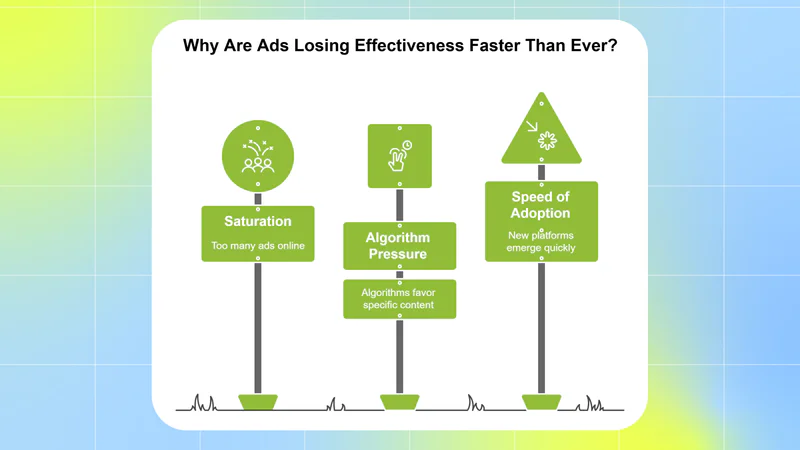
Three things are making this worse:
1. The saturation problem
Users are exposed to hundreds of branded impressions daily across feeds, stories, search, and retail media. Your single ad is competing for attention against an insane amount of noise. That was true five years ago, but it's worse now. Audiences have gotten pickier, too. They can spot weak creative instantly.
2. Algorithm pressure
Platforms like Meta and TikTok dynamically reduce delivery to creatives that show declining predicted engagement, conversion probability, or user value. Their algorithms are trained to prioritize fresh, engaging posts. If your creative isn't consistently generating engagement, the platform automatically starts deprioritising it. You don't need anyone to tell your ad is tired; the algorithm already knows.
3. Speed of adoption
High-performing creative patterns are rapidly replicated across advertisers, especially via creative spy tools and AI-assisted production pipelines. By the time your creative has been running for two weeks, dozens of similar variations exist in the same market. Audiences see the pattern and tune out.
The result? At scale, many ads now peak within 2–5 days before performance decays, particularly in auction-dense environments. If you're not rotating and refreshing constantly, you're draining money.
The Impact of Creative Fatigue on Ad Campaigns and Performance
When an ad loses its appeal, here's what happens to your key metrics:
CTR often declines 15–40% within a few days once fatigue sets in, depending on spend velocity and audience size.
Delivery volume declines as the system reallocates impressions toward higher-scoring creatives.
Cost per click rises as you're competing for the same inventory as fresher ads
Conversion rates tank because lower-quality traffic hits your landing page
Overall ROAS crumbles, turning a profitable campaign into a money pit
We've seen this pattern dozens of times. In multi-creative ad sets, it’s common to see a small subset fatigue early while structurally similar variants continue to perform. It's not random. It's fatigue.
This happens even when you're targeting the right audience. Your ICP is seeing the ad. They're just not clicking because they've mentally filed it away as "already know what this is."
How to Identify and Measure Creative Fatigue in Your Campaigns

You need to spot this early. Here's what to monitor:
Daily tracking of these metrics:
Click-through rate (CTR): watch for any consistent drop-off
Hook rate (3-sec view / thumb-stop) and Hold rate (3–10s): Crucial early-signal metrics for video creatives.
Engagement rate (likes, shares, comments per impression)
Cost per click (CPC): Rising CPC is a red flag
Cost per acquisition (CPA): if this trend up, fatigue is one likely culprit
Return on ad spend (ROAS): the ultimate health check
The pattern to watch for: stable metrics for 3-5 days, then a clear downward trend over the next 2-3 days without intentional changes to targeting, budget, or bid strategy.
Quick test: Compare a new creative running the same targeting to one that's been live for 10 days. If a new creative outperforms an existing one by a statistically meaningful margin (often 15–25%), fatigue is likely present.
Also, pay attention to the qualitative stuff like audience comments, engagement quality and sentiment. If people are commenting less or their tone shifts, that's an early warning sign.
Setting performance thresholds makes this automatic. For example: Use rolling averages or cohort-normalized thresholds to avoid reacting to short-term noise.
Effective Strategies to Combat Creative Fatigue
Rotate your creatives aggressively:
Don't run the same creative for three weeks. Use performance-based rotation rather than fixed time intervals; high-spend ad sets may require refreshes every 3–5 days. This doesn't mean completely new concepts, it means new variations. New color, different copy angle, similar character but different scene. Small tweaks that keep things fresh.
Test continuously, not periodically
Don't do A/B testing once a quarter. Run small tests constantly. Maintain a continuous creative pipeline sized to spend velocity (e.g., 1–2 net-new concepts per $10–20k in weekly spend). Most will underperform. Some will surprise you. This approach keeps your creative pipeline always stocked with fresh material.
Align creative testing to lifecycle stage (prospecting vs retargeting), platform placement, and intent signals.
Different segments respond to different creative angles. Your core power users might connect with a different hook than new install audiences. Test creatives against specific audience segments rather than blasting everything to everyone. Relevance matters more than volume.
Leverage storytelling and emotion
The creatives that last longest are the ones that create an emotional connection, not just a transaction. Pure feature or gameplay hooks often fatigue faster than narrative or problem-solution angles, especially in competitive categories.
Use real-time data to act fast
Don't wait for weekly reporting. Check your performance daily. If a creative is dying, pause it immediately. If something unexpected is winning, double down on it that same day. Speed is your competitive advantage now.
Leveraging Current Advertising Trends to Prevent Creative Fatigue
Trends shift faster now. What's winning this month might be overdone next month.
Short-form vertical video remains the dominant format, but early-signal metrics (first-second retention) now heavily influence delivery. You need a hook in the first second. Real emotion. Something that makes people stop scrolling.
Interactive formats often extend engagement curves, but require higher production effort and are not universally supported across placements.
User-generated content ages differently. An authentic user review or gameplay clip maintains credibility longer than a polished brand production.
Dynamic creative optimization (DCO) and AI-assisted variation generation are increasingly common, though true 1:1 personalization remains platform-controlled. Platforms can now personalize creative dynamically based on user behavior. If you're not using this, your competitors probably are.
The meta-lesson: Don't just follow trends. Understand why a trend works, then adapt it to your specific game or product. That's where you find pockets of underserved creatives that fatigue more slowly.
The Role of Performance Data in Managing Creative Fatigue
Your best defense against creative fatigue is seeing the patterns before anyone else does. Which creative elements perform consistently? Which audience segments respond to what messaging? Which concepts have longevity versus which burn out fast?
Without systematic analysis, you're guessing. You're rotating creatives based on gut feel. Maybe you get lucky. Probably you don't.
This is where tools that map creative variables to performance metrics make a massive difference. When you can see that "X character + Y background = 5.5% CTR consistently" versus "X character + Z background = 4% CTR", you stop making assumptions. You start making data-backed creative briefs.
Want to turn your creative data into actionable insights? Tools like Segwise leverage multimodal AI (visual, audio, and text analysis) to automate creative tagging and performance mapping across platforms, reducing manual analysis overhead.
Conclusion: Proactive Management of Creative Fatigue for Sustainable Ad Success
Creative fatigue isn't a problem you solve once. It's a rhythm you establish.
The marketers who stay ahead are the ones who:
Monitor performance daily, not weekly
Rotate creatives before they decline, not after
Test constantly rather than periodically
Use data to guide creative direction, not hunches
Move fast, pause underperformers same-day
Waiting for the creative to fail before refreshing it is leaving money on the table. Every day, a fatigued creative run is spent at suboptimal ROAS.
The good news? While fatigue is inevitable at scale, its impact is highly manageable with the right systems and cadence. You just need to stay ahead of the curve instead of behind it.
Ready to stop losing money to creative fatigue? Start tracking your creative performance with clarity. Segwise helps you identify which creative elements drive actual results, so you can iterate confidently and keep your campaigns fresh. Start your 14-day free trial today.