
A creative brief that gets ignored is a brief that buries the production direction under five pages of strategy. The version creative teams actually open is one page, written for the editor at 11pm, and built around a testable hypothesis, a specific hook, and an asset spec they can produce against today. Segwise's Creative Strategy Agent generates briefs and storyboards backed by tag-to-metric data, so the hypothesis and hook are not guesses, they are pulled from what is already winning in your account.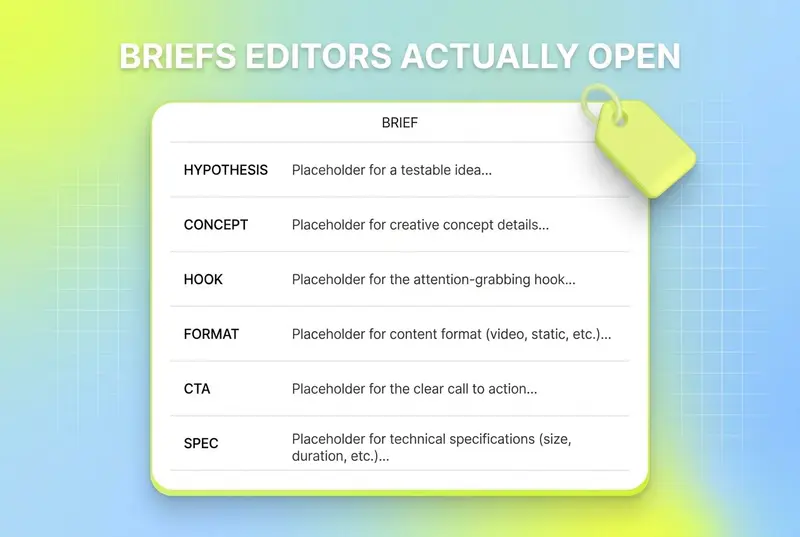
If you have ever sent a 1,400-word brief into Slack and watched it sink to the bottom of the channel by lunch, you already know the problem. The brief was probably good strategy. It was just terrible production direction.
Most creative teams now operate on weekly refresh cadences, with 2 to 3 refreshes per week on Facebook and TikTok being the new baseline for healthy ad groups. The reason is structural: as Eric Seufert lays out in Mobile Dev Memo's framework for producing and deploying creative at scale, every creative has a half-life, and the only way to maintain mean ad performance is to replace creatives before they degrade. At that velocity, a 5-page brief is a tax. It costs hours to write, more hours to read, and the editor still has to translate it into a shot list, a hook, and an aspect ratio before they can do anything useful. Most teams skip the translation. They glance, they guess, they ship something that was not what the strategist had in mind.
This guide gives you the 1-page brief format that actually gets opened, edited, and produced against. We will cover why most briefs fail, the six fields that belong on a 1-page brief, a hook bank you can pull from, an asset spec checklist by network, side by side examples of good and bad briefs, and the specific differences between a net-new brief and an iteration brief. Every section is built from how performance creative actually moves through production in 2026, not how a brand book says it should.
Also read The AI Creative Stack for App UA Teams in 2026
Key takeaways
Creative briefs fail because they overweight strategy and underweight production direction. A working brief tells the editor exactly what hook, format, length, and aspect ratio to ship, in a single page.
The 1-page brief contains six fields: hypothesis, concept, hook, format, CTA, and asset spec. Anything else is a strategy doc, not a brief.
Hook variety is the single biggest lever inside a brief. Performance teams using AI-driven creative optimization analyze emotional and psychological triggers at the hook level, not the campaign level.
Iteration briefs and net-new briefs are different documents. Iteration briefs reference the winning ad and call out which variable is changing. Net-new briefs explain the audience, the desired emotion, and the format from scratch.
A good brief makes the editor's life easier. A bad brief makes them ask questions. The number of questions a brief generates is a real quality signal.
Briefs grounded in tag-to-metric data outperform briefs grounded in opinion. Segwise's Creative Strategy Agent and Creative Generation Agent close the loop from data to brief to live creative.
Why most creative briefs fail
Briefs fail for the same reason most internal documents fail. They are written by the person who needs them less than the person who has to use them.
The brief is usually written by a strategist or a UA manager. The person who reads it is an editor, a designer, or an external production agency. The strategist understands the funnel, the audience, and the campaign goal. The editor needs to know what to put on screen, in what order, at what aspect ratio, with what voiceover, ending on what CTA. Those two needs do not overlap as much as people assume.
When briefs fail, you see the same patterns:
The brief is too long. A 5-page brief reads like a research deck. The editor scrolls to the bottom looking for the asset list, gives up, and DMs the strategist asking what to actually make.
The brief has no hypothesis. It says "we want to drive more installs from cost-conscious audiences." It does not say what specifically about this creative is supposed to drive that. There is no testable claim, so there is no way to learn from the result.
The hook is missing or generic. "Show the product benefits in the first 3 seconds" is not a hook. A hook is a specific opening line, visual, or scene. "When you realize the candle you bought for $40 burns out in 12 hours" is a hook. The first one is direction. The second one is something you can shoot.
The asset spec is buried or absent. A working brief tells the editor: 9:16, 6 seconds for the hook, 30 seconds total, captions burned in, two endcards (one with logo, one without), MP4 H.264, file size under 100MB. A failing brief says "make sure it works on TikTok and Reels."
The brief is treated as a one-way handoff. The strategist writes it, throws it over the wall, and treats the editor's questions as friction. In reality, a brief is the start of a conversation, and a brief that generates fewer questions is a better brief.
Asana's research on creative briefs frames the document as something that should align stakeholders and make execution easy. That framing is right. The mistake most teams make is interpreting "align stakeholders" as "include every stakeholder's concern in the document." That produces strategy bloat. A brief that aligns stakeholders is one where the strategist, the UA manager, and the editor all agree on the hypothesis, the hook, and the format, and the document captures that agreement in the smallest number of words possible.
The 1-page brief structure
The 1-page brief has six fields. Every field is required. Every field is short. The whole document fits on one screen, no scrolling.
1. Hypothesis
One sentence. What do you believe will happen if this creative runs, and why?
A hypothesis turns the brief into a test. Without one, you are just shipping creative and hoping. With one, every result either confirms or refutes the bet, which is how you build creative intuition over time.
Examples that work:
We believe a UGC testimonial-style hook will outperform our current studio-shot hooks for cost-conscious DTC buyers because it signals authenticity faster.
We believe leading with the gameplay loop in the first 2 seconds will increase install rate among casual gamers compared to the cinematic intro variant.
Examples that do not work:
Drive more conversions.
Test new creative angle.
The first set names the audience, the change, and the expected mechanism. The second set is just an objective.
2. Concept
One to three sentences. What is the creative actually about? What is the story or scene?
The concept is the elevator pitch for the ad. If a freelance editor read only this field, would they understand what to film?
Example:
A 30-second testimonial-style ad featuring a customer unboxing the candle, lighting it, and showing a timer running for 60+ hours. Voiceover is the customer comparing it to the cheap candle they used to buy. Ends on a comparison shot of the two candles side by side.
3. Hook
The literal first 1 to 3 seconds. Word for word, frame for frame.
This is the field most strategists shortchange. Performance creative lives or dies on the hook. Hook rate (3-second video plays divided by impressions) is one of the core performance metrics for creative testing, and the only way to improve it is to write specific hooks, not directional ones.
Examples that work:
Open on a hand placing a $40 candle next to a $4 candle. Text overlay: "I wasted $36."
Open on the customer holding the product. First line of voiceover: "Okay, I have to be honest about this."
Examples that do not work:
Strong opening that grabs attention.
Hook should highlight the value proposition.
4. Format
What is being made? Length, aspect ratio, asset count.
Examples:
1 master cut at 30 seconds, 9:16, with 6-second hook variant and 15-second mid-cut. Static endcard variant of the same scene.
1 playable ad, 30-second loop, Falling Objects mechanic, with a 6-second video lead-in.
3 static images, 1:1, with versions for Meta Feed, Stories, and Reels.
5. CTA
The endcard, button text, and any verbal CTA. Specific words, not direction.
Examples:
Endcard text: "Try Botanika risk-free for 30 days." Button: "Shop now."
Endcard text: "Download free." Button: App Store badge.
No endcard. CTA is verbal in the final 3 seconds: "Link in bio if you want one."
6. Asset spec
Network, file specs, deliverables. This is the production checklist.
This field is what stops the brief from generating five questions back to the strategist. Specifics include aspect ratios, video length variants, file format, captions burned in or off, audio levels, and number of variants per concept.
A complete spec might look like:
Networks: Meta, TikTok, AppLovin
Aspect ratios: 9:16 (master), 1:1, 4:5
Video lengths: 30s master, 15s cut, 6s cut
File format: MP4 H.264, AAC audio, max 4GB
Captions: burned in, white with black outline, sentence case
Variants: 1 master per platform, A/B endcard test (logo vs no-logo)
If you write all six fields tightly, the whole brief fits on one page. Anything more is an attachment, not the brief.
The hook bank
A hook bank is a running document of hook patterns that have worked, organized by category. Every brief should reference the bank. New hooks get added when they win. Old hooks get retired when they fatigue.
The categories below cover the hook archetypes that show up in AppsFlyer's analysis of 1.1 million creative variations and across the practitioner literature. You do not need every category in your bank, but you should have at least 8 to 12 hooks ready to brief at any time, with notes on which ones have been tested.
Problem-agitate hooks
"If you've ever spent $40 on a candle that burned out in 12 hours, this is for you."
"Why does my skin look like this even though I'm using a $200 cream?"
These hooks name a problem the audience already feels. They work for cold audiences in the prospecting stage, where you need to establish relevance fast.
Curiosity gap hooks
"I almost didn't post this, but..."
"POV: you finally figured out why your retention drops at level 3."
Curiosity hooks promise a payoff and force the viewer to wait for it. Hold rate (50% video plays divided by impressions) is the metric that tells you if the gap is being earned.
Social proof hooks
"200,000 people did this last month."
"My founder DMd me after she saw this."
Social proof works in the consideration stage where the audience knows the brand and wants validation.
Demonstration hooks
"Watch what happens when I drop this on concrete."
"This is the actual moment my CPI dropped 40%."
Demonstration hooks use a visual that pays off the claim. Best for products where the result is visible.
Direct address hooks
"If you run a mobile game, you need to see this."
"This is for marketers who are sick of guessing which ad worked."
Direct address narrows the audience. The viewer self-qualifies in the first second.
FAKE-format hooks
Onboarding-as-ad: a fake match-3 board where the player makes the wrong move. Real game underneath is a 4X strategy game.
These hooks are common in mobile gaming and are documented in the 2025 user acquisition learnings from Lancaric. They blend into the feed by mimicking a different format. They work, but retention rate at the creative level matters more than CPI for FAKE ads, since players churn fast if the actual game does not match the ad.
Game mechanic hooks (mobile gaming only)
Falling Objects: pick the correct item before it drops off the platform.
Spin the Wheel: a 3-second wheel spin reveals the prize, then cut to gameplay.
Defender: top-down defending mechanic, 5 seconds of clear-the-wave action.
These three mechanics dominated 2025 playable production according to Lancaric's review, with Falling Objects at 19%, Spin the Wheel at 16%, and Defender at 15% of all playables built on Playablemaker.
The bank should be maintained alongside performance data. Hooks that win for 8 weeks and then start to fatigue should be flagged. The flag tells the strategist to retire that hook from the bank and to start writing variants. Without performance data feeding the bank, the bank goes stale and the strategist is back to writing hooks from intuition.
The asset spec checklist
The asset spec is where most briefs fall apart. The strategist does not know the file requirements by network. The editor knows them but is not the one writing the brief. The result is a brief that says "make it work on Meta and TikTok" and a back-and-forth Slack thread that takes an hour to resolve.
A complete spec covers six items per network. The checklist below is what should appear at the bottom of every 1-page brief.
Aspect ratio. Vertical 9:16 is the master format for Reels, Stories, and TikTok. Square 1:1 and portrait 4:5 are still required for Meta Feed. 16:9 is for YouTube and CTV.
Video length. Master plus variants. Most performance teams ship a 30-second master with 15-second and 6-second cuts. Each cut is a different brief in terms of pacing. The 6-second cut is essentially the hook plus a cut to the CTA.
File format and size. MP4 H.264 covers most networks. AAC for audio. Max file size varies (4GB for Meta, 287MB for TikTok feed, smaller for some inventory).
Captions. Burned in or via SRT file. Most platforms favor burned in for performance, since 85% of mobile feed views are on mute by default.
Audio. Level normalized to network specs. Voiceover, background music, or no audio. TikTok strongly prefers original audio, which is a creative direction, not just a spec.
Endcard. With or without logo, with or without app store badge, with or without CTA button text. A/B testing endcards is one of the cheapest and most underused tests.
For Meta and TikTok specifically, Lancaric's 2025 review documents the platform-specific creative strategies: Facebook prioritizes vertical formats with flexible video lengths, TikTok prefers short hook-driven TTCC content for quick engagement, and AppLovin combines video with playables. The asset spec on the brief should match the network's actual format preferences, not a generic "vertical video" instruction.
Good brief vs bad brief: side by side
The clearest way to internalize the 1-page format is to compare a working brief against a bloated one for the same concept.
Bad brief (excerpt from a real-life-style 5-pager)
Section 3: Creative Direction
The creative should reinforce our brand pillar of "trusted craftsmanship" while also conveying the emotional warmth that customers associate with our category. We should ensure the creative speaks to our cost-conscious target audience while maintaining premium positioning. The hook should grab attention quickly and set up the value proposition. The body of the ad should highlight the key differentiators and the CTA should drive to the product page. We are looking for something that feels both premium and approachable, that captures the spirit of the brand without sacrificing performance.
This paragraph has zero production direction. It mentions "the hook" without naming what the hook is. It mentions "the CTA" without writing the CTA copy. It mentions audience and brand pillar without translating those into a shot list. An editor reading this has to invent the entire ad.
Good brief (1-page version of the same concept)
Hypothesis: A side-by-side cost demonstration will outperform our current studio-shot hooks for cost-conscious DTC buyers, because it gives the price story a visual.
Concept: A 30-second comparison ad. Customer holds two candles, one cheap and one ours. Lights both. Cuts to a timer at the 12-hour mark showing the cheap one out, ours still going.
Hook (first 3 seconds): Hand places a $40 candle next to a $4 candle. Text overlay: "I wasted $36."
Format: 1 master at 30s, 9:16. 1 cutdown at 6s for hook test. 1 static endcard variant.
CTA: Endcard text: "Try Botanika risk-free for 30 days." Button: "Shop now."
Asset spec: Meta + TikTok, 9:16 + 1:1, 30s/6s, MP4 H.264, captions burned in white with black outline, A/B endcard (logo vs no-logo).
Same concept. The good version takes 90 seconds to read and the editor knows exactly what to ship. The bad version takes 5 minutes to read and produces 4 questions.
The questions test - count the number of questions an editor sends back after reading your brief. More than 2 means the brief is incomplete. Zero means the brief is either complete or the editor stopped reading. Aim for 1.
Iteration brief vs net-new brief
A common reason briefs feel slow is that teams write the same long-form document for every creative, regardless of whether it is a brand-new concept or a variant of something already winning. These are different jobs, and they need different briefs. The distinction between a creative concept and a creative variant, as Mobile Dev Memo defines it, is the basis: a concept is the narrative or plot of the ad, a variant is a perceptibly different arrangement of the same concept. The brief format should match.
Net-new brief
A net-new brief introduces a fresh concept. The editor has no prior creative to reference. The brief has to do all the work of explaining audience, desired emotion, hook, format, and asset spec from scratch. All six fields are required. Length: full one page.
Iteration brief
An iteration brief modifies a known winner. The editor already has the parent ad to reference. The brief only needs to call out what is changing.
A working iteration brief looks like this:
Parent ad: candle_compare_v3 (30s master, ROAS 3.8, fatigue threshold not yet hit)
Change: Hook variant only. Replace text overlay "I wasted $36" with "Stop buying $4 candles."
Hypothesis: Direct command in the hook will outperform the regret-framing hook for cold audiences.
Format: Same as parent. 30s master, 9:16, 6s cutdown.
Asset spec: Same as parent.
Half the page. Five minutes to write. The editor has the parent file open, makes the one change, and ships.
The split between iteration and net-new is one of the highest-leverage process changes a creative team can make. It is also one of the easiest to operationalize. Once your team agrees on the iteration template, every winning ad can spawn 5 to 10 variants without a strategy meeting.
The cost of not splitting these documents is real. A team that briefs every iteration as a net-new brief is paying a strategy tax on every variant. At 2 to 3 refreshes per week, that tax compounds fast.
From brief to live creative
A brief is only valuable if it produces a creative that runs. The gap between brief and live ad is where most teams lose velocity. The 1-page brief format closes part of the gap by making production direction unambiguous. Performance data closes the rest of the gap by telling you which hypotheses are worth briefing in the first place.
Segwise's Creative Strategy Agent is built specifically for this loop. The agent maintains full context across all your creative data, with multimodal AI that automatically tags every element of every ad: hooks, CTAs, characters, scene changes, on-screen text, audio dialogue, music type, and emotional tone. It tags video, image, and playable (interactive) ads across 15+ ad networks (Meta, Google, TikTok, Snapchat, YouTube, AppLovin, Unity Ads, Mintegral, IronSource) and 4 MMPs (AppsFlyer, Adjust, Branch, Singular). When you write a brief, the hypothesis can be grounded in tag-to-metric data instead of opinion, which is the difference between "I think UGC will outperform studio" and "UGC creatives in our account have a 32% higher hold rate than studio."
The Creative Generation Agent then closes the loop from brief to live asset. It generates new creatives based on your winning tag patterns, edits them via prompt, and exports in the aspect ratios each network requires. This eliminates the production bottleneck entirely for iteration briefs, and dramatically shortens the timeline for net-new briefs by giving the editor a starting point grounded in what is already winning.
The combined effect is significant for high-velocity teams: customers report up to 20 hours saved per week per app and a 50% ROAS improvement when creative briefs are backed by tag-level performance data and connected directly to creative production.
Bottom line
A creative brief that gets used is one page, six fields, and built around a testable hypothesis with explicit production direction. The 1-page format is not a stylistic choice. It is a velocity choice. At 2 to 3 creative refreshes per week, the team that writes shorter, sharper briefs will out-iterate the team that writes longer ones, every time.
The fastest path to better briefs is not better strategy. It is grounding the hypothesis and hook in performance data, splitting iteration briefs from net-new briefs, and writing every brief like the editor will read it at 11pm on a Thursday with three other things open. The 1-page template above is the format. The hook bank is the input. The asset spec checklist is the safety net. Together they close the gap between strategy and shipped creative.
Briefs grounded in performance data outperform briefs grounded in opinion. Segwise is built for the teams who want to operate at that level. The Creative Strategy Agent surfaces what is winning. The Creative Generation Agent produces the next iteration. The brief becomes the connector, not the bottleneck.
Frequently asked questions
What is a creative brief in performance marketing?
A creative brief in performance marketing is a one-page document that gives the production team everything they need to ship a specific ad: a hypothesis, a concept, the literal hook, the format, the CTA, and the asset spec by network. Unlike a strategy doc, it does not explain the brand or the funnel. It explains the ad. Tools like Segwise's Creative Strategy Agent generate these briefs from tag-to-metric data, while platforms like Asana or Notion are typically used to manage the brief workflow.
How long should a creative brief be?
A working creative brief should fit on one page, around 250 to 400 words. Anything longer and the editor scrolls past the asset spec, asks questions back, or guesses. The constraint is intentional: it forces the strategist to make decisions instead of including every consideration. Iteration briefs (variants of a known winning ad) can be even shorter, often 100 to 150 words, since most fields reference the parent ad.
What goes on a 1-page creative brief?
Six fields belong on a 1-page brief: hypothesis (what you believe will happen and why), concept (the elevator pitch for the ad), hook (the literal first 1-3 seconds), format (length, aspect ratio, asset count), CTA (endcard and button copy), and asset spec (network, file format, captions, variants). Anything else is an attachment, not the brief itself.
What is the difference between a creative brief and a strategy doc?
A strategy doc explains the audience, the funnel, the brand pillars, and the competitive landscape. A creative brief tells the editor what to film. A strategy doc is read once at the start of a quarter. A creative brief is read every time a new ad gets made. Most failed briefs are strategy docs in disguise, which is why they sit unused in Slack while the editor ships something different.
How do I write a hook for a creative brief?
Write the literal first 1 to 3 seconds, word for word, frame for frame. "Strong opening that grabs attention" is direction, not a hook. "Hand places a $40 candle next to a $4 candle. Text overlay: I wasted $36" is a hook. Pull from a maintained hook bank organized by archetype (problem-agitate, curiosity gap, social proof, demonstration, direct address, FAKE-format, game mechanic). Tools like Segwise's Creative Strategy Agent surface which hooks are working in your account by tagging every ad's hook and mapping it to performance metrics.
What's the difference between a net-new brief and an iteration brief?
A net-new brief introduces a fresh concept and requires all six fields filled out from scratch. An iteration brief modifies a known winner and only calls out what is changing (usually the hook, the CTA, or one variable in the asset spec). Iteration briefs are often half the length of net-new briefs and are the right format for 70 to 80% of creative output, since most performance teams refresh winning patterns more often than they ship new ones.
What asset specs should a brief include for Meta and TikTok?
For Meta, the brief should specify 9:16 (master), 1:1, and 4:5 aspect ratios, video lengths of 30s/15s/6s, MP4 H.264 with AAC audio, captions burned in, and a max file size of 4GB. For TikTok, specify 9:16 only, 9-60 second range with the 6-second hook variant called out, MP4 H.264, original audio preferred (TikTok prioritizes platform-native sound), and a 287MB max file size for in-feed. Including these specs at the bottom of the brief eliminates the most common round of editor questions.
How does Segwise help with creative briefs?
Segwise's Creative Strategy Agent generates briefs and storyboards backed by tag-to-metric data from your actual creative performance, across 15+ ad networks (Meta, Google, TikTok, Snapchat, YouTube, AppLovin, Unity Ads, Mintegral, IronSource) and 4 MMPs (AppsFlyer, Adjust, Branch, Singular). The Creative Generation Agent then produces the asset directly, closing the loop from brief to live creative. Customers report up to 20 hours saved per week per app and a 50% ROAS improvement. Other tools like Asana handle brief workflow management, but Segwise is the layer that grounds the hypothesis and hook in performance data instead of opinion.