
The AI creative stack for app UA teams in 2026 is led by Segwise for cross-network creative intelligence and data-grounded generation, Arcads for assets for paid social UGC, and Ideogram for ad creatives with text. Other tools generate isolated assets; Segwise plugs into your ad networks, finds your winning patterns, and generates new creatives grounded in that data, closing the loop other tools leave open.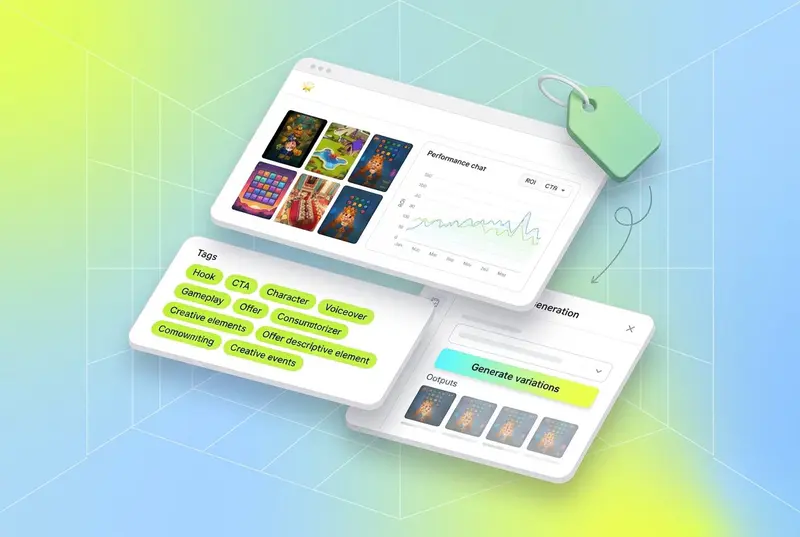
If you run UA for a mobile app in 2026, you don't have an "AI tool" problem. You have a stack problem.
There are dozens of generators that can spit out a hook, a static, a 6-second clip, a UGC actor, a voice over. Each one is good at one slice. None of them know which slice you actually need. None of them know what's working in your Meta or AppLovin account this week. And none of them close the loop between "we made 40 variants" and "these three are why our CPI dropped 18%."
This post is not a list of 50 AI tools. It's the stack serious UA teams are actually using in 2026, organized by job-to-be-done, with an opinion on what to try first by team size. We'll cover ideation (ChatGPT, Claude, Gemini), image generation (Midjourney, Flux, Ideogram), video (Runway, Pika, Sora, Kling, Veo), avatar and UGC (Arcads, HeyGen, Captions), voice (ElevenLabs), editing (CapCut, Descript), and the strategy layer that ties it together (Segwise).
Key takeaways
The 2026 AI creative stack has six asset layers (ideation, image, video, avatar/UGC, voice, editing) plus a strategy layer that decides what to actually generate.
Most teams over-invest in generators and under-invest in the strategy layer. Segwise sits above the asset stack: it plugs into your 15+ ad networks and MMPs, finds your winning patterns, and generates new creatives grounded in that data.
For ideation, Claude is preferred for long-form briefs and structured thinking, ChatGPT for volume and tone variation, and Gemini for Google Ads-connected workflows (Click Click Media, 2026).
For images, Ideogram wins for ad text and packaging accuracy (95% text accuracy vs Midjourney's ~40%), Midjourney for cinematic art direction, Flux for photorealistic UGC stills (PXZ, 2026).
For video, Runway Gen-4, Sora 2, and Veo 3.1 dominate cinematic and product motion; Kling 3.0 and Pika are the budget pick for high-volume hook testing.
For UGC ads, Arcads outperformed HeyGen by 2.3x CTR in head-to-head paid social tests because the actors look like real people, not produced presenters (WebSEO Trends, 2026).
For voice, ElevenLabs is effectively the default. Emotional range, multi-speaker assignment, and library scale aren't matched elsewhere.
Solo UA managers should start with Segwise + ChatGPT + Arcads + CapCut. Studios add Midjourney/Ideogram, Runway, ElevenLabs. Agencies add HeyGen and Descript.

What "the AI creative stack" actually means
The stack isn't one tool. It's a sequence: research and ideation, asset generation across image and video, voice and UGC, editing, and the strategy layer that decides which creatives to produce in the first place.
Each layer solves a different job. Ideation tools turn product context into briefs and scripts. Image generators turn briefs into static creatives. Video generators turn briefs or stills into motion. UGC tools produce talking-head ads at scale. Voice tools narrate. Editing tools compose the final asset. The strategy layer reads your network performance and decides what to feed into all of it.
What the stack does:
Replaces parts of the manual ideate-shoot-edit-test loop with software.
Cuts the cost-per-creative variation from hundreds of dollars to single digits.
Lets a 1-person UA team produce volume that used to require an in-house creative team or agency retainer.
What it does not do, on its own:
It does not know which creative angle will work for your app.
It does not learn from your campaign data unless something connects to your ad networks.
It does not unify what's running across Meta, TikTok, AppLovin, Unity, Mintegral, and your MMPs.
That gap between asset generation and creative intelligence is exactly where the strategy layer earns its place.
The strategy layer (above everything else)

1. Segwise — Best for cross-network creative intelligence and data-grounded generation

Segwise is the layer that sits above the asset stack. Plug in your ad networks and MMPs and Segwise analyzes everything, finds your winning creative patterns, and generates new creatives grounded in that data. It's true creative intelligence: you don't just know what worked, you produce more of what's working.
Other tools generate isolated assets. Segwise plugs into the same Meta, TikTok, AppLovin, Unity, Mintegral, IronSource, Snapchat, YouTube, and Google accounts your campaigns already run on, plus AppsFlyer, Adjust, Branch, and Singular for attribution. It tags every creative element with multimodal AI (video frames, audio, on-screen text, characters, hooks, CTAs) and maps each tag to performance metrics. Then the Creative Generation Agent builds new variations grounded in your winning tags, with prompt-based editing and multi-format export ready for each network.
Key features:
Plugs into 15+ ad networks (Meta, Google, TikTok, Snapchat, YouTube, AppLovin, Unity Ads, Mintegral, IronSource) plus AppsFlyer, Adjust, Branch, and Singular. No-code setup in under 15 minutes.
Multimodal AI tagging across video, audio, image, and text. The only platform that tags playable (interactive) ads, which matters for mobile gaming UA.
Creative Strategy Agent: an always-on AI strategist with full context across your data. Ask it which hook drove the most installs last month or what's different about your top 5 vs bottom 5 creatives.
Native fatigue tracking catches creatives going stale before performance crashes, with custom thresholds and Slack/email alerts.
Creative Generation Agent generates new statics from winning tag patterns, edits by prompting, exports in 1:1, 4:5, 9:16, 16:9 ready for each ad network.
Asset clustering groups ads sharing footage, audio, or images so you can isolate which specific change (hook, CTA, music) drove the ROAS difference.
Competitor tracking monitors competitor ads on Meta, applies the same tagging, and surfaces white-space angles competitors aren't using.
When you should try it: Any UA team running 50+ creatives across two or more ad networks, or any mobile gaming studio running playable ads. Especially relevant if you're spending 20+ hours a week consolidating dashboards or tagging creatives by hand.
Limitations: Strategic intelligence depth requires real account history, so the most useful insights surface after a couple of weeks of data. Video creative generation is in beta, so current generation output is strongest for statics. If your entire stack is one platform with 3 active creatives, this is overkill.
Pricing: Free trial with 14 days of historical data import. Paid pricing on request.
Layer 1: Ideation (the brief layer)
Ideation tools turn product context into hooks, scripts, angles, and briefs. The choice mostly comes down to depth versus speed versus integration.
2. Claude — Best for long-form briefs and structured creative thinking
Claude is the preferred ideation tool when the input is a detailed brand brief and the output is a long-form script, a creative testing roadmap, or a 10-hook variation set with consistent voice. It follows complex instructions with high fidelity and produces output that reads less like a template and more like a thinking colleague.
For UA teams, Claude's strength is in consistency across a sequence: the fifth hook variation in a 20-hook batch still feels like the same brand voice as the first. Click Click Media's hands-on testing across 17 years of campaign work concluded Claude is the strongest pure execution partner for long-form content briefs and structured thinking (Click Click Media, 2026).
When you should try it: Brief writing, hook ideation in batches, UGC scripts that need a specific tone, performance creative testing roadmaps where consistency matters across 20+ variations.
Limitations: Smaller third-party integration ecosystem than ChatGPT. Not natively connected to ad platforms, so you have to bring the data to it.
Pricing: Free tier available. Pro at $20/month, Max plans for power users.
3. ChatGPT — Best for tone variation at volume
ChatGPT is the volume play. Need 50 hooks for a 9:16 video test in one session, ad copy variations for Meta and TikTok in different registers, or a month of social captions? ChatGPT handles it faster than Claude and with broader integration coverage.
The trade-off is the default output. Without careful prompting, ChatGPT lands in a generic, capable-but-not-distinctive register that needs editing before it sounds like a real brand. For high-volume early-funnel testing where you'll filter heavily, that's fine. For a single hero hook, less so.
When you should try it: Hook generation at volume (30+ variants in a session), tone adaptation across platforms, repurposing one piece of long-form into many short formats, custom GPT workflows tailored to your brand voice.
Limitations: Default output skews generic without specific brand prompting. No native connection to Meta, TikTok, or AppLovin performance data.
Pricing: Free tier. Plus at $20/month, Team at $30/seat/month, Enterprise on request.
4. Gemini — Best for Google Ads-connected ideation
Gemini earns a spot when your ideation needs to be informed by what's already happening inside Google Ads, Search, or Analytics. The native connection to Google's stack means it can suggest keyword-aligned ad copy based on live performance, surface trending search topics, or tie content recommendations to GA4 data without manual exports.
For app UA teams running Google App Campaigns alongside Meta and TikTok, Gemini covers the Google-shaped corner of the stack better than the alternatives. It is less competitive for raw long-form quality, but the data integration earns its place.
When you should try it: Google App Campaign ad asset variations, ASO copy informed by Search Console data, marketing mix planning across Google's ecosystem.
Limitations: Raw writing quality lags Claude on long-form output. Most of the value is unlocked only if you operate inside Google's stack.
Pricing: Free tier. Gemini Advanced at $19.99/month, business and enterprise tiers via Google Workspace.
Layer 2: Image generation
Static ad creative still drives a meaningful share of paid social and ASO spend. The choice between image generators is mostly about what you're generating: text-heavy designs, cinematic art, or photoreal UGC stills.
5. Ideogram — Best for ad creatives with on-image text
Ideogram is the strongest image generator when the creative needs accurate, readable text inside the image. Posters, ASO screenshots with overlays, packaging mockups, hook frames with copy. PXZ's 50+ hour head-to-head test put Ideogram at ~95% text accuracy versus ~40% for Midjourney V7 (PXZ, 2026).
For app UA, Ideogram is the workhorse: app icon variations with text, store listing creatives, hook frames with bold typography, banner ads. The Canvas editor adds inpainting and outpainting for quick fixes. Style references let you upload up to 3 images to anchor an aesthetic across a creative set.
When you should try it: Any ad creative with text in the image, app store assets, hook frames with overlay copy, packaging or product mockups.
Limitations: Less artistic depth than Midjourney for fine art and concept work. No native video generation.
Pricing: Free tier with 10 slow credits weekly. Basic at $7/month, Plus at $16/month, Pro at $48/month.
6. Midjourney — Best for cinematic stills and concept art
Midjourney V7 still wins on raw artistic quality. If you need a cinematic still for an early-funnel awareness ad, a stylized character for a mobile game ad, or a concept board with rich composition and lighting, Midjourney produces output other generators struggle to match.
The trade-offs: text accuracy is weak (~40%), the workflow leans on Discord syntax even with the web interface, and Stealth Mode for private generation requires the $60/month Pro plan. For pure visual quality on hero creative, the cost is justified.
When you should try it: Hero awareness ads, game ad concepts with strong art direction, character design sets, atmospheric and stylized imagery.
Limitations: Text accuracy still inconsistent in V7. Stealth Mode (private generation) costs $60/month vs Ideogram's $16. Steeper learning curve via Discord syntax.
Pricing: Basic at $10/month, Standard at $30/month, Pro at $60/month, Mega at $120/month.
7. Flux — Best for photoreal UGC and product stills
Flux (from Black Forest Labs) is the third image option worth a slot, especially for photoreal product shots and UGC-style stills where the goal is "this looks like a real iPhone photo." Flux Pro and Flux Ultra render skin, fabric, and natural lighting with a level of realism that often beats both Ideogram and Midjourney for that specific aesthetic.
Flux is most often used through API or platform wrappers (fal.ai, Replicate, Krea) rather than a single first-party UI, which means slightly more setup friction but more flexibility for high-volume pipelines.
When you should try it: Photoreal product photography for DTC ads, UGC-style stills that need to feel like a phone shot, batch generation through API for multi-variant tests.
Limitations: No single polished consumer UI; most teams access Flux through wrappers. Less brand awareness inside marketing teams than Midjourney.
Pricing: Pay-per-image via API hosts (typically $0.05��$0.25 per generation depending on model and resolution).
Layer 3: Video generation
Short-form video creative drives most paid social spend on Meta, TikTok, and YouTube Shorts. Video generation models in 2026 are good enough to be a real production layer, not just a novelty.
8. Runway — Best for cinematic motion and editorial control
Runway's Gen-4 family is the most production-ready of the cinematic video models. It handles camera moves, scene continuity, and image-to-video conditioning well, and the surrounding editor is built for actual creative workflows: keyframes, motion brush, video-to-video restyling, and an audio toolkit.
For UA teams producing cinematic 15-second hero spots or stylized brand ads, Runway is usually the first stop. The output quality is high enough to survive the cut alongside live-action footage in a mixed-media ad.
When you should try it: Cinematic hero ads, stylized motion for brand campaigns, animating still ad stills into 6-second loops, video-to-video restyling of existing footage.
Limitations: Pricing scales fast at production volume. Output is editorial-grade; not the right tool for raw UGC-style hooks.
Pricing: Free tier with limited credits. Standard at $15/month, Pro at $35/month, Unlimited at $95/month.
9. Sora — Best for narrative product motion and complex scenes
OpenAI's Sora 2 (and the Pro tier with storyboard mode) handles longer, more coherent scenes than most competitors. For product demos, narrative-driven ads, or complex multi-scene creatives, Sora's continuity is its main edge.
In practice, Sora is most useful when the ad needs to hold a narrative for 10+ seconds without obvious cuts and the creative direction calls for natural motion rather than the slightly stylized look Runway and Pika tend toward.
When you should try it: Longer-form narrative ads, multi-scene product demos, story-driven creative for brand campaigns.
Limitations: Access often gated through ChatGPT Pro tiers. Output styles are less editorially flexible than Runway's broader toolkit.
Pricing: Available through ChatGPT Plus ($20/month) for limited generations and Pro ($200/month) for higher volume access.
10. Veo — Best for product motion inside the Google stack
Google's Veo 3 and Veo 3.1 produce strong photoreal product motion with native audio generation, which is genuinely useful for ad creative. For teams running YouTube App Campaigns or producing creative that ties into Google Ads workflows, Veo is the most natural fit.
Veo's strongest output is on real-world product motion: the bottle pouring, the phone unfolding, the food close-up. The native audio generation removes a step in the workflow other generators leave to ElevenLabs or CapCut.
When you should try it: YouTube ads, photoreal product motion, creatives that need synchronized audio out of the gate.
Limitations: Tight integration with Google's stack means less flexibility outside it. Less editorial breadth than Runway.
Pricing: Available via Google AI Pro / Ultra subscriptions and Gemini API at usage-based rates.
11. Kling — Best for high-volume hook testing on a budget
Kling (3.0 in 2026) is the cost-effective workhorse. The output quality has caught up to credible commercial standards for short-form vertical video, and the per-clip cost is dramatically lower than Runway or Sora at production volume.
For UA teams running 30+ hook variations per week, Kling and Pika are the practical choice. You sacrifice some editorial polish, but at testing volumes the math swings hard in their favor.
When you should try it: High-volume hook variation testing, vertical short-form content for TikTok and Reels, animating UGC stills into 5–8 second clips at scale.
Limitations: Editorial sophistication still trails Runway and Sora for hero creative. Quality variance higher per-generation.
Pricing: Subscription tiers starting around $10/month with credit-based generation.
12. Pika — Best for fast iteration on short-form ad clips
Pika sits in similar territory to Kling: fast generation, lower cost per clip, strong for short-form vertical formats. Pika's lip-sync and effects tooling is particularly useful for animating talking-head stills or adding stylistic effects to existing footage.
When you should try it: Fast hook iteration cycles, short-form ad clips with stylized effects, lip-sync animation on talking-head stills.
Limitations: Output ceiling lower than Runway and Sora for hero spots. Best treated as a volume tool rather than a hero creative tool.
Pricing: Free tier. Standard at $10/month, Pro at $35/month, Fancy at $95/month.
Layer 4: Avatar and UGC
Talking-head UGC ads remain one of the highest-performing formats on Meta and TikTok in 2026. The AI UGC layer replaces the creator-in-the-room with software, with very different aesthetics depending on the tool.
13. Arcads — Best for high-converting UGC ads on paid social
Arcads is purpose-built for UGC-style paid social ads. The actor library is built on motion-captured footage of real consenting humans, which is why the output passes the scroll test on TikTok and Reels in a way most avatar tools don't. Mani Pathak's head-to-head test at WebSEO Trends found Arcads delivered 2.3x higher CTR than HeyGen on the same script for a DTC client in the first 48 hours of testing (WebSEO Trends, 2026).
The bulk testing capability is the operational unlock: you can run the same script across 20–50 actors simultaneously and identify the winning face, age, and energy level within three days. That speed of audience-fit testing is genuinely unique in the category.
When you should try it: High-volume UGC ad production for paid social, hook-actor-CTA matrix testing, mobile app UA campaigns running on Meta and TikTok, agencies managing multiple client UGC pipelines.
Limitations: No built-in editor, so every clip needs a second pass through CapCut or Premiere for captions, music, and B-roll. No free trial, only one sample video on the Starter plan. Credits don't roll over.
Pricing: Starter at $77/month (10 credits, 300 actors), Creator at $154/month (20 credits, motion control, captions), Pro50 at $385/month (50 credits, 1000+ actors, ElevenLabs integration, actor cloning, API). Currently with promotional discount.
14. HeyGen — Best for polished multilingual product video
HeyGen is the right choice when the creative needs to look polished and professional. SaaS product explainers, B2B LinkedIn video, sales personalization, multilingual onboarding. The 175+ language support with matching lip-sync is unmatched, and the in-platform editor (text, music, backgrounds, screen recording) is more complete than Arcads.
For app UA on social feeds, HeyGen's polished aesthetic is its biggest weakness. Audiences register "ad" and scroll. For brand video on YouTube, in-app onboarding video, or B2B SaaS marketing, that polish is exactly the right register.
When you should try it: Multilingual product explainers, B2B SaaS app marketing, sales outreach video, in-app onboarding content, anywhere a polished produced look beats authenticity.
Limitations: Avatars look too produced for native paid social ad placements. No bulk A/B testing infrastructure. Not ad-specific in design.
Pricing: Free plan with watermark. Creator at $29/month, Team at $89/seat/month, Enterprise custom.
15. Captions — Best for fast UGC variants and AI editing
Captions sits between Arcads and editing tools. AI Edit, AI Twin (avatar cloning), AI Translate, and a strong mobile-first workflow make it useful for solo creators and small teams producing UGC variants quickly. Output quality is solid for testing, especially on iOS.
When you should try it: Solo creator UGC pipelines, mobile-first editing, fast turnaround on UGC variants when full Arcads volume isn't justified.
Limitations: Less actor diversity than Arcads. Less polished than HeyGen for B2B work.
Pricing: Free tier. Pro at $9.99/month, Scale at $24.99/month.
Layer 5: Voice
16. ElevenLabs — Best for AI voice over and ad narration
ElevenLabs is effectively the default. The Voiceover Studio combines text-to-speech, speech-to-speech, and sound effects in a single timeline workflow with multi-speaker assignment, emotional range that adapts to context, and a library of thousands of voices plus Voice Design for custom synthesis (ElevenLabs, 2026).
For UA teams, ElevenLabs is what you reach for when an Arcads clip needs a voice over, when a Runway video needs narration, or when a CapCut edit needs SFX without music licensing headaches. The integration with Arcads on the Pro50 plan is one of the genuinely useful workflow connections in the stack.
When you should try it: Voice over for ad creatives where you don't have or don't want to use real talent, multi-speaker dialogue for explainer content, sound effects for UGC and product video, voice localization across 30+ languages.
Limitations: Pricing scales with character usage; high-volume podcast and audiobook work can get expensive. Less useful when the brand voice is already a known real person you'd rather record.
Pricing: Free tier (10K characters/month). Starter at $5/month, Creator at $22/month, Pro at $99/month, Scale at $330/month, Enterprise custom.
Layer 6: Editing
17. CapCut — Best for fast vertical ad assembly
CapCut is the default final-mile editor for short-form vertical creative. It's free, fast, has the captions and effects performance marketers need, and produces vertical 9:16 output that drops directly into Meta, TikTok, and YouTube Shorts. CapCut is where most Arcads clips end up before they go live.
When you should try it: Final assembly of UGC ads, captions and text overlays, B-roll cuts, fast turnaround on vertical creative.
Limitations: Pro features behind paywall for some advanced effects. Less suited for long-form editorial work.
Pricing: Free. Pro at $9.99/month for advanced effects and unlimited cloud storage.
18. Descript — Best for podcast-style ads and UGC editing-by-text
Descript edits video by editing the transcript. For UGC ads where you cut to remove "ums," tighten pacing, or splice multiple takes, the text-based workflow is faster than a traditional timeline. Overdub for voice cloning and Studio Sound for audio cleanup are both genuinely useful production features.
When you should try it: UGC ad editing where you need to cut by transcript, podcast-style long-form content, internal UA team async video communications.
Limitations: Vertical short-form workflow is less polished than CapCut. Not the first pick for high-volume ad assembly.
Pricing: Free tier. Hobbyist at $19/month, Creator at $35/month, Business at $50/seat/month.
Comparison: where each tool sits in the stack
What to try first by team size
The right starter stack depends entirely on team size and ad volume. Here's the practical opinion.
Solo UA manager (1 person, $50K–$500K/month spend, 1–2 networks):
Start with Segwise (so you actually know what's working before you start generating), ChatGPT for ideation, Arcads for UGC, CapCut for assembly, ElevenLabs free tier for voice over. Total monthly cost: roughly $100–$110 for the asset stack on top of Segwise. Skip Midjourney and Runway initially. You don't need cinematic hero work yet; you need volume of variants tested against real performance data.
Small in-house studio (2–5 people, $500K–$3M/month spend, 3–5 networks):
Add Ideogram for static creative, Runway or Pika for video, Claude for long-form briefs and scripts, ElevenLabs Creator for production-grade voice over. Keep Segwise as the strategy layer pulling all networks together. Roughly $300–$500/month for the full asset stack on top of Segwise. The unlock here is the strategy layer scaling to multiple ICPs and creative types.
Performance marketing agency (5+ people, multiple clients):
Full stack. Add HeyGen for B2B and SaaS clients alongside Arcads for DTC and gaming, Descript for client-facing edits, Midjourney Pro for hero creative, Runway Pro for motion. Segwise's Studio View handles multi-brand management and per-client public sharing of dashboards. Roughly $1K–$1.5K/month total.
Mobile gaming studio (any size):
Same as above, plus prioritize Segwise specifically because it's the only platform that tags playable (interactive) ads. If you're running playables on AppLovin, Unity, or IronSource and you don't have tag-level performance data on them, you're flying blind on a meaningful share of spend.
How to choose the right tools for your stack
The 2026 AI creative stack works best when the strategy layer plugs into your network data first, with asset tools layered underneath. Here's how to decide what to add when.
If you need cross-network creative intelligence and data-grounded generation, Segwise is the right fit because it plugs into 15+ networks and MMPs and turns winning patterns into new creatives automatically.
If your primary need is long-form brief writing and consistent voice across many variations, Claude is the right ideation tool because instruction-following and consistency across a sequence is its core strength.
If your ad creatives need accurate text inside the image (posters, ASO assets, hook frames), Ideogram is the right image generator because it handles typography rendering at ~95% accuracy versus most alternatives at ~40%.
If you need cinematic hero motion that has to survive next to live-action footage, Runway is the right video generator because the editor and motion controls are built for actual production workflows.
If you need high-volume UGC ad creative for paid social on Meta and TikTok, Arcads is the right tool because the actors look like real people on phones, not produced presenters, and bulk testing across 20–50 actors lets you find the winning face fast.
If your stack lives inside Google (Gemini, Veo, Google Ads), the Google AI tools earn their place because the data integration removes manual export steps in your workflow.
If you're early and you only have budget for one strategic tool, prioritize the layer that connects to your ad networks. Asset generators are interchangeable. The strategy layer is what makes the rest of the stack worth running.
Bottom line
The 2026 AI creative stack isn't about which generator is best. It's about whether you have a strategy layer that knows what to generate. For app UA teams, the practical winning stack pairs Segwise (network-connected creative intelligence and generation) with Claude or ChatGPT for ideation, Ideogram and Midjourney for images, Runway and Kling for video, Arcads for UGC, ElevenLabs for voice, and CapCut for assembly. Solo teams can start with five of these for roughly $100/month on top of Segwise; agencies can run the full stack for under $1.5K/month. The tools that matter most are the ones that plug into your performance data and turn it into better creatives. Explore Segwise to see how the strategy layer fits above your asset stack.
Frequently asked questions
What is the AI creative stack for app UA teams in 2026?
The AI creative stack for app UA teams in 2026 has six asset layers and one strategy layer. The asset layers are ideation (ChatGPT, Claude, Gemini), image generation (Midjourney, Ideogram, Flux), video generation (Runway, Sora, Veo, Kling, Pika), avatar and UGC (Arcads, HeyGen, Captions), voice (ElevenLabs), and editing (CapCut, Descript). The strategy layer (Segwise) sits above the rest, plugging into your 15+ ad networks and MMPs to find winning patterns and generate new creatives grounded in that data. Most teams over-invest in generators and under-invest in the strategy layer.
Which AI tool is best for UGC ads on Meta and TikTok?
For UGC ads on Meta and TikTok, Arcads is the best AI tool in 2026. WebSEO Trends' head-to-head test of Arcads vs HeyGen on a real DTC campaign found Arcads delivered 2.3x higher CTR in the first 48 hours because the actors look like real people filming on phones, not produced presenters. HeyGen wins for polished multilingual SaaS and B2B video, but its avatars trigger ad recognition in social feeds. For data-grounded creative generation across networks, Segwise sits above this layer, taking your winning patterns and generating new creatives automatically.
How do I choose between ChatGPT, Claude, and Gemini for ad copy?
Choose Claude for long-form briefs and consistent voice across 20+ variants. Choose ChatGPT for tone variation at volume and broad integration ecosystem. Choose Gemini if your stack lives inside Google Ads, Search Console, and GA4 because the native data connections remove manual export steps. Click Click Media's hands-on testing concluded the most effective approach is using all three for their strengths. For UA teams, the practical move is Claude or ChatGPT for ideation, Gemini for Google App Campaigns, and Segwise as the strategy layer that grounds whichever LLM you use in your actual network performance data.
Is Midjourney or Ideogram better for app UA creatives?
Ideogram is better for app UA creatives that include text (ASO screenshots, hook frames with overlays, banner ads, app icon variations). PXZ's 50+ hour test put Ideogram at ~95% text accuracy versus Midjourney V7 at ~40%. Midjourney is better for cinematic hero stills, game ad concepts, and atmospheric work where artistic depth matters more than text accuracy. Many UA teams use both: Ideogram for production volume, Midjourney for hero creative. Segwise sits above both, ingesting whatever assets win and using those patterns to generate new creatives.
What's the best AI creative tool for mobile game UA?
For mobile game UA, Segwise is the differentiated choice because it's the only platform that tags playable (interactive) ads. If you run playables on AppLovin, Unity, IronSource, or Mintegral and you can't see tag-level performance on those creatives, you have a real blind spot. Pair Segwise with Midjourney or Ideogram for game ad statics, Runway or Kling for video hooks, Arcads for live-action UGC overlays, and ElevenLabs for character voice. The Segwise mobile gaming solution integrates with the full mobile gaming ad network stack out of the box.
How much does a full AI creative stack cost per month?
A full AI creative stack costs roughly $100/month for a solo UA manager (Arcads + ChatGPT + CapCut + ElevenLabs free tier), $300–$500/month for a small in-house studio (add Ideogram, Runway, Claude, ElevenLabs Creator), and $1K–$1.5K/month for a performance marketing agency running multiple clients (add HeyGen, Midjourney Pro, Runway Pro, Descript). On top of that, the strategy layer (Segwise) replaces 20+ hours of weekly manual tagging and dashboard consolidation. Compared to a single in-house designer or agency retainer at $5K–$15K/month, the stack ROI is straightforward.
Do I need all of these AI tools?
No. Most UA teams need three or four asset tools plus the strategy layer. The mistake is collecting generators without a strategy layer that decides what to generate. Start with Segwise for network-connected intelligence, one ideation tool (Claude or ChatGPT), one image tool (Ideogram or Midjourney), one video or UGC tool (Runway or Arcads), and one editor (CapCut). Add tools as specific gaps appear (multilingual video, photoreal product motion, cinematic hero work). The principle: pick tools that plug into where your money actually moves before tools that just produce assets.