
The best Bestever alternatives in 2026 are Segwise for tag-level creative analytics with generation built in, Creatify for cheap high-volume avatar and UGC video, and AdCreative.ai for fast bulk AI ad output. The bigger news for anyone shortlisting Bestever right now: Bestever was acquired by Samba (Samba TV) on 22 June 2026, and bestever.ai still doesn’t mention it. Eight more alternatives are compared below with current pricing.
TL;DR: Key Takeaways
Bestever is no longer an independent company. Samba (Samba TV) announced the acquisition on 22 June 2026; terms were not disclosed, and founder Apoorva Govind joined Samba as Director of Product, leading AI strategy. Any post describing Bestever as a venture-backed independent startup is now out of date.
The product is still live and still selling. Essential $10/mo (40 credits), Advanced $99/mo (400 credits), Enterprise custom, and you only pay at download. The site makes no mention of Samba at all.
What nobody can tell you yet: the announcement is silent on whether Bestever continues as a standalone product. It emphasises integration into Samba’s platform. That is genuine uncertainty, not a shutdown notice, but if you are signing an annual commitment this quarter, it is the thing to ask about on the call.
Match the tool to the bottleneck, not the feature list. Need to know which creative elements drive installs → Segwise. Need volume of avatar/UGC clips → Creatify. Need to decide what to make before making it → Atria. Need catalog ads per SKU → Marpipe. Need Meta ads run for you → Madgicx.
Cheapest credible entry points (Aug 2026): Bestever $10/mo, Pencil $14/mo, AdCreative.ai $39/mo, Creatify $39/mo (free tier available), Adnova free tier then $119/mo annually, Marpipe free feed-management tier.
Bestever Alternatives at a Glance (2026)
Tool | Best for | Key feature | Pricing (Aug 2026) |
|---|---|---|---|
Bestever (baseline) | Small DTC brands and freelancers wanting the cheapest entry into AI ad generation | Generates variations off your own and competitors’ ads, with hallucination detection / QA | $10/mo Essential (40 credits) · $99/mo Advanced (400) · Enterprise custom. Acquired by Samba, June 2026. |
Segwise | Mobile app, gaming and DTC teams that need to know which creative elements drive installs and revenue | Multimodal tagging (incl. playable ads) mapped to ROAS/IPM across 15+ networks and five MMPs, plus a Creative Generation Agent | 7-day free trial. Segwise starts at $499/month for advertisers spending up to $250K/month, with a special 50% discount for startups spending under $50K/month. |
Creatify | High-volume avatar and UGC-style video on a small budget | AI avatar and voice studio with batch generation from a URL or script | Free (10 credits) · $39/mo Starter (100 credits) · $99/mo Pro (300) · Enterprise custom |
Atria | Deciding what to make from data before generating anything | Raya AI creative-strategist agent + 25M+ ad library + review mining | $129 / $479 / $959 per month billed annually; Enterprise custom |
AdCreative.ai | Cheap, fast, high-volume AI ad creative and copy | Conversion-scored generation across static, display, social and video, plus product photography | $39/mo Starter · $249/mo Professional · $999/mo Ultimate · Enterprise custom; 7-day trial |
Pencil | The cheapest self-serve entry point, and separately, global enterprise brands | Generates complete ads (not components) with brand guidelines applied automatically | $14/mo Core (50 generations) · $55/mo Growth (250) · Pro custom. Owned by The Brandtech Group. |
Adnova | Meta-first ecommerce teams wanting research, competitor tracking and bulk launching | Creative Analytics 2.0 across 14 dimensions + 75M-ad library + bulk ad launcher | Free tier; $119 to $399/mo billed annually ($150 to $499 month-to-month) |
GetCrux | $1M+ spend teams wanting analysis, generation and auto-publish in one loop | Three agents (Creative Analyzer, Audience Analyzer, Creative Generator) with auto-publish to Meta/Google/TikTok | Starter $1,500/mo (up to $100K/mo ad spend); Professional & Enterprise custom; no free plan |
Madgicx | Shopify/DTC advertisers who want Meta ads run for them | AI Marketer agent plus AI Ads Generator with end-to-end generate-and-launch | Spend-tiered, quoted in-app; Tracking Pro add-on $49/mo; 7-day free trial |
Marpipe | Ecommerce brands running large catalog / Dynamic Product Ads | Turns product feeds into brand-compliant ad designs and per-SKU video | Free feed management · $199/mo Startup (500 SKUs) · Enterprise from $999/mo |
Icon | Teams that already have raw footage and want it remixed into many variants | Footage remix and AdCut editor with built-in templates and automation | Repositioned: its pricing page now leads with a $1,000/mo agency offering. Verify before budgeting. |
Lexi | Hands-off campaign setup and continuous optimisation from a URL | Builds and optimises Meta campaigns starting from your website URL | Not publicly confirmed for this update: check vendor site |
You need ad work that actually drives results, not just more videos. When tests take too much time or money, or it’s unclear which creative pieces boost installs, you end up repeating the same steps without real progress.
That’s why many teams are exploring Bestever Alternatives tailored to the gaps they face, whether it’s deeper creative insights, low-cost bulk clip production, or hands-off campaign setup. No single tool covers everything. While Bestever excels at fast creative generation and sourcing live ad examples, other platforms focus on element-level analytics, large-scale avatar/UGC content, or automated campaign creation from URLs.
The key is having options linked directly to the bottlenecks slowing you down. This lets you make decisions faster, test with confidence, and avoid wasted creative spend.
In this blog, we'll break down the top Bestever Alternatives for 2026, highlight what each one is built to solve, and show a simple way to test and pick the right tool for your creative workflow and growth goals.
What is Bestever?
Bestever.ai is an AI tool that accelerates ad creative production. It connects to ad accounts (e.g., Meta and LinkedIn), imports your campaigns and competitor ads, automatically tags elements in images and videos, identifies patterns, and generates multiple new variations. This makes it ideal for quickly producing on-brand video and image ads.
What this means for you in practice:
Feed it real ad data and generate rapid batches of new creatives.
Incorporate competitor insights, so suggested ideas often reflect what’s working in the market.
Analyze past performance and creative elements to inform new concepts.
Bestever.ai functions as both a creative generator and basic analyzer, making it useful when your primary goal is speed and first-pass optimization of ad campaigns.
Bestever Was Acquired by Samba in June 2026
This is the single most important thing to know before you shortlist Bestever in 2026, and it is not mentioned anywhere on bestever.ai.
On 22 June 2026, Samba (Samba TV) announced it had acquired Bestever AI to accelerate what Samba calls its agentic advertising roadmap, powered by deterministic signals from 1.5 billion opted-in users. Terms were not disclosed. Founder Apoorva Govind joined Samba as Director of Product, leading AI strategy.
Two things follow from that, and it is worth being precise about both:
What is confirmed: Bestever is no longer an independent company. If you read a 2025-era roundup describing it as a venture-backed independent AI ad startup, that description is now wrong.
What is not confirmed: whether Bestever continues as a standalone product. The announcement is silent on that question and emphasises integration into Samba’s platform instead. It is not a shutdown notice, and nobody should claim it is, but it is not a commitment to keep the product either.
Meanwhile, the product is live and transacting. As of 31 August 2026 bestever.ai still runs a “Try Bestever For Free” homepage, still sells Essential at $10/month (40 credits), Advanced at $99/month (400 credits) and a custom Enterprise tier, and still makes no reference to Samba at all. All plans include a free trial for creating and generating creatives; charges hit at download time. No trial length is published.
Practically: Bestever remains one of the cheapest credible ways to generate AI ads. It is also the one option on this list whose two-year roadmap you cannot read anywhere. If you are about to sign an annual commitment, that is the question to put to the salesperson, and it is a reasonable reason to have alternatives on the table.
Why Look for Bestever Alternatives?
You might consider Bestever Alternatives if your needs go beyond fast ad generation. Below are clear, simple reasons people choose other tools. Each reason links to the alternative's focus so that you can match the tool to the need.
You want roadmap certainty after the Samba acquisition: Bestever is now owned by Samba TV (June 2026) and the announcement doesn’t say whether it stays a standalone product. If your creative pipeline is going to depend on a tool for the next two years, an independently-run or clearly-roadmapped alternative removes a risk you otherwise can’t price.
You need deeper creative analytics and playable-ad support: If you want to know which exact creative elements (first hook, character, audio, playable features) drive installs or ROI across many ad networks, some tools focus on auto-tagging images, video, and audio, and in select cases, support tagging and analysis of playable creatives then tie those tags to campaign metrics. This is useful if you manage multiple apps or need to scale creative decisions across different DSPs and playable inventory.
You want very large volumes of UGC-style or avatar-driven creatives on a budget: If your strategy relies on many short, user-style clips or avatar videos (no filming), other products focus on low-cost batch generation with large avatar libraries. That helps when you need thousands of scroll-ready clips quickly and cheaply.
You need an ideas library and a shared creative workflow: When your team needs a single place to find high-performing ad examples, store ideas, and run a creative review process, some tools offer a searchable ad library and collaboration boards. This helps teams keep inspiration, tests, and feedback organized.
You want to remix existing footage into many polished variants cheaply: If you already have raw footage and want an economics-first solution that remixes clips into many ads without losing production quality, look for tools built to edit and repurpose footage at scale on a low fixed price.
You prefer campaign-level automation, not just creatives: If your priority is tying creative output directly into campaign setup and automated performance optimization (especially on platforms like Meta), consider tools that start with a URL and build campaigns automatically, then optimize continuously.
Choosing the right direction from here comes down to what slows you down today. If speed of production is the blocker, tools like Bestever may still fit well. If clarity on what actually drives installs, scale, or efficiency is the real challenge, exploring the right Bestever Alternative can help you move faster with fewer wasted tests. The following sections break down the options so you can decide what best fits your goals for 2026 and beyond.
Also Read: HTML5 Playable Ads: A Practical Guide
Top Bestever Alternatives for 2026
When scaling ads feels uncertain, choosing the right Bestever alternative can shape how quickly you move and how confidently you decide. The tools below are not direct replacements; each one solves a different challenge as ad volume, channels, and creative formats grow:
1. Segwise:
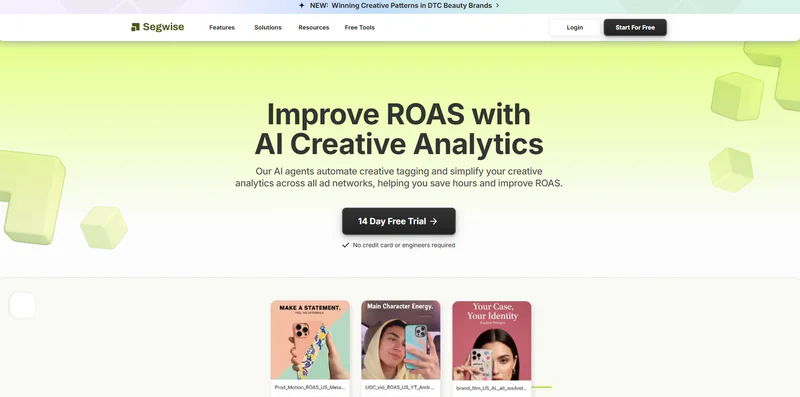
Segwise is a creative analytics platform built for app-focused advertising. It analyzes image, video, text, and playable ads, then connects individual creative elements to performance outcomes across 15+ ad networks and MMPs: Meta, Google, TikTok, Snapchat, YouTube, Axon (AppLovin), Unity Ads, Mintegral and IronSource among them, plus five MMPs: AppsFlyer, Adjust, Branch, Singular and Kochava. Instead of only producing new ads, it helps you understand why certain ads work and what to scale next.
Segwise stands out because it focuses on decision-making after ads are live. It is designed for situations where knowing which creative patterns drive installs and revenue matters more than producing more variations.
If your day-to-day work depends on deciding which creative to pause, refresh, or scale, Segwise gives you direct answers backed by performance data. Its focus on creative signals, fatigue detection, and competitor patterns makes it the most relevant option when performance clarity is the priority.
Key features:
Creative Tagging: Multimodal AI automatically tags hook scenes, first dialogues, headlines, characters, influencer traits, CTA text, CTA dialogue, and audio cues, and ties them to metrics such as CTR, IPM, and downstream performance metrics (including ROAS, where supported by attribution data).
Competitor tracking: Ingests and monitors competitor ads on Meta to surface patterns and benchmarks.
Custom tagging: Add or map your own tag library to ensure insights align with your taxonomy.
AI creative generation (Creative Generation Agent): Generates net-new, data-backed creatives, static images, video ads including AI UGC-style video, and interactive playables, built around the winning tags its own analytics identified, not generic AI guesses. It also produces scene-by-scene video storyboards, lets you refine outputs by prompting, and exports in each network’s aspect ratios (1:1, 4:5, 9:16, 16:9). Generated creatives are auto-tagged and tracked once live, so performance feeds back into the same intelligence that produced them.
Creative Strategy Agent (AI Chat): An always-on AI creative strategist with full context across your account. Ask “which hook style drove the most installs last month?” or “what’s different about my top 5 creatives versus my bottom 5?” in plain language and get an answer immediately: no dashboard building. It will also generate a stakeholder report on demand and return a shareable link.
Native fatigue detection: Monitors every creative across every connected network for continuous performance decline and spend-share drop, with fatigue thresholds you configure to your own business logic (say, a 20% ROAS decline over 7 days) so you get the warning before the budget is gone rather than after.
Video to Playable tool: MP4 → HTML5 playable conversion tooling and templates, supporting deployment to networks such as Mintegral and AppLovin (tooling and free converters available).
Portfolio/studio view: Manage analytics across multiple apps or brands from one interface.
Best for:
This is the best fit when your priority is understanding which creative elements actually drive results across channels and formats. It works best when performance insights guide creative decisions.
Why it can be a better alternative to Bestever:
Segwise is built specifically for tag-level creative analytics that link individual creative elements (hooks, dialogue, scenes) to network + MMP performance, so teams focused on diagnosing which exact creative signals drive installs, IPM, or ROAS will get deeper post-launch measurement than a platform whose primary emphasis is on generating and iterating ad variations.
Pricing:
7-day free trial via free trial, no credit card, no engineering setup. Segwise starts at $499/month for advertisers spending up to $250K/month, with a special 50% discount for startups spending under $50K/month. Setup is no-code and takes about 5 minutes per source (10 to 15 minutes to connect everything). Historical data is backfilled automatically on connection: up to 2 weeks on the trial, and up to 3 months on paid plans, so you have something to analyse on day one.
Limitations:
Competitor tracking currently covers Meta only, with more platforms in development. And if you run only a handful of creatives a month, tag-level analytics will be heavier machinery than your problem needs: a $10 to $39/month generator may genuinely serve you better.
2. Creatify

Creatify focuses on high-volume, avatar-driven, and UGC-style video generation. You can turn a product page or script into many short, platform-ready clips using avatars, voices, and templates. It’s built for large batches of scroll-first creative.
Key features:
AI avatar & voice studio: create presenter-style clips without filming.
Batch mode & templates: generate many short variants fast from a single URL or script.
Export controls & aspect ratios: supports 9:16, 16:9, 1:1 for social channels.
Best for:
Good when your main need is cheap, high-volume UGC or avatar videos. If your goal is to identify which creative elements drive installs across networks, this tool may not provide the deep, tag-level measurement you need.
Why it can be a better alternative to Bestever:
Creatify emphasizes high-volume, avatar-driven, and UGC-style video generation (batch mode, AI avatars, voice, and templates), making it a stronger choice when your priority is rapid, low-cost production of many scroll-first variants rather than the combined analytics + generation workflow Bestever offers.
Pricing:
Free plan (10 monthly credits: roughly 2 video ads or 20 image ads) · Starter $39/month (100 credits) · Pro $99/month (300 credits, expandable to 5,000 on an annual commitment) · Enterprise custom. Annual billing is promoted at up to 50% off. Read off Creatify’s own pricing page, August 2026.
Limitations:
It is a generator, not an analyst. There is no cross-network or MMP performance mapping, no tag-to-metric attribution and no playable support, so it will tell you nothing about why a clip worked. Output is credit-metered, which gets expensive at genuine volume.
3. Atria

Atria centers on inspiration, a large ad library, and team workflows. It captures competitor ads, extracts scripts and creative ideas, and gives a board-like hub for review and collaboration. It mixes research and simple creative generation.
Key features:
Ad library & search: searchable collection of in-market ads for idea discovery.
Workflow boards & asset hub: keep inspiration, assets, and reviews in one place.
Custom/AI tagging & URL analysis: pulls script, reviews, and ideas from competitor pages.
Raya, an AI creative-strategist agent: reported as launched in February 2026 and trained on $5B+ of ad spend, Raya auto-tags creatives, watches competitors and generates weekly ad concepts unprompted. (The date comes from third-party coverage rather than an Atria press page.)
Radar analytics and Review Mining: grades ads A to D on ROAS, CTR, hook rate and retention with prescriptive fixes, and extracts ad angles and customer language from Amazon, Google and uploaded reviews. Atria’s ad library covers 25M+ Meta and TikTok ads with semantic search by messaging angle.
Best for:
Best when your main need is an inspiration library and a simple team workflow. If your goal is rigorous tag-level measurement across ad networks or playable support, look for other options.
Why it can be a better alternative to Bestever:
Atria prioritizes an expansive ad library, competitor capture, script extraction, and board-style team workflows for inspiration and review. This approach is ideal when your primary need is discovery, research, and collaborative idea curation rather than automated variation generation and integrated performance tagging.
Pricing:
Core $129/month, Plus $479/month, Business $959/month, all billed annually, plus a custom Enterprise tier. Competitor tracking is capped at 50 to 200 brands depending on tier, and Atria’s MCP server and REST API are currently advertised as free and unlimited. Be careful with older write-ups: several still quote a cheaper ladder that Atria’s own pricing page no longer shows.
Limitations:
No playable-ad support and no MMP-grade app attribution, so mobile game UA teams will hit a wall. It is Meta- and TikTok-shaped, and the jump from Core to Plus is steep once you need more than a couple of tracked brands.
4. Icon AI

Icon is an “AI Admaker” that focuses on remixing your existing footage and running end-to-end ad creation workflows at a low monthly price. It bundles multiple ad production tools (editing, asset management, ad templates) into a single app.
Key features:
Footage remix & AdCut editor: repurpose raw clips into multiple short ads quickly.
High-volume ad creation with generous per-plan limits: many variants for a fixed low monthly fee.
Built-in ad spy/templates/automation: speed-focused creative tooling.
Best for:
Great when you already have raw footage and need to remix it into ad variants at an affordable price. If your main need is cross-network creative measurement and playable conversion, this is less aligned.
Why it can be a better alternative to Bestever:
Icon positions itself as an end-to-end, production-first “AI Admaker” that excels at remixing existing footage into large numbers of ad variants at a fixed, low monthly cost. It is a better fit when you already have raw assets and need high-volume, cost-effective editing and variant output rather than Bestever’s combined tag+generate approach.
Pricing:
Check this one before you budget. Icon appears to have repositioned: as read on 31 August 2026 its published pricing page leads with an agency-style offering: “The Agency” at $0 today, then $1,000/month after 3 days, built around human-filmed UGC ads, with a Dedicated Creative Director tier at custom pricing and an Agency Whitelabel tier at volume pricing. The cheap self-serve AI Admaker plan that older roundups quote at around $39/month is no longer the headline offer. Treat any figure you see in a 2025-era comparison as unreliable and read the live page.
Limitations:
Beyond the pricing ambiguity: no cross-network creative measurement, no MMP integration and no playable conversion.
5. Lexi AI

Lexi starts with your website or app URL and automatically builds campaigns and ad content. It focuses on campaign automation and continuous optimization (not just creative output). It’s often used where a hands-off campaign running on Meta/Instagram is desired.
Key features:
Start from URL: auto-extracts product and audience signals from your site to seed campaigns.
Campaign automation: hands-off setup and ongoing optimization for ad platforms.
Continuous optimization: shifts budget and creatives automatically based on performance signals.
Best for:
Choose this when you want an automated campaign setup and running. If your priority is hard creative measurement and playable ad tooling, this is not the primary fit.
Why it can be a better alternative to Bestever:
Lexi starts campaigns from a website URL and focuses on automated campaign setup and continuous optimization across ad platforms, so teams that want hands-off campaign orchestration (auto-generated audiences, budgets, and optimization) may prefer Lexi over a tool that centers on producing and analyzing creative variations.
Pricing:
Not publicly confirmed for this update. We could not verify current published tiers for Lexi in August 2026, so we are not quoting a figure: check the vendor site directly. Older third-party summaries place starter tiers in the low hundreds per month with custom enterprise pricing, but that is not something we would build a budget on.
Limitations:
Campaign automation is the product; creative measurement is not. There is no tag-level creative attribution, no playable tooling, and its focus is Meta and Instagram rather than the mobile ad networks.
6. AdCreative.ai
AdCreative.ai is the volume end of AI ad generation: cheap, fast, and scored for conversion. Note the ownership: it was acquired by Appier (announced 12 February 2025, closed early March 2025, $38.7M total), so it is no longer an independent startup either. Appier is wiring its generation engine into the AIRIS CDP so audiences feed straight into creative production.
Key features:
High-volume generation with conversion scoring: static, display and social creative plus AI copy and headlines, each scored for likely performance.
Video and product photography: product videos, UGC-style content, fashion videoshoots from images, and studio-quality ecommerce visuals from raw product photos.
Competitor campaign intelligence and brand-specific custom templates, plus newer additions like buyer personas and compliance checking.
Best for:
SMBs, solo marketers and small agencies who need a lot of creative fast and cheap. If your bottleneck is literally “we cannot produce enough variants,” this is the most direct swap for Bestever at a similar price point.
Why it can be a better alternative to Bestever:
It does the same core job, bulk AI ad generation, with an owner that has publicly stated how it intends to integrate the product, which is exactly the clarity the Samba announcement withholds.
Pricing:
Starter $39/month (10 credits, 1 brand) · Professional $249/month (50 credits, 10 brands) · Ultimate $999/month (100 credits, 25 brands) · Enterprise custom. Quarterly billing is 25% off and yearly 50% off, with a 7-day free trial.
Limitations:
No creative analytics worth the name: no cross-network performance mapping, no MMP attribution, no playable support.
7. Pencil
Pencil generates complete ads rather than isolated components, with your brand guidelines applied automatically, and it has the lowest published entry price of anything on this list. It has been part of The Brandtech Group since August 2023 and runs as two products: self-serve Pencil, and enterprise Pencil Pro sold through Brandtech.
Key features:
Whole-ad generation with brand guardrails applied automatically, across Editor, Canvas and Workflows surfaces.
Connects to your media accounts to pull performance data and predict likely winners.
Multi-model stack: current integrations include Claude (Fable 5 / Sonnet 5) for copy, Gemini Omni Flash and Nano Banana 2 Lite for image and video, and ElevenLabs for AI voiceover reusable across every surface.
Best for:
Two very different buyers: a solo marketer who wants credible AI ad generation for the price of a couple of coffees, and, at the opposite extreme, a global brand buying Pencil Pro through Brandtech for its brand-safety, data-protection and IP-ownership guarantees.
Why it can be a better alternative to Bestever:
It is cheaper at the entry tier than almost anything credible ($14/month), it is explicit about who owns it and how the two product tracks work, and Pencil Pro gives you an enterprise upgrade path that Bestever’s post-acquisition roadmap simply doesn’t document.
Pricing:
Core $14/month ($11 annually, 50 generations/month) · Growth $55/month ($44 annually, 250 generations) · Pro custom (unlimited, contact sales). Pencil Pro has no published pricing at all.
Limitations:
Generation-metered, so heavy testing pushes you up tiers fast. No playable ads, no MMP attribution, and no tag-level cross-network creative diagnosis.
8. Adnova
Adnova bundles creative research, competitor tracking and bulk ad launching into one low three-figure tool. (Mind the domain: adnova.ai; the similarly-named adnova.marketing is an unrelated ad network.)
Key features:
Creative Analytics 2.0: AI reports analysing creative performance across 14 dimensions.
Inspirations and Detective: a searchable library of a claimed 75 million ads, plus competitor launch tracking with strategy extraction.
Bulk Ad Launcher, Creative Hub and Scenes: launch 100+ ads at once, collect asset feedback in one place, and split assets with AI tagging for video production. Plus 1,000+ pre-built Meta static templates for Canva and Figma.
Best for:
Hands-on Meta-first ecommerce brands and small agencies that want research and operational throughput in the same tool, at a price they can approve without a business case.
Why it can be a better alternative to Bestever:
Where Bestever’s answer to “now what?” is more variations, Adnova’s is getting 100 ads live at once and tracking what competitors just launched. If your bottleneck is operational rather than creative supply, this is the more useful tool.
Pricing:
Free tier (1 workspace, 1 user, $25K monthly ad spend limit) · Plus $119/month billed annually ($150 month-to-month) · Growth $249/month annually ($309 monthly) · Pro $399/month annually ($499 monthly) · Enterprise custom. Standalone add-ons: Ad Launcher $79/month, Creative Hub $39/month, Scenes $69/month.
Limitations:
Adnova does not generate creative. There is no AI image or video generation product, so it is not a like-for-like Bestever replacement: it is research, analytics and launching. It is also Meta-centric, with no playable support and no MMP-grade app attribution.
9. GetCrux
GetCrux (backed by Y Combinator) runs three AI agents and, unusually, closes the loop by publishing creatives itself rather than handing you a file.
Key features:
AI Creative Analyzer: breaks ads into elements, finds patterns in winners, writes brand-aligned briefs and scripts.
AI Audience Analyzer: mines comments, reviews and competitor ads for objections and untapped angles.
AI Creative Generator with publishing to Meta, Google and TikTok, included from Starter (1,000 credits), plus pre-flight testing of creative before spend on the Professional tier.
Mobile-aware connectors: Meta, TikTok, Google, Pinterest, Snapchat, AppLovin, Moloco, The Trade Desk, Criteo (AppLovin and MMPs from Professional), plus BI (Power BI, Tableau), warehouses (Snowflake, Databricks) and attribution (AppsFlyer, Northbeam, Triple Whale).
Best for:
Performance teams at $1M+ annual spend, especially mobile app and gaming advertisers, that want analysis and generation in a single loop.
Why it can be a better alternative to Bestever:
It goes further in both directions than Bestever: deeper analysis feeding the generation, and auto-publishing out the other end. For a team buying mobile inventory, the AppLovin, Moloco and MMP connectors (MMPs from Professional) matter in a way Bestever’s Meta/TikTok/Google focus doesn’t reach.
Pricing:
Starter $1,500/month (up to $100K monthly ad spend) · Professional and Enterprise custom ($100K to $1M and $1M+ monthly spend respectively). No free plan.
Limitations:
Starter at $1,500/month only covers up to $100K of monthly ad spend. Pre-flight testing and MMP data sit on the custom-priced Professional tier (generation is on Starter), and no free trial or free plan is listed. This is a serious jump from Bestever’s $10 entry point.
10. Madgicx
Madgicx has repositioned as agentic Meta ads management: an AI Marketer that runs your Facebook ads autonomously, rather than a dashboard you drive. It is an official Meta Business Partner.
Key features:
AI Marketer: an agentic “personal AI media buyer” that runs Meta campaigns autonomously, alongside an Ads Rotation Agent and a Creative Refresh Agent.
AI Ads Generator: AI creative generation with automated ad launch across campaigns: generate and go live in one flow.
Ad fatigue detection, creative performance analytics, audience targeting and budget automation, plus a Cloud/Tracking Pro attribution add-on.
Best for:
Shopify and DTC advertisers running Meta at small-to-mid budgets who would rather buy automation than hire a media buyer.
Why it can be a better alternative to Bestever:
Bestever makes the ad; Madgicx makes the ad and runs the account. If the real problem is that nobody on your team has time to manage Meta daily, generation alone was never going to fix it.
Pricing:
Spend-tiered and quoted in-app. Madgicx deliberately gates its main price: the pricing page says “see price inside the app,” with published ad-spend brackets from under $1K up to $30K+/month. The Tracking Pro add-on is $49/month per connected account, the homepage carries an early-bird offer at $29/month forever for the data-analysis tier only (not the full AI suite), and there is a 7-day free trial of all features.
Limitations:
Meta-only, so it does nothing for TikTok, Google or mobile ad networks. Gated pricing makes budgeting awkward before you sign up. And its user reviews include a recurring thread of billing and cancellation complaints alongside the positive automation ones: worth reading before you commit.
11. Marpipe
Marpipe has repositioned around catalog and product-feed ads: it now calls itself “the operating system for your catalog ads.” The multivariate creative-testing product it was originally known for still exists but is no longer the headline, so older descriptions of Marpipe as “the multivariate testing tool” are incomplete.
Key features:
Catalog creative design: turns product feeds into brand-compliant ad designs, plus product-level video generated from individual SKUs.
SKU optimisation: automatically filters underperforming products out of your feeds.
Feed management and distribution across Meta, Google, Pinterest and Snapchat, with catalog-powered dynamic elements (social-proof counters, inventory timers, dynamic pricing).
Best for:
Ecommerce brands and retailers running large catalog or Dynamic Product Ads who need feed management plus automated, on-brand creative generated per SKU.
Why it can be a better alternative to Bestever:
If you sell thousands of products, the creative problem isn’t “write me a better hook”: it’s generating on-brand creative for every SKU and keeping the feed clean. Bestever doesn’t attempt that; Marpipe is built for nothing else.
Pricing:
Feed Management $0/month (unlimited seats, no SKU limit, feed features only) · Startup $199/month (500 SKU cap, 1 output feed, 1 market, 3 live designs) · Enterprise from $999/month (unlimited feeds, designs and markets; SKU tiers to 100,000+). Add-ons: extra location feeds $299/month each, extra SKUs at $100 per 200 on Startup. A 50%-off-first-year Enterprise promotion is listed for advertisers under $50k/month in spend.
Limitations:
Very narrow. If you don’t run a product catalog, none of this applies. No playable ads, no MMP attribution and no app UA story at all.
Each of these Bestever alternatives solves a different part of the creative and growth puzzle. Some focus on performance clarity, others on speed, automation, or cost efficiency. The right choice depends on what slows you down most today. To make that decision easier, the next section walks through a simple way to pick the right Bestever alternative based on your goals, workflows, and scale plans.
Also Read: Top Creative Analytics Tools for Successful Ad Campaigns 2025
How to Pick the Right Bestever Alternatives

What is the biggest blocker right now: making more ads, knowing which ads win, running campaigns automatically, or turning existing videos into interactive playables? Pick one problem first. This keeps your evaluation focused and saves time.
Step 1: Define the outcome you need
Name the outcome in plain terms: cut wasted tests, speed up video production, run campaigns with less hands-on work, or increase installs from playable ads. Keep the goal to one line so you can judge tools by how well they deliver that result.
Step 2: Match features to that outcome
Use this short mapping when you compare tools:
If you need to know which creative parts drive results, look for automated creative tagging, element-level analytics, and fatigue or trend signals. These features show which hooks, visuals, or captions actually move metrics.
If your ads rely on many short videos (10 to 30 seconds) for platforms like Instagram, Facebook, or TikTok, producing them one by one can slow you down and increase costs.
If you want hands-off campaign setup and optimization, choose a tool that can build campaigns from a URL and automatically manage budgets and audiences. That reduces manual campaign work.
If you already have raw footage and want more variants cheaply, pick a tool focused on remixing and editing at scale with fixed monthly pricing.
If you need interactive/playable ads, confirm that the tool converts MP4 to HTML5 playables and supports networks that accept playables (e.g., AppLovin, Mintegral). That unlocks interactive inventory for mobile installs.
Step 3: Check integrations and reporting
Ensure the tool integrates with the ad platforms and measurement partners you already use. Look for direct links to Meta, TikTok, major DSPs, and your measurement partner. Tools that pull real campaign data let you compare apples to apples.
Step 4: Test workflow fit
Try a short, practical test in each candidate tool:
Upload one real ad or video you ran last month.
Ask the tool to show what worked and why, or to generate five new variants.
Note how long each task takes and who on your team must be involved.
A tool that requires significant engineering time or a lengthy setup is often not the right choice when you need results fast.
Step 5: Compare price vs scale
Match pricing to how many creatives or campaigns you run. Fixed-price plans can be cheaper when you produce huge volumes. Usage or seat pricing can make sense when you need deep analytics across many accounts. Ask for a demo plan tied to your actual monthly volume before you buy.
Step 6: Measure impact during the trial
Run a short experiment for 2-4 weeks:
Keep one control ad set and test the tool’s creatives or recommendations in a mirrored ad set.
Measure installs, cost per install, and creative-level metrics (CTR, IPM).
Prefer the tool that improves your chosen outcome, not the one with the slickest UI.
This gives you real evidence before you commit.
Pick the tool that solves the single problem slowing you down today, run a short real test, and keep the winner only if it improves the exact metric you care about. That simple loop saves time and budget while improving results.
Conclusion
Choose Bestever Alternatives based on the outcomes you need, not features alone. Pick the tool that removes your single biggest blocker, cuts wasted creative spend, shortens test cycles, or proves what drives installs, then validate with a short, mirrored experiment that measures the exact metric you care about.
When decisions become the bottleneck, the right tool turns creative fragments into testable signals, enabling teams to scale what actually moves installs and revenue. Segwise automates element-level tagging, offers quick MP4-to-HTML5 playable conversion, and provides low-setup, no-code integrations with major ad networks and MMPs, along with reporting to help teams validate creatives quickly.
Factually, Bestever emphasizes rapid creative generation and competitor-inspired variant creation; teams focused on deep, tag-level cross-network attribution and built-in playable conversion may prefer a platform whose core product centers on those capabilities.
Segwise.ai helps teams validate what truly works before scaling spend. Start a Free Trial to test real creatives, measure impact quickly, and optimize with evidence rather than assumptions.
FAQ's
1. What are the top Bestever Alternatives for mobile app marketers in 2026?
Segwise (creative analytics with generation built in), Creatify (high-volume avatar and UGC video from $39/mo), AdCreative.ai (bulk AI ad output from $39/mo), Pencil (the cheapest entry point at $14/mo), Atria (ad library plus the Raya strategist agent, $129 to $959/mo), GetCrux (analysis, generation and publishing, from $1,500/mo), Adnova (research and bulk launching from $119/mo), Madgicx (agentic Meta ads management), Marpipe (catalog and product-feed ads), Icon (footage remixing) and Lexi (URL-driven campaign automation). For mobile app marketers specifically, Segwise and GetCrux are the two that handle MMP data and mobile ad networks properly.
2. Which Bestever Alternative shows which creative parts actually drive installs?
Segwise tags image, video, and audio elements and links those tags to performance using a unified ad network and attribution data, so you can see which hooks and visuals drive installs.
3. Which Bestever Alternative is best for low-cost, large-batch UGC-style or avatar videos?
Creatify. Its AI avatar and voice studio plus batch mode generate many short variants from a single URL or script, and pricing starts at a free 10-credit tier, then $39/month for 100 credits and $99/month for 300 (expandable to 5,000 on an annual plan). It is a generator only: it will not tell you which of those clips actually drove installs.
4. I have lots of raw footage, which Bestever Alternatives can remix into many polished ads cheaply?
Icon is built for footage remix and high-variant output from the same clips. Check its pricing before you plan around it, though: as of 31 August 2026 its published pricing page leads with a $1,000/month agency offering built around human-filmed UGC, not the roughly $39/month self-serve plan that older comparisons quote. If cheap remixing is the goal, Pencil ($14/mo) and Creatify ($39/mo) are the currently verifiable low-cost options.
5. How do I pick the right Bestever Alternatives for my team in 2026?
Pick the single problem that slows you (need more ads, clearer measurement, hands-off campaigns, or footage remix), run short trials to test your real metric, and keep the tool that improves that metric. (Segwise, Creatify, AdCreative.ai, Pencil, Adnova and Marpipe all offer trials or free tiers to test.)
6. Was Bestever acquired?
Yes. Samba (Samba TV) announced on 22 June 2026 that it had acquired Bestever AI, as part of Samba’s agentic advertising roadmap. Terms were not disclosed, and Bestever founder Apoorva Govind joined Samba as Director of Product leading AI strategy. As of 31 August 2026, bestever.ai makes no mention of the acquisition anywhere on the site.
7. Is Bestever shutting down?
There is no announcement that it is, and we are not going to guess. The product is live and purchasable today at $10/month (Essential, 40 credits) and $99/month (Advanced, 400 credits). What the acquisition announcement does not say is whether Bestever continues as a standalone product: it emphasises integration into Samba’s platform instead. That is real uncertainty rather than bad news, and it is a fair question to put to the vendor before signing an annual deal.
8. Which Bestever alternatives publish their pricing openly?
As of August 2026: Pencil ($14 to $55/mo), AdCreative.ai ($39 to $999/mo), Creatify (free tier, then $39 to $99/mo), Adnova (free tier, then $119 to $399/mo annually), Atria ($129 to $959/mo billed annually), Marpipe (free feed tier, then $199 to $999+/mo) and GetCrux ($1,500/mo Starter, no free plan). Segwise starts at $499/month for advertisers spending up to $250K/month, with a special 50% discount for startups spending under $50K/month. Madgicx gates its main price in-app; Lexi and Icon’s self-serve tier both require a conversation.
9. Which alternative handles playable ads and mobile network data?
Segwise is the one built for it: multimodal tagging that covers playable (interactive) ads, unified data across 15+ ad networks and five MMPs (AppsFlyer, Adjust, Branch, Singular, Kochava), and MP4-to-HTML5 playable conversion. GetCrux carries AppLovin, Moloco and MMP connectors (on Professional) and is the closest second. Every other tool on this list is Meta/TikTok/Google-shaped and does nothing with playable inventory.
How We Evaluated These Tools
Methodology. This comparison was rebuilt in August 2026 by reading each vendor’s own pricing and product pages, then cross-checking dated press releases for launches, acquisitions and shutdowns. Every dollar figure was read off a vendor pricing page or marketplace listing on 31 August 2026. Where a vendor publishes no price, or where we could not verify a current figure, we say so rather than repeating a number from an older roundup, which is why Lexi and Icon carry caveats instead of prices. Pricing in this category moves fast; re-verify before you sign.
About the author. Written by the Segwise team, who build creative intelligence infrastructure for mobile app, gaming and DTC advertisers and work daily inside live UA accounts across Meta, Google, TikTok, Axon (AppLovin), Unity Ads and Mintegral, connected to AppsFlyer, Adjust, Branch and Singular. Segwise appears first in this list: that is our bias, stated plainly, which is also why every alternative here carries its real published pricing and a limitations section written to be useful rather than flattering.