
Updated July 2026.
The best creative analytics tools for subscription apps in 2026 are Segwise, VidMob, and Singular (Creative IQ). Segwise leads for automated creative-element tagging and cross-network intelligence, VidMob for enterprise pre-launch creative scoring, and Singular for creative analytics tied to MMP-grade attribution. Winning new users for subscription apps isn't just about spending more; the real success often comes down to creative performance. If your creatives fail to stop the scroll or spark action, even the best media plan won't deliver installs. This is where Creative Analytics comes in.
Creative analytics platforms help UA teams understand which hooks, formats, and CTAs actually attract high-intent users, so campaigns aren't just reaching people, but converting them into app installers and engaged subscribers. So, with rising competition and endless creative variations, are you also finding it harder to identify what actually sparks installs?
This blog highlights the leading creative analytics platforms for subscription apps in 2026, what they offer, their key features, pricing, limitations, and how UA teams can use them to run smarter acquisition campaigns.
Key Takeaways
Acquiring new users for subscription apps isn't about spending more; it's about knowing which creatives convert scrollers into subscribers.
Creative analytics platforms support ad networks, automate tagging, offer fatigue alerts, and help pinpoint high-performing creatives.
Leading platforms in 2026 include Segwise, VidMob, Singular (Creative IQ), Pencil, Adnova, Superads, Atria, Foreplay, and Madgicx.
Segwise stands out for automatically tagging every creative element (including playable ads) across 15+ ad networks and 4 MMPs and mapping each element to ROAS, CPI, and LTV.
Choosing the right platform means scaling winning ads faster, improving ROI, and driving quality subscriber growth with data-backed decisions.
Quick Comparison: Creative Analytics Tools for Subscription Apps (2026)
| Tool | Best for | Key feature | Pricing | Rating |
|---|---|---|---|---|
| Segwise | Subscription apps and studios running cross-network UA at scale | Automated creative-element tagging (incl. playable ads) mapped to ROAS/CPI/LTV | 7-day free trial; subscription-based (contact sales) | - |
| VidMob | Enterprise pre-launch creative scoring and media optimization | AI creative scoring against performance outcomes | Custom / contact sales | 4.4/5 (G2) |
| Singular (Creative IQ) | Teams wanting creative analytics tied to MMP attribution | Visual reporting plus AI tagging on top of attribution data | Custom / contact sales | 4.4/5 (G2) |
| Pencil | Fast AI creative generation and predictive testing | AI ad-variant generation with pre-launch predictions | From $14/mo; Pro custom | 4.8/5 (G2) |
| Adnova | Creative discovery, inspiration, and bulk ad launching | Ad inspiration library plus bulk launcher and analytics | From $99/mo (launcher); research bundles from $119/mo | - |
| Superads | Visual multi-platform creative reporting dashboards | Creative reporting with thumbnails and shareable dashboards | Free plan; Pro from $49/mo (by ad spend) | - |
| Atria | Meta/TikTok ad inspiration plus creative reporting | Ad research library combined with creative reporting | Core from $129/mo | - |
| Foreplay | Saving, organizing, and briefing from competitor ads | Ad swipe file, ad library, and creative brief workflow | From $49/mo (annual) | - |
| Madgicx | Meta/Google ad optimization with creative reporting | Creative analytics inside an ad-automation suite | Pro from $99/mo (by ad spend) | - |
Pricing verified from vendor and G2 listings as of July 2026; enterprise plans marked "custom / contact sales" are quote-based. Ratings shown only where a public G2 score was available.
What Are Creative Analytics Platforms?
Creative Analytics Platforms connect ad creatives, such as images and videos, to performance data, revealing what truly drives results. Instead of relying on guesswork, these platforms offer deep insights into which visuals, messages, and formats are effective.
By showing which elements lead to acquiring more users, they empower UA teams to test faster, optimize smarter, and double down their budget on high-performing ads.
Let's look at why creative analytics platforms are essential for subscription apps.
Also Read: Creative Analytics Explained: How To Track, Measure, And Improve Ad Performance
Why Do Subscription Apps Need a Creative Analytics Platform?
Subscription apps are making it critical to pinpoint which creative formats, hooks, and CTAs actually attract high-intent users and drive installs. Without creative insights, you're left optimizing on guesswork, missing the chance to scale what works and cut what doesn't.
Here are the key reasons why these platforms are important:
Iterate faster: Automated tagging of assets, alert systems for creative fatigue, and streamlined testing workflows help you spot winners and cut losers quickly. By pinpointing which creatives deliver the best results, you can allocate spend where it counts and lower your cost per acquisition.
Win despite signal loss: With ATT, SKAN, and cookie changes reducing targeting data, creative becomes your strongest lever; analytics show which elements drive subscribers across channels.
Uncover Audience Preferences: By analyzing which creative elements resonate, be it tone, imagery, or storytelling, you gain clarity on what appeals to potential subscribers. This lets you tailor ads that truly connect with your target demographic.
Pinpoint What Moves the Needle Across Platforms: Not every channel rewards the same creative; what performs well on TikTok may flop on YouTube. Analytics tools let you compare performance across platforms and formats, helping you adapt and amplify the most effective creatives.
Now that you know why creative analytics is essential for acquiring new users, let's look at the leading platforms that can help subscription apps turn creative insights into real growth.
9 Best Creative Analytics Platforms for Subscription Apps in 2026
The right creative analytics platform can be the difference between scrolls and signup conversions. These platforms help you pinpoint exactly which creative drives new users. Here are the top platforms that UA teams should be watching in 2026:
1. Segwise
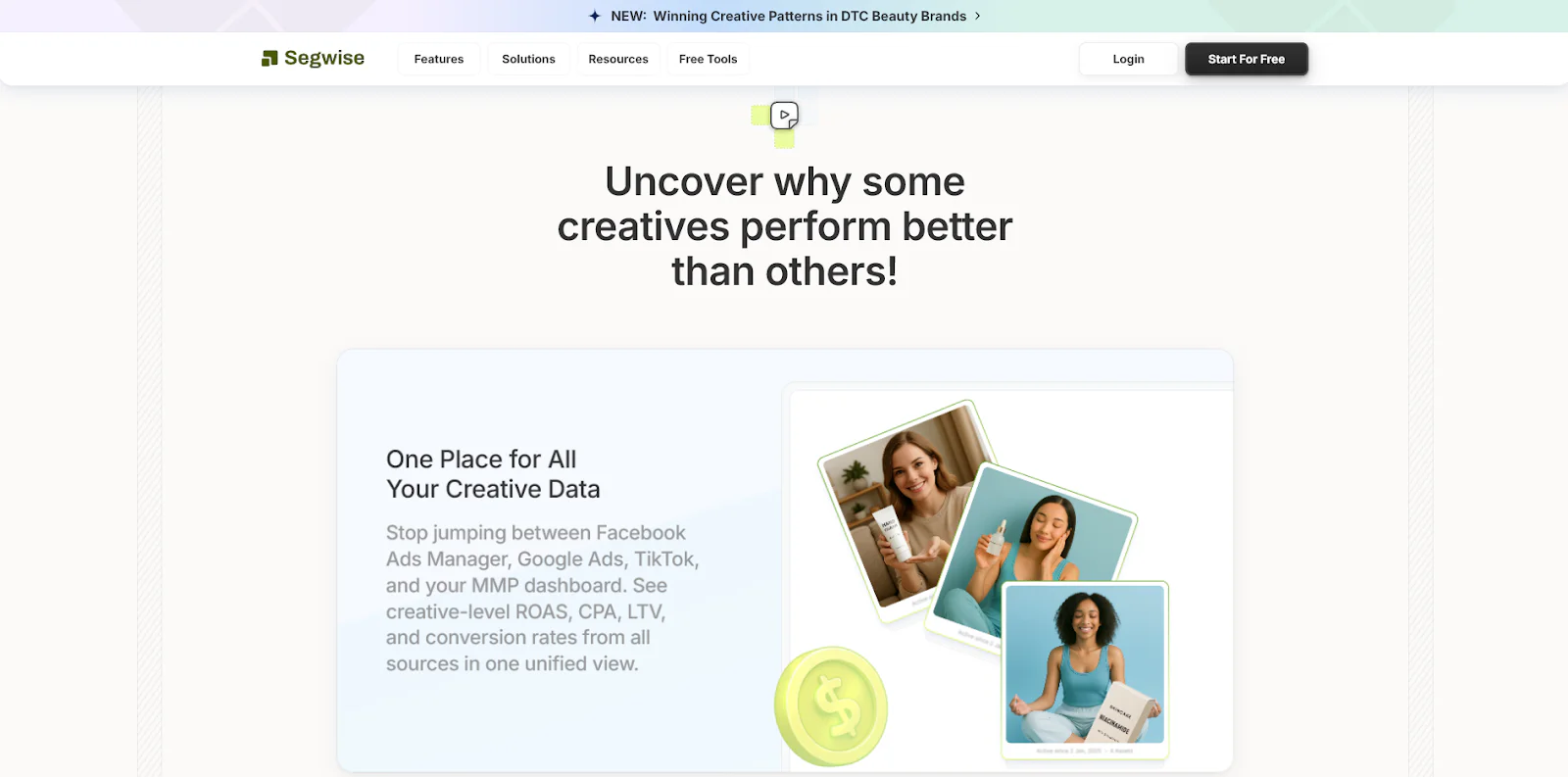
Segwise is built for subscription apps running cross-network campaigns at scale who need fast, reliable insights at the creative element level. Unlike tools that only report at the ad or asset level, Segwise automatically tags every creative element, including hooks, dialogues, visuals, CTAs, and character emotions, and maps them directly to performance metrics such as ROAS, CTR, CPI, CPA, LTV, and IPM. It is also the only platform that tags playable (interactive) ads, which matters for subscription and gaming advertisers testing interactive formats.
This makes it especially valuable for UA Managers, Growth Leads, and Creative Directors managing large creative volumes across multiple campaigns who need faster, more reliable creative performance insights than manual tracking can provide.
Best For
Mobile gaming publishers, subscription apps, DTC brands, and agencies managing large creative volumes
Teams that need unified dashboards across Meta, TikTok, Google, and other ad networks
Growth teams that want to move from guesswork to tag-driven creative briefs
Key Features:
AI-Driven Creative Tagging: Automatically tags elements like hooks, dialogues, visuals, and CTAs across images, videos, and playable ads, eliminating manual tagging efforts.
Unified Performance Dashboard: Aggregates creative-level ROAS, CPI, CPA, LTV, and conversion rates across 15+ ad networks and 4 MMPs into a single view. Networks include Meta (Facebook & Instagram), Google, TikTok, Snapchat, YouTube, Axon, Unity Ads, Mintegral, and IronSource, with MMP integrations for AppsFlyer, Adjust, Branch, and Singular.
Native Fatigue Detection: Monitors creative performance over time to catch early signs of fatigue, allowing proactive optimization before spend is wasted.
AI Creative Strategist (AI Chat): An always-on agent you can query in plain language about creative performance, tags, competitors, and custom metrics.
Creative Generation Agent: Generates net-new and variation creatives (image, video, and playable) grounded in your winning creative patterns, plus video storyboards.
Custom Dashboards & Reporting: Build dashboards tailored to specific KPIs, with automated reports linking creative decisions to ROAS outcomes.
Studio View for Multi-Project Management: Manage creative analytics across multiple apps, games, or brands from one unified interface.
Pricing:
7-day free trial with full platform access (up to 14 days of historical data imported automatically on the trial, and up to 3 months for paid customers).
Subscription-based model with flexible plans; contact sales for a quote based on your networks and creative volume.
Limitations:
Competitor tracking currently covers Meta (Facebook and Instagram), with additional platforms in development.
Why Subscription Apps and UA Teams Use It:
With Segwise, you can instantly see which scenes, dialogues, and CTAs actually drive subscriber installs and revenue, not just clicks. Instead of relying on intuition or fragmented network reports, UA and creative teams get clear, data-backed signals for scaling winners and cutting losers. The result is faster iteration cycles (teams report saving up to 20 hours per week per app or brand), more efficient ad spend, and creative briefs built on real performance rather than guesswork.
2. VidMob

VidMob is a creative data platform that combines AI insights with human expertise to help marketing teams analyze and optimize ad creative performance. It focuses on predictive insights, pre-launch scoring, and creative recommendations to guide media spend and campaign decisions.
While VidMob is strong in predictive analytics and cross-channel guidance, it is generally better suited for enterprise teams that prioritize media optimization and pre-launch creative scoring rather than detailed, element-level analysis at scale.
Best For:
Teams seeking pre-launch predictive scoring for campaigns
Brands or agencies that focus on media optimization and spend efficiency
Enterprise teams that need guidance on which assets to prioritize
Key Features:
Data-Informed Creative Strategy: Identify which creative strategies perform best by audience, region, or platform.
Budget Allocation Insights: Determine which assets deserve media spend and which should be paused.
Pre-Launch Effectiveness Prediction: Score creative assets before they go live to guide decision-making.
Cross-Channel Reporting: Gain insights into creative performance across multiple ad networks.
Pricing:
Custom / contact sales; enterprise contracts, no public free trial.
Rating: 4.4/5 on G2.
Limitations:
Does not provide granular automated tagging of every creative element the way Segwise does.
Enterprise pricing and complexity put it out of reach for many mid-market teams.
Focuses on media optimization rather than a direct link between each creative element and revenue metrics.
Why Subscription Apps and UA Teams Use It:
VidMob helps UA teams make smarter media allocation decisions and identify which ads are likely to perform before launch. This can be useful for subscription apps and DTC brands that want to reduce wasted spend.
3. Singular (Creative IQ)

Singular's Creative IQ is a platform designed to help marketers and UA teams connect creative performance to acquisition results. It focuses on visual reporting, A/B test analysis, and AI-powered tagging to help teams understand which creative elements drive installs and conversions, layered on top of Singular's MMP attribution data.
While Singular offers detailed insights into creative performance, it is generally best for teams that already use Singular for attribution and want creative analysis alongside it, rather than teams looking purely for automated element-level tagging across every network.
Best For:
Teams focused on A/B testing and granular visual comparisons
Brands that already use Singular as their MMP and want creative analytics in the same stack
UA teams looking for deep analysis of design elements and trends
Key Features:
Visual Reporting: Compare ad creatives side by side with performance metrics for quick analysis.
Endless Testing Analysis: Dive deep into A/B test results to identify which creative variations truly impact performance.
AI-Powered Tagging: Automatically categorize creative assets by design elements, tone, or style.
Cross-Platform Insights: Connect performance data across ad networks alongside MMP attribution.
Pricing:
Custom / contact sales; pricing is usage-based (Monthly Tracked Users). No fixed public tier.
Rating: 4.4/5 on G2.
Limitations:
Creative IQ is most valuable when you are already a Singular attribution customer.
Does not tag playable ads or map every element to revenue the way a dedicated creative-intelligence tool does.
Why Subscription Apps and UA Teams Use It:
Singular's Creative IQ helps teams analyze creative performance at a detailed level and run A/B tests efficiently, tied to attribution data. It is useful for subscription apps and DTC brands already on Singular that want to understand which variations perform best. For a deeper head-to-head, see Segwise vs Singular: Creative Analytics Tool.
4. Pencil

Pencil is an AI-powered creative analytics and generation platform that helps marketing teams create, test, and optimize ad creative quickly. It focuses on rapid video and image ad production, paired with insights on which variations are likely to perform best.
While Pencil offers speed and predictive insights, it is generally better suited for teams looking to generate creative quickly and run small to medium scale tests, rather than teams managing high-volume cross-network campaigns with detailed element-level analytics.
Best For:
Teams that need fast, AI-assisted creative generation for testing and experimentation
DTC brands, mobile games, or subscription apps running moderate volumes of creative
Marketing teams focused on predictive insights rather than deep element-level analytics
Key Features:
AI Creative Generation: Automatically generate multiple ad variants for video and display campaigns.
Predictive Performance Insights: Get early predictions of which creatives are likely to perform best before launching campaigns.
Rapid Testing Workflow: Easily test multiple variants and iterate quickly.
Cross-Channel Reporting: Track performance across major platforms, including Meta, TikTok, and YouTube.
Pricing:
Core from $14/mo (about $11/mo billed annually); Growth around $55/mo; Pro is custom.
Rating: 4.8/5 on G2.
Limitations:
Does not offer automated, granular element-level tagging.
Less effective for high-volume, cross-network campaigns.
Limited direct connection between individual creative elements and revenue metrics like ROAS or LTV.
Why Subscription Apps and UA Teams Use It:
Pencil is useful for UA teams and DTC brands that want to generate creative quickly and test multiple variants efficiently. However, for teams managing hundreds of creative variants across multiple ad networks, Segwise provides a more robust solution with automated element-level tagging, unified dashboards, and actionable revenue-linked insights.
5. Adnova

Adnova is an all-in-one creative workflow and analytics platform that helps marketing and UA teams discover, create, manage, and analyze ad campaigns from a single interface. It combines creative inspiration, campaign management, and performance analytics, making it suitable for teams that want to centralize creative operations.
While Adnova offers a wide range of tools, it is generally better suited for teams focused on campaign discovery and creative inspiration rather than granular, element-level performance tracking.
Best For:
Teams looking to streamline creative workflows and manage multiple campaigns in one platform
Agencies or brands seeking inspiration and rapid ad testing for smaller sets of creatives
Teams prioritizing creative discovery over detailed, element-level performance insights
Key Features:
Inspiration Library: Access a database of millions of ads to discover ideas, save them, and use them for creative ideation.
Bulk Ad Launcher: Launch multiple ad variants quickly, with mix-and-match creative combinations for testing.
Performance Analysis: Identify top-performing creatives from campaigns or inspiration feeds to guide future strategies.
Centralized Campaign Management: Manage multiple campaigns and creative workflows from a single interface.
Pricing:
Ad launcher from $99/mo ($79/mo annual); research and analytics bundles from $119/mo (Plus) up to $399/mo (Pro); Creative Hub alone from $39/mo.
Limitations:
Does not provide granular, automated element-level tagging.
Cross-network reporting and direct attribution to ROAS or LTV is limited.
Not ideal for high-volume UA teams running hundreds of variants where efficiency and speed are critical.
Why Subscription Apps and UA Teams Use It:
Adnova is useful for teams that want a central hub for creative ideas, bulk ad management, and general performance insights. It supports rapid testing and campaign management but may not meet the needs of UA teams that require precise, data-driven decisions at the creative element level.
6. Superads
Superads is a creative analytics and reporting tool focused on making multi-platform ad performance visual and shareable. It pairs creative thumbnails with performance metrics so teams can quickly see which ads are working across Meta, TikTok, and other channels without wrestling with native dashboards.
It is a strong fit for teams that mainly want clean creative reporting and dashboards rather than automated element-level tagging or generation.
Best For:
Teams that want fast, visual creative reporting across platforms
Agencies sharing creative performance dashboards with clients
Smaller UA and growth teams that find native ad dashboards clunky
Key Features:
Visual creative reporting with thumbnails alongside performance metrics.
Shareable dashboards for stakeholders and clients.
Multi-platform data consolidation across major ad networks.
Pricing:
Free plan (one report, 30 days of data); Pro from $49/mo priced by ad spend; Enterprise for spend above $1M/mo.
Limitations:
Focuses on reporting rather than automated element-level tagging or creative generation.
Does not tag playable ads or map individual creative elements to LTV.
Why Subscription Apps and UA Teams Use It:
Superads is useful for subscription and DTC teams that want a clean, visual view of creative performance and easy reporting, especially when the priority is sharing results rather than deep creative intelligence.
7. Atria
Atria combines ad inspiration and research with creative reporting, aimed primarily at Meta and TikTok advertisers. It helps teams find winning ad ideas from a large ad library and then track how their own creatives perform, in one workflow.
Atria suits teams that want inspiration plus lightweight reporting rather than automated, revenue-linked element tagging at scale.
Best For:
Meta and TikTok advertisers who want ad research and reporting together
DTC brands and small agencies building creative pipelines
Teams that value inspiration discovery alongside performance tracking
Key Features:
Ad inspiration and research library for Meta and TikTok.
Creative reporting to track performance of your own ads.
Workflow tools to move from inspiration to briefs.
Pricing:
Core from $129/mo; higher tiers available for larger teams.
Limitations:
Reporting is lighter than dedicated creative-intelligence platforms.
No automated element-level tagging tied to ROAS/LTV, and no playable-ad support.
Why Subscription Apps and UA Teams Use It:
Atria is useful for teams that want to shortcut ideation with a large ad library and keep reporting in the same place, though high-volume UA teams often need deeper element-level analytics.
8. Foreplay
Foreplay is a creative workflow tool built around saving, organizing, and briefing from competitor and inspiration ads. It is widely used by DTC and performance teams to build swipe files and turn winning references into creative briefs.
Foreplay is less an analytics engine and more a creative-strategy workflow tool, so teams often pair it with a dedicated analytics platform.
Best For:
Creative strategists building swipe files and briefs
DTC brands and agencies studying competitor ads
Teams that want an organized ad library workflow
Key Features:
Ad swipe file and searchable ad library.
Creative brief builder to turn references into briefs.
Board organization and team collaboration.
Pricing:
From $49/mo (annual) for a single user, scaling for agency teams.
Limitations:
Not a performance-analytics platform; it does not map creative elements to ROAS or LTV.
No automated tagging of your own creative performance data.
Why Subscription Apps and UA Teams Use It:
Foreplay is useful for the ideation and briefing stage, helping teams organize inspiration before they test, while the actual performance analysis happens in a tool like Segwise.
9. Madgicx
Madgicx is an ad optimization suite for Meta and Google that includes creative reporting alongside automation, targeting, and ad management. It appeals to teams that want optimization and creative insight in one platform rather than a standalone analytics tool.
Madgicx suits Meta-heavy advertisers who want automation plus creative reporting, though its creative analysis is not element-level in the way dedicated intelligence tools are.
Best For:
Meta and Google advertisers wanting optimization plus creative reporting
DTC brands and agencies managing spend and creative together
Teams that want automation and analytics in one suite
Key Features:
Creative reporting inside a broader ad-automation suite.
Automation and targeting tools for Meta and Google.
AI chat and ad generation features.
Pricing:
Pro from $99/mo, scaling by ad spend; optional Cloud Tracking add-on around $49/mo.
Limitations:
Creative analytics is secondary to optimization and automation.
No automated element-level tagging tied to LTV, and no playable-ad support.
Why Subscription Apps and UA Teams Use It:
Madgicx is useful for Meta-focused teams that want to combine campaign optimization with creative reporting in a single tool, though teams needing deep, cross-network creative intelligence often layer on a specialist platform.
While these nine platforms stand out in the market, the best choice depends on your team's goals, workflows, and acquisition strategy.
Also Read: Segwise vs Singular: Creative Analytics Tool
How to Choose the Right Creative Analytics Platform?

Not all creative analytics platforms are built for the speed, scale, and complexity of subscription app UA. If you're running paid ads to acquire trial users, here's what to look for:
- Channels & integrations: Make sure the platform connects seamlessly with your ad networks (Meta, TikTok, Google, etc.) and your subscription stack.
AI capabilities: Prioritize tools with automated creative tagging and fatigue detection, so you spend less time labeling and more time scaling what works.
Testing workflow: Look for side-by-side variant comparisons, creative-level performance dashboards, and clear reporting that helps you decide fast what to pause and what to scale.
Privacy & platform nuance: The platform should account for SKAN limitations and Apple Search Ads (ASA), so your creative strategy stays strong even as tracking signals weaken.
Conclusion
When it comes to acquiring new users for subscription apps, every creative decision counts. You know the frustration: manual tagging, scattered dashboards, and dozens or hundreds of ad variants that make it impossible to tell which elements actually drive installs. Creative fatigue goes unnoticed, campaigns underperform, and valuable spend slips away.
Segwise addresses these challenges head-on. By automatically tagging every creative element (including playable ads), consolidating data from 15+ ad networks and 4 MMPs into a single dashboard, and linking each element to real revenue metrics like ROAS and LTV, it gives you clarity, speed, and control. Instead of guesswork or fragmented reporting, you can see exactly what drives subscriber growth, scale winning creatives quickly, and stop wasting time on underperforming ads. For UA managers, growth leads, and creative teams juggling high-volume campaigns, Segwise turns creative data into actionable insights that can save up to 20 hours of work each week and maximize campaign ROI.
So, are you ready to turn creative data into subscriber growth? Try Segwise with a 7-day free trial and start scaling what works.
FAQs
1. What is the best creative analytics tool for subscription apps in 2026?
For subscription apps running cross-network UA at scale, Segwise is the strongest fit because it automatically tags every creative element (including playable ads) across 15+ ad networks and 4 MMPs and maps each element to metrics like ROAS, CPI, and LTV. VidMob and Singular (Creative IQ) are strong enterprise and MMP-aligned alternatives.
2. How much do creative analytics tools cost?
Pricing ranges widely. Entry tools like Pencil start around $14/mo and Foreplay around $49/mo, mid-tier tools like Superads (from $49/mo), Madgicx (from $99/mo), Adnova (from $99/mo), and Atria (from $129/mo) sit in the middle, and enterprise platforms like VidMob and Singular are custom-quoted. Segwise offers a 7-day free trial and subscription-based pricing (contact sales).
3. Does creative analytics help reduce wasteful spend?
Yes. By detecting creative fatigue (when performance dips over time) and surfacing under-performing assets early, these platforms help UA teams pause or refresh ineffective ads. This protects budget and directs spend toward higher-performing creative tests.
4. How does creative analytics complement A/B testing workflows?
It doesn't replace A/B tests; instead, it amplifies them. While A/B tests compare variants directly, creative analytics provides context (e.g., which tags or elements drive winners) and helps prioritize which experiments to run next or stop early.
5. Do these tools support playable and interactive ads?
Most creative analytics tools focus on image and video. Segwise is currently the only platform that automatically tags playable (interactive) ads, which matters for subscription and gaming advertisers testing interactive formats.
6. What should I look for in support or onboarding when choosing a platform?
Look for platforms that offer dedicated onboarding, best-practice templates, pre-built dashboards, and responsive customer support. The faster you can get set up with auto-tagging, dashboards, and test workflows, the sooner your UA campaigns will start improving. Segwise, for example, connects your ad networks in minutes with no-code integrations.
7. Can creative analytics tools generate new creatives, not just analyze them?
Some can. Pencil and Adnova focus on generation, and Segwise's Creative Generation Agent produces net-new and variation creatives (image, video, and playable) grounded in your winning creative patterns, closing the loop between analysis and production.