8 Best Facebook Ads Analytics Tools in 2026
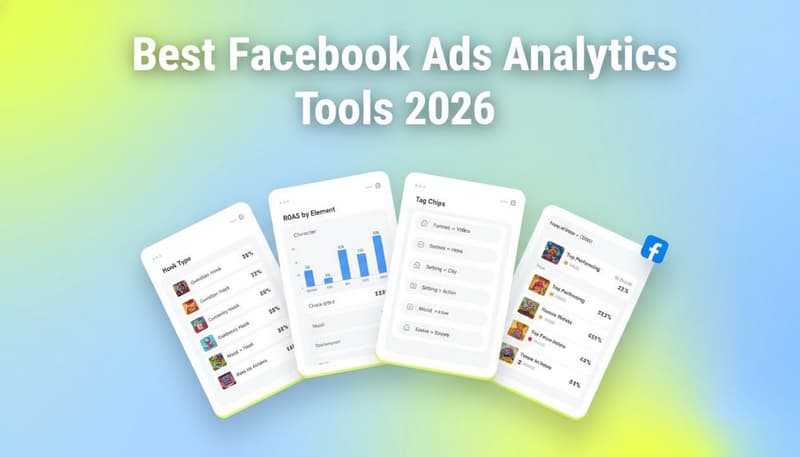
The best Facebook ads analytics tools in 2026 are Segwise, Superads.ai, and Madgicx - built for different layers of the analytics workflow, from multimodal creative intelligence across 15+ ad networks and MMPs to lightweight creative pattern analysis to Meta-native campaign auditing.
The real cost of running Facebook ads without the right analytics
Most performance marketers know they need Facebook ads analytics. Few stop to calculate what running the wrong kind costs them.
Here is the pattern: you are running 50 active creatives across Meta campaigns. Some are performing. Most are not. You check Ads Manager, see campaign-level ROAS, and push more budget into the "winning" campaign. Three weeks later that campaign tanks. The winning creative had been fatiguing for 10 days before you caught it.
That is not a reporting failure. It is an analytics gap. You saw campaign ROAS. You did not see creative-level fatigue signals, which elements were driving clicks, or why the winning creative was winning. By the time the data made it obvious, you had already burned the budget.
Research from Meta and Nielsen consistently shows creative is the largest single driver of campaign performance variation - outweighing audience targeting and bidding strategy. Yet most analytics tools default to campaign and ad-set level reporting, leaving teams blind to the variables that move the needle most.
This guide covers eight Facebook ads analytics tools, organized by what each one actually measures. By the end, you will know which tool fills the specific gap in your current stack.
What Facebook ads analytics actually means
Facebook ads analytics is not the same as Facebook ads reporting. Reporting shows you what happened: clicks, impressions, spend, ROAS within Meta's attribution window. Analytics helps you understand why it happened and what to change.
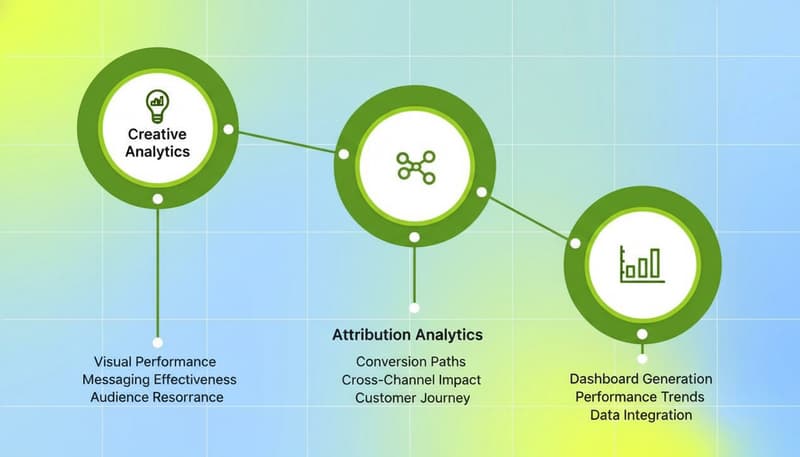
The category breaks into three distinct layers:
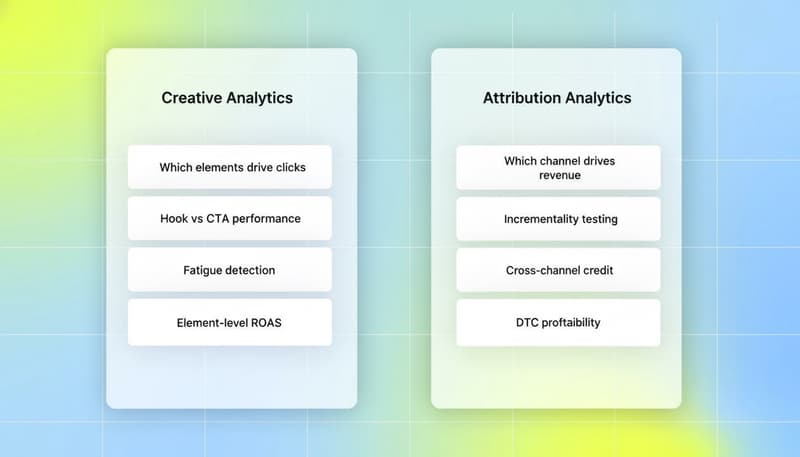
Creative analytics: Which elements inside your ads - hooks, CTAs, visuals, audio, format - are driving or killing performance
Attribution analytics: Whether the conversions Facebook claims are actually incremental, and how Facebook compares to other channels in your mix
Reporting and data infrastructure: Moving platform-reported data into dashboards, spreadsheets, or BI tools for operational visibility
Most tools solve one of these layers. Very few cover all three. Knowing which layer you are missing is the first step to choosing the right tool.
TL;DR - Key Takeaways
Creative is the largest driver of ad performance variation on Meta, yet most analytics tools do not track creative elements
Segwise is the only platform that tags creative elements using multimodal AI across 15+ ad networks and MMPs, including playable (interactive) ads - the only platform to do so
If you run 50+ active creatives on Meta, creative fatigue detection and element-level analytics are the highest-leverage analytics investment in your stack
Superads.ai offers a free entry point for creative analytics across Meta and TikTok - useful for smaller accounts testing the category
Attribution tools like Northbeam and Triple Whale measure revenue contribution but do not tell you which creative elements drove it - both layers are useful and complementary
Agency reporting tools (Whatagraph, Supermetrics) automate data delivery but add no analytical depth
Madgicx is the strongest Meta-native option for teams wanting campaign management and auditing within the platform itself
1. Segwise - Best for creative-level intelligence across ad networks
Most Facebook ads analytics tools tell you that ad A is outperforming ad B. Segwise tells you what inside ad A is responsible. Is it the hook style? The CTA copy? The opening visual? The background music? Without that level of detail, creative teams iterate on gut feel, and UA managers allocate budget without knowing why campaigns actually work.
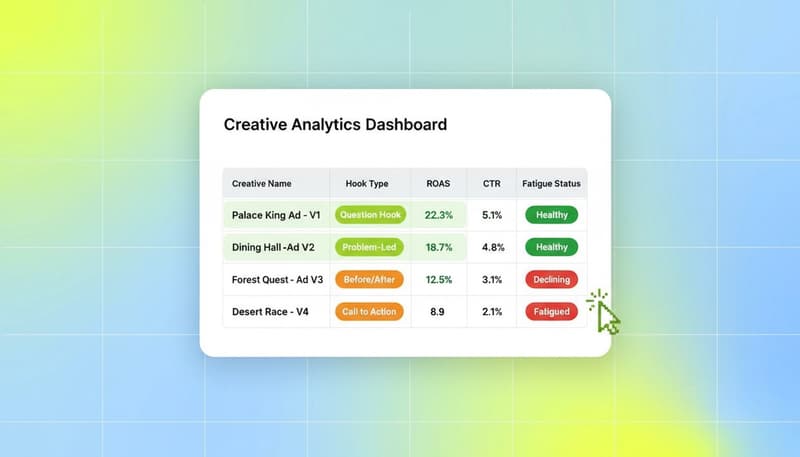
Segwise is an AI-powered creative analytics platform that solves this problem at the element level. Its Creative Tagging Agent uses multimodal AI to tag every creative element across every ad - video frames, audio, on-screen text, visual styles, characters, emotions, and more. Those tags map directly to performance metrics, giving you a clear signal: hook type X drives 2.3x higher CTR than hook type Y across all your active Meta campaigns.
For teams managing high creative volume, this is the analytics layer that typically gets skipped because manual tagging is too time-consuming. Segwise automates the entire tagging workflow.
Key features:
Multimodal AI tagging - Analyzes video, audio, image, and text together to tag creative elements including visual styles, hook lines, characters, CTAs, emotions, and background music types
Playable ad tagging - The only platform that tags playable (interactive) ads, which is critical for mobile gaming advertisers running interactive campaigns on Meta
Cross-network unified view - Connects to Meta, Google, TikTok, Snapchat, YouTube, AppLovin, Unity Ads, Mintegral, and IronSource, with MMP integration via AppsFlyer, Adjust, Branch, and Singular
Creative fatigue detection - Monitors all creatives for performance decline patterns with configurable thresholds and sends early warnings before budget is wasted on declining ads
Competitor tracking - Tags competitor ads on Meta using the same multimodal AI, surfacing creative angle gaps and oversaturated approaches in your competitive landscape
AI creative generation - Generates data-backed creative iterations from your winning tag patterns (static ads now; video generation in closed beta)
Custom metrics - Build business-specific KPIs by combining ad network and MMP data (for example, D7 ROAS per hook type or retention-adjusted CPI by visual style)
When you should try Segwise:
Try Segwise if you are managing 50+ active creatives across Meta and other networks and spending meaningful time each week manually reviewing what is working. It is also the primary choice for mobile gaming advertisers who run playable ads and need element-level insight into interactive creative performance. Teams at DTC brands, subscription apps, and performance marketing agencies that have multiple ad accounts and need a unified creative performance view are strong fits.
Teams using Segwise report saving up to 20 hours per week on manual tagging and creative review, and see 50% ROAS improvement through better fatigue management and element-level optimization.
Limitations:
Custom pricing with no self-serve tier - requires a demo conversation to evaluate
Getting full value requires all major ad accounts connected, which adds a setup step upfront
2. Superads.ai - Best for lightweight creative analytics on a budget
Superads.ai addresses the same creative analytics layer as Segwise but positions itself as an accessible entry point: free for unlimited ad accounts, with paid plans starting at $49 per month. For teams beginning to build systematic creative analysis, that accessibility removes the barrier to starting.
The platform uses AI auto-tagging to categorize creatives by hook type, visual elements, tone, and messaging pattern - without manual labeling. It groups individual ads into "concepts" (strategic creative themes) so you can see which narrative angles are working, not just which individual ads won last month.
Key features:
AI auto-tagging by hook type, visual element, tone, and messaging pattern
Concept-level grouping that aggregates ads into strategic creative themes for pattern analysis
ROAS-by-creative-element breakdowns across Meta, TikTok, LinkedIn, and YouTube
Unlimited ad account connections on the free plan
Cross-platform creative view from one interface
When you should try Superads.ai:
If your primary need is creative pattern analysis on Meta and TikTok and you want a low-barrier entry point, Superads.ai is worth evaluating. It suits freelancers and agencies managing multiple client accounts who need creative analytics without enterprise budget requirements.
Limitations:
Creative analysis only - no attribution engine, no cross-channel revenue measurement, no budget optimization capability
AI tagging accuracy can vary on nuanced messaging or brand-specific creative conventions
Relatively new platform with limited enterprise-scale track record
Pricing: Free plan (unlimited ad accounts); paid tiers from $49-$99 per month
3. Madgicx - Best for Meta-native automation and account auditing
Madgicx is built for advertisers whose entire operation lives inside Meta and who want an AI co-pilot that automates what they would otherwise do manually in Ads Manager. It is less a standalone analytics platform and more an optimization layer on top of Meta's own reporting, handling bid adjustments, budget changes, and account audits without requiring a separate measurement tool.
Key features:
AI account audits that flag underperforming targeting, budgets, and creative with specific fix recommendations
Automated bid and budget adjustments applied directly inside Meta Ads Manager
Cross-channel reporting dashboard spanning Meta, Google Ads, GA4, TikTok, and Shopify
Creative performance analytics at the ad asset level - identify which visuals, copy, and hooks drive engagement
Competitor ad library for creative inspiration
When you should try Madgicx:
Madgicx is a strong fit for Meta-focused advertisers and agencies managing multiple Facebook and Instagram accounts who want in-platform automation alongside basic creative performance data. Not designed for cross-channel revenue measurement or independent attribution.
Limitations:
All optimization decisions rely on Meta's own platform-reported data - no independent attribution layer to validate whether those numbers are accurate
No cross-channel revenue measurement or incrementality validation
Add-on pricing accumulates quickly: the base plan starts at $69 per month, but AI features and tracking tools require separate purchases
Support issues flagged in multiple G2 and Capterra reviews
Pricing: From $69 per month (annual billing); add-ons priced separately
4. Triple Whale - Best for Shopify DTC attribution and profitability
For Shopify-native DTC brands, Triple Whale ties Facebook ad performance to profitability metrics in a single view. With over 50,000 brands on the platform, it has become the default attribution dashboard for D2C founders who want to see margins, CAC, and LTV alongside their ad spend - without needing a data engineer to set it up.
Key features:
"Total Impact" proprietary attribution model blending pixel data, API data, and modeled estimates
Profitability dashboards with CAC, LTV, margin by channel, and unit economics
Post-purchase surveys for self-reported buyer attribution
AI assistant "Moby" for conversational data queries
Fast Shopify setup - typically under one hour to first data
When you should try Triple Whale:
Best for Shopify DTC brands spending $10K-$200K per month that want profitability visibility tied to attribution. Founders and marketing leads who prioritize speed of setup over attribution methodology transparency.
Limitations:
Shopify-only - does not support WooCommerce, Magento, or custom storefronts
"Total Impact" attribution weighting is proprietary and undisclosed, with no audit trail when numbers differ from Meta's
Multiple reliability incidents tracked since early 2024; users on review platforms describe persistent data bugs
No automated budget optimization - you see the data and make manual changes yourself
Pricing: From $179 per month (Starter); scales with plan tier
5. Northbeam - Best for creative-level attribution, DTC media buyers
Northbeam is built for media buyers who want creative-level attribution granularity across paid social and paid search. Where Triple Whale serves the brand founder who wants profitability at a glance, Northbeam serves the practitioner who adjusts bids and reallocates budgets daily - and wants to know exactly which ad variant drove revenue.
Key features:
Blended attribution model across Meta, TikTok, Pinterest, Snap, Google, and Microsoft
Creative-level performance tracking - attribute revenue to specific ad assets, not just campaigns
Configurable attribution windows per channel (different windows for Snap vs. Meta, for example)
Media-buyer-focused interface with straightforward Shopify onboarding
Incrementality testing launched Q1 2026 (early stage)
When you should try Northbeam:
Strong fit for Shopify DTC brands spending $20K-$500K per month with hands-on media buyers who want granular creative-level performance data and channel comparison across paid social and search.
Limitations:
Shopify-centric architecture - limited functionality for WooCommerce or custom storefronts
Attribution weighting undisclosed: you either trust the output or you do not, with no middle ground
No automated budget changes - you still interpret data and make allocation decisions manually
Incrementality testing recently launched without a substantial production track record
Pricing: From approximately $1,000 per month
6. Supermetrics - Best for automated data extraction to spreadsheets
Supermetrics solves one specific problem: getting Facebook data from Ads Manager into Google Sheets, Looker Studio, Excel, or a cloud database on a schedule. It is a data extraction tool, not an analytics platform. For small teams that just need Facebook metrics in a familiar format on Monday morning, it handles that cleanly.
Key features:
Scheduled data extraction from 175+ marketing platforms
Pre-built templates for common Facebook ads reports
Native integration with Google Sheets and Looker Studio
Automated refresh schedules so reports stay current
When you should try Supermetrics:
Small teams and agencies that need Facebook metrics in familiar tools without complex setup. Teams not yet ready for dedicated attribution or creative analytics.
Limitations:
Data extraction only - no transformation, normalization, or quality checks
If Meta reports a duplicated conversion, Supermetrics reports it too
Silent connector failures: broken connections do not always trigger alerts, so stale data can sit unnoticed
Does not scale well for large multi-account setups with complex naming conventions
Pricing: From $37 per month
7. Whatagraph - Best for agency visual reporting and client delivery
Agencies managing 20 client accounts do not need attribution depth - they need polished reports delivered on schedule without burning analyst hours. Whatagraph was built for exactly that workflow: it converts platform data into client-ready visual reports through a drag-and-drop interface, with white-labeling and automated delivery built in from the start.
Key features:
Drag-and-drop visual report builder with 55+ native integrations
White-label capabilities including branded reports, client logos, and custom domains
Pre-built templates for Facebook, Google, TikTok, LinkedIn, and Shopify reports
Automated report scheduling and delivery
AI summaries that convert data tables into narrative descriptions
When you should try Whatagraph:
Marketing agencies managing 5-50 client accounts that need branded, visual Facebook reporting delivered efficiently. Teams whose primary bottleneck is report production time rather than analytical depth.
Limitations:
No custom metric calculations beyond what platforms report - cannot build blended ROAS formulas or margin-adjusted KPIs inside the tool
Connector reliability issues flagged in G2 user reviews
Missing X (Twitter) Ads integration
Co-editing glitches reported when multiple team members work on the same report simultaneously
Pricing: From approximately $229 per month (annual billing)
8. SegmentStream - Best for cross-channel attribution and incrementality measurement
SegmentStream addresses a problem different from every other tool on this list: it measures whether Facebook's reported conversions represent real incremental revenue, not just conversions Meta claims credit for. For brands spending $50K or more per month across multiple channels, that measurement gap directly influences budget decisions.
Key features:
ML Visit Scoring attribution that evaluates behavioral engagement signals per session to assign credit based on measured impact
Multiple attribution models including first-touch, last paid click, and Advanced MTA
Synthetic conversion signals sent back to Meta via CAPI to improve bidding algorithm learning, recovering signals lost to iOS ATT and consent gaps
Geo holdout incrementality testing with statistical rigor to prove causal revenue impact
Automated budget reallocation based on marginal returns across channels - applied weekly
When you should try SegmentStream:
Teams spending $50K+ per month where Facebook is part of a multi-channel mix and attribution accuracy directly drives budget decisions. Not suited for single-channel Facebook advertisers or teams below that spend threshold.
Limitations:
Minimum ad spend threshold - the ROI does not justify the investment below $50K per month
Expert partnership model - onboarding involves SegmentStream's measurement team, which takes time but ensures rigorous setup
Not self-serve
Pricing: Custom; contact for demo
Quick comparison
How to choose the right Facebook ads analytics tool
Different teams hit different analytics walls. Use this to identify your actual bottleneck before evaluating tools:
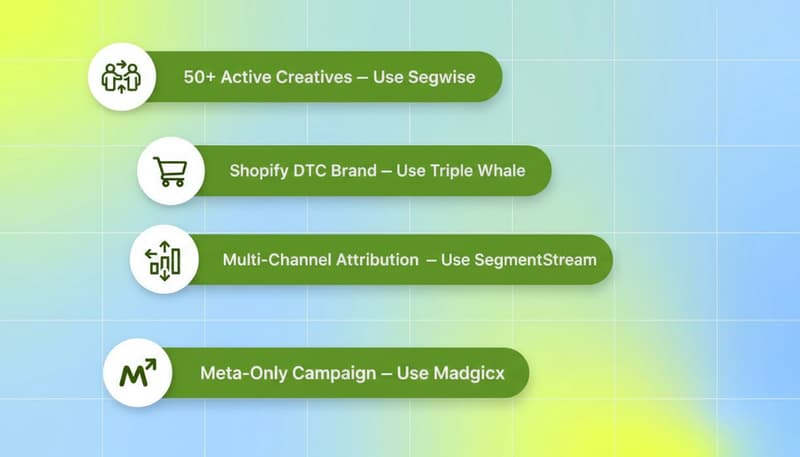
If you run 50+ active creatives and do not know which elements drive results - Segwise is the right fit. Not knowing what inside your ads works means creative teams iterate by gut, and UA managers cannot brief creatives based on data. Segwise's creative tagging closes that gap. Teams using it save up to 20 hours per week on manual creative review and attribution.
If creative fatigue is draining budget before you catch it - Segwise's fatigue tracking monitors all creatives for decline patterns and alerts you before performance tanks. If your current workflow is reactive - you notice ROAS dropping, then investigate - this is the tool that shifts you to proactive.
If you are a Shopify DTC brand and need profitability-linked attribution - Triple Whale gives you the fastest path to seeing Facebook spend versus margins. For more granular creative-level data alongside attribution, Northbeam adds that layer and is designed for hands-on media buyers.
If you suspect Facebook is over-attributing and want to validate incrementality - SegmentStream runs geo holdout experiments to prove whether Facebook campaigns drive real incremental revenue. Relevant for brands at $50K+/month where measurement accuracy changes budget decisions by thousands per week.
If you manage multiple client accounts and spend too much time on reporting - Whatagraph handles the delivery layer cleanly. Supermetrics is a lower-cost alternative if clients just need data in a spreadsheet format.
If you want Meta-native campaign automation without a separate analytics stack - Madgicx automates bid and budget adjustments inside Ads Manager and provides basic asset-level creative data. It is the most accessible option for Meta-focused accounts not yet ready for cross-channel measurement.
The best Facebook ads analytics tools in 2026 - Segwise for creative intelligence, SegmentStream for cross-channel measurement, and tools like Northbeam and Triple Whale for DTC attribution - tend to complement each other rather than compete. They answer different questions across the same campaign data.
Bottom line
Most Facebook ads analytics tools solve the reporting problem: making Meta's data easier to see. Very few solve the analysis problem - helping you understand which creative elements are responsible for performance and where the gaps are.
If creative performance drives your ad results (and the research consistently shows it drives the most variation), then creative-level analytics is the highest-leverage investment in your analytics stack. Segwise, Superads.ai, and Madgicx represent three different entry points into that category in 2026 - from full multimodal intelligence across 15+ networks to lightweight pattern analysis to Meta-native auditing. For cross-channel attribution, SegmentStream fills a complementary gap at the measurement layer.
Start with the layer where your current blindspot is biggest. Segwise is where most high-volume creative teams find the most immediate return.
Frequently Asked Questions
What are the best Facebook ads analytics tools in 2026?
The best Facebook ads analytics tools in 2026 depend on which analytics layer you need. For creative-level intelligence - understanding which hooks, CTAs, and visual elements drive performance - Segwise is the strongest option, covering 15+ ad networks with multimodal AI tagging. For lightweight creative analytics, Superads.ai has a free entry tier. For Meta-native campaign management and auditing, Madgicx is the leading choice. For cross-channel attribution and incrementality measurement, SegmentStream serves brands at $50K+ monthly spend.
How do I analyze Facebook ad creative performance?
To analyze Facebook ad creative performance at the element level, you need a tool that goes beyond Ads Manager's campaign and ad-set reporting. Segwise uses multimodal AI to automatically tag every creative element - hooks, CTAs, visual styles, audio, on-screen text - and maps each tag to performance metrics like ROAS, CPI, and CTR. This eliminates the 20+ hours per week most teams spend manually reviewing creative in spreadsheets. Superads.ai offers a lighter version of this with AI tagging across Meta and TikTok, including a free plan for smaller accounts.
What is the best Facebook ads analytics tool for mobile gaming?
For mobile gaming teams, Segwise is the clear choice. It is the only platform that tags playable (interactive) ads - a critical capability when a significant portion of Meta campaigns use interactive formats. Segwise also integrates with AppLovin, Unity Ads, Mintegral, IronSource, and the four major MMPs (AppsFlyer, Adjust, Branch, Singular), giving gaming UA teams a unified creative performance view across all networks where they actually spend.
What is the best Facebook ads analytics tool for DTC brands?
For DTC brands on Shopify, Triple Whale is a popular starting point - it connects Facebook spend to profitability metrics quickly. For creative-level optimization on top of attribution, Segwise shows which ad elements are driving the conversions Triple Whale is counting. Northbeam is a strong alternative for DTC teams with hands-on media buyers who need creative-level attribution data and configurable attribution windows by channel.
What is the difference between Facebook ads reporting and Facebook ads analytics?
Facebook ads reporting shows what happened: clicks, impressions, spend, ROAS within Meta's attribution window. Facebook ads analytics helps you understand why it happened and what to change. Reporting tools like Supermetrics and Whatagraph move platform data into dashboards efficiently. Analytics tools like Segwise go deeper - identifying which creative elements, hooks, and CTAs are responsible for performance, and flagging which creatives are approaching fatigue. Both have value; they operate at different layers of the same question.
How do I detect creative fatigue on Facebook ads automatically?
Manual fatigue detection means watching for performance drops in Ads Manager - by which point budget has already been wasted. Segwise's Creative Fatigue Tracking Agent monitors all creatives continuously for performance decline patterns across platforms and sends alerts before performance tanks. You can configure custom fatigue thresholds (for example, ROAS dropping 20% over 7 days) and set custom success criteria for new creatives so you are notified when they hit targets or underperform against them.
Do I need a separate attribution tool alongside a creative analytics tool?
Often yes, because they answer different questions. Creative analytics tools like Segwise and Superads.ai tell you which ad elements drive performance within Meta's reported data. Attribution tools like Northbeam, Triple Whale, or SegmentStream tell you whether those conversions are incremental and how Facebook compares to other channels. If you are running Facebook as your primary or only channel, creative analytics alone may be sufficient to start. If you are managing meaningful spend across three or more channels, adding an attribution layer makes the creative analytics more actionable for budget decisions.

Comments
Your comment has been submitted