
Updated July 2026.
AI market research tools automate the slowest parts of gathering consumer insight, from survey setup to open-end coding to creative-level competitive analysis, so research teams can move in days instead of weeks. For performance marketers, that means faster hypothesis testing, earlier fatigue signals, and the ability to turn market research into creative decisions that actually ship in Meta, TikTok, and Google campaigns. Segwise's creative intelligence platform extends that shift into the creative layer, tagging every ad element and feeding the insights straight back into production.
Updated July 2026.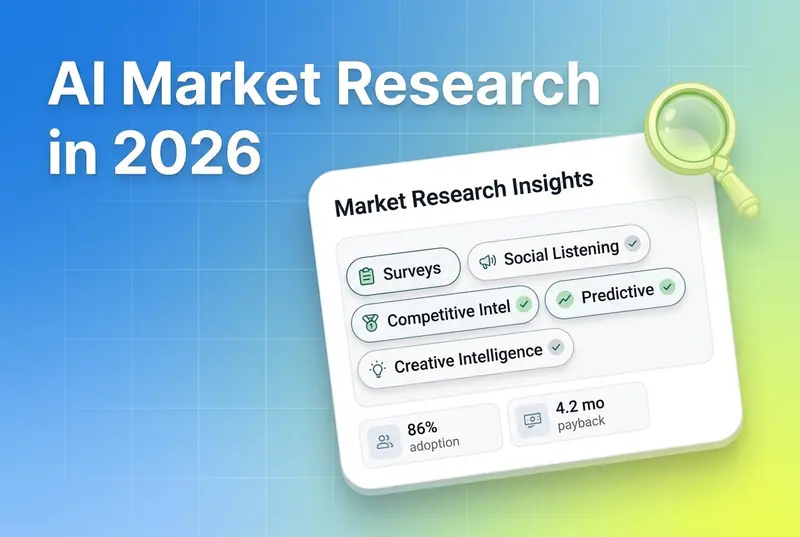
If you have ever watched a three-week research sprint land a week after the campaign brief was frozen, you know the real problem with traditional market research: the cycle time kills its own usefulness. That gap is exactly what the new generation of AI market research tools is closing.
86% of marketing teams now rely on AI-powered analytics platforms to surface campaign insights. Share of voice for generative AI in recurring marketing workflows has moved from 51% in Q1 2024 to 87% in Q1 2026, and audience research is one of the top three fastest-growing AI use cases year over year.
This guide is built for practitioners actively evaluating tools. We will cover what AI market research tools do in 2026, the five functional categories most buyers are picking from, a practical evaluation framework, ten tools worth shortlisting, and where each one actually earns its keep. By the end you should have a clear read on which tool fits your research question, your team, and your budget.
Also read Enterprise Creative Experimentation Platforms: The 2026 Buyer's Guide
Key Takeaways
87% of marketers now use generative AI in at least one recurring workflow in Q1 2026, a 36-point jump from Q1 2024, with audience research among the three fastest-growing use cases.
Median payback on AI tooling investments has compressed to 4.2 months, down from 7.8 months in 2024, and 71% of marketing leaders who adopted AI tools in the last two years report positive ROI within six months.
AI market research tools cluster into five functional categories: survey automation, competitive and social intelligence, predictive analytics and trend detection, qualitative and UX research, and creative intelligence for paid media.
Only 28% of AI use cases in infrastructure and operations fully meet ROI expectations. Success correlates with integrating AI into existing workflows and realistic scoping, not buying the flashiest tool.
Synthetic respondents reached about 88% relative accuracy in reproducing human responses in academic tests, but they still struggle with segmentation, so use them to pre-test, not replace, human studies.
For performance marketing teams, "market research" increasingly means creative intelligence: understanding which hooks, CTAs, and visual patterns drive ROAS. Segwise's creative tagging and fatigue tracking sit in that layer.
What AI Market Research Tools Actually Do in 2026
At their core, AI market research tools use machine learning, natural language processing, and multimodal models to automate the parts of research that used to eat analyst time: survey programming, data cleaning, open-end coding, visualization, and report generation. AI platforms typically shrink project timelines from weeks to days by taking over these repetitive tasks.
What is new in 2026 is the shift from descriptive to predictive and generative. The best tools no longer stop at summarizing what happened. They now forecast which concept will win, simulate what a segment is likely to say, detect when a creative will fatigue, and in some cases produce new creative variations grounded in winning patterns. This is how generative AI is reshaping research: supporting existing methods, replacing some with synthetic data, filling gaps, and creating new types of insight.
This does not mean human researchers are out of a job. It means their role moves from data production to interpretation. AI handles the logistics. Humans handle the strategic storytelling.
The Five Categories You Are Actually Choosing Between
Before looking at individual tools, map your research question to a category. Most buyers overspend because they pick by brand familiarity instead of by job to be done.
1. Survey Automation and Consumer Intelligence Platforms
These tools build surveys, field them to panels, and analyze the results. Modern platforms bundle 10+ advanced methods like MaxDiff, conjoint analysis, and segmentation so you are not stitching a stack together. Best fit: primary quantitative research, brand tracking, concept testing.
2. Competitive and Social Intelligence
Social listening, share-of-voice tracking, competitor ad monitoring, battlecard automation. These platforms crawl public data, tag it with AI, and surface themes, sentiment shifts, and competitor moves. Best fit: brand teams, comms, product marketing, and paid media teams that need to see what rivals are running.
3. Predictive Analytics and Trend Detection
Forecasting models built on top of historical data, search trends, social signals, or first-party data. Predictive analytics uses machine learning to forecast future behavior rather than just describe past behavior. Best fit: demand planning, product development, campaign optimization.
4. Qualitative and UX Research
Video and audio transcription with NLP, heatmaps, session replays, in-product surveys. These tools scale qualitative research by automating transcription and tagging, so a team of two can analyze 50 interviews without drowning. Best fit: product research, UX, customer discovery.
5. Creative Intelligence for Paid Media
This is the newest category and the one most relevant to performance marketers. Tools in this space tag every element of every ad, map creative elements to performance metrics, detect fatigue before budget burns, and increasingly generate new variations from winning patterns. Creative is now the primary lever for ROAS because audience targeting has commoditized across Meta, TikTok, and Google. Best fit: UA managers, creative strategists, and growth leaders running paid campaigns at scale.
How to Evaluate AI Market Research Tools
Buying the wrong tool is expensive in both cash and calendar time. Use this five-point framework, refined across enterprise procurement cycles.
Methodology transparency. Does the vendor publish how the AI actually works, or is it a black box with marketing adjectives? Ask for validation data against traditional research and, ideally, third-party correlation studies. This matters most for synthetic data and predictive tools where confidence in the method is the product.
Use-case fit. A tool that is excellent for concept testing can be terrible for pricing research. A social listening platform can produce noise instead of insight if your category has little organic social conversation. Match the platform's core competence to the research question you actually keep getting asked.
Speed and freshness. Real-time beats batch. Asynchronous analysis beats scheduled delivery. For trend detection and competitive intel, the half-life of an insight can be measured in days, so ingestion latency matters.
Total cost of ownership. Per-study pricing, seat-based subscriptions, and credit models all look different at 50 studies a year than at five. Build a 12-month projection that reflects your real research volume before you negotiate.
Integration and workflow fit. Gartner's finding that only 28% of AI projects fully meet ROI expectations is blunt: success comes from integrating AI into existing workflows and systems, not bolting a new dashboard onto a tired process. A tool your team does not open every week is shelfware.
10 AI Market Research Tools Worth Shortlisting in 2026
Tools are grouped by the category they serve best. For the creative intelligence layer specifically, Segwise sits at the center of the stack for any team running paid acquisition.
1. Quantilope: Best for end-to-end survey automation
Quantilope is a consumer intelligence platform with one of the largest libraries of advanced research methods, including MaxDiff, conjoint, and implicit association testing. Its AI research partner, quinn, helps researchers draft questionnaires, interpret open-ends, and generate chart headlines and dashboard summaries. Automated charting, LOI prediction, and an inColor qualitative video tool with emotion and sentiment analysis make it a genuine end-to-end option for quant teams that want fewer vendors in the stack. Strong fit for brand trackers, concept tests, and segmentation studies.
2. Segwise: Best for creative-level intelligence in performance marketing
Segwise is a fully agentic AI-powered creative intelligence and generation platform built for mobile apps, DTC brands, and performance marketing agencies. It is the tool performance marketers reach for when "market research" means understanding which creative elements drive ROAS, what competitors are running, and which ads are starting to fatigue.
Segwise unifies creative and campaign data from 15+ ad networks and MMPs in a no-code setup that takes about 10 to 15 minutes. That includes Meta, Google, TikTok, Snapchat, YouTube, AppLovin, Unity Ads, Mintegral, and IronSource on the network side, and AppsFlyer, Adjust, Branch, and Singular on the MMP side. It is the only platform that tags playable ads, a key capability for gaming advertisers.
The platform's multimodal AI analyzes video, audio, image, and text together, tagging hooks, CTAs, characters, emotions, voiceover styles, and on-screen text, and mapping every tag to performance metrics. The Creative Strategy Agent works as an always-on AI strategist you can ask anything about your account data in plain language, from "which hook style drove the most installs last month" to "what is different about my top five creatives versus my bottom five." Automated fatigue tracking flags decline before spend is wasted, and the Creative Generation Agent produces new data-backed variations directly from winning patterns.
Reported outcomes include up to 20 hours saved per week per app or brand, 50% ROAS improvement, and creative production time cut in half. Pricing is custom and tiered, with demos available on request.
3. Brandwatch: Best for social listening and brand sentiment
Brandwatch aggregates social posts, comments, mentions, and conversations across channels, then uses AI to segment themes and score sentiment. Image analysis covers objects, scenes, and logos, not just text, which matters for visual-first categories. Auto segmentation and AI-powered search make it easy to slice a dataset by topic, demographic, or campaign window. Strong fit for brand and comms teams that need a continuous read on consumer conversation.
4. Crayon: Best for competitive intelligence
Crayon's AI analysis engine monitors competitor websites, review sites, pricing pages, and publications, then pushes alerts on the changes that matter. Sales battlecards can be connected directly to the feed, and integrations with Salesforce, HubSpot, and Slack mean the intel reaches reps where they already work. Best fit for product marketing and sales enablement teams that need to keep pace with competitor product launches, messaging shifts, and positioning changes.
5. Pecan: Best for predictive analytics on existing data
Pecan is a predictive analytics platform that turns imported datasets into forward-looking predictions: churn, retention, LTV, demand forecasts, campaign ROI. Instead of running studies on the platform, users integrate data sources like Salesforce, Oracle, and Amazon S3, then ask questions like "predict whether a customer will spend more than X by day 30." Best fit for teams with mature first-party data that want forecasting without building models in-house.
6. Speak: Best for qualitative NLP at scale
Speak converts audio and video, including consumer interviews, focus groups, YouTube videos, and podcasts, into structured text using automated transcription, then runs NLP analysis on top. Magic Prompts help researchers ask the dataset useful questions without writing their own from scratch, and bulk upload plus Zoom and Vimeo integrations make it realistic to work through 50 qualitative sessions without burning a junior analyst. Best fit for UX and product researchers scaling qualitative work.
7. Glimpse: Best for emerging trend detection
Glimpse analyzes search trends, social conversation, online reviews, and ecommerce data to surface early signals of emerging consumer trends. Interactive dashboards let you filter by demographic and narrow in on specific categories. AI sentiment analysis lets you see not just what people are talking about but how they feel about it. Best fit for insights teams, product developers, and strategic planners who need to spot behavioral shifts before they hit the mainstream.
8. Hotjar: Best for behavioral and UX research
Hotjar combines session recordings, heatmaps, in-product feedback popups, and targeted on-site surveys, with an Engage tool that hosts and transcribes 1:1 user interviews. The AI layer surfaces satisfaction signals and usability issues in near real time. Best fit for product and growth teams studying how users actually behave on their site or app, rather than what they say in a survey.
9. Appen: Best for AI training data services
Appen provides data collection, annotation, model evaluation, and linguistic services for companies building their own AI systems. Data annotation covers images, video, audio, and text, and their NLP services support text generation, classification, and translation across many languages. Best fit for in-house AI and data science teams that need labeled training data at scale, not a research platform in the traditional sense.
10. Browse AI: Best for web data extraction and monitoring
Browse AI uses pre-built "robots" and a no-code browser extension to extract and monitor data from any website, from LinkedIn job postings to competitor product catalogs to property listings. Alerts trigger when tracked pages change. Best fit for ops, research, and competitive intel teams that need custom scraping without engineering support.
How to Choose the Right Tool for Your Team
A working rule of thumb from years of watching these stacks get built and rebuilt:
If the question is "What do my customers want?" start with survey automation (Quantilope) or qualitative NLP (Speak, Hotjar).
If the question is "What are competitors doing?" start with competitive intelligence (Crayon) or social listening (Brandwatch).
If the question is "What is about to happen?" start with predictive analytics (Pecan) or trend detection (Glimpse).
If the question is "Which of my ads is driving ROAS, and why?" start with creative intelligence. This is where Segwise's unified analytics, creative tagging, fatigue tracking, and competitor ad monitoring turn market research into creative decisions you can actually ship.
Most mature performance marketing teams end up with two or three tools, not one. A consumer intelligence platform for brand-level research, a creative intelligence platform for ad-level decisions, and either a competitive or predictive tool depending on category dynamics.
Avoid the shelfware trap - before you sign a contract, ask the vendor to run a paid pilot on your real data and publish the pilot results internally. If the pilot does not produce a decision your team would not otherwise have made, the tool probably will not stick.
Implementation: Getting Value in the First 90 Days
Three pillars drive AI value: realistic scoping, integration into existing workflows, and executive sponsorship. The version of that advice that travels well in performance marketing looks like this:
Week 1-2: Pick one research question your team keeps repeating. Brand tracker refresh, creative fatigue audit, competitor messaging mapping, and so on. Make that the first use case, not a generic "improve research."
Week 3-6: Run the tool in parallel with your existing process for one full cycle. Compare outputs, not promises. If the tool does not produce a decision faster or better, pause the rollout.
Week 7-12: If the pilot holds up, wire the tool into the workflow. For creative intelligence, this usually means a standing Monday review of tagged performance, a weekly fatigue alert in Slack, and a feed from winning tags into the next creative brief.
This is also where the shift from descriptive to generative pays off. Once winning patterns are tagged, platforms like Segwise can turn those tags into new variations through the Creative Generation Agent, which halves creative production time and closes the loop between analysis and shipping.
Bottom Line
AI market research tools in 2026 are no longer a novelty layer on top of traditional research. They are the default stack for teams that need insight in days instead of weeks. The winning move is not to buy the flashiest platform. It is to map your most common research question to the right category, evaluate two or three tools against a transparent scoring framework, and run a paid pilot before signing an annual contract.
For performance marketers, the frontier of market research is the creative layer. Audience targeting has flattened across the big networks, so the creative is the lever. That is why creative intelligence platforms like Segwise now sit alongside survey automation, competitive intelligence, and predictive analytics in most mature marketing stacks. The goal is the same as it always was: understand the customer better, faster, so you can make better decisions. The difference is that in 2026 those decisions can be executed in hours, not quarters.
Frequently Asked Questions
What are AI market research tools, and how are they different from traditional platforms?
AI market research tools use machine learning, natural language processing, and multimodal AI to automate survey setup, data cleaning, open-end coding, trend detection, and report generation, which compresses project timelines from weeks to days. Traditional platforms rely on manual programming and analyst-heavy workflows. Leading platforms today include Quantilope for survey automation, Brandwatch for social listening, and Segwise for creative intelligence in paid media, each covering a different slice of the research workflow.
Which AI market research tool is best for performance marketers?
For teams focused on paid acquisition, creative intelligence matters more than survey automation, because audience targeting has commoditized and the creative is now the primary ROAS lever. Segwise unifies data from 15+ ad networks and MMPs, tags every creative element with multimodal AI, and feeds winning patterns into generation. Alternatives like Crayon for competitor intel or Brandwatch for social listening are useful for brand-level context, but they do not operate at the ad-element level.
How accurate is AI market research compared to traditional methods?
Accuracy depends on the task. Synthetic respondents reached about 88% relative accuracy in reproducing human responses in Harvard-linked academic tests, but they struggle with segmentation differences. Automated NLP coding of open-ends is now reliable enough that most serious teams use it, though they still validate a sample by hand. For creative performance analysis, platforms like Segwise tie tags directly to measured ROAS and CTR, so accuracy is grounded in observed data rather than inference, in contrast to simulation-first tools like synthetic persona platforms or traditional survey vendors like Quantilope that rely on sampled respondents.
Can AI replace human market researchers?
No. AI replaces the slow, repetitive parts of the job: survey programming, data cleaning, basic reporting, and first-pass analysis. Strategic interpretation, qualitative nuance, and stakeholder storytelling still sit with humans. The shift is from "researchers produce data" to "researchers interpret AI-produced data," which is why tools like Quantilope's quinn or Segwise's Creative Strategy Agent are positioned as co-pilots rather than replacements.
What does a typical AI market research stack look like in 2026?
Most mature teams run two to three tools: a consumer intelligence platform for primary quantitative research, something like Quantilope; a competitive or social tool, often Crayon or Brandwatch; and for performance marketing teams, a creative intelligence layer like Segwise that plugs into ad networks and MMPs directly. Single-vendor stacks are rare outside early-stage teams.
How quickly can you expect ROI from an AI market research tool?
Median payback on AI tooling investments is now 4.2 months, down from 7.8 months in 2024, and 71% of marketing leaders report positive ROI within six months. Segwise customers specifically report up to 20 hours saved per week and 50% ROAS improvement once the platform is fully integrated. Competitive intel tools like Crayon typically pay back faster because the cost of missing a competitor move is quantifiable.
Are synthetic respondents safe to use for real decisions?
Synthetic respondents are useful for pre-testing surveys, screening concepts, and filling small gaps in data, but they should not carry high-stakes decisions on their own. They are best treated as a supplement to human research, not a replacement. For high-stakes creative decisions, tools that analyze real in-market performance, like Segwise's tag-to-metric mapping or Crayon's competitive intel, sit on firmer ground than pure simulation.
What should a buyer look for beyond features?
Methodology transparency is the big one: any vendor should be able to explain how their AI makes a claim and show validation against traditional research. Total cost of ownership over 12 months, integration with the tools your team already uses (Slack, CRM, BI stack), and the quality of customer support for onboarding all matter more than a feature checklist. Platforms like Segwise and Quantilope score well on transparency because their outputs tie directly back to observable data, measured ROAS in Segwise's case, validated methods in Quantilope's.