
If you are running user acquisition (UA) in 2026, you already know the score. Media buying has become a game of automation. Between Meta's Advantage+, Google’s AI-driven campaigns, and TikTok’s smart targeting, the days of manual growth hacks within the ad manager are mostly gone. The algorithms are better at finding your audience than you are.
This shift has left UA managers with one massive lever left to pull: the creative. But here is the problem: most teams are still treating creative like a guessing game. You know that Video A is crushing Video B, but you cannot explain why. Was it the person in the video? The background music? The specific text on the screen?
This is where creative tagging and creative intelligence come in. This is not just about organizing your files. It is about turning every pixel and every frame into data you can actually use to scale your ROAS.
Key Takeaways
Creative tagging is the "what" (identifying hooks, CTAs, and visual elements), while creative intelligence is the "why" (understanding how those elements drive performance).
Multimodal AI is now the standard for analyzing video, audio, and text simultaneously to find winning patterns that humans miss.
Tag-to-metric mapping allows you to see exactly how a specific creative element, such as a 3-second challenge hook, impacts your bottom line.
Playable ads require specialized AI tagging to analyze interactive gameplay, which is a major performance driver for mobile gaming in 2026.
Early fatigue detection uses creative tags to spot performance drops before they eat your budget, allowing for proactive asset swaps.
Data unification is the foundation, meaning you must sync creative data with ad networks and MMPs (AppsFlyer, Adjust, Branch, and Singular) while accounting for SKAN 4.0 and AdAttributionKit signals.
Also read more about Creative Strategy in 2026: Bridging the Gap Between Data and Design
What Exactly is Creative Tagging?
Creative tagging is the process of labeling the specific components of an ad so you can measure them. In the old days, this meant a junior media buyer sitting in a spreadsheet for hours, manually marking which videos had a "discount" message or a "blue background."
In 2026, that process is handled by AI. Modern tagging uses computer vision and natural language processing to "read" your ads. It breaks a video down into hundreds of data points, or tags, without a human ever having to hit play.
According to research on AI creative tagging trends, the goal is to create a structured library of every variable in your creative arsenal. When you do this, you stop looking at "Video_Final_v3.mp4" and start looking at a combination of specific attributes: a "UGC style" visual, a "limited time" CTA, and "upbeat" audio.
The Four Layers of an AI Tag
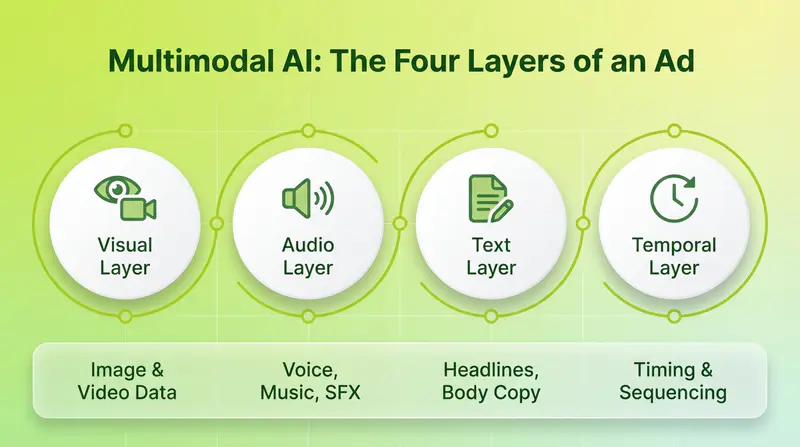
To get useful data, the AI looks at four distinct layers of every ad:
Visual Layer: Identifies objects, people, colors, and the overall vibe of the footage, such as cinematic versus raw styles.
Audio Layer: Transcribes what is being said, identifies the genre of music, and even detects the emotional tone of the narrator.
Text Layer: Scrapes all on-screen text and headlines to see which messaging hits hardest.
Temporal Layer: This is the timing data. It tracks exactly when a hook happens or when the product first appears on screen.
From Raw Tags to Creative Intelligence
Tagging is just the first step. The real value comes from creative intelligence. This is the part where you take those tags and layer them over your actual performance data from your ad networks and your Mobile Measurement Partner (MMP).
When you connect your creative tags to your spend and conversion data, you can finally see the ROI of your creative choices. You might find that ads with a "problem/solution" hook have a 20% higher conversion rate than "lifestyle" hooks. That is a concrete insight you can take to your design team to inform the next batch of ads.
For this to work effectively, your data cannot live in silos. You need a unified view that pulls from all your channels: Meta, Google, TikTok, Snapchat, YouTube, AppLovin, Moloco, Unity Ads, Mintegral, and IronSource. You also need to match this against your attribution data from AppsFlyer, Adjust, Branch, and Singular. Without this full-funnel view, you are only seeing half the picture.
Why Creative Tagging is Non-Negotiable in 2026
The market is too competitive to rely on vibes or intuition. Here is how high-performance teams are using creative intelligence to win.
1. Stopping Creative Fatigue Before it Starts
Creative fatigue is what happens when your audience gets bored of your ads and your ROAS starts to tank. Usually, you only notice this after you have already wasted thousands of dollars. With creative intelligence, you can track the performance of specific elements across your entire account. If the AI sees that a certain character or hook is losing its effectiveness across five different campaigns, it can flag that as "fatigued" before the overall campaign performance drops.
2. Building Better Creative Briefs
The biggest source of waste in most marketing departments is creative guesswork. Creative intelligence fixes this by providing a data-backed blueprint. Instead of a UA manager saying, "Give me something cool," they can provide a brief based on what is actually working: "Our data shows that 3-second ASMR hooks paired with Green CTA buttons are driving our highest ROAS. Let’s make five more versions of that."
3. Understanding Playable Ads
If you are in the mobile gaming space, playable ads are likely your top performers. But they are also a black box because they are built with code, not just pixels. New platforms are now capable of tagging playable ads, breaking down interactive elements like game difficulty, level design, and the specific moment a user decides to click through to the app store.
4. Competitive Intelligence
You can apply these same AI tagging principles to your competitors. By using AI to ingest and tag ads from the Meta Ad Library, you can automatically identify which hooks and styles they are leaning into. This helps brands identify white space or gaps in the market where they can launch a unique creative angle that has not been overused.
How to Set Up a Creative Intelligence Workflow
If you want to move away from spreadsheets and into automated intelligence, here is a practical framework to follow.
Step 1: Centralize Your Data. You need a single source of truth. This means connecting all your ad networks and your MMP (AppsFlyer, Adjust, Branch, and Singular) into one platform.
Step 2: Automate the Tagging. Use a platform that leverages multimodal AI to scan your existing library. Most systems, such as Segwise, will import 90 days of historical data so the AI can immediately start finding correlations.
Step 3: Analyze the Winners and Losers. Look for the common threads. Use tag-level reporting to see which attributes are present in your top 10% of ads versus your bottom 10%. Are all your winners under 15 seconds?
Step 4: Iterate and Generate. Use your findings to produce new variations. Modern platforms can now use these data-backed insights to generate new creative iterations, which can halve your creative production time.
The ROI of Knowing Why

The impact of this technology on your bottom line is significant. According to Kantar, using data to optimize creative elements is one of the single most effective ways to increase ad recall and purchase intent.
In the real world, teams that adopt this workflow save an average of 20 hours per week by cutting out manual data work. More importantly, by doubling down on winning elements and catching fatigue early, brands can see a 50% improvement in ROAS. In a world where every cent of ad spend counts, those are numbers you cannot ignore.
Scaling Your Growth with Segwise
For performance marketers who want to turn their creative into a predictable engine, Segwise provides an AI-powered creative intelligence platform built for 2026. Segwise unifies your data from 15+ ad networks and every major MMP, including AppsFlyer, Adjust, Branch, and Singular.
By using multimodal AI to automatically tag every video, image, and audio file, Segwise helps you understand exactly which elements are driving your performance. It is also the only platform on the market that tags interactive gameplay elements in playable ads, which is a game-changer for mobile studios. Beyond analysis, Segwise allows you to generate data-backed creative variations, closing the loop between insight and production. Whether you want to save 20 hours a week on reporting or aim for a 50% ROAS improvement, Segwise gives you the precision needed to scale.
Conclusion
The era of media buying secrets is over. In 2026, your success depends on how well you understand your creative. Creative tagging is the only way to turn the subjective world of design into a structured, data-driven discipline. If you are still looking at your ads and wondering why they work, it is time to stop guessing and start scaling with the precision that only creative intelligence can provide.
Frequently Asked Questions
Is creative tagging different from just naming my files correctly?
Yes. While a good naming convention helps, it is limited. AI creative tagging goes much deeper by scanning the actual content of the video (visuals, audio, and text) to identify elements you might have forgotten to include in the file name.
Does this work for TikTok and YouTube as well as Meta?
Yes. A proper creative intelligence platform unifies data from all major networks, including TikTok, YouTube, Snapchat, and Google, as well as gaming networks like AppLovin, Moloco, and Unity Ads.
How does AI read my ads?
It uses multimodal AI. This means it simultaneously processes the video frames (computer vision), the audio (speech-to-text and tone analysis), and any text overlays (OCR).
How much time does this actually save?
Most UA teams save about 20 hours per week. This time usually goes toward manual data entry, building cross-platform reports, and trying to figure out which ads to turn off.
Can I see which tags drive the most installs?
Yes. By connecting to your MMP (AppsFlyer, Adjust, Branch, and Singular), you can see the direct correlation between a specific tag, such as a UGC Hook, and bottom-funnel events like installs, purchases, or ROAS.
What is multimodal AI?
Multimodal means the AI can understand different types of data at once. Instead of just looking at an image, it looks at the visual, listens to the music, and reads the text all at the same time to understand the full context of the ad.