
The best Pixis alternatives in 2026 are Segwise, Motion and Madgicx: Segwise for element-level creative analytics and AI creative generation across 15+ ad networks and MMPs, Motion for DTC creative reporting with an always-on AI analyst, and Madgicx for agentic Meta ads management at small-to-mid budgets.
TL;DR: Key Takeaways
Pixis is no longer enterprise-only. Its flagship agent, Prism, is now self-serve with plans starting at $200/month and a 14-day trial. AWS Marketplace lists Standard at $500/month and Team at $1,000/month. Advance, Adroom, Edge and One AI remain custom, contact-sales products.
Pixis was selected for a dedicated Google Partner program on 26 March 2026, for technically advanced partners: the release noted more than $1B in ad spend flowing through Pixis in the prior year.
Its $85M Series C1 is from 2023, not a recent round. Treat any write-up presenting it as fresh funding news with caution.
The usual reason to leave is creative depth. Pixis optimises bids, budgets and audiences and generates creative through Adroom, but it does not tag creative down to the element level and map those tags to your first-party performance data.
Match the tool to the gap: element-level creative intelligence (Segwise, Motion), agentic ad management (Madgicx, Hawky), creative automation at scale (Smartly, Hunch, AdCreative.ai), omnichannel commerce planning (Skai), or copy volume (Jasper).
Pixis Alternatives: Pricing at a Glance (2026)
You need a Pixis alternative that actually fits how you work, not a tool that sounds great on paper but adds setup, guesswork, or unclear value. The hard part is that vendors now split into different strengths: some focus on deep creative element signals, some on fast dynamic creative and automation, some on template/feed scale, and some on broad commerce planning with AI agents.
That makes the search noisy: you want a platform that lowers your cost per acquisition, frees up time, and integrates cleanly with your existing workflow, not more dashboards. Below, nine platforms cover the distinct product types worth starting from when you look for a Pixis alternative in 2026.
In this blog, we'll compare the top Pixis alternatives based on what they actually help you do, show when each type wins, and end with a short pilot checklist so you can test a fit quickly.
What is Pixis?
Pixis is an AI-powered advertising platform that combines an AI campaign manager with a creative studio to help teams create, run, and optimize ads from one place.
Its campaign layer, Prism, offers a chat-style interface for performance monitoring and can make automated recommendations and actions across accounts. Pixis says Prism is trained on billions of data points to surface clear next steps. Its creative layer, Adroom, generates on-brand images and video variations quickly, enabling you to produce many testable ads without a long design cycle.
While Pixis brings together creative generation and campaign automation under one roof, no platform is a perfect fit for every team. As ad programs mature and priorities shift, some marketers begin to notice gaps between what Pixis excels at and what their day-to-day workflows demand. That's where the search for alternatives typically begins.
Pixis Pricing, Products and Recent Changes
Pixis now sells a productised suite: Advance (campaign optimisation: budget allocation, bid management, audience refinement), Prism (the conversational, agentic ad-campaign agent), Adroom (creative generation and optimisation), Edge (audience targeting) and One AI (the underlying ML infrastructure). Prism is the flagship, and Pixis says it is trained on over three billion data points from a decade of performance data.
Pricing. The important change since 2025 is that Prism is now self-serve, with plans starting at $200 per month, a 14-day trial and a free account that needs no card. On AWS Marketplace, a one-month Prism Standard contract lists at $500/month (1 ad channel, up to 2 ad accounts, 2 seats) and Team at $1,000/month (up to 5 ad accounts, 5 seats), with extra ad accounts at $250 each and roughly 17% off on a 12-month contract. Advance, Adroom, Edge and One AI remain custom, contact-sales products with no published pricing. Describing Pixis as enterprise-only, quote-only is now only half true.
Recent changes. Pixis was selected for a dedicated Google Partner program on 26 March 2026, aimed at technically advanced partners shaping AI-native performance marketing; the announcement cited more than $1B in ad spend running through Pixis over the previous year. Its $85M Series C1 dates from 2023: it is not recent funding news. Pixis also carries an enterprise security posture: SOC 2 Type II, ISO and GDPR.
Why Do Teams Seek Pixis Alternatives?
Pixis is capable, but some groups look for other tools when their priorities differ. Common reasons you might consider an alternative:
You need element-level creative answers: Some tools automatically tag individual creative elements (hooks, characters, audio, CTAs) and map those tags to performance so you know which part of an ad moves metrics. Teams focused on that level of signal often choose a specialist.
You want faster setup or simpler workflows: Reviews and comparison write-ups note that larger AI ad platforms can feel heavyweight to get up and running, while teams that need very fast time-to-value sometimes prefer leaner, more focused tools.
Pricing or scale doesn't match your program: Prism has a published $200/month entry point now, but the rest of the Pixis suite, Advance, Adroom, Edge, is still custom-quoted enterprise software. If you want a single self-serve price for the whole capability set, a different product may fit better.
You need a niche capability (massive social creative scale, feed-driven personalization, or copy-first automation): If your top priority is extremely fast social video scaling or content automation at scale, specialized platforms exist that focus just on those workflows.
These are the practical trade-offs people report when they compare options. Use the list above to match what you need (speed, fine-grain creative signal, budget, or a specific workflow) before you pick a platform.
Pixis Alternatives at a Glance
The table below provides a quick, side-by-side view of how Pixis and its top alternatives compare on the capabilities that matter most for ad creative performance, testing speed, and optimization decisions. It's meant to help you spot the right fit in seconds, before digging into the deeper breakdowns above.
Use this snapshot to narrow your shortlist quickly, then rely on the detailed sections to confirm which platform best aligns with how you run and scale your campaigns in 2026 and beyond.
9 Best Pixis Alternatives for AI Marketing in 2026
Below, we break down the strongest Pixis alternatives in detail, starting with tools that deliver the clearest creative performance signals and ending with platforms better suited for scale, automation, or specific channel needs:
1. Segwise
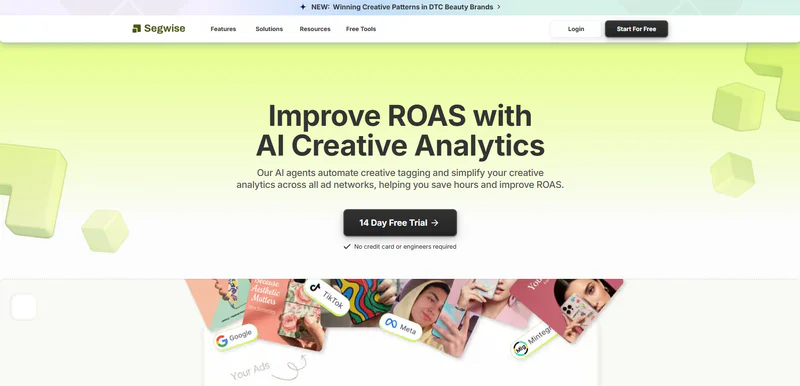
Segwise is a creative analytics platform that automatically tags every part of an ad visuals, audio, copy, hooks, CTAs, and ties those tags to performance across ad networks. That lets you see which specific element (hook scenes, first dialogues, headlines, characters, influencer traits, CTA text, CTA dialogue, audio cues) is lifting or hurting metrics.
Segwise also develops new creative variants based on winning tags, providing a steady pipeline of data-backed ads. This focus on element-level signals is why Segwise is the top pick here.
Key features:
Multimodal element tagging: auto-labels hooks, characters, on-screen text, music, and more, so you can link those tags to installs and ROAS.
Custom tagging: add or refine tags to match how you describe creative elements in your workflow.
AI creative generation: generates new creative variations based on the best-performing tags, delivering tested iterations quickly.
Competitor tracking (meta-only): track public creative trends and how competitors' creatives behave in the market (where available).
Creative fatigue detection & alerts: spot drops in creative effectiveness at the element level so you can refresh earlier.
Cross-network mapping: brings creative assets and performance from 15+ ad networks and MMPs into one view: Meta, Google, TikTok, Snapchat, YouTube, Axon (AppLovin), Unity Ads and Mintegral among them, plus five MMPs: AppsFlyer, Adjust, Branch, Singular and Kochava.
Creative Strategy Agent (AI Chat): an always-on AI creative strategist with full context across your creative, tag, competitor and fatigue data. Ask in plain language, “which hook style drove the most installs last month?”, and get the answer, a formatted report or a recommendation, without building a dashboard first.
Playable ad tagging: Segwise tags playable (interactive) ad elements alongside video, audio, image and text, so gaming teams can see which mechanics and end cards actually drive IPM. Almost no other creative tool reads this format.
Best For:
Segwise fits best if you want fast, clear answers on which parts of your ads drive results and a simple way to turn those insights into new creatives. It works well when your focus is on lowering acquisition costs, spotting creative fatigue early, and keeping fresh, data-backed ads live across channels without manual tagging.
Why is it a better alternative to Pixis?
Segwise is built around element-level creative signal, not just asset-level metrics or ad generation. That means instead of guessing which parts of an ad work, you get direct proof tied to CPI/ROAS, and ready-to-run creative iterations based on those signals. Pixis offers strong creative generation and campaign automation, but Segwise gives deeper, actionable insight into which creative elements drive your KPIs.
Pricing
A 7-day free trial (start here). Segwise starts at $499/month for advertisers spending up to $250K/month, with a special 50% discount for startups spending under $50K/month. Setup is no-code and takes about five minutes per source, and historical data is backfilled on connection, up to two weeks on the trial, up to three months on paid plans, so you are reading real patterns from day one.
2. Hunch

Hunch helps automate creative and media workflows for paid social. It focuses on creating many ad combinations, automating tests, and managing dynamic creatives for social platforms. The product aims to speed up production and deliver more personalized ad variants.
Key features:
Dynamic creative workflows: assemble many ad permutations for platform testing.
Automation rules: automate social channel trafficking and campaign setup.
Creative & media coordination: combine creative asset generation with automated media rules to scale tests.
Best for:
Good if you run broad catalog or social-first campaigns and want automation for creative assembly and trafficking. If your priority is element-level creative signal and tightly data-driven creative iteration, this tool is less focused on that outcome.
Why is it a better alternative to Pixis?
Hunch centers on automated creative assembly and social ad workflows. If your program needs to scale many social permutations and simplify trafficking, Hunch can be a lean option. Pixis is broader with campaign-level AI and brand-aware creative generation, while Hunch focuses on flow and scale for social ads.
Pricing:
Not publicly listed. Hunch does not publish pricing tiers or figures on its site: the only call to action is “Request a demo”, and the vendor quotes each deal. Budget accordingly: this is a sales-led purchase, not a card swipe.
3. Smartly

Smartly (the company simplified its brand from “Smartly.io” to Smartly) is an ad platform built for large-scale social advertising and creative automation. It combines creative production, template-based personalization, and automated testing so teams can produce many ad variations and push them live quickly. Smartly is commonly used by larger brands and ecommerce teams.
Key features:
AI creative studio: fast video and image templates, automated cropping and resizing.
Feed-based creative generation: create personalized ads from product or content feeds.
Cross-channel automation: unify social channels with one workflow and reporting layer.
Best for:
Pick this if you need a heavy creative scale for social ads and catalog personalization. If you need fine-grained, element-level creative signal tied specifically to CPI/ROAS, this platform is less focused on that.
Why is it a better alternative to Pixis?
Smartly shines when you need to produce and test very large volumes of creative using templates and feed automation. Pixis offers integrated AI campaign orchestration and brand-led creative generation; Smartly is stronger when your primary need is high-volume creative scaling and social catalog ads.
Pricing:
Not publicly listed: demo and contact-sales only. Per third-party reports the model is a percentage of managed media spend plus a monthly minimum, split between a Self-Serve + Support tier and a higher-percentage Managed Service tier; users report the monthly minimum rising to around €2,500. There is no free trial and no free plan. Smartly manages $7B+ in ad spend across 800+ brands.
What changed recently:
Smartly launched Synapse on 22 June 2026, an AI orchestration and memory layer beneath its agents that synthesises campaign data and business context, coordinates actions across channels, and learns from each campaign.
4. Skai

Skai is an omnichannel commerce media platform. It brings search, social, retail, and programmatic together with data centralization and AI-driven planning. Skai is built to run marketing across many channels with an emphasis on commerce and retail outcomes.
Key features:
Omnichannel campaign management: manage search, social, display, and retail ads from one platform.
AI planning & forecasting (Celeste AI): Use predictive planning tools to model outcomes and budgets.
Data centralization: connect commerce, CRM, and ad data for a single view.
Best for:
Choose Skai if your business runs retail or commerce campaigns across multiple media and needs planning and centralized reporting. If your primary need is very granular creative element signals and rapid creative iteration, Skai is not primarily designed for that.
Why is it a better alternative to Pixis?
Skai is a broader commerce-focused platform for omnichannel media planning and retail growth. Pixis focuses on creative generation and campaign-level AI; Skai is stronger for forecasting, retail media, and unified media planning across many channels.
Pricing:
Not publicly listed. Skai does not publish self-serve prices: pricing is quote-based and enterprise-tier, and third-party directories confirm there is no free version or free trial. Request a quote before shortlisting it.
5. Jasper

Jasper is an AI writing and content platform. It speeds up written creative ad copy, emails, landing page text, and long-form content, and offers marketing workflows and brand control. Jasper's strengths are language, templates, collaboration, and marketing-centered automation.
Key features:
AI copy generation: produce ad headlines, body copy, and long-form content fast.
Brand & style controls: keep the tone consistent across outputs, aligned with brand voices and knowledge assets.
Campaign and content automation: agents and templates to scale copy production for many campaigns.
Best for:
If your top need is high-volume, on-brand copy across channels, Jasper is a good match. If your priority is insights into visual/audio elements in creative and automated, tag-driven creative variations, Jasper will not meet that need on its own.
Why is it a better alternative to Pixis?
Jasper focuses on writing and content automation, while Pixis bundles creative generation and campaign-level ad automation. Use Jasper when word count and messaging matter most; use Pixis when you want creative visuals and campaign orchestration in one place.
Pricing:
Pro is $69 per month per seat, or $59 per month per seat billed annually, including the Canvas platform, core marketing agents and limited customisation (2 brand voices, 5 knowledge assets, 3 audiences). The Business plan adds unlimited customisation, advanced agents, API access and dedicated support at custom pricing.
6. Motion
Motion is the creative analytics benchmark for DTC and consumer-app teams, and over the past year it has become an AI-agent product rather than a dashboard: every paid Motion plan includes Runneth, its always-on AI agent, which answers in Slack, writes briefs, makes static ads and runs scheduled reports and alerts.
Key features:
Ad leaderboard and creative analytics with AI tags and AI-generated tasks.
Slack-native workflow: ask in Slack, get briefs, hooks and reports back, plus daily and weekly routines, iteration finders and alerts.
Inspo: Brand Intel competitor tracking, boards and a Discover feed of 600+ brands on paid plans, with Northbeam and Google Analytics attribution integrations.
Best for:
DTC, ecommerce and consumer-app performance teams spending $50k+ a month who can absorb a four-figure monthly floor.
Why is it a better alternative to Pixis?
Pixis optimises the buy; Motion interrogates the creative. If your open question is “which ads worked and why” rather than “is my bidding efficient”, Motion answers it directly, and unlike Pixis it publishes its prices.
Pricing:
Starter $750/month (up to $50k monthly ad spend), Pro $1,200/month (above $50k), Growth custom (above $125k). Seats are unlimited on every tier. Note this is ad-spend tiered.
7. Madgicx
Madgicx now markets itself as an agentic Meta ads management platform, with a named AI Marketer that runs Facebook and Instagram ads autonomously, plus an Ads Rotation Agent and a Creative Refresh Agent.
Key features:
AI Marketer: an agentic “personal AI media buyer” for Meta.
AI Ads Generator: AI creative generation with automated launch straight into campaigns.
Fatigue detection and cross-account analytics, with a Tracking Pro attribution add-on. Official Meta Business Partner.
Best for:
Shopify and DTC ecommerce advertisers on Meta at small-to-mid budgets who want automation without hiring a media buyer.
Why is it a better alternative to Pixis?
It is far cheaper to start with and far narrower in scope. If essentially all your spend is on Meta, Madgicx does the agentic work Pixis does across channels, without the enterprise footprint.
Pricing:
Gated. The pricing page for Madgicx Pro Complete with AI says “see price inside the app”: you sign up, connect Meta, and see the rate for your ad-spend bracket (brackets run from under $1K a month to $30K+). Published figures: Tracking Pro add-on at $49/month, a $29/month early-bird entry offer for the data-analysis tier, and a 7-day free trial.
8. AdCreative.ai
AdCreative.ai sits at the volume end of creative generation: static, display and social ads, product video, UGC-style content, product photography and copy, generated fast with conversion-focused scoring on top.
Key features:
AI ad-creative and copy generation with scored outputs and brand-specific templates.
Video and product photography: product videos, UGC-style content and studio-quality ecommerce visuals from raw photos.
Competitor campaign intelligence and compliance checking.
Best for:
SMBs, solo marketers and small agencies whose bottleneck is creative supply rather than campaign management.
Why is it a better alternative to Pixis?
It does what Pixis’s Adroom does, at a self-serve price you can see before you talk to anyone. It is a generator, though, not an optimiser: there is no bid or budget automation.
Pricing:
Starter $39/month (10 credits, 1 brand), Professional $249/month (50 credits, 10 brands), Ultimate $999/month (100 credits, 25 brands), Enterprise custom. Quarterly and yearly billing are discounted; 7-day free trial. AdCreative.ai was acquired by Appier in early 2025 for around $38.7M and continues under its own name.
9. Hawky
Hawky is the closest philosophical match to Pixis Prism: always-on agents that run spend rather than report on it, sharing a memory layer across creative and performance decisions.
Key features:
Performance Agent: manages Meta, Google, YouTube and TikTok campaigns 24/7 against a real KPI (CPA or ROAS), reallocating budget and pausing underperformers.
Creative Agent: generates on-brand creatives weekly from winning patterns and competitor strategy, through approval workflows. Statics today; video listed as coming soon. Separately, Creative Studio (live July 2026) generates images and video.
FeatherDB: a shared memory layer holding brand guidelines, winning creatives, competitor insight and decision history, plus an AI Copilot for natural-language questions and configurable approval gates.
Best for:
Performance teams and agencies comfortable with a performance-linked commercial model who want an agent to actually run spend, not just advise on it.
Why is it a better alternative to Pixis?
Approval gates give you human control over every agent action, and pricing has no per-seat fee: unlimited users on every tier.
Pricing:
Not publicly listed. Three tiers, Dashboards, Ask and Auto-pilot, are all contact-sales. Per Hawky’s FAQ, pricing is per brand and scales with creative volume and questions asked, with no per-seat fees; the homepage describes a subscription minimum plus KPI-tied upside.
Each option is evaluated on what it does best, who it's built for, and how it compares to Pixis in real-world performance marketing workflows, so you can confidently choose the platform that matches how your team operates in 2026.
How to Pick the Right Pixis Alternatives

Choose a platform that removes friction from your daily workflow, not one that adds complexity. Use this practical framework to find a tool that matches how you plan, test, and optimize campaigns.
Start with your single biggest goal: Decide whether your priority is uncovering which parts of an ad move metrics, running always-on campaign automation, or simply producing lots of creatives fast.
How deep do you need the creative signal to be? If you need to know which scene, line, or sound drives installs, choose a platform that auto-tags elements and maps tags to performance. That level of insight lets you make targeted creative fixes. If you mainly need template-driven volume, a feed or template platform will be enough.
Check campaign automation and controls: If you want a system that can automatically reallocate budgets or act on performance, prioritize products with explicit campaign-management engines. Some platforms provide always-on decision layers and bidding automation; others focus solely on analytics. Know whether you need insight or automated action.
Test integrations and setup time: Look for no-code integrations to ad networks and measurement partners so you won't need heavy engineering. Faster setup means you start learning from real data sooner. Also, confirm which networks and MMPs the vendor supports.
Evaluate creative production workflow: If you must scale personalized or catalog ads, pick a tool built for feed automation and template-based creative. If you need data-driven iterations (create what won), pick a tool that generates variants based on winning tags.
Budget, pricing model, and speed to value: Compare pricing against what you'll actually use. Some vendors list transparent pricing for smaller teams; others provide enterprise quotes. Factor in time to value a cheaper tool that takes months to launch may cost more in the long run.
Run a short, focused pilot: Pick one clear KPI (CPI, ROAS, or creative CTR), run a short pilot, and measure whether the platform yields actionable wins in 2 to 4 weeks. Preferred pilots: tag-to-metric tests for creative-signal products, or budget-reallocation tests for automation products. Use the pilot to test both accuracy and operational load.
Take these steps, and you'll quickly narrow the field to the platform that actually helps you lower acquisition cost and keep winning creative live.
Conclusion
When people search for Pixis alternatives, they're looking for a tool that closes a specific gap faster, delivers measurable uplift on the metric you care about, and minimizes friction so you can act on the data. Pick the platform that turns creative signals into concrete ad changes you can run this week, not just reports you file away. Prioritize clear ROI impact, operational simplicity, and the vendor that delivers measurable improvement in your core KPI.
Segwise fits naturally when your goal is to move beyond surface-level ad metrics and understand why creatives win or fail. It automatically tags visual, audio, and copy elements, links them directly to CPI and ROAS, and flags creative fatigue before performance drops so teams can act faster without manual analysis or heavy setup.
If you want proof-driven creative decisions instead of guesswork, start a free trial with Segwise to see element-level insights and data-backed creative iterations on your live campaigns.
FAQ's
1. Which Pixis alternatives give the clearest element-level creative insights?
Segwise automatically tags ad elements (hooks, scenes, audio, CTAs) and links them to performance so you know which part of a creative moves CPI/ROAS.
2. Which Pixis alternatives are best for scaling social creative fast?
Smartly and Hunch are built to crank out thousands of platform-ready ad variations from templates or feeds, speeding up social creative production and testing.
3. Which Pixis alternatives focus on omnichannel campaign automation and planning?
If you need unified planning, forecasting, and cross-channel activation (search, social, retail), Skai is designed for omnichannel commerce media and AI planning.
4. Are there Pixis alternatives focused mainly on copy or lower-cost copy-first workflows?
Yes, Jasper is a copy-first AI platform that scales on-brand headlines, descriptions, and landing copy quickly and offers transparent SMB pricing tiers.
5. How should I pilot Pixis alternatives to pick the right one?
Run a short 2 to 4 week pilot with a single KPI (CPI or ROAS); for creative-signal tools test tag→metric correlations, while for automation tools test budget/actions to measure real lift.
6. How much does Pixis cost in 2026?
Prism, the flagship agent, is now self-serve with plans starting at $200 per month and a 14-day trial. On AWS Marketplace a one-month Prism Standard contract lists at $500/month and Team at $1,000/month, with extra ad accounts at $250 each. The rest of the suite, Advance, Adroom, Edge and One AI, is custom, contact-sales, with no published pricing.
7. Is Pixis still enterprise-only?
No. That was true through 2025, but Prism was pushed to the front of the suite and made self-serve with a published entry price and a free trial. The rest of the product line is still sold through an enterprise motion.
8. Which Pixis alternatives publish real prices?
Motion ($750 and $1,200/month), AdCreative.ai ($39 to $999/month) and Jasper ($69/month per seat, $59 annually) publish figures outright. Segwise starts at $499/month for advertisers spending up to $250K/month, with a special 50% discount for startups spending under $50K/month. It also offers a 7-day free trial. Hunch, Smartly, Skai and Hawky are contact-sales only, and Madgicx gates its headline price behind an app login.
9. Which Pixis alternative is best for mobile app and game UA?
Segwise, because it joins ad-network data with five MMPs, AppsFlyer, Adjust, Branch, Singular and Kochava, tags creative down to the element level across video, audio, image, text and playable ads, and maps every tag to CPI, IPM, ROAS and LTV. Playable-ad tagging in particular is something almost no other tool in this list does.
How We Evaluated These Tools
Every tool here was re-checked on 31 August 2026 against the vendor’s own live pricing page. Where a vendor does not publish a price we say so, rather than repeating a stale figure from a third-party directory. Capability claims come from vendor documentation and product pages, and the Segwise capabilities described here reflect the shipping product.
Written and maintained by the Segwise creative intelligence team: the group that builds and runs Segwise’s creative tagging, analytics, generation and competitor-tracking agents for mobile UA, DTC and agency advertisers.