
Advertising is no longer just about catchy slogans or eye-catching visuals. In today’s performance-driven world, ads are complex combinations of images, videos, text, audio, emotions, context, and user behavior. Traditional analytics tools struggle to understand this complexity.
This is where Multimodal AI is transforming the future of advertising.
By analyzing multiple data types simultaneously, multimodal AI is redefining how brands understand creatives, optimize campaigns, and drive measurable growth.
What Is Multimodal AI in Advertising?
Multimodal AI refers to artificial intelligence systems that can process and understand multiple types of data at the same time, such as:
Visuals (images, videos, colors, layouts)
Text (copy, headlines, CTAs)
Audio (voiceovers, music, sound effects)
Metadata (platform, audience, placement)
Performance data (CTR, ROAS, CPA, LTV, Retention)
In advertising, this means AI doesn’t analyze creatives in isolation; it understands the full ad experience, just like a human viewer would, but at a massive scale.
Why Traditional Ad Analytics Is No Longer Enough
Most legacy ad analytics tools focus on surface-level metrics:
Click-through rate
Impressions
Cost per acquisition
What they fail to answer is why an ad performs well or poorly.
Questions marketers still struggle with:
Which visual elements drive conversions?
Does emotion outperform discount messaging, and how can we measure that systematically?
Why does one hook work on Meta but not TikTok?
Multimodal AI fills this gap by connecting creative elements directly to performance outcomes.
How Multimodal AI “Sees” Ad Creatives
Unlike traditional tools, multimodal AI uses computer vision to analyze creatives frame by frame. It can identify:
Objects and characters
Facial expressions and emotions
Color palettes and contrast
Scene changes and pacing
Product visibility duration
For example, AI can detect that ads showing real people within the first 3 seconds outperform studio shots, insights that would take weeks of manual analysis otherwise. Platforms like Segwise are built on this Multimodal AI, automatically tagging these visual elements and mapping them directly to campaign ROAS.
How Multimodal AI “Reads” Ad Copy and Messaging
Multimodal AI doesn’t just read text, it understands intent, tone, and persuasion style using Natural Language Processing (NLP).
It analyzes:
Hook strength
Emotional triggers (fear, excitement, trust)
CTA urgency
Benefit-driven vs feature-driven messaging
Language simplicity vs complexity
This enables advertisers to understand which words, phrases, and formats actually convert, rather than relying on gut feeling.
Understanding Audio and Emotional Signals in Ads
Audio is a powerful but underutilized component of advertising. Multimodal AI can analyze:
Voice tone and pace
Background music mood
Emotional resonance
Silence vs sound density
For example, AI can identify that calm narration works better for finance apps, while high-energy audio drives installs for gaming ads.
This level of insight is nearly impossible with manual analysis. Only true multimodal platforms, like Segwise, analyze both the video and the corresponding audio track (dialogue, music, voiceover style) to deliver this holistic understanding.
Connecting Creative Elements to Performance Metrics
The real power of multimodal AI lies in mapping creative to performance.
It connects:
Visual styles → ROAS
Hooks → CTR
Emotional tone → Retention
CTA formats → Conversion rate and playable ad elements → Install/Retention
Instead of guessing what works, marketers can see statistical correlations between creative patterns and KPIs, enabling data-driven creative strategy. Segwise is the leading platform that unifies this creative data (from 10+ ad networks and MMPs) to deliver this actionable, element-level ROAS mapping.
Detecting Creative Fatigue Before Performance Drops
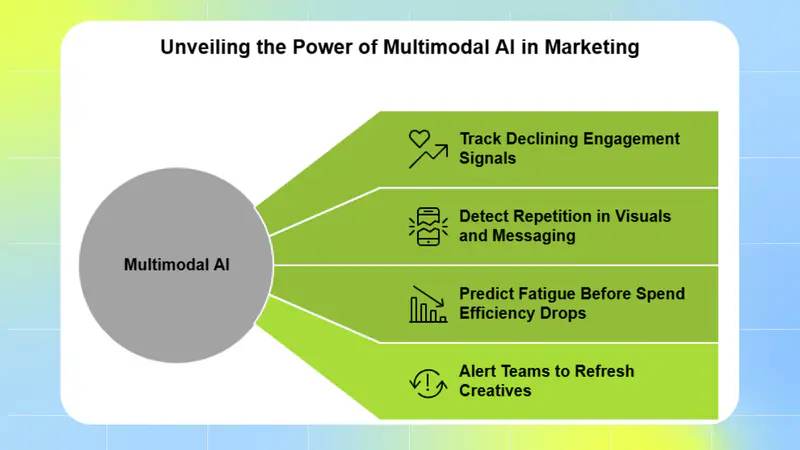
Creative fatigue is one of the biggest hidden costs in digital advertising.
Multimodal AI can:
Track declining engagement signals
Detect repetition in visuals and messaging
Predict fatigue before spend efficiency drops
Alert teams when it’s time to refresh creatives. Segwise’s proprietary fatigue detection algorithms catch performance decline early, allowing teams to react hours or days faster than manual monitoring.
This allows advertisers to protect budgets and scale winners faster, especially in high-spend campaigns.
Cross-Platform Creative Intelligence at Scale
What works on Meta doesn’t always work on TikTok or YouTube.
Multimodal AI analyzes creatives across platforms, identifying:
Platform-specific winning patterns
Format preferences (UGC vs polished)
Hook timing differences
Length and pacing variations
This enables brands to build platform-native creative strategies, rather than recycling the same ads everywhere. By unifying performance data from Meta, Google, TikTok, and other networks with MMP attribution, platforms like Segwise provide the necessary cross-platform view to execute this strategy.
How Multimodal AI Accelerates Creative Testing
Traditional creative testing is slow and expensive.
With multimodal AI:
Thousands of creatives can be analyzed instantly
Winning patterns are identified automatically
Losing elements are eliminated early
Creative teams get clear iteration directions
Instead of “test and hope,” teams move to test, learn, and scale with confidence.
From Insights to Auto-Generated Creative Iterations
The future of advertising isn’t just analysis, it’s action. Advanced multimodal AI platforms, including Segwise, move beyond just identifying winners to automatically generating data-backed creative variations.
Advanced multimodal AI platforms can:
Suggest new hooks based on winners
Recommend visual changes
Generate creative briefs automatically
Support AI-assisted creative production
This creates a closed-loop system where insights directly fuel faster, smarter creative output.
Why Multimodal AI Is the Future of Advertising

As ad platforms become more competitive and privacy-focused, creative quality is the biggest differentiator.
Multimodal AI enables:
Deeper understanding of consumer attention
Faster creative learning cycles
Better ROI on ad spend
Scalable, insight-driven growth
In the future, the brands that win won’t be the ones spending the most, but the ones understanding their ads the best.
Conclusion: How Multimodal AI Helps To Increase Creativity
Multimodal AI is reshaping advertising by bringing human-like understanding at machine scale. It bridges the gap between creativity and data, helping marketers move from intuition to intelligence.
As digital advertising continues to evolve, multimodal AI won’t be a competitive advantage, it will be a necessity.