
Updated July 2026.
TL;DR: Gossip Harbor's creative strategy works because it treats a merge puzzle ad like a short emotional film: it opens on a family in genuine crisis, casts the merge mechanic as the rescue, then cuts away before the story resolves so viewers download to finish it. Segwise's creative-tag analysis of their top creatives found a precise formula: 90% use 50+ second storytelling, 67% feature a mother or daughter in the hook scene, and 66.7% end on unresolved suffering to drive download urgency. That playbook now sits behind roughly $677M in lifetime revenue and 22M+ downloads, and independent 2026 creative data shows the wider industry has since followed Gossip Harbor into the same emotional, cliffhanger territory.
Updated July 2026.
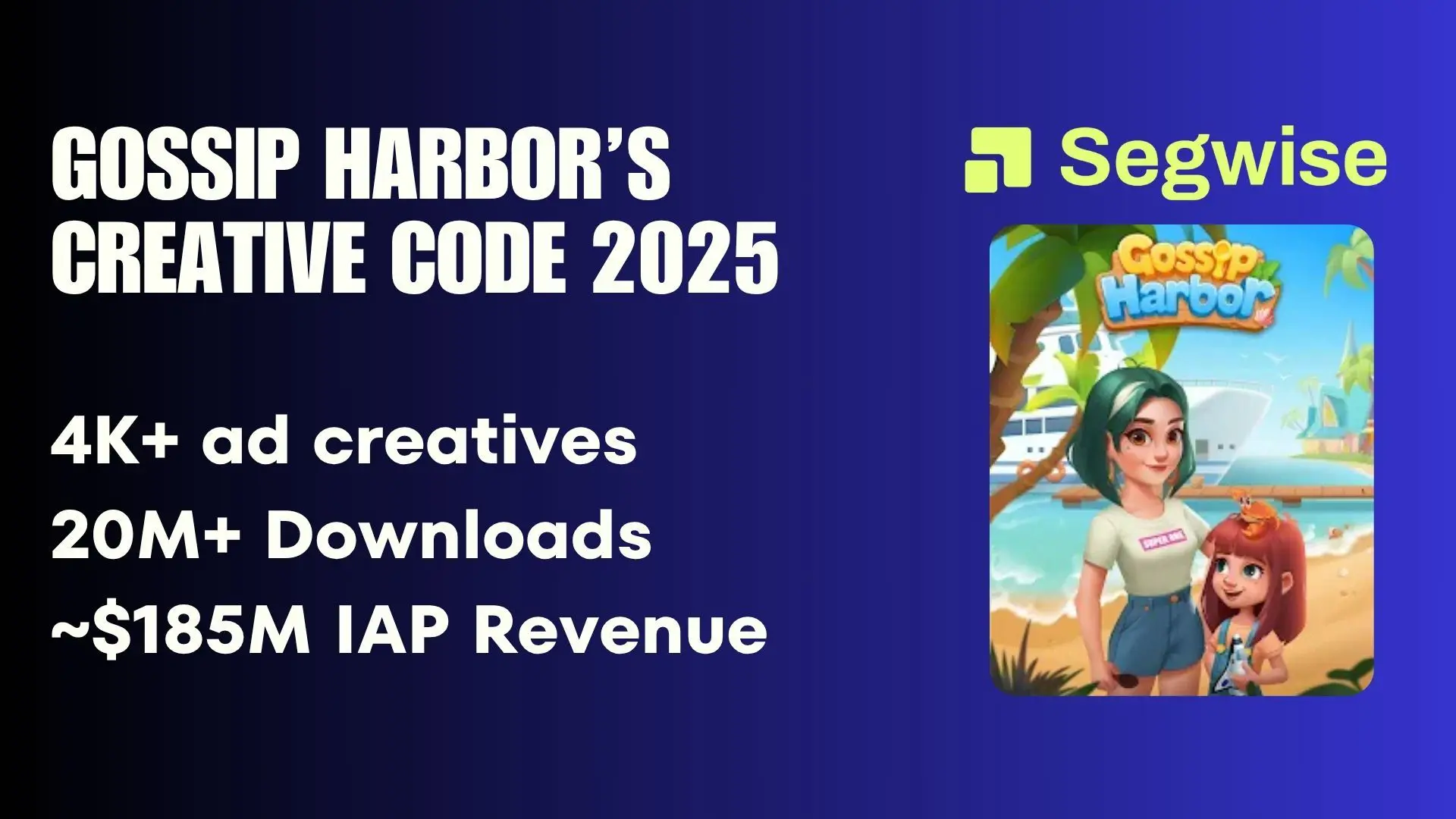
The Merge Game Market Just Got Disrupted
If you've been watching the merge game space, you've witnessed something remarkable. Gossip Harbor: Merge & Story is completely steamrolling established players like Merge Mansion and Travel Town, and it has only accelerated into 2026.
The numbers tell an incredible story. Microfun's title crossed roughly $677M in lifetime revenue, and in Q1 2026 its revenue rose 172% year over year to $270M while downloads climbed 74% to 22M. In March 2026 the game broke $100M in monthly net revenue for the first time. But here's what really caught our attention at Segwise: their creative strategy is insanely good, backed by a solid testing framework and thousands of ad variations across global markets.
Most merge games rely on satisfying progression mechanics or cheerful renovation scenarios. Gossip Harbor took the opposite approach: pure emotional angles of family suffering. And it's working at a scale that's reshaping the entire genre.
Also read How Habby's Latest Hit Wittle Defender Generated $1.4M in <30 Days
Why Traditional Merge Game Creatives Are Failing
Before diving into Gossip Harbor's strategy, let's address the elephant in the room. Traditional merge game advertising was becoming painfully predictable:
- Generic progression hooks: "Look how satisfying this merge mechanic is!"
- Cheerful renovation themes: "Help restore this beautiful mansion!"
- Simple before/after transformations: "Watch this room become amazing!"
The problem? These approaches created zero emotional stakes. Users might click out of mild curiosity, but there's no psychological urgency driving them to download immediately.
Gossip Harbor's team understood something fundamental about human psychology: crisis creates action. When you see a family freezing in a collapsing shelter, your empathy circuits fire up in ways that a pretty room renovation simply cannot match.
The Gossip Harbor Formula: Emotional Crisis as User Acquisition
Segwise's creative-tag analysis of Gossip Harbor's top-performing ads reveals a sophisticated emotional storyline framework. Using the Creative Tagging Agent, which automatically tags visual elements, characters, on-screen text, and audio across video, image, and playable creatives, we identified the patterns that explain their explosive growth.
The Core Emotional Architecture
100% of analyzed creatives feature family hardship scenarios. This isn't coincidence, it's strategic emotional engineering. Every single ad opens with a family in genuine distress, creating immediate viewer investment.
83.3% involve weather-related suffering, primarily freezing and cold exposure. Harsh weather conditions create universal anxiety because it's uncontrollable and immediately life-threatening. A family freezing in snow triggers deeper psychological responses than abstract game challenges.
66.7% show structural collapse like roofs breaking or shelters failing. This adds urgency through imminent physical danger - viewers instinctively want to "fix" the immediate threat they're witnessing.
Character Strategy: The Mother-Daughter Dynamic
67% of hook scenes feature the mother or daughter in them. This character selection is psychologically brilliant. Mother-child relationships trigger the deepest protective instincts, making viewers emotionally invested within seconds.
The rotation strategy is equally sophisticated:
- Young female girl (child) (33%): Appeals to protection and innocence
- Middle-aged femal (mother) (33%): Triggers parental empathy and responsibility
- Meta-commentary animated characters (25%): Addresses competitor criticism directly
- Family dynamics (remaining %): Creates complex emotional scenarios
The Storytelling Sweet Spot: 50+ Seconds
Here's where Gossip Harbor breaks conventional mobile advertising wisdom. 90% of their ads exceed 50 seconds, with the optimal range hitting 54-58 seconds.
Most performance marketers would consider this creative suicide. Mobile users have short attention spans, right? Wrong. When emotional investment is high enough, viewers will watch longer content.
The extended duration allows for:
- Emotional buildup through crisis establishment
- Solution demonstration via merge gameplay
- Stakes reinforcement through continued suffering
- Clear call-to-action with level progression hints

The Genius of Tragic Endings: Converting Empathy Into Downloads
This might be Gossip Harbor's most counterintuitive strategy: 66.7% of their ads end with continued suffering rather than happy resolutions.
Traditional marketing logic suggests showing positive outcomes to motivate downloads. Gossip Harbor does the opposite, and here's why it works:
Unresolved tension creates psychological pressure. When viewers watch a family's problems remain unsolved, they experience what psychologists call the "Zeigarnik Effect" - unfinished tasks stick in our minds longer than completed ones.
The incomplete rescue scenarios make viewers think: "I need to download this game to actually help this family." It's brilliant psychological manipulation disguised as storytelling.
What looked counterintuitive in 2025 is now the dominant pattern across mobile UA. A 2026 breakdown of top-performing creatives found that 84% used either a direct viewer challenge or a deliberately unresolved ending, with the takeaway that "leaving viewers wanting more consistently outperforms delivering a clean, resolved narrative." Merge specialists describe the exact Gossip Harbor beat: an ad opens on a mother and daughter shivering in a cold, damaged room, shows a few merge repairs, then introduces an unexpected setback that leaves the story unfinished so viewers download to continue it. Gossip Harbor did not just find a hack; it found where the whole category was heading.
Advanced Tactics: Meta-Advertising and Authenticity Positioning
25% of Gossip Harbor's creatives directly address competitor criticism through meta-commentary. They use animated characters (brains, animals) who say things like "but Gossip Harbor ads aren't fake!" in multiple languages.
This defensive-offensive strategy accomplishes two goals:
- Differentiates from competitors by acknowledging fake ad complaints
- Positions Gossip Harbor as authentic while implying others are misleading
It's a masterclass in competitive positioning through creative content.
Global Localization Strategy
Their geographic distribution reveals sophisticated market understanding:
- Turkey (17%) and Italy (12%) lead targeting
- European focus with 11 countries representing 79% of spend
- AppLovin dominance at 86% of ad network allocation

The multilingual approach (including Portuguese dialogue) shows they're not just translating, they're culturally adapting emotional triggers for specific markets.
That network concentration also explains why they keep iterating on tone. AppLovin has made a decisive pivot toward humor and meme-style hooks in 2026, while Facebook and YouTube still reward a classic intro, conflict, and climax arc that ends on either a strong success CTA or an abrupt, curiosity-sparking cut. A creative library that leans this heavily on one network has to track those platform-level shifts, which is exactly the kind of divergence a unified, cross-network view is built to catch.
Recent Creative Evolution: Production Quality and Format Innovation
Segwise's creative-tag analysis surfaced three major trend shifts in Gossip Harbor's newer creatives:
Production Quality Upgrades
- Crisper character animation approaching premium mobile game standards
- Environmental diversification from snow to jungle/rain scenarios
Character Scope Expansion
- Richer family dynamics introducing second daughter characters
- Fresh rescue targets like eggs instead of puppies
- Expanded emotional contexts including divorce and abuse backstories
Format Experimentation
- Plain HTML card creatives for simplified ad units
- Cross-genre visual borrowing from cooking/restaurant games

What Your Studio Can Steal (And Implement This Week)
Immediate Actions for Merge Game Studios
1. Implement the 50+ Second Storytelling Framework
- Test creative duration between 54-58 seconds
- Build emotional arc: Crisis → Partial Solution → Unresolved Tension
- Always end with stakes remaining high
2. Adopt the Emotional-Crisis Hook Strategy
- Try opening a creative with genuine family distress
- Use weather/shelter as universal stressors
- Show imminent physical danger (falling objects, structural collapse)
3. Deploy Meta-Advertising Tactics
- Create 20-25% of creatives addressing "fake ads" criticism
- Use animated characters to deliver authenticity messaging
- Position your game as "the real experience" competitors aren't
Advanced Implementation for Other Genres
Character Rotation System:
- Identify your genre's equivalent emotional archetypes
- Maintain 33/33/33 distribution across character types
- Test unexpected character combinations for breakthrough hooks
Choice Integration Pattern:
- Always show binary decisions directly connected to core mechanics
- Use choice outcomes to drive emotional stakes higher
- Connect user agency to character welfare
Creative Intelligence Tools: Measuring What Matters
Traditional creative analysis focuses on surface metrics like CTR and CVR. Gossip Harbor's success requires deeper creative intelligence:
Essential Creative Tags to Track:
- Character archetype distribution
- Emotional arc progression
- Crisis-to-resolution ratios
- Duration optimization by story complexity
- Meta-commentary effectiveness
Advanced Performance Indicators:
- Emotional engagement duration (time to first emotional hook)
- Stakes escalation timing (when tension peaks)
- Resolution satisfaction scores (tragic vs. happy ending performance)
Using AI-powered creative intelligence like Segwise lets you tag every creative element and map it to performance at scale across all your creatives. Segwise's Creative Tagging Agent uses multimodal AI to read video, audio, image, and text together, and it is the only platform that tags playable (interactive) ads, so you can score hooks, characters, durations, and endings exactly the way we did for Gossip Harbor. From there, the Creative Strategy Agent (an always-on AI Chat) answers plain-language questions about which patterns actually drive installs and ROAS, flags creative fatigue before performance crashes, and the Creative Generation Agent turns those winning patterns into net-new image, video, and playable creatives. You can connect your ad networks and MMPs in minutes and start on a 7-day free trial. For a repeatable way to turn these patterns into a test plan, see our guide to mobile game UA creative testing at scale.
What This Means for the Mobile Game Industry
Gossip Harbor's success signals a fundamental shift in mobile game marketing. Emotional authenticity is becoming more valuable than gameplay mechanics in user acquisition creative strategy. The volume side is shifting just as fast: 56% of the top 100 grossing mobile games used AI in ad creative production in 2025, so studios can now spin up dozens of emotional-arc variations cheaply and let performance data pick the winners.
This trend has implications beyond merge games:
- RPGs can leverage character backstory for deeper engagement
- Puzzle games can create stakes through endangered characters
- Strategy games can emphasize civilian protection over conquest themes
The studios that adapt emotional intelligence frameworks first will likely dominate their respective genres in 2026 and beyond.
Implementation Considerations for Your Creative Strategy
Creative Portfolio Assessment
- Analyze your current emotional content distribution and character archetype usage
- Benchmark creative duration against engagement performance to identify optimization opportunities
- Map existing creative themes against psychological trigger frameworks
Core Framework Testing
- Experiment with crisis-based hooks adapted to your game's context and audience
- Test extended duration creatives (50+ seconds) with proper emotional arc development
- Compare tragic versus resolved ending performance across different user segments
Advanced Strategic Development
- Invest in production quality improvements for emotional authenticity
- Develop culturally-adapted frameworks for global market expansion
- Build systematic creative intelligence processes using AI-powered creative tagging and analytics tools like Segwise.
The Future of Mobile Game Creative Strategy
Gossip Harbor proved that emotional arcs can generate massive revenue when executed with precision and cultural sensitivity. Their $677M success story isn't luck, it's the result of understanding human psychology better than their competitors.
The question isn't whether emotional-first creative strategies will spread across mobile gaming. The question is whether you will adopt them before or after your competitors do.
As user acquisition becomes increasingly competitive, the studios that master emotional intelligence in their creative strategy will build the strongest user acquisition foundations. Gossip Harbor showed us the playbook. Now it's time to adapt it to your game, your audience, and your market.
What emotional triggers will you test in your next creative campaign?
Want to analyze your competitors' creative strategies with the same depth we used for Gossip Harbor? Segwise's AI-powered creative analytics platform provides detailed tagging and analytics for thousands of mobile game ads across all major networks.
Frequently Asked Questions
How much money has Gossip Harbor made?
Gossip Harbor: Merge & Story has crossed roughly $677M in lifetime revenue. In Q1 2026 its revenue rose 172% year over year to $270M and downloads reached 22M, and in March 2026 it passed $100M in monthly net revenue for the first time.
Why do Gossip Harbor ads show a family in crisis and end sadly?
Crisis creates action. Opening on a family in genuine distress triggers protective empathy within seconds, and ending before the rescue is complete leaves an open loop (the Zeigarnik Effect) that viewers resolve by downloading. This is now a category-wide pattern: a 2026 analysis found 84% of top-performing ads used a direct viewer challenge or an unresolved ending.
Is the Gossip Harbor game actually like its ads?
The merge grid shown in the ads is a real part of the game, but the intense family-crisis storyline is a dramatized hook rather than the core loop. Gossip Harbor even leans into that debate directly: about 25% of its creatives use animated characters delivering "the ads aren't fake" meta-commentary to position the game as the authentic option.
How long are Gossip Harbor's video ads?
Unusually long for mobile. 90% of the analyzed creatives exceed 50 seconds, with the sweet spot landing around 54 to 58 seconds. The extra runtime buys room to build the crisis, demonstrate the merge solution, reinforce the stakes, and cut to an unresolved cliffhanger.
What can other studios copy from Gossip Harbor's creative strategy?
The transferable pattern is a crisis hook in the first three seconds, the core mechanic cast as the rescue, a character with strong protective pull, and an unresolved ending, then heavy localization by market. Adapt the emotional archetypes to your genre and validate every variant against performance data rather than copying the theme wholesale. Our step-by-step creative strategy guide walks through how to build that testing loop.
How do you analyze a competitor's ad creative strategy at this depth?
You tag creatives at the element level and map each tag to performance. Segwise's Creative Tagging Agent applies multimodal AI to video, audio, image, text, and even playable ads, and its Creative Strategy Agent (AI Chat) lets you ask which hooks, characters, durations, and endings drive installs and ROAS in plain language. You can connect your ad networks in minutes and start on a 7-day free trial.