
AI in mobile game marketing now runs the full loop from creative ideation through fatigue detection to attribution, which means UA teams competing on manual spreadsheet analysis are losing ground every quarter. For mobile game marketers in 2026, the real question has shifted from "should we use AI?" to "where does AI actually move ROAS, and which capabilities are worth paying for?" Segwise's agentic creative intelligence platform is built to handle the parts where the math matters most: creative-level performance, fatigue patterns, and data-backed creative generation from your winning elements.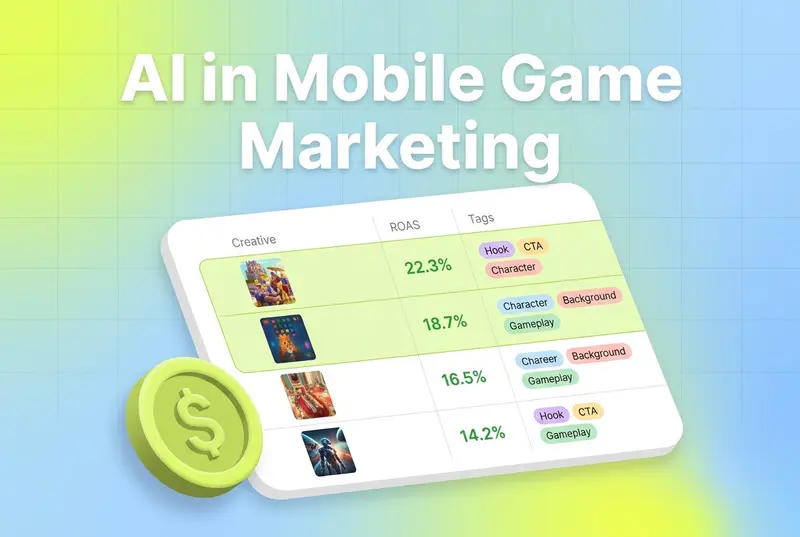
What's the role of AI in mobile game marketing?
Mobile game user acquisition gets weirder every month. According to AppsFlyer's 2026 State of Gaming for Marketers report, top gaming advertisers are now producing 2,400 to 2,600 creative variations per quarter, up 25 to 30 percent year over year. Global gaming app UA spend hit 25 billion dollars in 2025.
At the same time, Google Cloud's 2025 games developer study found that 90% of games developers already use generative AI somewhere in their workflows. And by the end of 2026, Gamelight's industry forecast expects roughly half of all UA creatives to either have AI-generated hooks or be built entirely by AI.
Stack those numbers together and you get the defining problem of mobile game marketing in 2026: teams can generate creative faster than they can evaluate it, and the audience is not growing fast enough to absorb the volume. The attention ceiling is real. The marginal cost of a bad creative is going up, not down.
This guide walks through where AI is actually pulling weight in mobile game marketing, where it is mostly hype, and how UA managers, creative strategists, and growth leaders should structure their stack this year. It draws from practitioner discussions (including a frequently cited thread on r/mobilegamemarketing), AppsFlyer and Liftoff benchmark data, and hands-on analysis of the tools shipping real ROAS wins.
Key takeaways
Global mobile gaming UA spend reached 25 billion dollars in 2025, growing 3.8% YoY, with top advertisers producing 2,400 to 2,600 creatives per quarter, per AppsFlyer.
78% of top-quartile campaigns now refresh creatives at least weekly, compared to 41% in 2024, per AppsFlyer's creative optimization data. The refresh cycle is the new leverage point.
90% of games developers use generative AI in some workflow, and 68% of gaming studios are actively implementing AI in UA, creative, and player engagement, per Google Cloud.
AI-optimized creatives can reduce CPI by up to 30%, and structured creative refresh cycles improve performance stability by 30%, per mobile UA benchmark analysis.
Playable ad IPM grew roughly 23% YoY in 2025, per Liftoff data, making playable tagging a hard requirement for gaming UA teams.
Sett raised a 30 million dollar Series B in 2025 specifically to automate UA creative generation for mobile games, per Contentgrip, signaling that the AI-creative category is now well-funded.
The 2026 winning stack tends to be specialized: one tool for creative intelligence, another for generation, another for attribution. Not a single monolith.
Also read How to beat Meta's Andromeda algorithm: 8 practical steps for creative-led growth
The 2026 reality check for mobile game marketers
Here is what actually changed between 2024 and 2026. The algorithmic side of mobile UA, which covers bid optimization, targeting, and budget pacing, has largely been absorbed by the ad networks themselves. Meta's Andromeda, Google's AI-powered App Campaigns, and TikTok's Symphony optimize audiences and bids in ways no human can replicate at scale. That shift left creative and measurement as the only two controllable levers UA teams still own.
Liftoff's 2025 Casual Gaming Apps Report shows iOS CPIs running roughly 9x higher than Android for casual games, with D30 ROAS averaging 47% on iOS and 15% on Android. Those gaps are not closing on their own. What does close them, measurably, is creative velocity paired with tight fatigue detection loops.
The AppsFlyer 2026 report makes the point explicit. Creative production and creative optimization are the two areas where studios saw the most benefit from AI adoption, with over half of surveyed respondents pointing to those areas. The real challenge has shifted from producing enough creative to knowing which creatives work, why, and when to replace them.
Where AI actually moves the needle
Not every "AI-powered" feature in a mobile game marketing tool deserves your attention. Based on shipped results from gaming UA teams, five areas are where AI genuinely improves unit economics.
Creative ideation and production at scale
Gen-AI tools have collapsed the cost of producing ad variations. Sett raised a 30 million dollar Series B in 2025 to automate the UA creative pipeline for mobile games: research, ideation, playable and video generation, deployment, and analysis all in one system. Layer AI runs a similar playbook for brand-consistent creative at scale.
The thing to look for is tools that produce variations on proven winners, not arbitrary creative. IPM lift comes from iterating on top performers with different hooks, CTAs, and pacing, rather than generating 500 variants on a weak theme. Segwise's Creative Generation Agent, for example, uses tag-level performance data to generate data-backed variations, letting teams export in aspect ratios ready for each ad network (1:1, 4:5, 9:16, 16:9).
The trap to avoid is producing hundreds of near-identical creatives because your winning pattern was too narrow. Variation needs to be deliberate: different hook archetypes, different emotional registers, different opening frames.
Creative tagging and intelligence
Creative tagging is the foundational layer. Without per-element tagging (hooks, CTAs, characters, visual styles, audio tone, playable mechanics), teams cannot isolate what actually drove an install.
Manual tagging typically runs 20 or more hours per week per app, per the widely cited benchmarks across creative analytics vendors. Multimodal AI, which analyzes video, audio, image, and text together, eliminates that cost and enables tag-to-metric mapping. That is how you answer questions like "which hook archetype drove D7 ROAS on TikTok versus Meta?" without building the answer from scratch in a spreadsheet.
Segwise's creative tagging is one of the few platforms that tags playable (interactive) ads natively, alongside video, audio, image, and text. That matters because playable ad IPM grew ~23% YoY in 2025, per Liftoff, and video-only tagging systems treat playables as black boxes.
Fatigue detection and budget protection
Creative fatigue sets in quickly and costs real money. Analytics at Meta's own research found that conversion likelihood drops roughly 45% by the fourth repeat exposure of a creative. Multiply that decay curve across a 500K monthly spend and the budget leakage gets substantial fast.
AI-powered fatigue detection monitors CTR, CVR, frequency, and spend share drop against configurable thresholds. It flags decline patterns before performance crashes, not after. The practical difference is 7 to 14 days of earlier intervention, which translates to meaningful ROAS recovery if you have creative queued to replace fatigued assets.
Segwise's fatigue tracking lets teams set custom thresholds (say, 20% ROAS decline over 7 days) and monitors across Meta, TikTok, Google, Snapchat, YouTube, AppLovin, Unity Ads, Mintegral, and IronSource. Multi-platform monitoring is the right scope. Single-platform fatigue tools miss cross-platform audience overlap effects that show up when the same user sees the same creative across two networks in a week.
Competitor ad intelligence
Mobile game competitive landscapes shift every week. Puzzle, casino, 4X, and hyper-casual segments see messaging shifts and new hook patterns launch constantly, and reading them manually is a losing proposition.
AI competitor tracking now goes beyond scraping ad libraries. Tools apply the same multimodal tagging to competitor creatives so you can see their hook archetypes, CTA frequencies, and visual treatment patterns, then identify gaps your creative can exploit. Segwise's competitor tracking agent currently monitors Meta (Facebook and Instagram), with additional platforms in development.
The practical value shows up in creative briefs. Instead of generic "let's test a new hook" direction, you brief against the specific white space your top competitors are not filling.
Attribution unification
The SKAdNetwork 5.0 era continues to complicate iOS attribution. What helps is unifying MMP data (AppsFlyer, Adjust, Branch, Singular) with ad network data in a single creative-level view. Creative-to-tag-to-metric mapping only works if you have clean attribution data feeding it.
Segwise integrates with all four MMPs (AppsFlyer, Adjust, Branch, and Singular) and 15+ ad networks and MMPs combined, giving UA teams a unified creative-level performance view with MMP attribution layered in. That is very different from most campaign-level reporting, which aggregates too high to inform creative decisions.
Common pitfalls UA teams hit in 2026
Practitioner discussions on r/mobilegamemarketing and similar forums surface the same traps repeatedly when gaming teams start rolling out AI tools.
Tool sprawl. Adding five AI tools to a stack that already has three dashboards does not speed anyone up. Pick a primary creative intelligence platform, a generation tool (or use your intelligence platform's generation feature), and leave the rest alone until you have proven the first two move real metrics.
AI-generated slop. Generating 200 video variants from a weak concept just spreads the weakness across more ad spend. Gen-AI amplifies whatever input you feed it. Data-backed iteration, where generations come from tag-level winners, outperforms "generate 50 creatives on this theme" by a wide margin.
Metric worship. Most teams track CTR and IPM because they are easy. The metrics that actually predict ROAS are downstream: D7 retention, D7 ROAS, spend share growth, and custom in-app events. Build dashboards around the metrics you are paid to move, not the ones that come pre-built.
Skipping tagging entirely. Teams that skip creative tagging because it feels boring end up running A/B tests they cannot explain. If you cannot say why your top creative outperformed your bottom creative, you cannot replicate the win. Tagging is the unsexy foundation that makes everything else work.
How to evaluate an AI mobile game marketing platform
Use these criteria before signing a contract.
Does it tag playable ads? For gaming teams, this is disqualifying if missing. Playables are a growing share of gaming ad spend.
Multimodal or video-only? Video-only tagging misses audio hooks, which drive a disproportionate share of IPM on TikTok.
Integrations match your full stack? List every ad network and MMP you use. If the tool misses one (especially Singular on the MMP side), you are building workarounds on day one.
Setup time actually realistic? No-code OAuth setups should take 10 to 15 minutes per integration. If the vendor quotes "implementation services," that is a red flag for gaming teams that need speed.
Creative-level granularity, not campaign-level. If the dashboard aggregates to campaign, it cannot answer creative questions.
Can the AI chat actually answer questions about your data? Try it in the demo. Ask: "Which hook style drove the most installs last month on TikTok?" If the answer is a generic dashboard link, the agent is not real.
A practical 2026 implementation sequence
If you are starting from spreadsheets and manual creative tagging, here is the order that works for most gaming teams.
Connect your top three ad networks and primary MMP. Import 14 to 30 days of historical creative data. Validate it matches what your UA team sees in native dashboards.
Let the AI tagging agent process your creative library. Review the auto-generated tags for accuracy and add 3 to 5 custom tags specific to your game (for example, "gameplay footage," "character intro hook," "meta-gaming UI reveal")
Build tag-to-metric reports. Identify top-performing tags for your core KPI (typically D7 ROAS). Brief your creative team, internal or agency, against those winning tags.
Turn on fatigue detection with custom thresholds. Set up alerts in Slack or email. Begin using AI-powered creative generation on your top tag winners to produce data-backed variations. Teams at this stage typically start saving 20 or more hours per week on manual tagging and reporting work alone.
Layer in competitor tracking. Identify 2 to 3 gaps in your competitive set and brief creative against them.
This is a practitioner-tested sequence, not a theoretical framework. Gaming teams that go in this order typically report meaningful ROAS lifts within 60 to 90 days.
What this means for you
AI in mobile game marketing is not a single product category. It is five related capabilities (creative production, creative intelligence, fatigue tracking, competitor analysis, and attribution unification) that are best implemented in sequence, not all at once. The teams winning in 2026 are the ones who understand that the old game of manual creative analysis cannot keep up with the volume ad networks now demand, and that AI-powered creative intelligence is the specific layer that determines whether all that creative volume earns its keep.
For UA managers, creative strategists, and growth leaders running gaming apps, the decision simplifies - pick a creative intelligence platform that tags playables, tags multimodal-ly, integrates with every major ad network and all four MMPs (including Singular), and generates new creatives from your winning patterns. Segwise is built for exactly this shape of problem, with publicly cited outcomes of up to 50% ROAS improvement and up to 20 hours per week saved per app. Whichever platform you pick, the order of operations matters more than the brand.
Frequently asked questions
What does AI actually do for mobile game marketing in 2026?
AI in mobile game marketing handles four main jobs: generating creative variations from winning patterns, tagging creative elements across video, audio, image, and text for performance analysis, detecting fatigue early by monitoring CTR and ROAS decline, and unifying attribution data across ad networks and MMPs. Segwise focuses on the creative intelligence layer (tagging, fatigue, generation), while tools like Sett and Layer AI lean more toward production. Most mobile game UA teams pair two platforms rather than relying on one.
How much of a gaming studio's creative output is AI-generated in 2026?
By the end of 2026, roughly 50% of all gaming UA creatives will have AI-generated hooks or be entirely AI-generated, per Gamelight's 2026 forecast. 90% of games developers already use generative AI in some part of their workflow, per Google Cloud's 2025 study. Share varies by budget tier: smaller advertisers (under 500K monthly) scaled AI-generated output fastest in 2025 to compete with top spenders.
What is the best AI tool for mobile game UA creative analytics?
The leading creative intelligence platforms for mobile gaming UA in 2026 include Segwise (multimodal tagging with playable ad support, fatigue tracking, and integrated creative generation), Uplifted (creative asset management with fatigue detection), and Sett (production-first with an analysis layer). For teams running playables, tools that tag interactive ads specifically are essential. Segwise is one of the few platforms that tags playables natively alongside video, audio, image, and text.
How do I know if my mobile game ads are suffering from creative fatigue?
Creative fatigue shows up as a gradual decline in CTR, CVR, and spend share over 7 to 14 days, typically after audiences have seen a creative four or more times. Analytics at Meta's research puts the conversion drop at roughly 45% by the fourth repeat exposure. Tools like Segwise detect this automatically against configurable thresholds (for example, 20% ROAS decline over 7 days) across Meta, TikTok, Google, Snapchat, YouTube, AppLovin, Unity Ads, Mintegral, and IronSource. Single-platform fatigue monitoring misses cross-platform overlap.
What is the difference between AI creative intelligence and AI creative generation?
Creative intelligence analyzes existing creative performance at the element level to identify which hooks, CTAs, visual styles, and audio components drive installs. Creative generation produces new creative assets, ideally informed by intelligence data so variations come from winning tags rather than random concepts. Segwise combines both in one platform; some competitors specialize in just one side. The best results come from pairing them: intelligence first, then generation off winning patterns.
Which ad networks and MMPs should a mobile game marketing AI tool support?
For mobile gaming UA in 2026, the non-negotiable networks are Meta, Google, TikTok, AppLovin, Unity Ads, Mintegral, IronSource, Snapchat, and YouTube. On the MMP side, AppsFlyer, Adjust, Branch, and Singular are the standard four. Missing Singular leaves a meaningful share of gaming attribution outside the platform. Segwise integrates with all four MMPs and 15+ ad networks and MMPs combined, while most competitors cover most but not all.
How long does it take to see ROAS improvements from an AI creative intelligence platform?
Most gaming teams see measurable ROAS improvements within 60 to 90 days of implementation, provided they follow a proper sequence: connect integrations, validate data, run AI tagging, build tag-to-metric reports, and then enable generation and fatigue detection. Segwise publicly cites up to 50% ROAS improvement and up to 20 hours per week saved per app, numbers consistent with what a well-implemented creative intelligence layer should deliver in a gaming context.
Is AI mobile game marketing worth it for smaller gaming studios?
Yes, with one caveat. Smaller gaming advertisers scaled AI-driven creative output 20 to 40% YoY in 2025, per AppsFlyer, often faster than larger budgets. The caveat is that AI amplifies what you feed it. If your creative intuition is weak, AI production just produces more mediocre creative. Small gaming teams should start with creative intelligence (to understand what is working) before investing heavily in generation. Segwise offers custom tiered pricing that accommodates various budget ranges.