
A high Meta CPM in 2026 is almost never one problem. The viral take says it is always a pixel signal issue, fewer than 50 conversions a week keeps you stuck in learning, and creative testing is noise. That is half right. Signal volume sets the floor on your delivery costs, but creative hold rate moves CPM by 30 to 60 percent inside an account that already has clean signal. The fix is a four-step diagnostic, run in order: conversion volume, audience frequency, creative hold rate, then format benchmarks.
If you have spent any time in r/FacebookAds or r/PPC lately, you have seen the same thread a dozen times. CPM is up, ROAS is down, spend is flat, and someone in the comments insists the only thing that matters is getting the pixel 50 purchases. Then someone else swears it is all creative. Both camps are arguing past each other, because both are describing a different layer of the same stack.
This guide settles it with numbers. We will walk through why your Meta CPM is high in 2026, when signal is the real bottleneck, when creative is, and the exact thresholds that tell you which lever to pull. Average Meta CPM hit $13.48 across industries in 2026, up roughly 20 percent year over year, according to WebFX's Meta benchmarks. So before you blame your account, know that some of the increase is the whole auction getting more expensive.
Also read Where to Place New Meta Ads Creatives: Winning vs New Ad Set
Key takeaways
A Meta CPM above your category benchmark has four common causes, and they stack: thin conversion signal, audience saturation, weak creative hold, and format mix. Diagnose in that order.
The 50-conversion-per-week rule is real but misread. Once an ad set clears ~50 optimization events in 7 days, Meta shifts from exploration to exploitation and cost efficiency can improve 20 to 30 percent
Frequency is the fastest CPM tell. Once frequency on cold audiences climbs past 2.5 to 3.0, engagement drops and CPM rises to compensate
Hold rate is the creative lever the "it is all pixel" crowd ignores. A hold rate below 30 percent signals creative that loses viewers mid-video, and strong hold lowers CPM over time.
The Andromeda rollout added CPM volatility on top of all of this in 2026, so wait for a 28-day rolling trend before reacting
First, what counts as a "high" CPM in 2026
CPM, or cost per mille, is what you pay per thousand impressions. It is the price of attention, not the price of a conversion, so a high CPM is only a problem when it is not buying you proportionally more value.
Benchmarks moved in 2026. Ecommerce brands are seeing Meta CPMs in the $10 to $18 range, per Threadpoint, and the cross-industry average sits around $13.48, up about 20 percent from 2025, according to WebFX. Tier 1 markets carry a premium on top of that. If your CPM is $16 in a US ecommerce account, you are inside the normal band and the real question is conversion rate, not CPM. If your CPM is $40 and climbing, something in your account is wrong.
Here is the mental model. Meta sets your CPM based on how much the auction wants to show your ad. Strong engagement and clean signal lower the price. Saturation, weak creative, and thin data raise it. The four-step diagnostic below isolates which of those is driving your number.
The 4-step high-CPM diagnostic
Run these in order. Each step has a threshold and a verdict. Stop when you find the layer that is broken, fix it, then re-measure before moving on.
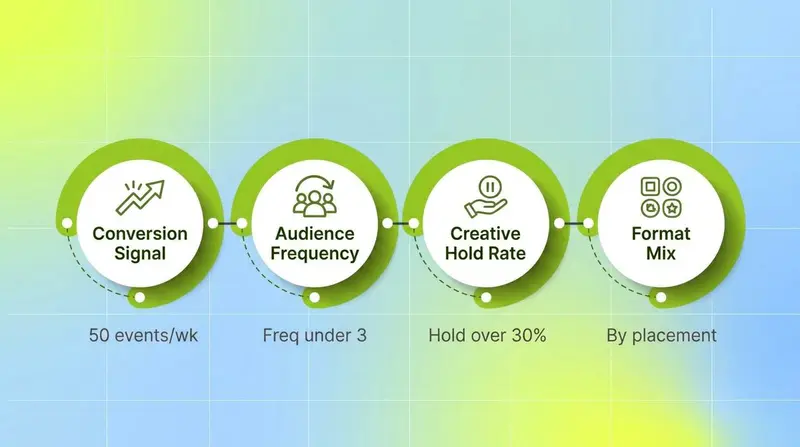
Step 1: Conversion signal, the 50-event floor
Meta's algorithm needs roughly 50 optimization events per ad set per week to exit the learning phase. This is the part the pixel-signal crowd gets right. Below that floor, delivery stays in exploration mode, CPM and CPA swing wildly, and the model never settles.
What actually happens at 50 events is the interesting part. Once an ad set clears the threshold in a 7-day window, Meta's engine transitions from exploration to exploitation, prioritizing users who resemble past converters. Cost efficiency can improve 20 to 30 percent versus campaigns still stuck in learning, according to LeadEnforce.
The practical math is simple. To hit 50 events in 7 days you need about 7 conversions a day. Multiply your target cost per acquisition by 7 to get a rough daily budget floor, as Modern Marketing Institute lays out. A $30 CPA needs roughly $210 a day per ad set to give the algorithm a fair shot. If your budget cannot support that, you have too many ad sets splitting too little signal. Consolidate, or optimize for a higher-volume event like add-to-cart to feed the model faster.
Count optimization events, not purchases - if you optimize for purchases but only get 12 a week, you are below the floor no matter how good your creative is. Move the event up-funnel until volume clears 50, then move it back down once delivery stabilizes.
Step 2: Audience saturation and frequency
If your signal is healthy and CPM is still high, check frequency. This is the fastest tell in the whole diagnostic. When frequency on cold audiences climbs past 2.5 to 3.0, engagement rate drops, CPM rises to compensate, and your effective reach shrinks, according to Threadpoint.
Frequency above 5 is a different diagnosis. At that point you are not looking at normal saturation, you are looking at creative fatigue, the same source notes. The audience has seen the ad too many times, stopped engaging, and Meta is charging you a premium to keep forcing it in front of them.
The fix for saturation is not cutting budget. It is giving the algorithm fresh material, either a broader audience or new creative variants, so it has something new to optimize against. Cutting spend just slows the bleed without solving the cause.
Step 3: Creative hold rate, the lever the signal crowd ignores
Here is where the "it is all pixel" argument breaks down. Inside an account with clean signal and controlled frequency, creative quality still drives CPM by a wide margin. Meta serves engaging content more cheaply because engaged users are worth more to the auction. Strong hold translates into lower CPM over time, per Great Marketing AI.
The two metrics that matter are hook rate and hold rate.
Hook rate is 3-second views divided by impressions. Above 35 percent is strong, 25 to 35 percent is workable, and below 25 percent means your first three seconds are not stopping the scroll, per Great Marketing AI.
Hold rate is through-plays divided by 3-second views. Above 50 percent is strong, 40 to 50 percent is average, and below 30 percent means viewers bail before your message lands.
A low hold rate is the single most common creative cause of a high CPM in an otherwise healthy account. It tells you the hook is doing its job but the body is losing trust or attention. That is a completely different fix than a low hook rate, and you cannot see it without measuring both. Creative quality accounts for 47 percent of the sales lift from video ads, per Nielsen research cited by Great Marketing AI, which is why this step moves CPM more than most marketers expect.
The hard part is that hold rate is an element-level question. It is not enough to know the ad has a weak hold. You need to know which scene, hook, or section drives the drop-off so you can fix it without rebuilding the whole asset. This is exactly the gap Segwise's creative fatigue tracking and element-level tagging close. Segwise's multimodal AI tags every creative element, hooks, scenes, on-screen text, audio, and maps each tag to performance, so you can see whether the second-3-to-5 cut is what is tanking your hold rate across a whole library, not just one ad.

Step 4: Format and placement benchmarks
The last layer is mix. CPM varies a lot by placement and format, so an account-level average can hide a single expensive placement dragging the number up. Reels, feed, and Stories price differently, and so do video versus static.
Pull CPM by placement and format and compare each to your category band. If one placement sits far above the rest without matching conversion value, exclude it or rebalance budget toward placements that price efficiently. This is also where the 2026 auction context matters most, since the increases are not uniform across formats.
The Andromeda wildcard in 2026
One more thing before you act on any of the above. Meta's Andromeda rollout reshaped the personalization layer in 2026 and added CPM volatility that is unusual even by Meta's standards. Some accounts saw ROAS swing 15 to 40 percent over four to six weeks with CPM looking similar and spend unchanged, according to HyperFX.
Andromeda also stretched the typical learning-phase exit from 4 to 7 days out to 7 to 14 days for many accounts, the same source reports, and its attribution is more conservative about which conversions it credits to Meta. Advantage+ campaign types are the most disrupted because they lean hardest on the personalization layer Andromeda is rebuilding.
The practical takeaway: wait for a 28-day rolling CPM trend before reacting, and hold campaigns steady through the 4-to-6-week window per account. Reacting to a 3-day CPM spike during Andromeda turbulence is how you reset your own learning phase and make the problem worse.
So, is it pixel signal or creative testing?
Both. The honest answer the Reddit debate keeps missing is that they govern different layers. Signal volume sets the floor: below 50 events a week, nothing else you do will stabilize CPM. Above that floor, creative hold rate and frequency become the dominant levers, moving CPM by 30 to 60 percent within the same account. The pixel-only crowd is describing a campaign that never cleared learning. The creative-only crowd is describing one that did. Run the four steps in order and you will know which conversation you are actually in.
The teams that win this in 2026 are the ones who stop treating it as an either-or. They get signal to the floor first, control frequency, then attack hold rate at the element level, because that is where the largest efficient CPM gains live once the basics are handled.
Frequently asked questions
Why is my Meta CPM so high in 2026 even though my ads were fine last year?
Three things changed. The auction got more expensive across the board, with average CPM up about 20 percent year over year to $13.48, per WebFX. The Andromeda rollout added volatility on top, per HyperFX. And creative that worked last year may now be saturated. Run the four-step diagnostic to separate market-wide increases from account-specific ones. Tools like Segwise track CPM and creative fatigue across networks so you can tell which is which.
Is a high CPM always a pixel signal problem?
No. Thin conversion signal, fewer than 50 optimization events a week, does keep delivery in learning and inflates CPM. But in accounts that already clear that floor, audience frequency and creative hold rate drive CPM far more than signal does. The pixel-signal explanation only fully applies before an ad set exits the learning phase.
How many conversions do I need to exit the Meta learning phase?
About 50 optimization events per ad set per 7-day window. That is roughly 7 conversions a day. A practical budget floor is your target CPA times 7, per Modern Marketing Institute. If you cannot hit that, consolidate ad sets or optimize for a higher-volume event.
What is the difference between hook rate and hold rate, and which affects CPM more?
Hook rate is 3-second views over impressions and measures whether your opening stops the scroll. Hold rate is through-plays over 3-second views and measures whether the body keeps viewers, per Great Marketing AI. In a healthy account, weak hold rate is the more common hidden cause of high CPM, because it signals disengagement after the hook. Segwise measures both at the element level so you can fix the specific scene causing drop-off.
My frequency is 4 and CPM is climbing. What do I do?
Frequency above 2.5 to 3.0 on cold audiences raises CPM, and above 5 it usually means creative fatigue, per Threadpoint. At 4 you are in saturation territory. Broaden the audience or introduce fresh creative variants rather than cutting budget, which only slows delivery without fixing the cause.
How do I know if it is my account or just the 2026 market?
Compare your CPM to your category band, ecommerce sits around $10 to $18, per Threadpoint. If you are inside the band, the increase is mostly market-wide and you should focus on conversion rate. If you are well above it, the four-step diagnostic will locate the account-specific cause. Cross-platform creative analytics in Segwise make this comparison faster by unifying CPM and creative metrics across Meta, Google, TikTok, and more.
The bottom line
Your high Meta CPM in 2026 is a stack, not a single fault. Get conversion signal to the 50-event floor, pull frequency back under 3 on cold audiences, fix hold rate at the element level, then rebalance format mix, and do it all against a 28-day trend so Andromeda noise does not throw you off. Signal sets the floor, creative moves the ceiling, and the marketers who treat both as the same problem keep paying for it.
The element-level work in step 3 is where most teams lose the most money, because they can see that hold rate is low but not which part of the creative is causing it. Segwise's creative intelligence platform tags every element, maps it to performance, and flags fatigue before CPM spikes, so your team spends less time guessing and more time fixing the thing that actually moves cost. Segwise integrates with Meta, Google, TikTok, Snapchat, YouTube, AppLovin, Unity Ads, Mintegral, and IronSource, plus AppsFlyer, Adjust, Branch, and Singular, and teams using it report saving up to 20 hours a week and improving ROAS by up to 50 percent.