
ChatGPT and Claude give generic Facebook ad advice because they can't see your account. They don't have your spend, your results, a record of the ads you already tested or a view of what's inside each ad, so they fill the gaps with averages and confident guesses. To fix it, give them a dated export or Meta's ads MCP server, add tagged creative history, and make them cite a row for every claim.
The hardest gap to close is creative memory. A chat can read a results table, but it can't tell that the "new" offer ad it just suggested repeats a hook you tested and dropped last quarter. Segwise is an AI creative analytics and creative generation platform that tags every element of every ad you run and ties each tag to its results, so its Creative Strategy Agent, or ChatGPT and Claude through the Segwise MCP, can answer from your own ad history instead of a guess.
TL;DR
- If the advice sounds generic: the model has no account data. Attach a dated export and a short brief, or connect Meta's ads MCP server.
- If it keeps suggesting things you already tried: it has no test log. Keep one, or give it tagged creative history it can query.
- If it sounds sure but turns out wrong: make it quote the row behind every number and say when the data can't answer.
- If you run more than about 30 creatives a quarter or two or more networks: a creative analytics agent that already holds your tagged history saves the rebuilding every week (rule of thumb).
Why is ChatGPT's ad advice so generic?
General AI models answer the question you type, with whatever they can see. When you ask "how do I lower my Facebook CPA?", they see that sentence, a few saved notes and maybe a web search, but not your account. Four gaps explain most bad AI ad advice: no account data, a training process that rewards guessing, no record of your past tests and no view inside your ads. The first two make advice generic. The other two, covered in the next section, make it forget what you tested.
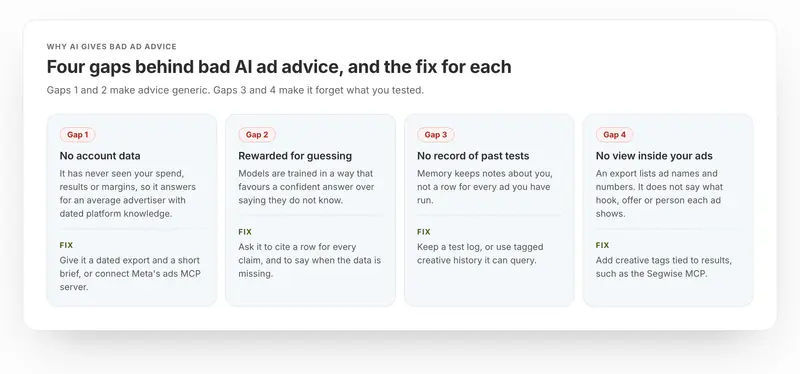
Gap 1: it has never seen your account
A model with no data answers for an average advertiser. It doesn't know your target cost per purchase, your margin, which network your installs come from or how many creatives you can make a week. So it falls back on advice that fits almost everyone: broaden targeting, refresh creatives, test more hooks. Sensible in general, and silent on your account.
Without your numbers, it also reaches for industry benchmarks it saw in training. A "good CTR" or a "normal CPA" from a blog post has nothing to do with your offer, price point or country mix. Advice built on someone else's average can push you to fix a number that is already fine for your business, or to ignore one that is quietly losing money.
What it does know about Meta is dated, too. Anthropic lists a reliable knowledge cutoff of June 2026 for its current Claude models. In February 2026, Meta told developers that all remaining legacy Advantage+ shopping and app campaigns would be paused in Marketing API v26.0, "estimated September 2026." A model with a June cutoff may know the plan but not what happened next, unless it searches the web.
Gap 2: it is rewarded for guessing
OpenAI's own research on why language models hallucinate says "standard training and evaluation procedures reward guessing over acknowledging uncertainty." In ad terms, a model that doesn't know why your ROAS fell will still give you a reason, and it will sound as confident as a correct one. That is the advice that costs money, because it reads like analysis.
Why does ChatGPT forget what you already tested?
It's a common complaint from marketers who use AI for ads: the model suggests a test, you point out you ran it two months ago, and next week it suggests it again. Gaps 3 and 4 cause it.
Gap 3: it keeps no record of your past tests
ChatGPT's memory saves details about you and can refer back to past chats, but OpenAI's Memory FAQ is clear that "Memory does not retain every detail from every conversation." It decides what is relevant to each reply. That works for "I run a cereal brand." It doesn't work for "we ran ad 14 with a 30% off banner from August 3 to 17 and it lost." A test log is rows of data, and chat memory isn't built to hold rows.
Pasting six months of results into one chat helps less than you'd expect. Researchers at Stanford and elsewhere found in Lost in the Middle that model performance "significantly degrades when models must access relevant information in the middle of long contexts." The test you care about is usually a few rows buried in the middle of a long export.
Gap 4: it can't see inside your ads
Even a perfect export from Ads Manager tells the model each ad's name and numbers. It doesn't say the ad opens on a person holding the box, carries an offer banner or shows a protein claim. So the model can't answer "have we tested an offer before?" unless your ad names happen to say so, and the same idea keeps coming back as new advice.
How do you ground AI ad advice in your own data?
Grounding means the model answers from your data instead of its training. Work up these four steps in order and stop when the answers are good enough for the decision you're making.
Step 1: give it a dated export and a short brief
Export the ad-level report for one network and one date range, and add five lines of context: your objective, your target cost per result, your margin or payback window, the attribution setting and what you can produce each week. Add your test log as a second file: one row per test with the date, the idea, the ads and the result. This alone fixes most "average advertiser" answers. Our guide to ChatGPT prompts for Facebook ads has templates for the brief.
Step 2: connect Meta's ads MCP server for live numbers
Exports go stale. Meta's ads MCP server is "a Meta-hosted Model Context Protocol server that lets you manage Meta ads directly from an AI agent," so ChatGPT or Claude can pull reporting itself. It can also "Create and edit ads, ad sets, and campaigns," so set your AI tool to ask before any write action. Our comparison of ChatGPT vs Claude for Meta ads covers how each tool asks for approval, and our Meta ads MCP and Google Ads MCP explainer covers what each server can read and change.
Step 3: add tagged creative data
Live numbers still don't tell the model what's inside each ad. Tagged creative data does. The Segwise MCP connects Claude, ChatGPT, Cursor, Codex and Grok Bot to your Segwise data, where every ad is already tagged by hook, offer, people, visuals and CTA and joined to its results from your ad networks and MMP. It has three tools: one lists your organizations, one starts a query and one collects the answer. It can't change your campaigns or ad data. For setup, see our guide to connecting Meta and Google Ads data to ChatGPT or Claude. A first question to try: "Which hook angles had the lowest cost per purchase on Meta in the last 90 days, and which of them have we only tested once?"
Ask about your full ad history: Segwise lets you ask what you already tested, and what won, from Claude, ChatGPT or its own chat. Book a demo.
Step 4: make it cite or say "not in the data"
Grounded data still needs a grounded prompt. Anthropic's guide to reducing hallucinations suggests three moves that work just as well for ad questions: give the model permission to say "I don't know," tell it to use only the documents you provided, and have it cite a source for each claim and drop any claim it can't support.
A decision rule for how far to go
These numbers are rules of thumb, not hard limits:
| Your situation | What to add |
|---|---|
| One network, under 20 live ads, a weekly review | Step 1 and step 4. Exports and a strict prompt are enough. |
| You re-export more than once a week, or want daily checks | Add step 2 for live reporting. |
| Over 30 creatives a quarter, two or more networks, or repeated "didn't we test this?" moments | Add step 3, so the model can see inside each ad and across your history. |
| Several clients or brands | Step 3 with each account kept separate, so one client's results never leak into another's advice. |
Before and after: prompts that force grounded answers
The difference between bad and useful advice is often one paragraph of prompt. The examples below illustrate the pattern.

An ungrounded prompt
"How do I lower my Facebook CPA?" With no data, the most honest answer a model can give is a list of general practices. You'll get one, written with confidence.
A grounded prompt
"Using only the attached Meta export (September 1 to November 20) and my test log: which hook angles had the lowest cost per purchase? Cite the ad name for each claim. Flag any idea in your answer that appears in the test log. If the data can't answer a question, say so instead of estimating."
This prompt names the source, the date range and the metric, forces citations, checks past tests and gives the model a way out other than guessing.
What to check before you act
Run the six checks in the image above on any recommendation before it touches budget. The most important is the third: did it check what you already tested? If you can't answer that without digging through old spreadsheets, the problem is your creative history, not the model. For a full diagnosis workflow, see our guide on using AI to diagnose ad performance.
What is a creative analytics agent?
A creative analytics agent is an AI assistant that already holds your creative data: every ad you've run, what's inside it and how it performed. You ask a question in plain English and it answers from that data, with the ads behind the answer. It's the difference between briefing a new freelancer every Monday and asking a strategist who has seen every ad you ever ran.
How Segwise's Creative Strategy Agent holds your history
Segwise's Creative Strategy Agent is the AI chat inside Segwise. It holds context across all your past and live ads, their metrics and your competitors' ads. Every ad is tagged by Segwise's Creative Tagging Agent and tied to its results, so a question like "have we tested an offer before?" gets a real answer.

Here is what that looks like in an example. Say ChatGPT told a cereal brand to lead its next Meta ads with a 30% off offer. In Segwise, the team asks whether that has been tried. The answer: yes, once. The static with a 30% off banner had the highest cost per purchase on Meta over the last 90 days, $21.60, while the ad with a person holding the box came in at $12.40. So the next test is the protein claim on a person holding the box, and because that row is one ad, the agent suggests making a second one to confirm it before moving budget.

From there, the Creative Generation Agent lets you make statics and videos up to 30 seconds, including AI UGC-style ads, from your own winning patterns. You can use each agent on its own, or do it all in one place by chatting with the Segwise agent: ask how your ads are performing, see what competitors are running, and make new ads from your winners. If your team lives in ChatGPT or Claude, the same data is a question away through the Segwise MCP.
How grounded creative analytics changes your team's briefs
Influence Mobile, which runs paid UA for its Rewarded Play app, moved its creative testing into Segwise. Its CEO, Daniel Todd, put it this way in the Influence Mobile case study: "Before, if our creative lead said something would work, we kind of just had to trust him. Now he can show you exactly what's driving it, and our briefs are a lot clearer." The company reports a 10% lift in D7 ROAS on creatives built from what it learned in Segwise.
Honest limits, and when you don't need one
A creative analytics agent only knows what's connected. It needs at least one ad network connected, and history import goes back up to 3 months, so older tests stay in your own log. Tags are a starting point that your team can review and adjust. The Segwise MCP answers questions but can't change campaigns, budgets or tags, and it doesn't generate ads; that happens inside Segwise, where your team reviews every ad.
If you run one network, fewer than 20 live ads and a weekly review, an export, a test log and a strict prompt are enough. Segwise starts at $999/month for advertisers spending up to $250K/month; startups spending under $50K/month pay $499/month (limited eligibility). For a wider view of where AI fits in a paid team, see our guide to using AI agents to run and scale paid ads.
How to get AI ad advice you can trust
AI gives bad ad advice because of four gaps: it has no account data, it is rewarded for guessing, it keeps no record of your past tests and it can't see inside your ads. Close them with a dated export or live reporting, a prompt that demands a source for every claim, a test log, and tagged creative history. Your next step is simple: write down the last five tests you ran in a one-line-per-test log, and attach it to your next question. If keeping that log by hand is already a chore, that's the point where an agent that holds your creative history earns its place.