
Where to test new creatives in Meta ads comes down to three checks: has your winner stabilized its cost per result, do you have three or more stacked winners ready for CBO, and does the new batch share the same hook and format as the winner. If the winner is stable and the new creatives are genuinely different, drop them into a separate ABO ad set so spend stays clean. If they share 80% or more of the winning ad's elements, you are refreshing, not testing, and the winning ad set is fine.
If you run a small ABO account, $50 a day, three or four creatives, a fresh batch every week, you have probably asked this exact question. You found a winner. Now the next batch is ready. Do you drop it into the proven ad set and let it ride the existing pixel data, or open a clean ad set so the test stays honest?
Most "should I" answers online assume you have a five-figure budget and a creative team. You do not. You have a tight budget, a handful of ads, and no room to waste a week on a muddy test. The wrong call costs you real money: bury a good creative inside a stable winner and you will never know it was good, or fragment $50 across too many ad sets and nothing exits the learning phase.
This guide gives you a decision tree with hard thresholds, plus a budget-tiered testing structure from $50 to $500 a day. No theory you cannot act on by tonight.
Also read Cost Cap vs Auto-Bid for Meta Ads in 2026: When to Switch
Key Takeaways
Test new creatives in a separate ABO ad set when your winner has stabilized, meaning it has cleared roughly 50 optimization events in a 7-day window, the threshold Meta says delivery needs to leave the learning phase (Wonderful).
Never test a brand-new creative directly against an aged winner in the same ad set. The old ad carries delivery history the new one cannot match, so the comparison is rigged (AdsUploader).
Only migrate to CBO once you have three or more ad sets that each cleared the learning phase with 50+ conversions in the last 7 days. CBO scales proven winners, it does not find them (AdsUploader).
If a "new" creative shares the same hook, format, and 80%+ of the winning ad's visual elements, it is a refresh of the winner, not a test, so it belongs in the winning ad set.
On $50 a day, run one ABO test ad set at $20 to $30 holding two or three genuinely different new creatives. Fragmenting across many ad sets starves each one of signal (Get Ryze).
Jon Loomer notes Meta now rewards creative diversity inside an ad set, format, angle, and approach, rather than near-identical variations, so make new creatives actually different (Jon Loomer).
The Core Question: Same Ad Set or New Ad Set?
You have a winner. The instinct is to drop the next creative right next to it, same ad set, and let them fight. On a small budget that instinct is usually wrong.
Here is why. Your winning ad has spent days accumulating delivery data. Meta knows who responds to it. A new creative in the same ad set starts cold, with no history, fighting for impressions against an ad the algorithm already trusts. Meta will starve the newcomer. You learn nothing about whether it could have won with a fair shot.
Barefoot Performance frames the rule plainly: isolate one variable at a time, because testing several changes at once tells you nothing about what drove the result (Barefoot Performance). Mixing a tested winner with an untested challenger in one ad set is the opposite of isolation.
The cleaner move for small accounts is Account Based Budget Optimization, or ABO. With ABO you set a fixed budget per ad set, so you control exactly how much each test gets. That control matters more than algorithmic efficiency when you are spending $50 a day and cannot afford Meta dumping your whole budget into one ad set on day one.
The Decision Tree: Winning Ad Set, New Ad Set, or CBO
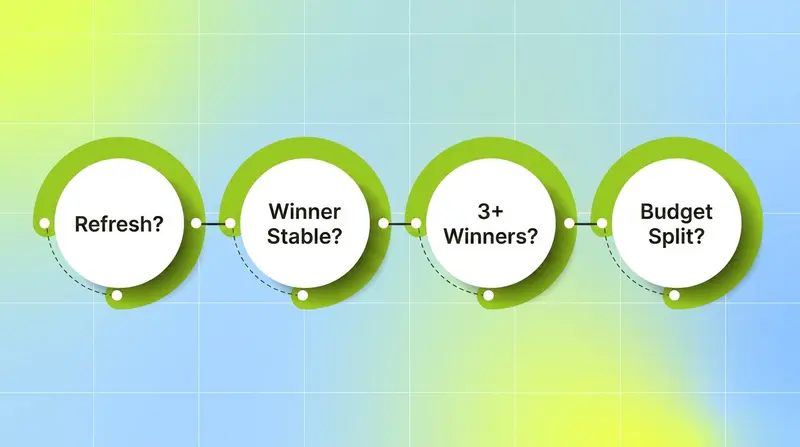
Run your situation through these checks in order. Stop at the first one that fits.
Read it as a funnel. First rule out a refresh masquerading as a test. Then confirm the winner is stable enough that a parallel test will not steal its momentum. Only then ask whether you have enough winners to justify CBO. And always sanity-check that you are not spreading a small budget too thin.
The thresholds are not arbitrary. Meta's own guidance is that delivery stabilizes once an ad set gathers roughly 50 optimization events in seven days (Wonderful). Below that, your cost per result is noise, not signal, so testing against an unstable winner tells you nothing.
Why You Test New Creatives Against New Creatives, Not Old Winners

This is the single most common small-budget mistake. You build a new creative, you are proud of it, and you want to know if it beats the champion. So you put them head to head.
The problem: your old winner has weeks of pixel optimization and delivery history. The new ad has none. Meta hands impressions to the proven ad because that is what the algorithm is built to do. AdsUploader calls this out directly, testing new creatives against old ones right away creates an unfair comparison because older ads carry accumulated data new ads cannot match (AdsUploader).
So the question is not "where do I test against the winner." It is "where do I test the new batch fairly." The answer is a separate ABO ad set where new creatives compete against each other, on equal footing, with a budget you control. Your winner keeps spending in its own ad set, untouched.
Once a new creative proves itself in that clean test, then it earns the right to scale alongside or replace the old winner. Not before.
Budget-Tiered Testing Structure ($50 to $500/Day)
Your budget decides how many ad sets you can realistically run. Spread too thin and nothing clears the learning phase. Here is a practical structure for small ABO operators. Treat the conversion math as directional, since your real numbers depend on your cost per result.
Two principles hold across every tier. First, get-ryze notes that starting with one or two ad sets at $25 to $50 a day until you find winners beats fragmenting budget, and produces meaningfully better early ROAS (Get Ryze). Second, give each creative enough spend to mean something. A creative that got $4 over two days did not "lose," it was never tested.
When to Move From ABO to CBO
CBO, which Meta now calls Advantage+ campaign budget, lets the algorithm distribute one campaign budget across ad sets based on predicted performance (AdsUploader). It is a scaling tool, not a discovery tool.
The trigger is simple. You move to CBO once you have three or more ad sets that each cleared the learning phase, with 50+ conversions in the last seven days and CPA at or under target. Below that bar, CBO has nothing reliable to optimize toward, and it will happily pour your budget into one ad set while starving the rest.
When you do migrate, build a fresh CBO campaign and move the proven winners into it. Do not convert your existing ABO campaign. Starting clean avoids inheriting learning-phase baggage, and a common approach is to seed the new CBO at roughly 1.5x to 2x the winners' combined budget so the algorithm has room to scale.
For a $50-a-day operator, this is usually a later-stage problem. You will spend weeks in ABO finding two or three real winners before CBO even makes sense. That is fine. CBO is where you go after you win, not how you win.
How "New Creative" Often Means "Refresh in Disguise"

Here is the trap that wrecks small-budget tests. You think you made a new creative. You actually made a variation of your winner: same hook, same format, swapped background, new caption. That is not a test of a new concept. It is a refresh of the existing one, and it belongs in the winning ad set, not a separate test.
Why it matters: if you open a fresh test ad set for what is really a refresh, you burn budget proving something you already knew. And you crowd out room for a genuinely different concept that could become your next winner. Jon Loomer's point about Meta rewarding real creative diversity, different formats, angles, and approaches, cuts both ways (Jon Loomer). Diversity only helps if the creatives are actually diverse.
The hard part is judging element overlap by eye, especially across a weekly batch. This is where element-level tagging earns its keep. Segwise uses multimodal AI to automatically tag every creative element, the hook, CTA, characters, visual style, on-screen text, and audio, then maps each tag to performance. So when you load a "new" creative, you can see at a glance that it shares 80%+ of the winning ad's tagged elements. That flags it as a refresh, not a test, before you waste an ad set on it. The same tag-to-metric mapping shows which elements actually drove the win, so your next batch varies the things that matter.
A Simple Weekly Workflow for Small ABO Accounts
Putting it together, here is a repeatable loop for a $50-to-$500 a day account dropping a fresh batch weekly.
Audit the batch. Before launch, check each new creative against your current winner. If it shares the hook, format, and 80%+ of elements, route it into the winning ad set as a refresh. Keep only the genuinely different ones for testing.
Confirm the winner is stable. Has it cleared ~50 events in 7 days with a steady cost per result? If not, hold the test and let it finish learning.
Open one clean ABO test ad set. Load 2-3 different new creatives. Give it $20-$30 a day on a $50 budget. New creatives compete against each other, never against the aged winner.
Wait for signal. Run 3-4 days minimum. Judge on cost per result and spend share, not day-one impressions.
Promote or kill. A clear winner from the test graduates to scale. The rest get cut. Document what won and why.
Stack toward CBO. Once three or more ad sets are proven winners, build a fresh CBO campaign to scale them together.
Conclusion
Where you place a new Meta ads creative is not a style choice, it is a sequence of checks. Confirm the new creative is genuinely different from your winner, not a refresh wearing a new caption. Confirm your winner has stabilized past the roughly 50-event learning threshold. Then, and only then, open a separate ABO ad set so the test stays clean and the winner keeps its momentum. Save CBO for when you have three or more proven winners to scale, because CBO concentrates budget on winners, it does not discover them.
For a small account, the discipline is the edge. You cannot afford muddy tests or fragmented budgets, so the decision tree keeps every dollar working. The hardest call, telling a real new concept from a disguised refresh, is also the easiest to get wrong by eye. Segwise's element tagging flags when a new creative shares 80%+ of your winning ad's elements, so you stop testing refreshes by accident and put your limited budget behind concepts that can actually become your next winner.
Frequently Asked Questions
Should I test new Meta ads creatives in my winning ad set or a new ad set?
Use a new ABO ad set if the creatives are genuinely different from your winner and the winner has stabilized past roughly 50 optimization events in 7 days. A separate ad set keeps the test fair, since a new creative in the winning ad set gets starved of impressions by the algorithm. Only add new creatives to the winning ad set when they are refreshes sharing the same hook and format. Tools like Segwise, alongside testing frameworks from agencies like Barefoot Performance, help you tell a real test from a refresh by tagging element overlap.
What does this mean for a $50-a-day advertiser specifically?
On $50 a day you cannot afford to fragment budget, so run one clean ABO test ad set at $20-$30 holding two or three genuinely different new creatives, while your winner keeps spending in its own set. Each creative gets roughly $8-$12 over the test, enough for directional signal if you run 3-4 days. Avoid spreading the budget across several ad sets, since none will gather enough events to clear Meta's learning phase. This focused approach beats scattered testing on small budgets (Get Ryze).
How do I know when to move from ABO to CBO?
Move to CBO once you have three or more ad sets that each cleared the learning phase, meaning 50+ conversions in the last 7 days with CPA at or under your target. Build a fresh CBO campaign and move the proven winners in, rather than converting your existing ABO campaign, to avoid inheriting learning-phase baggage. CBO scales winners, it does not find them, so do not migrate before you have stable performers. Below three proven ad sets, stay in ABO.
What's the difference between testing a new creative and refreshing a winner?
A new creative tests a genuinely different concept: a new hook, format, or angle that could become a separate winner. A refresh keeps the winning concept and swaps minor elements, like a background or caption, while sharing 80%+ of the original's tagged elements. Tests belong in a separate ABO ad set for a fair comparison. Refreshes belong in the winning ad set as fresh variations. Platforms like Segwise tag creative elements automatically, so you can measure overlap instead of guessing.
why does my new ad get no spend when I put it next to my winner
Because the winner already has delivery history and pixel data, so Meta's algorithm trusts it and hands it most of the impressions, leaving your new ad starved. This is expected behavior, not a bug. The fix is to test new creatives in their own ABO ad set with a fixed budget, where they compete against other new creatives on equal footing. Never judge a new creative by how it performs sharing an ad set with an aged winner.
how many creatives should I put in one test ad set on a small budget
Two or three genuinely different creatives per test ad set on a $50-a-day budget, so each gets enough spend to gather signal. Jon Loomer notes Meta now rewards creative diversity inside an ad set and removed the old six-ad limit, with top performers testing many ads per set, but that assumes larger budgets (Jon Loomer). On a small budget, fewer creatives with more spend each beats many creatives starved of data. Scale the count up as your budget grows toward $250-$500 a day.
How long should I run a creative test before picking a winner?
Run a test 3-4 days minimum on a small budget, and judge on cost per result and spend share rather than day-one impressions. The goal is enough optimization events to be meaningful, with Meta's stabilization guideline being roughly 50 events in a 7-day window (Wonderful). On very tight budgets you may not hit 50 events fast, so look for a clear, consistent gap in cost per result before deciding. Do not declare a winner after a few hundred impressions.