
Ad creative fatigue is the decline in an ad's performance that happens when your audience sees the same creative too many times. The ad still runs and still spends, but people stop responding to it. Click-through rate falls, cost per acquisition climbs, and your return on ad spend slips, even though nothing about your targeting or budget changed. In short, the creative wore out, and the metrics are telling you so.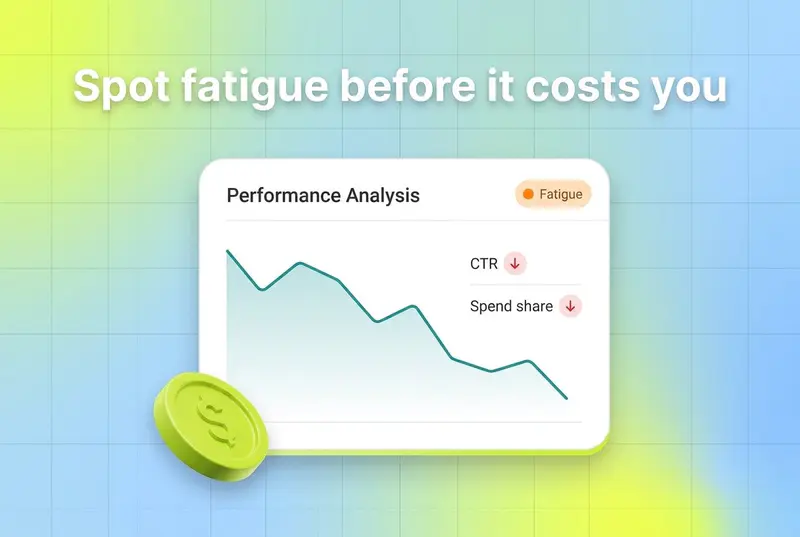
That definition sounds simple, but the consequences are not. Creative fatigue is the quiet leak in most ad accounts. It does not announce itself with a crash. It drifts down a few percent at a time, across dozens of creatives, on platforms that each measure it differently. By the time it is obvious in your headline numbers, you have usually already paid for it.
And the window is shrinking. Meta's Andromeda ranking system weights creative signals harder than the previous generation, so a concept that used to last six weeks now burns through its audience in two or three. More creatives, faster decay, and more platforms add up to a problem that a weekly manual scan cannot keep up with.
This guide explains what ad creative fatigue is, the signs that tell you it is happening, the causes behind it, and the fixes that actually work, with an emphasis on catching the slide early. It sits under our broader guide to ad creative fatigue, which covers detection, decay velocity, and refresh cadence in more depth.
Key takeaways
Ad creative fatigue is the performance decline that sets in when an audience sees the same creative too often. CTR falls, CPA rises, and ROAS slips while spend stays flat
Frequency is the earliest predictor. On Meta prospecting, the warning zone begins at a weekly frequency of 2.5 to 3.0, and performance falls off a cliff past 4.0
CTR decline is the clearest symptom. A 10 percent drop over seven days is an early flag, and a 20 percent drop over 14 days signals a serious problem.
Fatigue is not the same as a bad creative or audience saturation. If one ad declines while others stay healthy, it is creative fatigue, not saturation.
The cause is repeated exposure plus diminishing novelty. Meta's own analysis found that managing repeated exposures directly improves campaign outcomes.
The fix is early detection, not faster reaction. Spotting continuous performance decline and spend share drop before ROAS moves is what separates a cheap refresh from a wasted budget.
What ad creative fatigue actually means
Ad creative fatigue happens when an audience has seen an ad enough times that it stops working. The creative does not break in any technical sense. It fades into the background. People scroll past, click less, and convert less, while the platform keeps serving the ad and charging you for the impressions.
Singular puts it plainly: audiences will tune an ad out at some point, and modern ad platforms detect that stagnation through their own algorithms. The mechanics are consistent across accounts. Click-through rate drops first, conversion rate follows, and cost per acquisition rises, all while you spend the same money for less result.
This matters more in 2026 than it used to. Platform automation now runs your targeting and bidding, so the creative became the main lever a human still controls. When that creative wears out, you do not have a targeting dial to compensate with. You have a fresh-creative problem, and the only real fix is detecting the decline early enough to act.
Fatigue is a detection problem, not a creative problem
Every creative fatigues eventually, and that is fine. The trouble is that fatigue happens invisibly and gradually, and account-level reporting smooths it out of view. A creative does not flag its own decline. It loses a few percent of CTR per day, often across many creatives at once, and your campaign average hides all of it. The dashboard looks roughly fine right up until the slide is severe, and by then the budget waste has already happened. Making new creative is the easy half. Knowing exactly when to deploy it is the hard half.
The signs of ad creative fatigue
There is no single number that proves fatigue. The teams that catch it early watch a small set of signals together and look for them moving the wrong way at the same time. These are the ad fatigue early warning signals that matter most.
Rising frequency
Frequency is the average number of times each person in your audience has seen your ad, and it is the earliest and most reliable predictor. On Meta prospecting audiences, the warning zone begins around a weekly frequency of 2.5 to 3.0, with fatigue setting in past 3.0 and a critical threshold at 4.0. Retargeting audiences tolerate more, with a safe range closer to 4.0 to 6.0. The principle holds either way: the more often the same person sees the ad, the less they respond.
CTR decay
Click-through rate is the symptom you see first when frequency climbs. A 10 percent CTR drop over seven days is an early warning, and a 20 percent drop over 14 days points to a real problem. The decline matters more than the absolute number, because every creative starts from its own baseline. At high exposure the fall gets steep fast, with CTR dropping by roughly half once viewers hit five to eight impressions of the same ad.
Climbing CPM and CPA
As response weakens, the platform works harder to deliver results, so your costs rise. A 15 percent jump in CPA over seven days is an early flag, and a 30 percent climb over 14 days calls for immediate action. CPM tends to drift up alongside it, often 15 to 25 percent over two weeks once a creative is tired. The pattern to watch is flat or falling CTR paired with rising CPM, which means the system is paying more to put a fading ad in front of people.
Spend share drop
This signal is easy to miss because it is not a per-impression metric. Inside automated campaigns, the algorithm quietly shifts budget away from creatives it expects to underperform. So when a previously strong ad starts losing its share of spend, that is the system telling you it has lost faith in the creative before your dashboards show it. A continuous spend share drop is one of the cleanest early reads available, and it shows up sooner than ROAS does.
Read the signals together
Any one of these can be noise. A single bad day of CTR means nothing. Read together, though, they form a diagnosis. The most reliable read is several signals moving the wrong way at once over a 7 to 14 day window: frequency up, CTR down, CPC up, conversion flat or falling. That combination is fatigue, and catching it early is the entire game.
What causes ad creative fatigue
The root cause is simple to state and harder to manage: repeated exposure to the same creative erodes its impact. Meta's own analytics team found that actively managing repeated exposures improves campaign performance, which is another way of saying that unmanaged repetition is what drives the decline. A few specific forces push it along.
High frequency on a finite audience. The smaller or more tightly targeted the audience, the faster each person accumulates impressions. Narrow remarketing pools fatigue quickest.
Higher spend compressing the curve. Scaling budget forces frequency up faster. A creative that stays fresh for weeks at a modest budget can wear out in days once you pour spend into it.
Variety that only looks varied. Rotating ads that share the same hook, format, or visual style feels fresh to your team but reads as the same ad to the audience.
Platform pace. Fast-cycling feeds like TikTok and Instagram Stories saturate quicker than slower channels, so the same concept burns out on different timelines depending on where it runs.
Fatigue versus a bad creative versus saturation
These three get confused constantly, and the distinction changes your fix. A bad creative underperforms from day one, so its metrics are weak from launch. A fatigued creative performed well first and then declined as the audience saw it repeatedly, showing up as a downward slope from a strong baseline. Audience saturation is different again. As Polar Analytics explains, if one creative declines while others in the same ad set stay healthy, that is creative fatigue, and a fresh creative will fix it. If every creative declines at once, you have likely saturated the audience, and no new creative helps until you expand targeting.
How to fix and prevent ad creative fatigue
Fixing fatigue is less about reacting faster and more about catching the decline before it costs you. Here is a sane order of operations that focuses on early detection first.
1. Define your fatigue criteria
Decide in advance what fatigue looks like for your accounts, and write it down so detection is objective rather than a gut call. A common rule is a 20 percent ROAS decline over seven days, or a 25 percent CTR drop from the launch baseline with frequency above your tolerance. If you want to ground those thresholds in real numbers, our guide on how to measure creative fatigue walks through the metrics and benchmarks. Your thresholds will differ by platform and audience type, so set them per context, not as one universal number.
2. Monitor at the creative level, across every platform
Account averages hide fatigue, which is the whole reason it goes uncaught. You need each creative tracked individually, and you need that view unified across networks so a creative fatiguing on TikTok is not masked by one still winning on Meta. Multi-platform monitoring at the creative level is the foundation everything else sits on.
3. Watch spend share, not just CTR
CTR is the symptom most people watch, but continuous performance decline and spend share drop together are a stronger early signal than either alone. Track both per creative. When a creative is both losing engagement and losing budget share inside an automated campaign, you have your answer well before ROAS confirms it.
4. Get alerted instead of going looking
The point of early detection is that the system tells you before you would have noticed on your own. Manually checking frequency, CTR, CPM, and spend share across hundreds of creatives every day is not realistic, which is exactly why fatigue gets caught late. Alerts that reach you where you already work turn fatigue from something you discover into something you are warned about.
5. Keep refreshes ready, and refresh on triggers
Detection only pays off if you can act fast. Keep a pipeline of new creatives ready, ideally built from the elements your winners already proved, so a fatigue alert leads to a launch within days rather than weeks. Use the calendar to plan production capacity, but pull the trigger on performance: refresh when your thresholds fire, not when a date arrives.
Where Segwise fits
The hard part is not knowing the signals. It is watching them across every creative, on every platform, every day. That is the gap Segwise's automated fatigue detection is built to close. It monitors all your creatives across platforms for patterns of continuous performance decline and spend share drop, the two signals that show up before ROAS does. Because the monitoring is continuous and creative-level, fatigue does not get to hide inside an account average.
You set the rules. Custom fatigue criteria let you configure thresholds based on your own business logic, like a 20 percent ROAS decline over seven days, rather than a generic default. When a creative crosses your threshold, the early warning system alerts you before performance tanks, so you avoid the wasted budget that comes from finding out late. Multi-platform monitoring runs across every network you connect: Segwise unifies creative and performance data from 15+ ad networks and MMPs, including Meta, Google, TikTok, Snapchat, YouTube, AppLovin, Unity Ads, Mintegral, and IronSource, alongside the MMPs AppsFlyer, Adjust, Branch, and Singular. Alerts arrive by email and Slack.
To be clear about what it does and does not do: Segwise detects fatigue and alerts you. It does not pause ads or move budgets for you. The decision and the action stay with your team. The same creative intelligence that spots a fatiguing creative also knows which elements made it win, which is what you need to brief the replacement before the slide turns into wasted spend.
Restating the definition
If you take one thing from this guide, take this. Ad creative fatigue is the gradual performance decline that hits when an audience sees the same creative too many times, and it is fundamentally a timing problem, not a creative one. Every ad fades eventually. What costs you money is paying for the fade because nobody noticed it for two weeks. The teams that win are not the ones with fatigue-proof creative, which does not exist. They are the ones who detect the decline while it is still a 10 percent CTR dip and not yet a doubled CPA.
So watch frequency, CTR, CPM, and spend share together. Learn your real decay curve, which in 2026 is shorter than the old playbooks assume. Refresh on triggers, not just the calendar. And above all, monitor continuously, because fatigue hides in averages and moves faster than any weekly review can catch. If you want that monitoring to run in the background instead of on your to-do list, Segwise watches every creative for continuous performance decline and spend share drop, lets you set custom fatigue criteria, and alerts you by email and Slack before budget burns.
Frequently asked questions
What is ad creative fatigue?
Ad creative fatigue is the gradual decline in an ad's performance that happens when an audience sees the same creative too many times. Click-through rate falls, conversion rate slides, and cost per acquisition rises, while the platform keeps spending on the ad. It is best understood as a detection problem, because the decline is slow and easy to miss until budget has already been wasted, which is why early-warning monitoring across every creative matters more than any single threshold.
What are the signs of creative fatigue?
The clearest signs are several metrics moving the wrong way together: rising frequency, falling CTR, climbing CPM and CPA, and a drop in a creative's share of spend inside automated campaigns. A week-over-week CTR drop of 10 percent is an early flag, and a 20 percent drop over two weeks is a serious one. No single metric is reliable on its own, so the strongest read is the combination over a 7 to 14 day window.
What causes ad creative fatigue?
The root cause is repeated exposure: the more often the same person sees an ad, the less they respond to it. Frequency builds faster on small or tightly targeted audiences, and higher budgets accelerate it further. Rotating ads that share the same hook or visual style also contributes, because audiences read them as the same ad even when your team sees variety. Faster-paced platforms like TikTok saturate quicker than slower channels.
what's the difference between ad fatigue and a bad creative?
A bad creative underperforms from the day it launches, so its metrics are weak from the start. A fatigued creative performed well first and then declined over time as the audience saw it repeatedly. The tell is the trend: fatigue shows up as a downward slope from a strong baseline, usually alongside rising frequency, while a bad creative never had a strong baseline to slope down from.
How do I fix creative fatigue once I spot it?
The direct fix is refreshing the creative, but the bigger win is catching the decline early so the fix is cheap. Define your fatigue thresholds in advance, monitor each creative individually across all platforms, and watch spend share alongside CTR. When a creative crosses your threshold, replace it with a fresh variation built from the elements your winners already proved, so the refresh launches in days rather than weeks.
Can ad creative fatigue detection be automated?
Yes, and at any real scale it has to be. Manually checking frequency, CTR, CPM, and spend share across hundreds of creatives on multiple platforms every day is not practical, which is exactly why fatigue gets caught late. Segwise provides automated fatigue detection across 15+ ad networks and MMPs, monitoring every creative continuously for continuous performance decline and spend share drop, then sending early-warning alerts by email and Slack so you act before budget is wasted.