
A creative strategist decides what ad creative to make next and why, using performance data to turn campaign results into briefs the creative team can run with. The role sits between the analytics and the designers: it reads which hooks, formats, and messages are working, researches competitors and the audience, then writes the briefs and runs the tests that decide what ships. In 2026, AI now does the slow half of that job, the data wrangling and tagging, while the strategist keeps the judgment.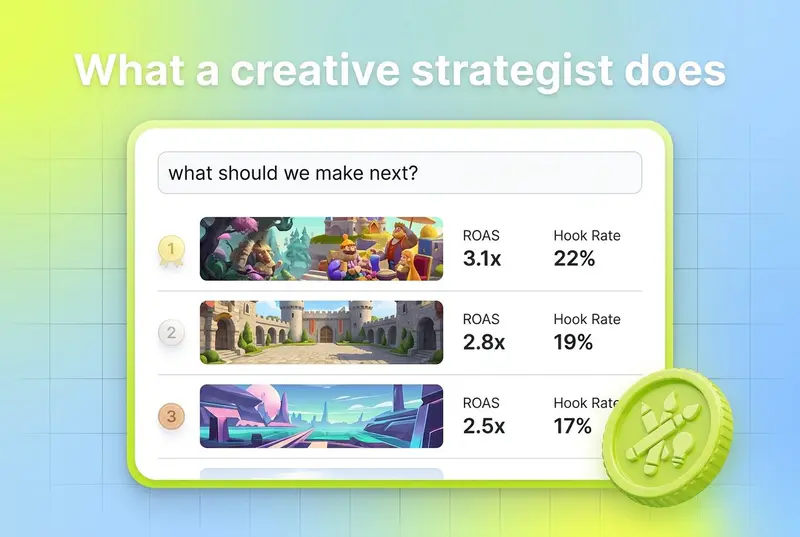
Ask ten people what a creative strategist does and you will get ten answers, most of them vague. Part of the confusion is that the role changed faster than the job descriptions did. Five years ago it leaned creative: concepts, mood boards, big ideas. Today, at any performance-marketing shop, it leans analytical, and the best ones live as much in the data as in the deck.
The short version: a creative strategist owns the system a team uses to answer one question on repeat, what should we make next, and why. According to Indeed, the role covers studying audience behavior, industry trends, and competitor strategies, then applying those insights to campaign planning and tracking KPIs like engagement, conversion, and ROI. That is a lot of distinct jobs under one title, which is exactly why people struggle to define it.
What makes 2026 different is AI. The parts of the role that used to eat the week, pulling data from five dashboards, tagging creatives by hand, building reports, are now automated. That does not shrink the role. It moves the strategist back to the work that needs a human: forming hypotheses, interpreting the data, and deciding which bet to make. This post breaks down the real responsibilities, a realistic day, the skills that matter, and the line between what AI now handles and what stays human.
Key takeaways
A creative strategist decides what creative to make next and why, translating performance data into briefs, per Indeed's breakdown of the role's research, planning, and KPI-tracking duties.
The core responsibilities cluster into five jobs: audience and competitor research, performance analysis, brief writing, creative testing, and campaign oversight, according to role guides from magicbrief.
It pays like a senior role. As of June 2026, the average US creative strategist earns about $92,879 a year, with top earners near $135,500.
The role moved to the center because creative drives results. Westwood One reports creative drives about half of sales effect versus 9% for targeting, while marketers credit creative at just 19%.
AI now automates the slow half: data consolidation, element-level tagging, pattern detection, and first-draft production, leaving the strategist the hypotheses and the judgment.
The new bottleneck is not production, it is intelligence: knowing what to make and what worked. A modern creative strategist needs a system that closes that feedback loop fast.
What a creative strategist actually does
A creative strategist is the person who owns the decision of what to make next. They are not the designer and not the media buyer. They sit between them, reading what performance reveals and turning it into direction the creative team can execute.
That position is why the role is a hybrid. It is analytical enough to read a Meta breakdown by creative and tell whether an ad is fatiguing or the audience is saturating. It is creative enough to know what a winning hook feels like before the numbers confirm it. And it is clear enough to hand both to a production team without the intent getting lost. Job descriptions for the role now read like that hybrid on purpose.
Here is the thing most definitions miss. The job is not to have good ideas. It is to run a repeatable system that produces good ideas backed by evidence, then proves or kills them fast. A great strategist with no system gets lucky sometimes. A decent strategist with a tight loop wins consistently. The system is the job.
The core responsibilities, broken down
Strip away the title inflation and the role comes down to five recurring jobs. Most role guides map to roughly these:
Audience and competitor research
The strategist studies who the audience is and what they respond to, then watches what competitors are running. This is where messaging angles come from. Market research and competitor analysis as foundational duties, and in performance marketing that means tracking competitor ads to spot which angles are saturated and which are open.
Performance analysis
After ads launch, the strategist reads the results at the creative level, not just the campaign level. Which hooks held attention, which CTAs converted, which formats fatigued. This is the analytical core, and it is where most of the role's leverage lives. Reading a campaign average tells you nothing about what to make next. Reading by element does.
Brief writing
The output of analysis is a brief. A good one is specific and falsifiable: it states the segment, the message, the hook type, the format, a reference, and the success metric. Vague mood-board briefs are how teams burn production hours on guesses. The strategist's brief is the document the whole creative team runs on, which is why the strongest teams write data-backed creative briefs grounded in element-level results rather than hunches.
Creative testing
The strategist designs the tests that prove or kill a hypothesis. That means isolating one variable at a time so a result actually teaches something. It also means setting success criteria up front, so a new creative is judged against a target rather than a vibe. Sequencing those tests into a creative testing roadmap keeps the learning compounding instead of one-off.
Campaign and creative oversight
Finally, they manage the work end to end: multiple concepts in flight, multiple teams, and the loop from brief to launch to result. The role oversees execution from start to finish and tracks the KPIs that say whether it worked.
This is senior work, and it is paid like it. As of June 2026, the average US creative strategist earns about $92,879 a year, with the typical range running from roughly $68,500 to $103,000 and top earners near $135,500.
A day in the life
Titles are abstract. A day is concrete. Here is the role when the week runs well versus when it does not.
The bad version, still the common one, goes like this. The strategist opens Meta Ads Manager, exports a creative breakdown, does the same in TikTok, then the MMP, and starts reconciling three tools that count things differently. By the time the data is clean enough to trust, half the day is gone. They eyeball what looks like a winner, write a brief from a hunch, and move on. The thinking, the part they were hired for, got squeezed into whatever time was left.
The good version flips the ratio. The data is already unified and tagged in the background, so the strategist starts the day asking what moved, what is fatiguing, and which new creatives are hitting target. The answers form a hypothesis, the hypothesis becomes a brief, often informed by comparing two near-identical ads to isolate exactly which change drove the difference. The brief ships, the new creatives get tracked, and the loop closes. Same person, same talent, completely different output. The difference is not effort. It is whether the plumbing runs itself.
The skills that actually matter
The role rewards a specific blend, and it is rarer than it sounds.
Data literacy comes first now. The strategist has to read creative-level performance and know the difference between a fatiguing creative and a saturating audience. Comfort with analytics is non-negotiable, which is why role guides consistently list it as a core requirement.
Then comes creative judgment. Numbers tell you what happened, not why, and not what to try next. A strategist who can only read dashboards produces safe, derivative work. The good ones pair the data with a feel for what makes a hook land.
Communication carries the rest. The whole role is translation: turning a pattern in the data into a brief a designer can execute, and turning a result into a recommendation a growth lead can act on. If the brief is fuzzy, the creative is fuzzy. Clear writing is a performance lever here, not a soft skill.
What AI now automates, and what stays human
This is the part of the role that changed most. AI did not replace the creative strategist. It ate the slow half of the job and handed the time back.
On the automation side, AI now handles the work that used to fill the week. It consolidates performance data across networks and MMPs into one view. It tags every creative at the element level, hooks, CTAs, emotions, formats, and connects each tag to real performance, which is exactly the data wrangling that used to be manual. AI automatically tags every asset at the element level and ties it to performance across channels. It detects fatigue patterns, surfaces what is winning, and even drafts first-pass creative at volume, since the production bottleneck is largely solved.
What stays human is the part that was always the actual job. AI does not understand your brand's positioning, the nuance in your messaging, or which hypothesis is worth a real bet. As industry coverage of the shift notes, AI automates data consolidation, pattern detection, and iteration, but the human role moves to defining the narrative, forming high-impact hypotheses, and interpreting AI-generated insights to steer the work. The new bottleneck, is intelligence: knowing what to make, what worked, and what to iterate next. That is judgment, and judgment does not automate.
Put plainly: AI is the analyst that never sleeps and never gets tired of tagging. The strategist is the one who decides what the analysis means and what to do about it. The clean line is that AI builds the map; the strategist picks the route.
That is also where a tool like Segwise fits the role. Its Creative Strategy Agent is an always-on creative strategist that holds full context across all your creative data: performance numbers, tag insights, competitor data, custom metrics, fatigue patterns, and asset clusters. The agent powers AI Chat, a creative strategy command center where you ask questions in plain language and get an answer with full account context. Worth being precise about the boundary: the Creative Strategy Agent answers questions, builds reports, tracks fatigue, and clusters assets. It does not manage campaigns or place bids. It is the intelligence layer that informs the strategist's decisions, not the bidding tool that executes them.
Why the role matters more than it used to
Why did this role move to the center of performance marketing? The answer is structural. As platforms automated targeting and bidding, the creative became the main lever a human still controls, and the person who decides what to make next became one of the most leveraged hires on the team.
The data backs it. Creative drives roughly half of a campaign's sales effect while targeting accounts for only 9%, yet marketers still credit creative at just 19%. So the modern creative strategist is exactly what the thesis says: the person who decides what creative to make next and why, now backed by AI that handles the data wrangling so the human can focus on the thinking. For how this fits into a broader system, see our guide to AI creative strategy, and for the measurement layer underneath it, unified creative analytics.
Conclusion
A creative strategist decides what to make next and why, and in 2026 that decision is backed by data instead of instinct. The role pulls together five jobs, research, analysis, brief writing, testing, and oversight, into one system built to answer the make-next question with evidence and speed.
What changed is the split of the work. The slow half, unifying data and tagging creatives, is now automated, which hands the strategist back the time for the half that needs a human: the hypotheses, the interpretation, and the judgment. If you want to give your creative strategy an always-on analyst that holds full context across your account and answers in plain language, Segwise unifies your creative data across 15+ ad networks and MMPs, tags every element automatically, and saves teams up to 20 hours a week while helping them improve ROAS by up to 50%.
Frequently asked questions
What does a creative strategist do?
A creative strategist decides what ad creative a team should make next and why, using performance data to turn campaign results into briefs the creative team executes. The role spans audience and competitor research, creative-level performance analysis, brief writing, creative testing, and campaign oversight. It also involves tracking KPIs like engagement, conversion, and ROI to judge whether the strategy worked.
What is the difference between a creative strategist and a graphic designer?
A graphic designer produces the creative; a creative strategist decides what creative to produce and why. The strategist reads performance data, researches the audience and competitors, and writes the brief; the designer turns that brief into the actual ad. They work closely together, but one owns the direction and the other owns the execution.
How much does a creative strategist make?
As of June 2026, the average creative strategist in the United States earns about $92,879 a year, with the typical range running from roughly $68,500 to $103,000. Top earners reach around $135,500. Pay rises with seniority and with performance-marketing experience, since the role increasingly requires data literacy alongside creative judgment.
what skills do I need to become a creative strategist
You need three things together: data literacy to read creative-level performance, creative judgment to know what makes a hook work, and clear communication to turn both into briefs. Comfort with analytics tools is now non-negotiable, since the role is as analytical as it is creative. The rarer combination is being genuinely strong on both the data side and the creative side at once.
does AI replace creative strategists
No, but it changes the job. AI now automates the slow half of the role, data consolidation, element-level tagging, pattern detection, and first-draft production, which frees the strategist to focus on hypotheses and interpretation. The new bottleneck is intelligence, knowing what to make and what worked, and that judgment stays human. AI is the analyst; the strategist still decides.
What does AI automate for a creative strategist, specifically?
AI handles unifying performance data across networks and MMPs, tagging every creative at the element level, mapping each tag to performance, detecting fatigue, and drafting creative at volume. What it does not do is understand your brand positioning, choose which hypothesis is worth a real bet, or interpret what a pattern means for your strategy. A platform like Segwise's Creative Strategy Agent automates the analysis and answers questions in plain language, but it does not manage campaigns or place bids, those decisions stay with the strategist.