
The best VidMob alternatives in 2026 are Segwise for mobile apps and games that judge creative on MMP data, Motion, Atria or Superads for DTC teams on Meta and TikTok, Hawky for agents that act on Meta and Google, and CreativeX for brand governance. VidMob publishes no dollar price; six of these nine do.
The gap most app and game teams hit is that VidMob scores ads against brand rules and ad-platform KPIs, while its 13 channels skip AppLovin and Unity and we found no MMP connector. Segwise is an AI creative analytics and creative generation platform that tags every element of your ads on networks like AppLovin, Unity and Meta and joins each tag to installs and D7 ROAS from your MMP, so you can see which hooks and end cards earn money and build the next round from them.
If you can't see which hooks, visuals or messages drive performance, every new creative brief becomes a guess. VidMob is a strong enterprise answer to that problem. It is also priced and built for global brand portfolios, which is why many app, game and DTC teams look elsewhere. This guide compares nine creative analytics tools that do the same job, with prices read from each vendor's own site on November 6, 2026.
TL;DR
- Mobile games and apps: Segwise. It connects AppLovin (Axon), Unity, Mintegral and Moloco plus AppsFlyer, Adjust, Branch, Singular and Kochava, plays and tags playables, and helps you make new ads from your winners.
- DTC paid social with a published price: Superads (from $150/month), Atria (Core from $159/month) or Motion ($999/month, capped at $50K of spend).
- AI agents that also run media: Hawky, sold per brand through sales.
- Larger multi-channel spenders: GetCrux, whose Starter plan is $1,500/month.
- Brand governance at global scale: CreativeX, the closest like-for-like swap for VidMob's scoring.
- Research first, analytics second: Foreplay (Lens from the Workflow plan) or AdSkate (synthetic-audience pre-testing).
- Stay on VidMob if you manage several global brands across Amazon, DV360 and DSPs and need brand-guideline scoring more than install-level data.
What is VidMob, and where does it fall short?
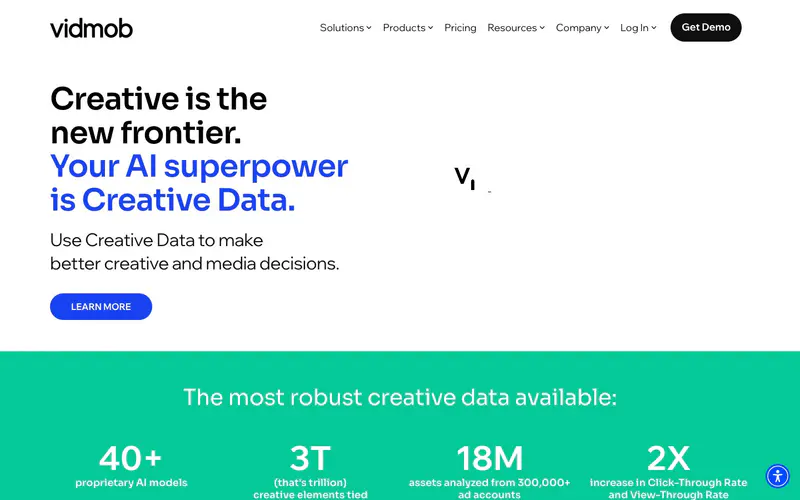
VidMob calls itself "the creative data company". It scores ads against your brand guidelines and platform best practices, links creative elements to ad platform KPIs, and sells to large brands and agencies. Its homepage says it has analysed 18M assets from 300,000+ ad accounts with 40+ proprietary AI models.
Who are VidMob's customers?
VidMob's own customer stories name Kroger (with MMA Global), Kellanova, Marriott, Corona and Neon. Its Creative Scoring page quotes L'Oréal's media and data director, and its pricing page shows Coca-Cola, Mars, Kellanova and L'Oréal logos. That list tells you who VidMob is built for: consumer brands with many markets and a brand book to enforce.
What changed at VidMob in 2026?
In June 2026 VidMob launched Vidmob360, which it describes as "a composable intelligence layer, not another destination app". Phase one is live: an MCP server and a REST API that let Claude, ChatGPT, Gemini or any MCP client query your VidMob data. VidMob's own FAQ says Vidmob360 is "an access layer on top of Vidmob's platform, not a separate product". A Recommendation Engine and Vidmob Agents are listed as "in testing".
Inside the app, an AI assistant called Maddie writes a daily briefing on a redesigned Home page, and a cross-channel Campaign Manager shipped in the September 2026 release notes. The October 2026 update added aggregate reporting tools to the MCP (KPI performance by campaign, ad or asset, scoring rollups and attributes ranked by lift) and saved, shareable Campaign Manager reports.
Key features:
- Creative Scoring: checks every asset against brand and platform best practices, before launch (Pre-test) and in flight.
- Creative Analytics: links creative attributes to performance by audience, region and platform, with an Element Impact report.
- Creative Decay: a Home page widget that lists assets that have fallen about 15% below their own peak and are still declining.
- 13 channels: Meta, Amazon Sponsored Ads, Amazon DSP, Google Ads, DV360, Pinterest, LinkedIn, TikTok, X, Snapchat, Reddit, The Trade Desk and Yahoo DSP.
- Creative Data API and exports for BI tools, marketing mix models and DCO, plus Influencer Intelligence for creator content.
Where VidMob falls short for performance teams
1. No mobile app ad networks. VidMob's 13 channels do not include AppLovin (Axon), Unity Ads, Mintegral, Moloco or Liftoff. For a game studio, that is often most of the spend.
2. No MMP connector found. We found no AppsFlyer, Adjust, Branch, Singular or Kochava integration on VidMob's site; its help center says KPIs are "pulled in directly from VidMob's integration with each platform API". Without MMP data you can't tie a hook or a character to installs that retain or pay by day 7.
3. Fatigue is a widget, not an alert rule. VidMob shows decaying assets on its Home page. We found no page describing fatigue thresholds you set yourself or Slack and email alerts when an ad crosses them, which is how most UA teams catch creative fatigue in time.
4. Playables are supported, but not played. VidMob lists playable ads as a supported Meta and TikTok ad type. We found no page describing analysis of what happens inside a playable: the core mechanic, the tutorial or the end card.
5. No published price. VidMob now has a pricing page, but it shows package names, not dollars, as the pricing section below explains.
6. Production is human, not AI. VidMob's Creative Studio delivers ads made by "expert creators" in its Creative Network, with a first draft in 5 to 7 business days. We found no VidMob page describing AI generation of finished ads from your winning patterns.
None of this makes VidMob a weak product. It is built for a global brand team that cares about guideline compliance across many channels. The tools below fit teams whose problem is different: what to make next, on which network, measured on revenue.
How much does VidMob cost?
VidMob does not publish a dollar price. Its pricing page, read on November 6, 2026, says packages are "priced per brand, based on each brand's annual impression volume, not seats or users", in three tiers:
| VidMob package | Impressions per brand per year |
|---|---|
| Slate | Up to 1B |
| Portfolio | 1B to 10B |
| Premier | 10B+ |
Every package includes the full platform, the Maddie AI assistant, a dedicated account manager and all 13 channels. There is also a one-time model activation that trains on 13 months of your history, scoped per account, and agencies get tailored multi-brand pricing. You request a quote and VidMob promises a package recommendation within one business day. We found no self-serve plan or free trial.
What this means for a buyer: a single-brand app or DTC company pays for a package sized to impressions, not to the number of creatives or networks it actually needs analysed. If you run one brand on five networks, a spend-banded tool with a public price is easier to budget.
VidMob alternatives at a glance
| Tool | Best for | Key strength | Price (read Nov 6, 2026) |
|---|---|---|---|
| Segwise | Mobile games, apps and DTC teams that need MMP data | Element-level tagging across 15+ networks and 5 MMPs, playable tagging, generation from winners | From $999/mo ($499 for startups under $50K spend) |
| Motion | DTC brands and agencies on Meta | Runneth AI agent, AI tags, ad leaderboard | $999/mo Starter (to $50K spend); Pro and Growth on request |
| Hawky | Teams that want agents to act on Meta, Google and TikTok | Element analysis plus media-buying and creative agents | Talk to sales, per brand |
| GetCrux | Larger spenders on many channels | Creative OS with Copilot, generation, pre-flight on Professional | $1,500/mo Starter (to $100K spend) |
| Atria | Ecommerce brands running Meta ads | Radar grades, ad library, image and video ad generation | Core $159/mo, or $129/mo billed annually |
| Superads | Lean paid social teams wanting low-cost analytics | Superads Scores and AI chat across Meta, Google, TikTok, LinkedIn | $150/mo, or $125/mo billed yearly |
| Foreplay | Agencies doing research and briefs | Swipe files, Spyder, Lens analytics | $59 to $459/mo; Lens from Workflow |
| CreativeX | Global brand governance | Creative Quality Score and Creative Salience | Not published |
| AdSkate | Pre-launch testing with synthetic audiences | 1,000+ synthetic audiences, AdSkate GPT | Not published, subscription tiers |

For the wider category, see our guide to the top creative analytics tools, and if you run an agency, our list of creative analytics tools for agencies.
What a year costs at the entry tier
This is the math the top results skip. Monthly billing, read on each vendor's pricing page on November 6, 2026:
| Tool | Entry price | Year at entry tier | Monthly ad spend the entry tier covers |
|---|---|---|---|
| Superads | $150/mo | $1,800 | $100K |
| Atria Core | $159/mo | $1,908 | $500K analysed |
| Foreplay Workflow | $175/mo | $2,100 | No spend limit (Lens on 1 brand) |
| Segwise | From $999/mo ($499 for startups under $50K spend) | $11,988 | $250K |
| Motion Starter | $999/mo | $11,988 | $50K |
| GetCrux Starter | $1,500/mo | $18,000 | $100K |
| VidMob, Hawky, CreativeX, AdSkate | Not published | Quote only | Set in the quote |
Cheapest is not the same as best value. Superads, Atria and Foreplay cover Meta-first paid social and list no MMP. If you need AppLovin or Unity data and post-install revenue in the same view, the comparison that matters is Segwise against VidMob, Hawky and GetCrux, and of those only Segwise and GetCrux publish an entry price.
How to choose: a decision rule
These are rules of thumb, not laws. Count how many of these five are true for you:
- You buy on at least one mobile network: AppLovin (Axon), Unity, Mintegral or Moloco.
- You judge creative on MMP data such as D7 ROAS or retention, not platform clicks.
- You run playable ads.
- You launch more than 20 new creatives a month across two or more networks.
- You need new ads every week, not only reports.
Which tool fits your count?
- Two or more true: shortlist Segwise first. Those five are the gaps VidMob and most DTC tools leave open.
- None true, and you are DTC on Meta and TikTok: Motion, Atria or Superads. Spend under $100K a month points to Superads or Atria on price; Motion's $999 Starter caps at $50K.
- You want software to change bids and budgets too: Hawky.
- You manage several global brands and care most about guideline compliance: CreativeX, or stay on VidMob.
When you don't need a paid tool yet
If you spend under about $10K a month on one network and launch fewer than ten new creatives a month, Ads Manager breakdowns and a tagged spreadsheet will do. Revisit the count when you add a second network or an MMP.
The 9 best VidMob alternatives in 2026
1. Segwise

Segwise is an AI creative analytics and creative generation platform for mobile game studios, subscription apps, DTC brands and performance agencies. It tags every element of every ad, maps each tag to your performance data, and helps your team make the next round of ads from what is already working.
Best for: UA and creative teams running several networks with an MMP, especially in mobile gaming, where VidMob's channel list stops short.
Key features:
- AI creative tagging: multimodal AI tags video, audio, image, text and playables, including hook dialogue, characters, colours and CTAs. You get 20+ standard tags, custom tags, and tags pulled from your file-naming conventions, each mapped to IPM, CTR, CPA and ROAS.
- Playables, played through: Segwise is the only platform that tags playable ad elements. It plays each playable end to end and tags the core mechanic, tutorial style, hook scene, end card and CTA. VidMob supports playables as an ad type; this is the layer inside them.
- 15+ ad networks and five MMPs: Meta, Google Ads (including YouTube), TikTok, Snapchat, AppLovin (Axon), Unity, Mintegral, Moloco, Liftoff, Reddit, LinkedIn and more, plus AppsFlyer, Adjust, Branch, Singular and Kochava. Setup is no-code: some networks sign in with OAuth, while AppLovin, Unity, Mintegral and Moloco take an API key from that network's dashboard. The integration docs cover every connector.
- Fatigue tracking on your rules: set a threshold such as a 20% ROAS decline over 7 days and get alerts by email and Slack, per network or across all of them. You can also set success criteria for new creatives, such as a ROAS or CPI target.
- Pre-flight Testing: upload up to 10 images or short videos and get a score out of 100, a run-or-hold verdict and the winning ads it compared against, before any spend.
- Competitor tracking: tags competitors' ads from the Meta, TikTok, LinkedIn and Google ad libraries in one place, with gap reports on the elements they lean on.
- Creative Strategy Agent: an AI chat grounded in your creative data. Ask which hook style drove the most installs last month and get charts and rankings, or a shareable report.
- Creative generation from your winners: the Creative Generation Agent lets you make statics and videos up to 30 seconds, including AI UGC-style ads, from your own winning patterns, with exports sized for each network. Playables and CTV spots come as managed services that the Segwise team finishes.
- Segwise MCP: a server, available on request through your account manager, so you can query your Segwise data from Claude, ChatGPT, Cursor or Codex. It is the closest match to VidMob's MCP, though it can't generate ads or change your campaigns or ad data.
You can use each agent on its own, or do it all in one place by chatting with the Segwise agent: ask how your ads are performing, see what competitors are running, and make new ads from your winners.

See your own hooks ranked: Segwise lets you connect your networks and MMP and see every hook ranked by D7 ROAS like the view above. Book a demo.

Pricing: Segwise starts at $999/month for advertisers spending up to $250K/month; startups spending under $50K/month pay $499/month (limited eligibility). Segwise imports up to 3 months of history.
Results customers report: golf game WGT says its early concept-to-test cycle went from 2 to 3 weeks down to 2 to 3 days, and rewards app Influence Mobile reports D7 ROAS up 10%, according to the Segwise case studies page.
Limitations: Segwise does not score ads against brand guidelines the way VidMob and CreativeX do; its pre-flight compares against your own winners and needs connected ad network data to do it. Playable and CTV generation are managed services, not a self-serve builder. The MCP is on request and can't change your campaigns or ad data. If most of your spend sits in retail media and DSPs, check the integration list against VidMob's 13 channels first.
For a head-to-head on enterprise scaling, see our Segwise vs VidMob comparison.
2. Motion

Motion is the creative analytics tool DTC brands and agencies most often shortlist. In 2026 it rebuilt itself around Runneth, an always-on AI agent on a dedicated virtual machine that is included in every paid plan. Runneth answers in Slack, ships briefs, hooks and reports, and runs scheduled routines and alerts.
Best for: DTC brands and performance agencies on Meta that want an AI analyst inside Slack and a public price.
Key features:
- Ad leaderboard and creative analytics across Meta, TikTok, YouTube and LinkedIn.
- AI tags in four categories (visual, persona, messaging and more), on Meta creatives.
- Routines: daily and weekly reports, iteration finders and alerts.
- Inspo for competitor research and benchmarks, on paid plans.
- A read-only MCP server, which supports Meta only for now.
Pricing: Starter is $999/month for up to $50K monthly ad spend. Pro (over $50K) and Growth (over $125K) are "Let's chat". Motion's help center says the free trial runs 14 days and no credit card is taken before it starts.
Limitations: Motion lists no MMP integration; its attribution integrations are Google Analytics 4 and Northbeam, on Pro and up. It does not list AppLovin, Unity or other game networks, or playable support, and its AI tagging runs on Meta only. The Starter price only covers $50K of spend, so a growing brand moves to a quote quickly.
3. Hawky

Hawky sells itself as an "agentic performance marketing platform". Two always-on agents and a Copilot sit on top of element-level creative analysis: a Performance Agent that buys media against your KPI on Meta, Google, YouTube and TikTok, and a Creative Agent that makes more of what is already winning.
Best for: performance teams on Meta, Google and TikTok who want software to act on the analysis, not just report it.
Key features:
- Element-level analysis that takes each ad apart into hook, frames, copy, audio and CTA, and scores each element against your winners.
- Pre-launch scoring of draft creatives, and fatigue alerts that name the element causing the drop.
- Creative generation from your winners on every tier, plus Hawky Studio for on-brand images and video.
- Revenue attribution through CRM, GA4 and MMPs; AppsFlyer is the MMP Hawky names.
Pricing: every tier (Dashboards, Ask, Auto-pilot) is "Talk to sales". Hawky says pricing "is per brand and scales with how much you use", meaning creative volume and questions asked, with no per-seat fees.
Limitations: no published price and no self-serve sign-up. Its pages list Meta, Google (including YouTube) and TikTok, with none of the app-install networks such as AppLovin or Unity, and no playables. The Copilot is not in the entry Dashboards tier, and the autonomous agents sit on Auto-pilot only.
4. GetCrux

GetCrux calls itself a "Creative OS" for creative insights, competitor intel and ad generation. It pairs AI tagging and a Copilot chat with creative generation.
Best for: larger advertisers who want analysis, competitor research and generation from one vendor, and who spend enough to reach the Professional tier.
Key features:
- AI tagging across 15 creative dimensions, plus fatigue monitoring you can customise by KPI, channel and threshold.
- Copilot on every plan, with a choice of GPT, Claude, Llama or Gemini.
- Creative generation; Starter includes 1,000 generation credits.
- Competitor monitoring across Meta, TikTok, Google, YouTube, LinkedIn, X and Snapchat.
Pricing: Starter is $1,500/month for up to $100K monthly ad spend. Professional ($100K to $1M) and Enterprise ($1M+) are custom. You start with a 30-minute call with the founders; no free plan is listed.
Limitations: Starter connects up to 2 ad accounts on Meta, Google, TikTok and LinkedIn only. AppLovin, MMP and other custom data integrations, MCP and Creative Pre-Flight Testing all sit on Professional. GetCrux lists no playable tagging and does not name Unity or Mintegral (its reporting page does list AppLovin and Moloco).
5. Atria

Atria helps ecommerce brands and agencies decide what to make next. It combines Meta and TikTok analytics with an ad library, competitor following, review mining and image and video ad generation, run through its AI teammate, Raya, and its Ad Maker.
Best for: DTC and ecommerce brands that live on Meta and want research, grading and new image and video ads in one self-serve tool.
Key features:
- Radar, a "24/7 AI strategist" that grades your recent ads on every plan.
- AI creative tags and custom tags.
- A large ad library and following of 50 to 200 brands depending on plan.
- AI image generation, concepts, scripts and copy, plus review mining, and Ad Maker, which makes image and video ads from your AI agent "from a brief, a script or your own media".
- An MCP server and a REST API on every plan.
Pricing: Core is $159/month billed monthly or $129/month billed annually, for up to $500K of analysed ad spend. Plus is $599/month billed monthly or $479/month billed annually at its standard price (Plus is on a temporary "Black Friday Cyber Monday" promo at $343/mo yearly as of November 6, 2026), and Business is $1,199/month billed monthly or $959/month annually. Enterprise is custom, and there is a free plan.
Limitations: analytics covers Meta and TikTok accounts. Atria names Triple Whale and Northbeam for attribution and no MMP, lists no app networks such as AppLovin and no playables, and gates custom metrics to Business.
6. Superads

Superads is a creative analytics and reporting tool built by the creative services company Superside. It auto-tags ads by visual format, hook, product and angle, and scores each one against your other ads.
Best for: lean paid social teams and agencies that want AI tagging and reporting at a low, public price.
Key features:
- Superads Scores from 0 to 100 for Hook, Hold, Click, Engagement and Conversion, ranked against your own ads.
- Superads AI chat over your ad data, with Workflows that deliver scheduled insights to Slack or email.
- Reports that combine several ad accounts and platforms: Meta, Google Ads, TikTok and LinkedIn.
- Competitor tracking and creative research through its Inspiration feature.
Pricing: Professional is $150/month, or $125/month billed yearly ($1,500), for up to $100K monthly ad spend, plus $100/month per extra $100K. A 14-day free trial is offered, and Enterprise is custom for $1M+ spend.
Limitations: Superads says it "does not generate ad creatives". It lists no mobile game networks and no MMP, and we found no page describing scoring of an unlaunched creative.
7. Foreplay

Foreplay is a research-first suite for performance marketers and agencies. You save ads into swipe files, track competitors with Spyder, write AI briefs and storyboards, and analyse your own ads with Lens.
Best for: agencies and DTC teams whose main job is finding angles and writing briefs, with light reporting on top.
Key features:
- Swipe File and Discovery for saving and searching a 200M+ ad database.
- Spyder tracks competitors' Meta ads around the clock, with up to 3 years of history.
- Lens: creative analytics for your own Meta and TikTok ad accounts, with Foreplay Creative Scores and shareable reports.
- Briefs: AI scripts and storyboards, plus an MCP server and API.
Pricing: Basic $59/month, Workflow $175/month, Agency $459/month (or $49, $149 and $389 billed annually), Enterprise custom. Every paid plan has a 7-day free trial, and pricing does not change with ad spend.
Limitations: Lens is not on Basic and connects Meta and TikTok ad accounts only. Foreplay names no MMP and none of AppLovin, Unity, Mintegral or Moloco, and it does not list finished ad generation.
8. CreativeX

CreativeX is the closest like-for-like swap for VidMob's scoring side. It grades every ad against platform best practices and your own guidelines and rolls that into a Creative Quality Score.
Best for: global brands and their agencies that need creative governance across markets.
Key features:
- Creative Quality Score, with checks such as aspect ratio, brand early, safe zones, sound on and custom guidelines.
- Creative Salience (launched April 2026), which checks that brand cues show up in every ad.
- Creative Lifecycle, which tracks how core assets are activated and reused across Meta, YouTube, DV360, TikTok and more.
- Datalink, which brings in attention and emotion data from partners such as Kantar, Dragonfly, DAIVID, Realeyes and Neurons.
Pricing: not published; demo and contact only.
Limitations: like VidMob, CreativeX is built for brand governance more than finding what drives installs or revenue. It names no MMP and no gaming ad network, and it lists no ad generation of its own (it lists Pencil as a GenAI partner).
9. AdSkate

AdSkate is an AI creative analytics platform that tests ads before launch on synthetic audiences and analyses live creative afterwards.
Best for: brands and agencies that want a read on a concept before any media is bought.
Key features:
- Pre-campaign analysis on 1,000+ synthetic audiences.
- Creative analytics on live campaigns, with persona insights and audience analysis.
- AdSkate GPT, a chat that answers creative performance questions.
- Integrations shown on its homepage include TikTok, Meta and Google Ads.
Pricing: AdSkate's FAQ says pricing is "a subscription model with different tiers" and asks you to contact the team.
Limitations: no published price, and we found no MMP or mobile game network on its site. Synthetic-audience scores predict response; they don't replace results from your own spend.
Hawky vs VidMob: which one fits?
Both are sold per brand through sales, and both score creative elements. The difference is what happens after the score.
| Hawky | VidMob | |
|---|---|---|
| Core job | Analyse creative, then let agents buy media and make new ads | Score creative against brand and platform rules, then report |
| Channels | Meta, Google (including YouTube) and TikTok | 13, including Amazon, DV360, The Trade Desk and Yahoo DSP |
| Pre-launch check | Scores draft elements against your winners | Pre-test against your brand guidelines |
| Acts on media | Yes, on Auto-pilot, with spend caps you set | None found; Phase 3 of Vidmob360 plans to extend creative decisions into media decisions |
| AI generation | Creative generation from winners, plus Hawky Studio | None found; human Creative Studio |
| MMP | Names AppsFlyer | None found |
| Pricing basis | Per brand, by usage | Per brand, by annual impressions |
Pick Hawky if you run Meta, Google and TikTok yourself and want an agent to shift budget the moment an ad slips. Pick VidMob if you are a global brand that needs consistent guideline scoring across retail media and DSPs. If you are a mobile app or game, neither covers AppLovin or Unity, which is where Segwise fits. Our Hawky alternative page covers that pairing.
How does Proxima compare with VidMob for ecommerce creative briefs?
Proxima is not in the list above because it is not a creative analytics tool. It is a buyer intelligence tool for ecommerce, and it answers a different question from VidMob.
- Proxima starts from the buyer. You connect Shopify, Meta, TikTok, Google and Klaviyo, and Proxima matches your data against its Commerce Graph, which it says covers 100M+ US shoppers across 2,200+ brands. Data ingestion takes 24 to 36 hours, and you get buyer personas and conversion insights for free. Creative Briefs and audience-specific messaging angles are on Pro, from $250/month.
- VidMob starts from the ad. It breaks your existing creative into elements and links them to platform KPIs and your brand rules. We found no Shopify connector or purchase-data buyer personas on VidMob's site or in its help center.
So for connecting buyer insights to ecommerce creative briefs, Proxima is built for exactly that job and VidMob is not. The trade-off is that Proxima's briefs say who to make ads for, not which hook or scene in your current ads is working. Many DTC teams pair a buyer-data tool with a creative analytics tool, and Segwise's Creative Strategy Agent can turn its own tag-level findings into briefs from your ad data.
How to switch from VidMob

- Export before you give notice. VidMob lets organisation admins export Creative Scoring, Element Tags and Performance Reporting data. Pull all three while you still have access, and save your guideline scorecards as written rules.
- Check your contract. VidMob prices per brand with a scoped activation, so confirm the renewal date and notice period with your account manager before you plan the overlap.
- Connect the new tool. With Segwise, setup is no-code: sign in to some networks and paste an API key for others such as AppLovin, then connect your MMP. History imports on its own, up to 3 months.
- Run both for two to four weeks. Compare the same top ads in each tool. Do the winners match? Does the new tool show anything VidMob could not, such as D7 ROAS by hook or results on AppLovin?
- Move the workflow, then cut over. Rebuild your weekly report, set fatigue thresholds and Slack alerts, and route briefs through the new tool before VidMob's renewal.
Tip: Keep VidMob's guideline checklist. Brand rules don't expire when the contract does, and you can paste them into your briefs or your new tool's custom tags.
Which VidMob alternative should you pick in 2026?
The right VidMob alternative depends on the gap you are trying to close. If it is mobile networks, MMP data, playables or a steady flow of new ads, Segwise covers all four in one tool at a published price. If you are a DTC brand living in paid social, Superads, Atria and Motion cost less to start, and Hawky fits if you want agents to run the account. If brand governance is the job, CreativeX is the closest swap, and VidMob itself may still be the right answer. Your next step: count how many of the five decision-rule points are true, then test the top match on your own data for two weeks.