The UA manager job split in two between 2024 and 2026. Media buying got automated away into Advantage+, Performance Max, and AI bidding, while creative strategy got harder, more strategic, and more valuable. For anyone running paid user acquisition in 2026, the role is now either Creative Strategist or Media Operator, and the people stuck in between are the ones with a hiring problem.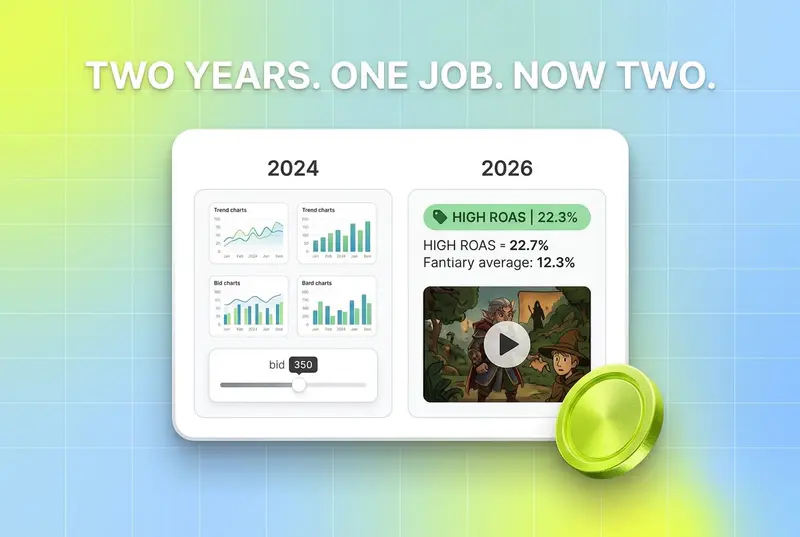
If you ran UA in 2024, your day looked like 12 browser tabs. Meta Ads Manager. Google Ads. TikTok. AppLovin. Unity. AppsFlyer. A Looker dashboard. Three Google Sheets. A Slack channel where designers asked which hook variation to make next.
Two years later, half those tabs are gone, and the half that's left looks different. The bid sliders are mostly hidden. The "campaign structure" decisions that used to take half a Tuesday are now a single budget and a creative library. And the question that consumes UA managers' time has shifted from "which audience and bid" to "which creative pattern is actually working, and how do I make more of it." This is not a small evolution. It's a job split, and it's happening fast enough that the difference between a UA manager hired in 2023 and one hired in 2026 is now structural, not generational.
This post is an opinion on what changed, what got automated, what didn't, what the role splits into, and what to do this year if you want to be on the right side of the line.
Also read How to Test Creatives in the iOS-era: The 2026 Playbook
Key takeaways
The UA manager role bifurcated between 2024 and 2026. Media buying mostly automated into Meta Advantage+, Google Performance Max, and AI bidding products. Creative strategy got harder and more strategic.
According to Mobile Dev Memo, "media buying as a distinct role is becoming almost obsolete" as analysis and creative experimentation become the high-impact levers available to marketing teams. That call from 2019 fully landed in 2025.
Over half of mobile marketers say creative production and creative optimization are where gen AI delivered the most business value in 2024, according to the AppsFlyer 2025 App Marketer Survey. Creative is now the primary lever.
Per the same AppsFlyer survey, more than half of teams worked more with data and analytics teams in 2024, 43% worked more with product, and 34% had to acquire new technical skills. The job demands a different toolkit now.
Branch and M&C Saatchi Performance describe the shift bluntly: marketers now "give up certain levels of transparency in exchange for faster optimizations," and "experienced manual inputs are very much still required, especially when it comes to creative optimization" (Branch).
Upptic's 2024 review noted that "traditional UA channels such as Meta and Google are losing favor as their cost-effectiveness declines," pushing UA managers to learn influencer, web stores, and alternative channels (Upptic).
The 2026 UA manager is either a Creative Strategist (informs creative briefs from data, runs creative testing roadmaps, owns hooks/CTAs/angles) or a Media Operator (configures Advantage+/PMax structures, feeds clean signal events, owns MMR/incrementality and SKAN/AAK setup). Hybrid is still possible at small teams, but the skills are diverging.

What the UA manager job looked like 2 years ago (2024)
In 2024, the UA manager job was still recognizably the same job it had been for a decade. You ran campaigns. You tuned bids. You moved budget. You wrote a creative brief in a Google Doc, slacked your designer, waited two weeks for the asset, launched it, and watched the dashboard.
A normal day:
Open Meta Ads Manager. Pause two underperforming ad sets. Increase budget on one that hit CPI target. Duplicate a winning ad into a new audience.
Open Google Ads. Tweak target CPA on a UAC campaign. Add a couple of new asset variations to an existing ad group.
Open TikTok Ads Manager. Same dance. Add three new creative variants to the running campaign.
Open AppLovin. Open Unity. Same dance again, with a different UI for each one.
Open AppsFlyer or Adjust. Export yesterday's installs. Compare to your spend pull from each network.
Open Google Sheets. Reconcile. Build a CPI + ROAS report by campaign and by creative. Email it to your growth lead.
Open Slack. Brief the designer on the next two creative variants based on what won this week. Wait.
This was the bidding-and-spreadsheet era. The job was 60% data wrangling, 25% bid and budget micro-adjustments, 10% creative briefing, and 5% strategy. AdExchanger's 2019 coverage of the early automation wave already nailed where this was going: "most mobile user acquisition managers... are highly analytical creatures whose job is to dig into the data, analyze ad spend and manually adjust bids. But there's increasingly less and less for them to do" (AdExchanger). The call was right. It just took another five years to fully play out.
In 2024, the constraint was still time, not skill. You knew what to do, you just couldn't do it fast enough across enough networks and creatives. The data was scattered. The creative brief loop was slow. SKAN 4 added a layer of postback complexity that ate half a day. And ad creative production was a bottleneck: you knew which angle was working but couldn't get 20 variants of it produced in under three weeks.
What got automated
Almost everything below the creative layer.
Advantage+ and ASC on Meta. Meta's Advantage+ Shopping Campaigns and Advantage+ App Campaigns put the algorithm in the driver's seat with broad targeting and dynamic creative permutations. Branch's interview with Jonathan Yantz at M&C Saatchi Performance describes it directly: "Meta's Advantage+ Shopping Campaigns... also put the algorithm in the driver's seat, leveraging broad targeting and the best possible creative permutations based on the assets you provide to find the right consumer at the right time" (Branch). The thing being automated isn't a slider. It's the campaign structure decision itself.
Performance Max on Google. PMax replaced the campaign-by-network slicing that used to require a UA manager to think about YouTube vs. Search vs. Display separately. "PMax is a comprehensive solution that leverages Google's advanced machine learning algorithm and a single campaign to reach multiple channels (YouTube, SEM, display, etc.)... letting Google find them with minimal human intervention and direction" (Branch). UA managers who used to spend Tuesday afternoon balancing channel mix in Google Ads now spend that time on creative reviews.
AI bidding. Bid-by-hand died first. Target CPA, target ROAS, value-based bidding, and the ML-driven equivalents on every major network became the default. Manual bid adjustments are now an anti-pattern on most channels; they actively hurt by starving the algorithm of signal.
Automated creative testing. Meta's Advantage+ Creative does visual touch-ups, text improvements, music, 3D animation, and image expansion automatically. Google PMax does "automatically created assets" that recombine your inputs into channel-specific permutations. The UA manager no longer launches 12 ad sets to test a hook variation. They feed assets in and watch which variants win.
Dashboard reconciliation. This one is less talked about but bigger than people credit. The combination of MMP integrations (AppsFlyer, Adjust, Branch, Singular), creative intelligence platforms, and AI-powered analytics has gutted the spreadsheet job. You still need to know what numbers matter. You no longer need to spend three hours building a pivot table to see them.
What's left after all this automation? Two things, primarily: deciding what creative to produce next, and deciding which signals to feed the algorithm. Everything in between got eaten.
What the UA manager job looks like now (2026)
The 2026 UA manager runs Creative Strategist and Media Operator as two separate jobs, often inside one body, sometimes split across two people, and at larger studios split across two teams.
The Creative Strategist half
This person decides what creatives get made and why. They review last week's winning ads, identify the underlying tag pattern (a specific hook, character, opening frame, CTA style, music type), brief the next batch of variations, and own the creative testing roadmap. They live inside creative intelligence platforms, not Ads Managers.
Their KPIs are creative-level: hit rate (% of new creatives that beat the benchmark), creative testing velocity (how many concepts tested per week), winning element identification (which tags drive ROAS), and time-to-decision (how fast a new creative is judged a winner or killed).
The shift to this role is partly a function of automation eating everything below it, and partly a function of where the value moved. Per the AppsFlyer 2025 survey, "over half of respondents cited creative production and creative optimization as the areas where their business saw the most benefits" from gen AI in 2024 (AppsFlyer). Creative is the lever. Everything else is plumbing.
The Media Operator half
This person sets up Advantage+ and PMax correctly, builds the event taxonomy that gets fed into the algorithm, owns SKAN postback configuration and AAK setup, runs incrementality tests, and makes sure the signal flowing into the platforms is clean.
Their KPIs are operational and structural: signal quality, incrementality lift, attribution accuracy, and the cost efficiency of the algorithm. They don't tune bids. They tune the inputs the algorithm sees.
This is the job that used to be "media buying." It's still there, but the surface area changed completely. Tuning a bid is a 2024 job. Designing an event schema and an incrementality methodology so Advantage+ optimizes toward the right outcome is a 2026 job.
Why the split matters - when Advantage+ and PMax do the bidding, the only places a human moves the number are upstream (what signal the algorithm sees) and upstream of that (what creative the algorithm has to choose from). The Media Operator owns the first. The Creative Strategist owns the second. Everything between those two layers is automated.
The hybrid (small team) reality
At studios under 50 people, the hybrid still exists, and probably should. One person owns both halves, knowing that they're switching modes between them. Mornings: Creative Strategist (review yesterday's creatives, brief today's). Afternoons: Media Operator (audit signal events, run an incrementality test, fix a SKAN conversion value schema). The key is knowing they're different jobs that happen to share an office chair.
What does not survive is the in-between role: the person who spends their day micro-adjusting bids and copying campaigns. That job is gone. The platforms do it now, and they do it better than humans.
Skills the new UA manager needs
The skill set diverged. Here's what each half looks like, and what the hybrid needs.
Creative Strategist skills (2026):
Reading tag-level performance data. Knowing how to look at a creative library, identify the underlying patterns that won (hook type, character, scene composition, CTA, audio style), and brief the next batch built on those patterns.
AI-assisted creative briefing. Writing briefs and prompts for AI creative generation tools that include the winning pattern, not just the topline goal.
Hypothesis-driven testing roadmaps. Designing a 4-week testing roadmap that runs structured variants against a baseline, not random shotgun creative.
Cross-platform creative literacy. Knowing what wins on Meta is not what wins on TikTok is not what wins on AppLovin. Reading the same creative through three different network lenses.
Competitor creative analysis. Reading competitor creative libraries (Meta Ad Library, plus tools like Segwise's competitor tracking) to identify positioning white space.
Media Operator skills (2026):
Event taxonomy design. Building the schema of in-app events that feeds Advantage+, PMax, UAC, and similar algorithmic campaigns. What signal gets sent, when, with what value.
Incrementality measurement. Designing geo-holdout or ghost-ads incrementality tests to validate that algorithmic spend is actually causal, not just claiming credit for organic.
MMP and attribution literacy. Configuring AppsFlyer, Adjust, Branch, or Singular correctly. Knowing the difference between SKAN, AAK, and SAN attribution. Understanding what your CMP and conversion values are doing.
MMM and post-attribution measurement. As per-user attribution dies further, media mix modeling and incrementality become how budget gets allocated. This was the call Mobile Dev Memo made years ago: "Media mix modeling and marketing incrementality are at the frontier of exciting marketing science at the moment, and these functional skillsets will sit at the core of the growth team of the future" (Mobile Dev Memo).
Algorithm-aware structuring. Knowing how to set up an Advantage+ App Campaign or a PMax campaign such that the algorithm has enough volume and enough signal to exit the learning phase. Knowing when to consolidate, when to split, and why hyper-segmentation kills ML-driven campaigns.
Cross-cutting skills (both halves need):
Comfort with cross-functional collaboration. Per AppsFlyer's 2025 survey, "over half of respondents cite working more with data, analytics, and BI teams" in 2024, and "43 percent reported more work with product teams." Modern UA work is collaborative, not siloed (AppsFlyer).
New technical skills. 34% of marketers in the same survey said they needed to acquire new technical skills in 2024. That number is not going down.
A working understanding of AI tooling. Not how to fine-tune a model. How to operate a stack of AI tools (ideation, image, video, UGC, voice, editing, plus creative intelligence) and know when to use which.

Tools to learn this year
Pick a couple and go deep rather than dabbling in all of them.
Creative intelligence and creative generation:Segwise for plugging into your 15+ ad networks (Meta, Google, TikTok, Snapchat, YouTube, AppLovin, Unity Ads, Mintegral, IronSource) and MMPs (AppsFlyer, Adjust, Branch, Singular), tagging every creative element with multimodal AI, and generating new creatives grounded in your winning patterns. The Creative Strategy Agent is the always-on AI strategist that answers questions about your data and competitors in plain language. Fatigue tracking catches creatives going stale before performance crashes. Segwise also tags playable (interactive) ads, which still no other platform does and which matters specifically for mobile gaming UA.
Algorithmic campaign products: Meta Advantage+ Shopping Campaigns and Advantage+ App Campaigns. Google Performance Max. Google App Campaigns. TikTok Smart Performance Campaigns. Spend a week on each, reading the official docs and the M&C Saatchi-style practitioner notes.
MMP and measurement: AppsFlyer, Adjust, Branch, or Singular, depending on your stack. Plus the incrementality and MMM tools your team uses (Measured, Northbeam, Haus, internal MMM, etc.).
AI creative production: Whichever generators your team standardized on (Runway, Sora, Veo, Kling for video; Ideogram, Midjourney, Flux for image; Arcads or HeyGen for UGC). Pick one per layer and go deep.
Apple AdAttributionKit and SKAN setup. Per AppsFlyer's survey, "67 percent of respondents cite at least some familiarity with AAK," and the marketers who are good at it have a real edge in iOS UA (AppsFlyer).
What to do this year
Specific, practitioner-level, and opinionated. Pick the ones that apply.
Pick a half. If you're a UA manager wondering where to invest your career capital this year, pick Creative Strategist or Media Operator and go deep. Hybrid is fine, but only if you can clearly articulate both jobs.
Audit your time. If more than 30% of your week is spent on tasks that an algorithm now owns (bid tweaks, manual budget reshuffling, dashboard reconciliation), you are the role that's being automated. Move that 30% into creative strategy or signal design.
Connect your creative data once. Plug your ad networks and MMPs into a creative intelligence platform so you stop spending half a day a week consolidating dashboards. The unified data layer is the precondition for both halves of the new role.
Build a 4-week creative testing roadmap. Not a backlog. A structured roadmap with explicit hypotheses, structured variants, and a kill rule. This is the work that was barely happening in 2024 and that defines good Creative Strategists in 2026.
Run one incrementality test this quarter. Geo-holdout or ghost-ads. Validate one channel. Most teams have never done this. The ones that have, allocate budget very differently from the ones that haven't.
Learn the new attribution stack. Spend a focused day on SKAN 4 + AAK and another on your MMP's conversion value setup. The Media Operator half of the job lives here now.
Standardize on one creative intelligence and one creative generation tool. Don't run six. Pick the stack that makes your team faster. For most mobile UA teams running multiple networks, Segwise does both halves: intelligence and grounded generation.
Diversify your channels. Per Upptic's 2024 review, traditional UA channels like Meta and Google are losing cost-effectiveness, pushing teams toward influencer, web stores, and alternative inventory (Upptic). Test one new channel this year.

The UA manager job in 2026: what changed in two years, summarized
The job split. Media buying as a craft mostly automated into Advantage+, PMax, and AI bidding. Creative strategy got harder, more strategic, and more valuable. The 2026 UA manager is either a Creative Strategist who decides what creatives get made and why, a Media Operator who configures algorithmic campaigns and signal infrastructure correctly, or, on small teams, a hybrid who knows they're switching between two distinct jobs. The role of the person who spends their day micro-adjusting bids in a campaign manager is gone. The platforms do it now.
What's left for the human is upstream of the algorithm: what creative goes in, and what signal it optimizes against. Both of those are now strategic, data-heavy jobs, and both deserve a tool stack and a skill set that match. The teams that have made the switch are running with fewer people, faster cycles, and better creative. The teams that haven't are filling open headcount with a job description from 2022.
If you're a UA manager in 2026, the question isn't whether your job is automatable. Parts of it already got automated. The question is which half you want to own.
Frequently asked questions
What does a UA manager do in 2026 vs 2024?
In 2024, a UA manager spent the day in ad managers across Meta, Google, TikTok, AppLovin, and Unity, tweaking bids, adjusting budgets, duplicating campaigns, and reconciling spend across MMP exports in spreadsheets. In 2026, most of that work is automated into Advantage+, Performance Max, AI bidding, and creative intelligence platforms like Segwise, AppsFlyer, and Adjust. The 2026 UA manager spends their time on creative strategy (briefing, reviewing, and iterating creative based on tag-level performance data) and on signal design (configuring conversion events and incrementality tests so algorithmic campaigns optimize toward the right outcome).
Is the UA manager role being automated out of existence?
The middle of the role is. Manual bid adjustments, campaign duplication, channel mix decisions, dashboard reconciliation, and creative testing setup are mostly automated by Meta Advantage+, Google PMax, and creative intelligence platforms. What remains is the strategic work above and below the algorithm: deciding which creative to produce and which signal to feed in. Per Branch and M&C Saatchi Performance, "there will always be a need for experienced people overseeing campaigns" (Branch). The role is splitting, not disappearing.
What does this mean for UA managers who don't want to specialize?
At small studios (under 50 people), hybrid Creative Strategist + Media Operator roles still work, and probably should. The trick is being explicit that you're doing two jobs that happen to share a chair, and giving each its own block of time and tool stack. At larger teams, the split is structural: separate people, separate KPIs, sometimes separate teams. Generalists who can't articulate which half they own are the ones with hiring problems.
How do creative strategists differ from media buyers in 2026?
Creative strategists own what gets produced and why. Their KPIs are creative-level (hit rate, creative velocity, winning element identification). They live inside creative intelligence platforms like Segwise and creative-tagging dashboards rather than ad managers. Media buyers (now better called Media Operators) own the structural and signal layer: Advantage+ and PMax configuration, event taxonomy, SKAN/AAK setup, incrementality measurement, and MMP attribution. Their KPIs are signal quality, attribution accuracy, and algorithmic spend efficiency. Both roles work with AI tools, but on different sides of the algorithm.
What skills should I learn this year if I'm a UA manager?
Pick a half. If Creative Strategist: tag-level creative data analysis, hypothesis-driven testing roadmaps, AI creative briefing, cross-platform creative literacy, and competitor creative analysis using tools like Segwise's creative analytics and competitor tracking. If Media Operator: event taxonomy design, incrementality testing (geo-holdout, ghost ads), MMM, SKAN 4 + AAK setup, and algorithm-aware campaign structuring. Both halves need comfort with cross-functional work; per AppsFlyer's 2025 survey, over half of marketers worked more with data and analytics teams in 2024.
What tools do modern UA managers actually use?
Creative intelligence and generation: Segwise for connecting 15+ ad networks and MMPs (including Singular), tagging creative elements with multimodal AI, fatigue tracking, and grounded creative generation. Algorithmic campaign products: Meta Advantage+ App Campaigns, Google Performance Max, Google App Campaigns, TikTok Smart Performance Campaigns. MMP and measurement: AppsFlyer, Adjust, Branch, Singular, plus an incrementality tool like Measured or an in-house MMM. AI creative production: a chosen stack across video (Runway, Sora, Veo, Kling), image (Ideogram, Midjourney, Flux), and UGC (Arcads, HeyGen). Pick one per layer and standardize.
Are traditional UA channels still worth running?
Yes, but the mix is shifting. Upptic's 2024 review noted that "traditional UA channels such as Meta and Google are losing favor as their cost-effectiveness declines," and marketers are diversifying into influencer, web stores, and alternative ad networks (Upptic). Meta and Google still dominate volume, but the marginal ROAS of incremental spend on them has been declining for several years. The 2026 playbook is to run them well (with Advantage+ and PMax, not against them) while testing 1-2 new channels per year.
How did SKAN and AAK change the UA manager job?
They made the Media Operator half of the role significantly more technical. SKAN 4 conversion value schemas, postback timer logic, and the new AAK framework all require the UA manager (or someone they work closely with) to design the signal layer that algorithmic campaigns optimize against. Per AppsFlyer's 2025 survey, only 25% of marketers see a noticeably positive impact from SKAN three years in, and 30% report a negative impact. The teams that have invested in the signal layer are pulling ahead of the ones that haven't.