
Updated July 2026.
The best ad creative analysis tools in 2026 are Segwise, Hawky, and VidMob: Segwise for cross-network creative intelligence with multimodal AI tagging, Hawky for element-level scoring with competitor intelligence, and VidMob for enterprise-scale creative data.
You know which ads won last month. You probably don't know why they won.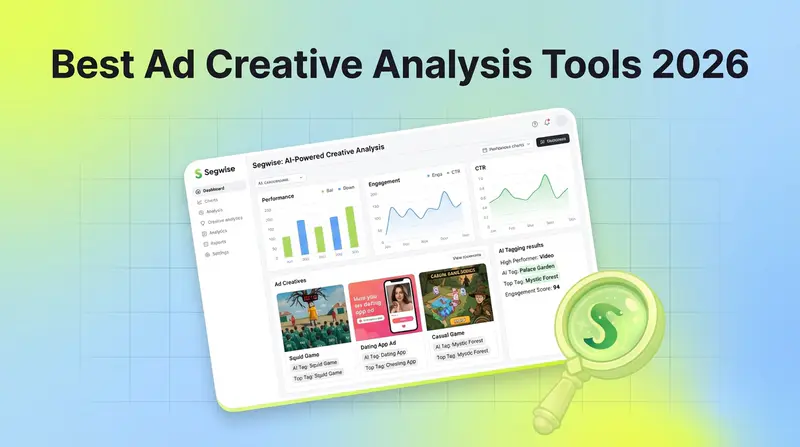
That's the gap most performance teams are stuck in. Campaign dashboards will tell you your CTR was up and your CPA came down. What they won't tell you is whether it was the hook in the first two seconds, the CTA that changed in the fourth revision, or the visual style you tested against your gut instinct. And when a creative starts fading, most teams catch it after the damage is done.
Ad creative analysis tools exist to close that gap. They connect specific creative elements to actual performance outcomes, flag fatigue before your ROAS slides, and tell you what to fix rather than just what happened.
This guide covers the 16 best options in 2026. Some are pure analysis tools. Others sit adjacent to analysis, covering testing, generation, or discovery. Each one closes a different piece of the gap, so the right choice depends on where your biggest blind spot actually is. And there is real money riding on the choice: Meta's own research attributes up to 56% of a campaign's ROI to creative quality, and Nielsen has long estimated that creative drives roughly half of a campaign's sales impact, more than reach, targeting, or recency.
To keep the comparison honest, we evaluated every tool against the same seven criteria: element-level analysis, fatigue detection, competitor intelligence, network coverage, MMP integration, pricing, and setup time, drawing on each vendor's documentation, pricing pages, and G2 reviews alongside our own hands-on work in the category.
TL;DR
Segwise is the best option for teams running cross-network campaigns who need AI tagging across video, audio, image, and text, with fatigue detection and competitor tracking built in.
Superads gives the broadest multi-platform coverage with a real free tier, though the analysis layer is shallow.
Hawky combines element-level creative scoring with competitor intelligence, making it strong for DTC brands on Meta and Google who want both in one place.
Madgicx pairs creative clustering with budget automation rules, which is useful for Meta-heavy teams who want analysis tied directly to spend management.
VidMob is the enterprise standard for creative data at scale, with 40+ proprietary AI models trained on assets from 300,000+ ad accounts. Custom pricing, built for Fortune 500 programs.
CreativeX measures creative quality and brand consistency across markets. It works as a governance layer for large multi-agency brand teams, not a performance diagnosis tool.
Foreplay is a swipe file and discovery tool, not an analysis tool. Start here for ideation; graduate to something else for performance analysis.
AdCreative.ai generates and scores new creatives; it doesn't diagnose existing ones.
Marpipe is a catalog/DPA management platform with built-in creative testing. Best for ecommerce teams running product catalog ads at scale.
Pencil generates variations from winning creative patterns. Useful once you know what works.
Creatify turns a product URL into a finished video ad, a fast production layer for DTC and e-commerce teams rather than an analysis tool.
Midjourney sets the benchmark for AI image quality, best for hero imagery and brand-led visuals, though it outputs raw images only.
Runway offers professional-grade AI video generation and editing for teams producing premium video without a full post-production workflow.
Canva Magic Studio bundles AI copy, image generation, and templates inside Canva, a practical all-in-one for smaller teams already working there.
Copy.ai is built for high-volume ad copywriting with platform-specific templates and bulk generation; words only, no visuals.
Predis.ai pairs AI creative generation with social scheduling and light competitor analysis, aimed at social managers running organic and paid together.
For most teams: start with reporting (Superads), move to creative intelligence (Segwise or Hawky) once you're past $20k/month in spend, and treat Foreplay or Pencil as production tools, not analysis tools.
Quick Comparison: Pricing and Ratings at a Glance
Also read TikTok vs Meta Ads: Which Platform Performs Better for Your Ad Campaigns
The 16 Best Ad Creative Analysis Tools
1. Segwise -- Best for Cross-Network Creative Intelligence with AI Tagging
Segwise is an AI-powered creative intelligence platform built for mobile game studios, DTC brands, subscription apps, and performance marketing agencies. Its core job is to tell you which specific creative elements are driving performance and which aren't, across every network you're running on.
Most creative analytics tools handle one modality at a time. Segwise's multimodal AI analyzes video frames, audio tracks, on-screen text, and image components together. That means a single ad gets tagged for its hook dialogue, background music style, visual emotion, on-screen CTA, scene transitions, and character type in one pass, automatically. Every tag gets mapped to performance metrics, so you can see exactly which hooks, visual styles, and CTAs are correlating with higher IPM, better ROAS, or stronger retention -- without building the analysis manually.
Key features:
Multimodal AI tagging -- Video analysis (scene changes, product shots, visual styles), audio transcription (hook lines, voiceover tone, background music), image analysis (colors, characters, emotions), and text extraction (headlines, CTAs, benefit statements), all running together.
Only platform that tags playable ads -- Critical for mobile gaming teams. Segwise identifies interactive gameplay elements and user engagement patterns in playable formats, which no other platform covers.
Fatigue detection -- Proprietary algorithms monitor performance decline patterns across all networks simultaneously and alert you before creatives tank. You configure the thresholds yourself based on your business logic.
Competitor creative tracking -- Monitor competitor ads on Meta, with AI tagging applied to their creatives. You can see which hook styles, visual formats, and messaging angles your competitors are running and how their strategies evolve over time.
AI-powered creative generation -- Once you know which tags are winning, Segwise generates new creative variations built around those elements. You can produce data-backed iterations without waiting for the creative team to guess what to test next.
Creative Strategy Agent (AI Chat) -- Ask questions about your creative performance in plain language. "Which hook style drove the most installs last month?" gives you an answer without building a report.
Cross-platform integration -- Connects to Meta, Google, TikTok, Snapchat, YouTube, AppLovin, Unity Ads, Mintegral, IronSource, plus MMPs AppsFlyer, Adjust, Branch, and Singular. Setup in 10-15 minutes, no engineering.
When you should try it:
If you're running creatives across multiple ad networks and spending more than $20k/month, Segwise gives you the cross-network pattern recognition that no single-platform tool can match. It's particularly well-suited to mobile gaming teams (playable ad tagging is genuinely unique), DTC brands managing high creative volume across Meta and TikTok, and agencies running portfolio accounts who need a single source of truth.
Limitations:
Competitor tracking currently covers Meta only, with additional platforms in development. Not the right fit for teams running exclusively on one network who don't need MMP integration. Better suited to UA managers and creative strategists than brand managers focused on brand metrics.
Pricing: Paid plans start at $49/month and scale by ad spend and networks, up to $499+ for agency tiers. A 7-day free trial runs with no credit card and no engineering setup; it imports up to 14 days of historical data automatically, extending to 3 months once you're on a paid plan.
2. Hawky -- Best for Element-Level Analysis Combined with Competitor Intelligence
Hawky is an AI-native creative intelligence platform focused on performance marketing teams running on Meta and Google. It breaks down ad creative at the element level (hook, visual, body copy, CTA) and connects those findings directly to spend data. At the same time, it tracks what competitors are running, so the analysis includes market context.
The combination is what differentiates Hawky from most tools on this list. Element-level analysis and competitor intelligence typically live in separate platforms. Hawky combines them.
Key features:
Element-level creative scoring -- Scores each component of an ad separately. You can see that a specific hook underperformed even when the overall ad's CTR looked decent.
Predictive fatigue detection -- Tracks engagement decay and flags creatives before performance drops. Most platforms tell you about fatigue after your ROAS has already slid.
Competitor creative intelligence -- See the formats, angles, and offers your direct competitors are testing across paid social, updated in near real-time.
AI creative briefs -- Recommendations generated from what's working in your account and in your category.
When you should try it:
DTC brands and performance marketing agencies with meaningful monthly spend on Meta and Google who need both element-level creative diagnosis and competitive visibility in one place. If you're currently running two separate tools for analysis and competitor tracking, Hawky removes the need for one of them.
Limitations:
Platform coverage is primarily Meta and Google. If you're running significant spend on TikTok, AppLovin, or gaming networks, Hawky doesn't cover those. No MMP integration, which limits attribution depth for app-focused teams.
Pricing: Flat-rate plans from around $129/month (billed annually), with higher tiers up to roughly $269/month. No ad-spend percentage fees. Contact for a custom quote at your volume.
3. Superads -- Best for Multi-Platform Creative Reporting
Superads gives you a consolidated creative analytics view across Meta, Google, TikTok, LinkedIn, and Pinterest. For agencies managing multiple clients across multiple channels, the data aggregation is the main value: one place to compare creative performance across platforms without jumping between ad managers.
Superads has a generous free tier with unlimited ad accounts and unlimited users, which makes it a common starting point for smaller teams.
Key features:
Multi-platform coverage -- Meta, Google, TikTok, LinkedIn, and Pinterest in one view.
Creative-level reporting -- Performance data organized by creative asset, not by campaign.
Unlimited ad accounts on free tier -- Genuinely useful for agencies managing multiple clients.
Clean reporting interface -- Designed for presenting performance data without complex setup.
When you should try it:
Agencies managing multi-channel paid social across clients who need consolidated reporting in one view. If your current pain is jumping between ad managers for each platform, Superads solves that without a large budget commitment. The free tier is real, not crippled.
Limitations:
The analysis layer is shallow. No element-level breakdown, no fatigue detection, no competitor intelligence. This is a reporting tool, not a creative analysis tool. It tells you what happened but not why.
Pricing: Free tier available. Professional plans start at $49/month, priced by monthly ad spend.
G2 rating: 4.7/5.
4. Madgicx -- Best for Meta-Focused Creative Analysis with Budget Automation
Madgicx is an ad cloud platform built primarily for Meta advertisers. Its Creative Insights module groups similar ads into concept clusters based on visual content and shows aggregate performance by cluster rather than by individual ad ID. It also analyzes ad copy language and sentiment to surface which messaging styles drive conversions.
What separates Madgicx from pure analytics tools is the automation layer. You can identify underperforming creative clusters and let Madgicx automatically shift budget away from them.
Key features:
Concept clustering -- Groups similar ads into clusters and shows aggregate performance, which surfaces patterns that individual ad-level reporting misses.
Copy sentiment analysis -- Analyzes ad copy tone and messaging style to show which approaches drive conversions in your account.
Budget automation -- Automatically acts on creative insights by shifting spend away from declining clusters.
Meta-focused depth -- Built specifically for Facebook and Instagram, which means the Meta-specific analysis is more detailed than multi-platform tools.
When you should try it:
Meta-focused performance marketers and agencies who want creative analysis tied directly to automated budget management. If you find yourself manually pausing underperforming ads after reviewing creative clusters, Madgicx automates that loop.
Limitations:
Pricing scales with ad spend, so costs increase automatically as you grow. Primarily Meta-focused with limited cross-platform coverage. G2 reviews note a steep learning curve. Not the right fit for teams running significant spend outside Meta.
Pricing: Pro plan from $99/month, scaling with ad spend; agency tiers reach $499+/month. Free 7-day trial available.
G2 rating: 4.6/5.
5. VidMob -- Best for Enterprise Creative Data at Scale
VidMob calls itself "the creative data company," and at enterprise scale the claim holds up. Its 40+ proprietary AI models have analyzed 18 million assets from more than 300,000 ad accounts, which gives its recommendations something most tools on this list can't offer: cross-advertiser benchmarks rather than just your own account history.
VidMob is built for brand teams, creative teams, and media buyers who all need to work from the same creative intelligence. It connects creative decisions to media outcomes and generates channel-specific creative requirements from top-performing patterns, with a creator network attached for teams that want production handled in the same loop.
Key features:
Creative scoring system -- Evaluates ad performance element by element and generates specific improvement suggestions.
40+ proprietary AI models -- Each trained on platform-specific data, because what works on TikTok is not what works on Meta.
Cross-platform creative requirements -- Data-driven creative guidelines for each channel, generated from what actually performs there.
Brand consistency monitoring -- Tracks whether brand guidelines are applied consistently across markets and agencies.
Creative Studio -- A workflow that connects performance data to a network of vetted creators who apply the insights to new production.
When you should try it:
VidMob fits enterprise brands running at serious scale across multiple markets: global CPG companies, large e-commerce brands, or agencies managing Fortune 500 clients. If you need to justify creative decisions to an executive team with cross-advertiser benchmark data, VidMob's dataset gives you that credibility.
Limitations:
Enterprise-only pricing with no self-serve option, and onboarding involves custom implementation. Smaller performance teams that need quick iteration will find it inaccessible, and teams with established production relationships may find the Creative Studio redundant.
Pricing: Custom enterprise pricing via demo; contracts are reported to start in the $3,000-$5,000/month range.
G2 rating: 4.4/5.
6. CreativeX -- Best for Brand Consistency and Creative Governance
CreativeX solves a different problem from most tools here. Where Segwise asks which elements drive ROAS, CreativeX asks whether a creative meets the quality and brand standards that make good performance possible in the first place. Its Creative Quality Score (CQS) checks every asset against platform best practices and your own brand guidelines before media dollars get spent on it.
That makes it a compliance and quality gate more than a performance diagnosis tool, and for the teams that need one, that gate saves real money on creative that would have failed for avoidable reasons: wrong aspect ratios, text positioning problems, missing brand elements.
Key features:
Creative Quality Score (CQS) -- A standardized score for every asset against digital suitability standards and brand-specific rules.
Brand compliance tracking -- Checks logo placement, color use, and guideline adherence across markets, agencies, and production partners.
Pre-testing, creative, and media in one view -- Links creative datasets end to end across live and historical campaigns.
Benchmark analytics -- Compares your creative quality against industry and global averages from a large repository of anonymized campaign data.
When you should try it:
Large brand advertisers managing creative consistency across multiple markets, agencies, and production partners. If your pain is "our brand looks different in every market" or "our partners don't follow the guidelines," CreativeX is purpose-built for exactly that.
Limitations:
Governance is the job, not element-to-ROAS diagnosis. Performance teams focused on why a specific hook or CTA won will need a creative intelligence platform alongside it. Expect an enterprise sales motion with onboarding measured in weeks.
Pricing: Custom enterprise pricing via demo.
G2 rating: 4.2/5.
7. Foreplay -- Best for Competitor Ad Discovery and Brief Building
Foreplay is a swipe file and competitor ad discovery tool. It lets you save, organize, and browse competitor ads from Meta's Ad Library and other sources, and build inspiration libraries to brief creative teams. Its Spyder feature tracks competitor ad activity across social platforms, surfacing new ads as competitors launch them.
Be clear about what this is and what it isn't: Foreplay is an ideation tool. It doesn't connect competitor ad data to your own performance metrics and doesn't explain why competitor ads work. It tells you what exists, not what's working.
Key features:
Swipe file management -- Save and organise competitor ads from Meta Ad Library and other sources in one library.
Spyder tracking -- Monitor competitor ad launches in near real-time across social platforms.
Community ad library -- Access a large community-curated library of ads across categories.
Brief building -- Share saved ads with creative teams to brief specific directions and styles.
When you should try it:
Creative directors and brand strategists building briefs from competitor research. If your biggest challenge is ideation (what angles to test, what formats competitors are using), Foreplay is a practical starting point before you have enough of your own performance data to analyze.
Limitations:
Not an analysis tool. It doesn't link competitor ad data to any performance metrics. You can see what competitors are running but not whether it's working for them. Treat it as a research and inspiration layer, not a performance layer.
Pricing: Basic plan from $59/month; Workflow plan (adds Spyder tracking and Lens analytics) at $175/month; Agency plan at $459/month. Around 15% off on annual billing.
G2 rating: 4.8/5.
8. AdCreative.ai -- Best for High-Volume Creative Generation with Performance Scoring
AdCreative.ai is a generative tool that produces ad creatives using AI based on your brand inputs and historical performance signals, and scores generated assets before you spend on them. It's not a creative analysis tool in the traditional sense, but it uses performance data to guide what it generates.
The primary job here is production speed, not diagnosis. If your question is "what should I create next?" it can help. If your question is "why is this specific creative underperforming?", it doesn't answer that.
Key features:
AI creative generation -- Produces ad creatives from brand inputs and performance signals.
Performance scoring -- Scores generated assets before you spend budget testing them.
Template library -- Large library of ad formats and styles to start from.
Multi-platform output -- Generates creatives sized for Meta, Google, and other platforms.
When you should try it:
Small teams and solo performance marketers who need to produce and score ad variations quickly without a designer. If your bottleneck is creative volume rather than diagnostic depth, AdCreative.ai addresses that constraint.
Limitations:
This is a creative production tool, not an analysis tool. It doesn't tell you why your existing creatives are performing the way they are. If you need element-level diagnosis or fatigue detection, you'll need a different tool alongside it.
Pricing: Starter plans from $39/month, scaling to $149/month (Scale-Up) and $249/month (Professional). 7-day free trial with 10 credits; discounts on annual billing.
G2 rating: 4.3/5 (about 790 reviews).
9. Marpipe -- Best for Catalog Ad Creative Management and Testing
Marpipe is a catalog ad management and dynamic product ad (DPA) platform. Its core job is managing product feeds and designing catalog ad creatives at scale. Within that workflow, it supports multivariate testing of creative combinations -- different headlines, backgrounds, and product image treatments -- to identify what drives best results in catalog campaigns.
Key features:
Multivariate test generation -- Automatically creates every combination of your creative elements and runs them as separate ads.
Winner identification -- Surfaces which specific combinations of elements drive the best results without requiring you to manually interpret test data.
Catalog ad integration -- Strong integration with product catalog feeds, particularly useful for ecommerce teams.
Feed management -- Free tier includes catalog feed management, which is useful for ecommerce before you need testing at scale.
When you should try it:
Ecommerce teams running product catalog ads who need better control over how their product images, backgrounds, and copy variations look and perform. If catalog/DPA campaigns are a significant part of your paid social spend, Marpipe gives you more design control and testing capability than the native ad manager tools.
Limitations:
Primarily a catalog/DPA tool. If you're running video ads, UGC, or non-catalog creatives, Marpipe isn't the right fit. No ongoing creative intelligence, no fatigue detection, no competitor tracking. Startup plan starts at $199/month for up to 500 SKUs.
Pricing: Free Feed Management tier. Startup plan at $199/month (500 SKU cap). Enterprise plan starting at $999/month.
G2 rating: 4.9/5 (small review sample).
10. Pencil -- Best for AI-Powered Creative Iteration from Winning Patterns
Pencil focuses on generative iteration. Once you know which creative patterns are working in your account, it builds variations of those patterns at speed using AI. It's a production accelerator, not a diagnostic tool.
Key features:
Pattern-based generation -- Builds new creative variations from your historical winners, using your established creative DNA.
Volume production -- Designed for teams that need to generate many variations quickly once they know what's working.
Performance data input -- Uses your account performance signals to inform which patterns to iterate on.
When you should try it:
Performance teams with established winning creative patterns who need to generate validated variations at volume. If you've already done the analysis work and know what elements win, Pencil accelerates the next phase of production.
Limitations:
Depends entirely on having clear winning patterns to iterate from. Less useful when you're still figuring out what works in your account. Not a diagnostic tool at all -- if you don't know what's driving your performance, Pencil can't help you figure it out.
Pricing: Core plan starts at $14/month for 50 generations. Higher tiers available for more volume.
11. Creatify -- Best for URL-to-Video Ad Production at Scale
Creatify targets the single most common video ad bottleneck: sourcing raw footage. You give it a product URL and it delivers a finished video ad, script and avatar included. It's a production tool, not an analysis tool, but for teams that need volume video output fast it removes a real constraint.
Key features:
URL-to-video -- Input a product URL and get a production-ready video ad out the other end.
AI avatars -- Realistic digital presenters deliver scripts in multiple languages.
Automated scripting -- Generates persuasive ad scripts from product features.
E-commerce integrations -- Native Shopify integration for product video creation.
Multi-language support -- Produce video ads in multiple languages for localized campaigns.
When you should try it:
DTC brands with high product SKU counts, direct-response e-commerce teams, or brands testing video ads without production resources. Also useful for international campaigns that need localized versions quickly.
Limitations:
AI avatars still read as synthetic in close-ups or longer formats. Less creative control than a tool like Runway. The credit system caps high-volume users quickly. It generates creatives; it doesn't tell you why they perform.
Pricing: Free tier available. Paid plans start around $19/month, with a Pro tier at $49/month and custom Enterprise pricing.
12. Midjourney -- Best for High-Quality Hero Imagery
When visual differentiation is strategic, Midjourney sets the benchmark for AI image generation quality. Few tools consistently match its artistic detail, which makes it a source for hero imagery and brand-led visuals rather than a performance layer.
Key features:
Best-in-class image quality -- Among the most detailed and visually sophisticated AI images available.
Advanced style controls -- Parameters for lighting, focal length, color palette, and artistic style.
Image variations -- Generate multiple versions with controlled modifications.
Consistent characters -- Maintain the same character, setting, or visual style across outputs.
Commercial rights -- All paid plans include commercial rights for advertising use.
When you should try it:
Creative teams running brand-led campaigns where visual quality shapes perception, such as luxury goods, lifestyle brands, or premium gaming. Also useful as source material feeding into a video production pipeline.
Limitations:
The Discord-based workflow feels awkward for marketing teams. It generates raw imagery only, with no ad copy, video, or platform formatting, and consistent brand colors and logos need post-processing.
Pricing: Basic plan at $10/month, Standard at $30/month, Pro at $60/month, and Mega at $120/month. Annual billing takes roughly 20% off. No free tier.
13. Runway -- Best for Professional-Grade AI Video Editing
Runway fills the gap between consumer video generators and professional editing software, offering AI-powered generation and editing that previously required dedicated post-production skills.
Key features:
Video generation -- Creates coherent, high-quality video from text prompts.
AI editing suite -- Background removal, automated color correction, and motion tracking.
Motion tracking -- Automatically tracks objects through scenes for applying effects.
Professional export -- High-resolution export in paid-media-suitable formats.
Rotoscoping -- Isolates subjects from backgrounds automatically.
When you should try it:
Marketing teams producing premium video content that needs professional output quality without a full production workflow, and teams with creative vision but limited post-production resources. Also handy for creating b-roll alongside live-action footage.
Limitations:
Steeper learning curve than consumer-focused tools like Creatify. Credit-based pricing means heavy users need higher tiers, and text-to-video outputs show artifacts at longer durations, so it is best for short-form.
Pricing: Free tier with limited credits. Standard plan at $15/month and Pro at $35/month (about $12 and $28/month on annual billing).
14. Canva Magic Studio -- Best All-in-One Tool for Smaller Teams
Canva Magic Studio builds AI generation directly into Canva's familiar interface: AI copywriting, text-to-image, background tools, and brand kit management without switching tools. For smaller teams already living in Canva, it removes friction.
Key features:
Magic Write -- AI copywriting for ad headlines, body text, and CTAs inside the design.
Text-to-image -- Generates custom images from descriptions to fill visual gaps.
Background tools -- One-click background removal and AI-powered replacement.
Template library -- Thousands of ad templates pre-formatted for major platforms.
Brand kit -- Stores colors, fonts, and logos and applies them across AI content.
When you should try it:
Small to mid-sized marketing teams producing diverse content beyond ads (social posts, email, presentations, landing pages), especially if the creative workflow already centers on Canva.
Limitations:
Not purpose-built for performance advertising; the AI generation is general-purpose, not conversion-optimized. Video ad capabilities are limited compared to specialized tools, and heavy customization still requires manual design skill.
Pricing: Free tier available. Canva Pro, which includes full Magic Studio access, is around $15/month (lower on annual billing).
15. Copy.ai -- Best for High-Volume Ad Copywriting
Copy.ai focuses on words, not visuals. It removes copy bottlenecks with platform-specific templates and bulk generation, which suits teams running constant messaging tests.
Key features:
Platform-specific templates -- Pre-built frameworks for Meta, Google, TikTok, and LinkedIn.
Brand voice training -- Train the AI on existing copy to keep messaging consistent.
Bulk generation -- Generate dozens of headline and body variations at once.
Workflow automation -- Build custom workflows combining multiple AI steps.
Team collaboration -- Shared workspaces with version history.
When you should try it:
Performance marketing teams whose primary bottleneck is copy volume rather than visuals, particularly teams running continuous testing across channels that need constant headline and CTA variation.
Limitations:
Copy only, with no visual creative generation, so you need separate tools for images or video. Quality varies by use case, and the free tier is now limited for production use.
Pricing: Free tier with limited features. Pro at $49/month (covers up to 5 seats; around $36/month billed annually). Enterprise is custom.
16. Predis.ai -- Best for Social Ad Management with Built-In Creative Generation
Predis.ai combines creative generation with social media management, folding competitor analysis and scheduling into one platform. It suits teams that want to reduce tool sprawl across organic and paid social.
Key features:
Competitor analysis -- Monitors competitor posts to surface successful themes and formats.
AI creative generation -- Produces platform-optimized static and video creatives.
Integrated content calendar -- Schedule and manage social ad content without switching platforms.
Multi-platform publishing -- Publish directly to social platforms from within Predis.ai.
Hashtag intelligence -- Suggests hashtags based on content and audience signals.
When you should try it:
Social media managers and small marketing teams running both organic and paid social who want fewer tools. If one person handles both creative production and the posting workflow, Predis.ai covers both ends.
Limitations:
Not built for performance marketers managing large-scale multi-network campaigns. Creative quality for paid ads is solid but not conversion-optimized, and the competitor analysis is less thorough than dedicated tools.
Pricing: Free plan available. Core from around $32/month, Rise at $79/month, with higher Enterprise+ tiers; contact sales for agency volume.
Feature Comparison: How These Tools Stack Up

How to Choose the Right Tool

The choice comes down to which gap you're actually trying to close.
If you need element-level diagnosis across multiple networks: Segwise handles the most ground here. Multimodal tagging across 15+ networks with MMP integration is genuinely useful for teams where creative performance varies by platform and you need to understand why. The competitor tracking on Meta adds a layer that most tools don't have.
If you're running primarily on Meta and Google and want element-level analysis plus competitor intelligence in one place: Hawky is the direct answer. It combines those two capabilities more cleanly than most tools that try to do both.
If you're an enterprise brand team managing creative across markets: VidMob brings cross-advertiser benchmark data that single-account tools can't match, and CreativeX adds the governance layer that keeps every market, agency, and production partner on standard. Both are enterprise engagements, so budget for a sales process rather than a self-serve signup.
If you're a multi-channel agency needing consolidated reporting: Superads handles the most platforms and the free tier is real. It won't tell you why creatives perform the way they do, but it will tell you what's happening across all channels without a significant budget commitment.
If you're Meta-heavy and want analysis linked to spend automation: Madgicx is the clearest choice. The ability to identify underperforming creative clusters and automatically adjust budget is a workflow that other tools don't replicate.
If you're in the ideation phase: Start with Foreplay for competitor discovery. Use AdCreative.ai if you need volume production. Graduate to an analysis tool once you're running enough volume to have meaningful performance data.
The pattern that high-performing DTC brands tend to follow: reporting tool first (Superads), then element-level analysis (Segwise or Hawky) once spend crosses $20k/month, and keep Foreplay or Pencil as production layers rather than analysis layers.
What to Check in a Demo
Before committing to any tool on this list, run it against these specific questions:
Does it actually show element-level analysis or just concept-level grouping? Ask them to show you which specific part of an ad underperformed, not just which ad underperformed.
How does fatigue detection work? Is it automated with alerts, or do you still have to check manually? Can you configure thresholds?
What does MMP integration actually give you? Some tools list it as a feature but only surface install counts. Ask specifically which MMP events feed into creative-level reports.
What does competitor intelligence cover? Which platforms, how frequently is it updated, does AI tagging apply to competitor ads or just your own?
How long does onboarding take? For most teams, anything requiring engineering resources becomes a blocker. Tools that connect via OAuth in under 15 minutes have a meaningful advantage.
Conclusion
Most teams are doing creative reporting and calling it creative analysis. They know which ads won. They don't know what inside those ads drove the win, when the next one will start to fade, or what competitors are testing that they haven't tried yet.
The tools on this list each close a piece of that gap. The question is which piece matters most to your team right now.
If you're running on multiple networks and need systematic, element-level analysis with fatigue detection and competitive context, Segwise is the platform built for that job. It covers the full creative intelligence loop: tag every element, map it to performance, catch fatigue before it hits, track what competitors are running, and generate the next iteration from what the data says works.
Book a Segwise demo to see how multimodal AI tagging works across your actual creative library -- no manual setup, and no engineering time to get connected.
Frequently Asked Questions
What is ad creative analysis?
Ad creative analysis connects specific creative elements (hooks, visuals, CTAs, copy, audio) to actual performance outcomes. It goes deeper than campaign reporting, which tells you which ad won. Creative analysis tells you which part of the winning ad drove the result, why a specific creative is starting to fatigue, and how your creative compares to what competitors are running. The goal is to understand mechanics, not just scoreboard results.
How is ad creative analysis different from ad reporting?
Ad reporting shows aggregate metrics: CTR, ROAS, CPA, impressions. It tells you which ads won and which lost. Ad creative analysis goes inside the ads themselves to explain why. It identifies which hook held attention, which CTA drove action, which visual format is starting to fatigue, and how those patterns compare across your library and against competitors. Most ad managers provide reporting. Only dedicated creative intelligence platforms do the deeper analysis.
What's the best ad creative analysis tool for mobile gaming teams?
Segwise is the strongest option for mobile gaming. Its multimodal tagging reaches into playable (interactive) ad formats that most creative tools skip entirely, which closes a persistent blind spot for gaming advertisers. It also integrates with all major mobile ad networks (AppLovin, Unity Ads, Mintegral, IronSource, Meta, TikTok, Google) plus MMPs like AppsFlyer and Adjust, and it applies multimodal AI tagging to video, audio, image, and text across that entire library.
What's the best ad creative analysis tool for agencies?
For agencies, it depends on whether the primary need is reporting or analysis. For client-facing reporting across multiple platforms, Superads handles that workflow well without a big budget commitment. For element-level diagnosis that actually improves creative performance (not just reports on it), Segwise or Hawky provide deeper analytical capability. Many agencies end up using a reporting tool for client delivery and a creative intelligence platform for the analysis that drives brief recommendations.
How much do ad creative analysis tools cost?
Pricing varies significantly. Superads has a free tier with a paid plan starting at $49/month. Pencil starts at $14/month for basic use. Marpipe's startup plan is $199/month. Segwise starts at $49/month and scales by ad spend and networks, with a 7-day free trial. Madgicx starts at $99/month, Hawky from roughly $129/month, and Foreplay from $59/month, while enterprise platforms like VidMob and CreativeX run custom pricing, with VidMob contracts reported to start around $3,000/month. Expect to book a demo to confirm pricing for your scale.
Do I need MMP integration for creative analysis?
Not always, but it matters for mobile-focused teams. Without MMP integration, creative analysis relies on ad network data alone (clicks, impressions, CTR). MMP integration adds attribution data (installs, in-app events, LTV signals), which gives a complete picture of which creatives drive downstream value, not just top-of-funnel engagement. If you're running mobile app campaigns, MMP integration is close to essential. For web-based DTC brands, ad network data is often sufficient.
How long does it take to set up a creative analysis tool?
Tools with OAuth-based integrations (like Segwise) typically connect in 10-15 minutes without engineering resources. Segwise backfills up to 14 days of historical data on the 7-day free trial, and up to 3 months on paid plans, so you have something to analyze immediately. More complex setups involving custom data pipelines or API integrations can take days to weeks. When evaluating tools, ask specifically whether setup requires any engineering involvement.
What's the difference between AI creative generation and AI creative intelligence?
AI creative generation tools produce assets (images, video, scripts, ad copy), usually from a brief or a product URL. Creative intelligence platforms do the opposite job: they analyze your existing creative performance across ad networks and MMPs, automatically tag creative elements, and surface which of those elements actually drive results. Generation answers "what should I make next?"; intelligence answers "why did this work, and what should I make more of?" The most effective teams run both, using intelligence to decide what to generate. Segwise is unusual in covering both sides -- it tags and analyzes every element, then generates new creatives built around the patterns that win.
Is Segwise only for mobile game companies?
No. Segwise is built for mobile game studios, DTC brands, subscription apps, and performance marketing agencies. Any team running performance-focused ads across multiple networks and MMPs benefits from creative-level intelligence. The playable ad tagging is uniquely valuable for mobile gaming teams, since Segwise is the only platform that tags playable (interactive) ads, but the multimodal tagging, fatigue detection, and generation apply to video, image, and static ads for any advertiser.
How is creative analysis different from dynamic creative optimization (DCO)?
DCO is a production technique: it assembles ad variations automatically from templates and data feeds. Creative analysis is the discipline that tells you whether those variations worked and why. The two pair well. Analysis platforms like Segwise surface which elements win, and those learnings feed the rules your DCO or automation setup runs on. One without the other means you're either assembling blind or learning without acting.
How do I validate a creative scoring tool before trusting it?
Take a batch of ads you've already run with known outcomes and feed them through the tool, then compare its scores to what actually happened. Watch for formats or styles it consistently over-values or under-values. From there, run one matched-pair test: same concept, two edits, controlled spend. You're not trying to prove the tool right or wrong, just to learn where its predictions hold up for your category and audience before you let it steer budget.