
Key Takeaways
Platform Roles: TikTok drives discovery and creative testing, while Meta focuses on conversions and scaling. You need both to build a complete growth system.
Creative Impact: Your performance depends on creatives, not just targeting. TikTok rewards fast iteration, while Meta rewards structured, high-converting messaging.
Cost vs ROI: TikTok is cheaper and drives higher engagement, but Meta delivers stronger and more consistent conversion performance over time.
Funnel Strategy: Use TikTok at the top to find winning ideas, and Meta at the bottom to retarget and convert those ideas into revenue.
Winning Approach: The best results come from combining both. Test and find winners on TikTok, then scale them on Meta using data-backed insights.
Are you still splitting your ad budget between TikTok and Meta without knowing which one is actually driving results?
You launch campaigns, test creatives, and hope something sticks, but the results feel inconsistent. One week TikTok performs, the next week Meta does, and you’re left guessing what really worked. Meanwhile, your best creatives burn out fast, your costs keep rising, and scaling feels more like luck than strategy.
If you’re a creative strategist working with mobile games, DTC brands, subscription apps, or managing multiple client accounts, this confusion slows down your entire growth engine. In this blog, you’ll learn the key differences between TikTok and Meta Ads, how each platform actually works, and how to scale winners instead of guessing your way through campaigns.
What Are TikTok Ads?
TikTok Ads are paid promotions that appear inside the TikTok feed and look like regular videos. With 135 million users, the platform gives you massive reach and strong discovery potential in the US market. These ads blend into organic content, making them less disruptive and more engaging to younger audiences than traditional ad formats.
As a creative strategist, TikTok Ads give you a platform where creative execution matters more than production quality. Your success depends on how quickly your hook grabs attention and how well your story keeps users watching.
To understand how to scale performance, you also need to look at how Meta Ads work.
What Are Meta Ads?
Meta Ads are paid ads that run across Meta platforms like Facebook, Instagram, and Messenger. With 3.58 billion daily active people (DAP), Meta gives you access to one of the largest and most data-rich advertising ecosystems. These ads offer advanced targeting based on demographics, interests, and behaviors, making them powerful for both conversions and retargeting.
As a creative strategist, Meta Ads gives you more control over how you scale and optimize campaigns. You can test different creatives across audience segments, build retargeting flows, and refine messaging based on performance.
Now that you understand how both platforms work individually, let’s look at how they compare side by side.
Also Read: Winning on Meta: The Best Tools for Testing and Scaling Ads
TikTok vs Meta Ads: A Quick Comparison
TikTok and Meta Ads differ mainly in how users engage with content and how your creatives perform across the funnel. Here are the key differences between TikTok Ads and Meta Ads:
That quick comparison gives you a high-level view, but the real differences become clear when you break down how each platform performs across key factors.
TikTok vs Meta Ads: Detailed Comparison by Key Factors
TikTok and Meta Ads operate on completely different growth mechanics; one is driven by creative discovery, the other by data-driven optimization and retargeting. To get consistent results, you need to understand how each platform behaves across key factors and adjust your strategy accordingly.
Here are the key factors that clearly show how TikTok Ads and Meta Ads work differently: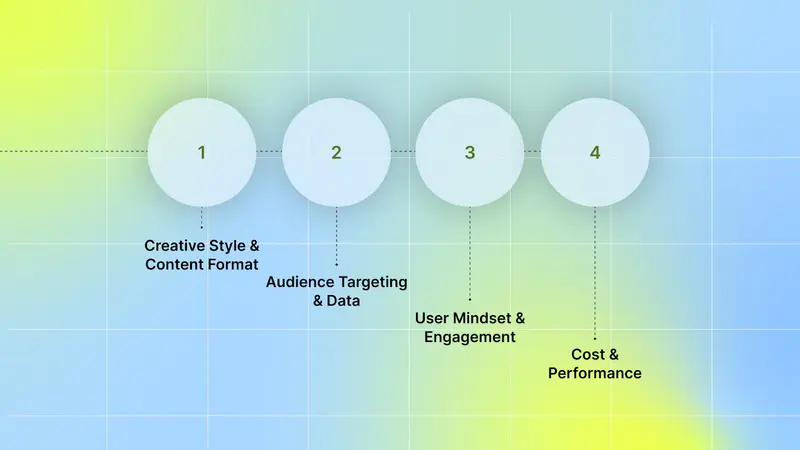
1. Creative Style & Content Format
On TikTok, your ads need to feel native to the platform. Short-form, vertical videos work best, and they should look like user-generated content (UGC), not polished brand ads. Trends, hooks, and storytelling drive performance. For mobile games and DTC brands, this means testing multiple creative angles quickly, like gameplay hooks, problem-solution videos, or influencer-style content.
But how do you know which creative elements are actually driving results? This is where a creative intelligence platform like Segwise comes in.
With tag-level creative element mapping, you can see which specific creative elements drive performance. Also, you can discover patterns like "this hook appears in 80% of top-performing creatives" with complete MMP attribution integration.
On Meta, you have more flexibility with formats, such as images, carousels, videos, Stories, and Reels. Creatives can be more polished and structured. As a creative strategist, you can reuse brand assets and focus on clear messaging, especially for retargeting and conversion-focused campaigns.
2. Audience Targeting & Data
TikTok targeting is based on interests and behavior, but the platform relies heavily on its algorithm to find the right audience. Your creative plays a bigger role in reaching the right users. If your hook works, TikTok will push your ad further.
Meta offers advanced targeting built over years of data. You can create custom audiences, lookalikes, and strong retargeting segments. For subscription apps and DTC brands, this allows you to target users at different stages—from first touch to repeat purchase.
3. User Mindset & Engagement
Users come to TikTok for entertainment and discovery. They are not actively looking for ads, so your creatives must blend into the content they already enjoy. This makes TikTok powerful for reaching new users and testing new creative ideas.
Meta users are more familiar with ads while browsing feeds, stories, and groups. This makes Meta stronger for direct response campaigns. As a creative strategist, you can guide users from awareness to conversion using structured messaging and retargeting flows.
4. Cost & Performance
TikTok ads are generally more affordable, while Meta ads tend to drive stronger conversions over time.
Here’s how they compare:
The data confirms what you likely see in your own TikTok vs Meta campaign performance: TikTok is cheaper and drives more engagement, while Meta remains stronger when it comes to conversions.
Lower CPM and CPC make TikTok a powerful platform for visibility and top-of-funnel growth, especially when you’re testing new creatives or reaching new audiences. Its higher CTR shows how well native-style content performs; users engage more when ads feel like part of their feed.
However, when your goal is profitability and scale, Meta has the edge. Its advanced targeting and optimization systems help you achieve a lower cost per action and drive a higher volume of conversions over time.
In simple terms: TikTok attracts, Meta converts.
These differences become more meaningful when you look at how each platform performs across different stages of your funnel.
The Role of Each Platform Across the Funnel
TikTok and Meta Ads play different roles across the funnel. To get consistent results, you need to use both platforms based on where your audience is in their journey.
Here is how TikTok and Meta Ads fit into each stage:
1. Awareness: Top of the Funnel
Objective: Capture attention and reach new users
At this stage, your goal is to get in front of as many relevant users as possible.
TikTok Ads: TikTok is highly effective for large-scale visibility. Its lower CPM and native video formats help your creatives reach a wide audience quickly. For mobile games, DTC brands, and subscription apps, this is where you test hooks, concepts, and storytelling to see what grabs attention.
Meta Ads: Meta can also drive strong reach, but competition often makes it more expensive. It works better when you already have some winning creatives and want to distribute them to a broader but more defined audience.
2. Consideration: Middle of the Funnel
Objective: Build interest and drive engagement
Here, users are aware of your brand but need more reasons to engage.
TikTok Ads: TikTok continues to drive strong engagement with entertaining, relatable content. Your creatives should focus on storytelling, product benefits, or gameplay highlights to keep users interested.
Meta Ads: Meta becomes more powerful at this stage because you can track user interactions, clicks, video views, likes, and refine your targeting. As a creative strategist, you can start segmenting audiences and testing messaging that moves users closer to conversion.
3. Conversion: Bottom of the Funnel
Objective: Drive actions like purchases, installs, or sign-ups
This is where performance and optimization matter most.
Meta Ads: Meta has a clear advantage here. Its advanced retargeting, custom audiences, and conversion-focused formats help you turn interest into actual results. For DTC brands and subscription apps, this is where you scale revenue efficiently.
TikTok Ads: TikTok is improving its conversion capabilities with tools like the TikTok Pixel and Events API. However, conversions are often indirect; users may discover your product on TikTok but convert later through Meta or another channel.
The next step is deciding where to focus based on your goals and creative strategy.
How to Choose Between TikTok Ads vs Meta Ads
There’s no single “better” platform. As a creative strategist, the key is to match platform strengths with your creative approach and campaign goals.
Here are simple ways to decide which platform to prioritize:
1. Choose TikTok Ads If
You want to test new creative ideas quickly.
Your goal is discovery and reaching new audiences.
Your creatives are UGC-style, trend-driven, or story-based.
You are running campaigns for mobile games, DTC products, or visually engaging offers.
You need lower-cost traffic to validate hooks and concepts.
TikTok works best when you want to find what works fast and generate new winning creatives.
2. Choose Meta Ads If
You want to scale campaigns and drive consistent conversions.
Your goal is retargeting, purchases, or subscriptions.
Your creatives focus on clear value, benefits, and structured messaging.
You need advanced targeting and audience segmentation.
You are optimizing for ROAS and long-term performance.
Meta works best when you already know what works and want to scale it efficiently across your funnel.
In short:
For most mobile apps, DTC brands, and growth teams, the best results don’t come from choosing one platform.
Use TikTok to test and discover winning creatives.
Use Meta to convert and scale those creatives.
This is how you move from guessing to building a repeatable creative system that drives consistent growth.
Choosing the right platform is just the first step; what really drives results is how you execute your strategy across both.
Best Practices to Win with TikTok and Meta Ads
To get consistent results from TikTok and Meta Ads, you need a structured approach that combines testing, creative iteration, and funnel-based scaling. As a creative strategist, your focus should be on building a system to quickly identify winners and scale them efficiently.
Here are the best practices to follow:
1. Phase Testing
Start by allocating a small test budget across both platforms, around 10–20% of your total spend. Run campaigns for 7 to 14 days and compare key metrics like CTR, CPA, and ROAS. This helps you understand which platform and which creatives are working before you commit larger budgets.
2. Fast Creative Iteration
On TikTok, your performance depends heavily on creatives. Test multiple variations, different hooks, angles, UGC styles, and storytelling formats. Once you identify winning creatives, adapt them for Meta formats like Reels and Stories to scale performance. Your goal is to build a pipeline of creatives, not rely on one or two assets.
But how do you consistently generate new creative variations based on what’s actually driving performance? This is where a creative intelligence platform like Segwise comes in.
With data-backed creative iterations, you can generate creative variations based on actual performance data from your campaigns. Segwise understands which specific creative elements drive ROAS, CPA, and conversion rates via its Creative Tagging and Analytics agents.
3. Cross-Targeting and Multi-Channel Retargeting
Use TikTok to capture new audiences and generate interest. Then retarget those users on Meta to improve conversion rates. This approach helps you move users across the funnel instead of relying on a single platform for everything.
4. Funnel-Based Campaign Structure
Structure your campaigns based on funnel stages; awareness, consideration, and conversion. This allows you to align your messaging and creatives with user intent at each stage.
5. Continuous Optimization
Track your key metrics, including CPM, CPC, CTR, CPA, and ROAS. Review performance every 2–3 days and scale top-performing campaigns gradually (no more than +20% at a time). This prevents performance drops and helps you scale sustainably.
Conclusion
TikTok and Meta Ads serve different roles in your growth strategy. TikTok helps you discover what works through fast testing, high engagement, and creative-driven performance. Meta helps you scale those winning creatives with better targeting, retargeting, and conversion efficiency. As a creative strategist, your success depends on how well you connect both platforms, testing on TikTok, learning from data, and scaling on Meta to drive consistent ROAS.
But the real challenge is not choosing the platform; it’s understanding which creative elements actually drive performance across both. This is where a creative intelligence platform like Segwise fits in.
Segwise integrates directly with your Meta and TikTok ad accounts and helps you analyze your creatives across the channels withcreative analytics andAI creative tagging. It connects creative elements (hooks, visuals, formats, etc.) directly to business outcomes (ROAS, CPA/CPI, LTV, IPM, conversion rates), so teams stop guessing what works and start scaling creatives with data-backed insights.
Moreover, with Segwisecreative analytics, you don't need to jump across major ad networks and MMPs dashboards. You can see creative-level ROAS, CPA, LTV, and conversion rates from all sources in a single view. Also, with tag-level performance optimization, you can instantly see which creative elements, themes, and formats drive results across all your campaigns and apps.
So, why wait? Start your free trial today and see which creatives truly drive your performance!