
Updated July 2026.
Updated: July 2026
Key Takeaways
Hook First: The first three seconds decide whether users keep watching or scroll away. 71% of viewers make that call within three seconds, and TikTok's own creative guidance shows 63% of successful ads deliver their main message inside that window.
Native Creatives: TikTok ads perform best when they look and feel like organic content. Using vertical video, UGC-style storytelling, creators, and trending formats helps your ads blend naturally into the feed.
Creative Testing: Winning TikTok ads rarely come from a single idea. Testing multiple creatives with different hooks, visuals, and storytelling approaches helps you quickly identify patterns that drive installs, purchases, or subscriptions.
Prevent Fatigue: Even high-performing creatives lose effectiveness over time. Regularly refreshing hooks, visuals, and formats helps maintain engagement and protects campaign performance.
Data Insights: Identifying which creative elements drive results is key to improving ad performance. Platforms like Segwise analyze hooks, visuals, and other creative variables so teams can scale the ads that generate the highest ROAS, and then generate new creatives built on those winning patterns.
Are you testing dozens of TikTok creatives but still struggling to find a consistent winner?
Many creative strategists assume a good concept is enough to win on TikTok. But on a platform where users scroll fast, even strong creative ideas can fail if the execution isn’t built for how TikTok works. If your hook doesn’t grab attention in the first few seconds, your message may never be seen.
In fact, research shows that 71% of TikTok users decide whether to keep watching a video within the first three seconds, meaning a weak opening can cause your ad to lose viewers before your story even begins.
In this blog, you’ll learn proven TikTok ad best practices that help improve ad performance and build a repeatable strategy. These strategies can help mobile game studios, DTC brands, subscription apps, and growth agencies scale successful campaigns on TikTok.
What are TikTok ads?
TikTok ads are paid video promotions that appear in users feeds as they scroll through the platform. These ads are designed to look like regular TikTok videos so they blend naturally into the content experience while promoting a product, mobile app, or offer.
For you as a creative strategist, TikTok ads are not just about running campaigns; they are about understanding which creatives actually drive results. You constantly test different hooks, visuals, storytelling styles, and formats to find what captures attention and drives conversions. The goal is to identify winning creative patterns and scale them across campaigns.
Once you understand what TikTok ads are, the next step is knowing the different formats you can use.
Also Read: TikTok Ads Dashboard: Best Practices and Metrics That Matter in 2026
Types of TikTok ads
TikTok offers several ad formats that allow you to promote products or mobile apps through short-form video content. As a creative strategist, choosing the right ad format helps you present your creative ideas in ways that capture attention and drive engagement.
Here are the main types of TikTok ads: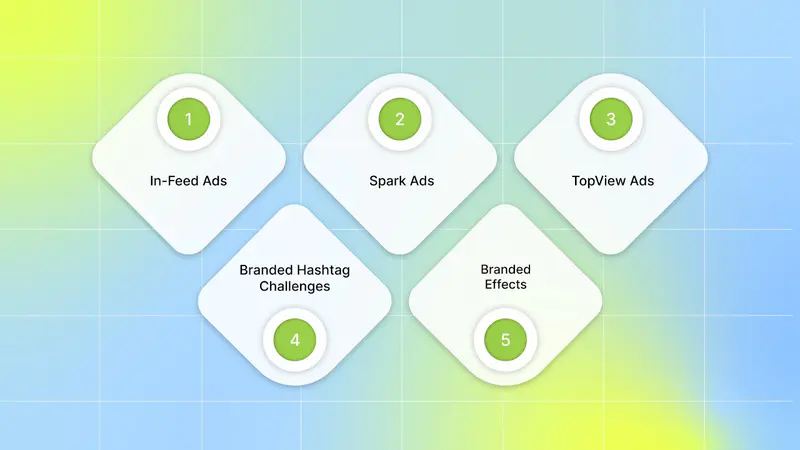
In-Feed Ads: These ads appear directly in the user’s For You feed as they scroll. They look similar to regular TikTok videos, making them ideal for testing different creative concepts, hooks, and storytelling styles.
Spark Ads: Spark Ads allow you to promote existing organic TikTok content as paid ads. This format helps you amplify creator-led or user-generated content that already feels native to the platform.
TopView Ads: TopView ads appear when users first open the TikTok app. They provide high visibility and are often used for major campaign launches or product announcements.
Branded Hashtag Challenges: This format encourages users to participate in a challenge using a specific hashtag. It helps brands or games to generate user-generated content and increase awareness through community participation.
Branded Effects: Branded Effects allow you to create custom filters, stickers, or AR effects that users can apply to their own videos. This helps increase engagement and interaction on the platform.
Beyond the variety of ad formats available, TikTok offers several benefits that make it a powerful advertising platform.
What are the benefits of advertising on TikTok?
Advertising on TikTok helps you reach highly engaged audiences through short-form video content that captures attention quickly. For creative strategists, it also creates opportunities to test different creative ideas and identify which concepts drive results.
Here are some key benefits of advertising on TikTok:
1. Large and highly engaged audience
TikTok has become one of the most popular social media platforms, with projections estimating growth to approximately 1.9 billion by 2029. Users also spend close to an hour per day on the platform, creating strong opportunities to reach active audiences.
This means your creatives have a higher chance of gaining visibility and engagement compared to many other platforms.
2. Creative-first ad formats
TikTok offers several ad formats designed for creative storytelling, including In-Feed ads, Spark Ads, and branded hashtag challenges. These formats let you showcase products, app features, or gameplay in a way that feels natural in the TikTok feed.
This gives you the flexibility to test different hooks, storytelling styles, and creator-led content.
3. Advanced audience targeting
TikTok offers multiple targeting options to help you reach the right users. You can target audiences based on demographics, interests, behaviors, and device types.
For example, a mobile game studio can target users interested in similar game genres, while a DTC brand can reach audiences who engage with product-related content.
4. Performance tracking and campaign optimization
TikTok provides analytics that help you track campaign performance and optimize your strategy. You can monitor metrics such as engagement and click-through rates to understand which ads are performing.
These insights help you improve your creative strategy and allocate budget to the best-performing campaigns.
5. High potential for organic growth
TikTok’s algorithm rewards engaging content, which means strong ad creatives can sometimes gain reach beyond paid impressions. If your ad feels native to the platform and captures attention quickly, it can generate more engagement and visibility.
To turn TikTok’s reach and engagement into real campaign results, it’s important to follow proven creative practices.
TikTok Ad Best Practices to Improve Ad Performance
TikTok campaigns perform best when your creatives align with how users consume content on the platform. Applying the right best practices helps you improve creative quality and campaign outcomes.
Here are proven TikTok ad best practices that can help you improve your ad performance:
1. Start with an attention-grabbing hook
The first three seconds decide almost everything on TikTok. Beyond the 71% of users who choose whether to keep watching in that window, TikTok's own creative best practices for auction ads report that 63% of successful ads deliver their main message within the first three seconds, and most of an ad's total recall impact is captured in the first six. If your product, promise, or problem has not appeared by second three, most viewers will never see it.
Five hook formats keep showing up in top-performing TikTok ads in 2026:
Bold claim: a specific, contestable statement in the first frame ("This is why your skincare routine isn't working").
Pattern interrupt: an unexpected visual or sound that breaks the scrolling rhythm, like starting mid-fall, mid-argument, or mid-reveal.
Question hook: a direct question the viewer wants answered ("Would you survive level 200?").
Transformation first: show the end result before you explain how to get it, then rewind to the process.
Testimonial flash: open on a real reaction or result before the product ever appears.
How you build the opening frame matters as much as which format you pick:
Start mid-action. No logo intro, no slow pan, no title card. A mobile game ad should open on its most intense gameplay moment; a DTC ad should open on the problem being solved on camera.
Put the hook in the audio too. More than half of successful TikTok videos bring in music within the first three seconds, and a voiceover that states your claim at second zero reaches viewers who are only half-watching. Layering voiceover over a licensed track from TikTok's Commercial Music Library is one of the strongest-converting audio setups.
Repeat the hook as on-screen text so it lands with sound off. TikTok recommends keeping text to 5 to 10 words per second, placed inside the safe zone so captions and buttons do not cover it.
When viewers stay past the hook, completion rate and engagement signals climb, and TikTok's algorithm distributes the ad more effectively. That makes the hook the highest-leverage variable to test in any TikTok campaign.
But how will you know exactly which hook is performing well across your creatives? This is where Segwise comes in.
With tag-level creative element mapping, you can see which specific creative elements drive performance. Also, you can discover patterns like "this hook appears in 80% of our top-performing creatives" with complete MMP attribution integration. And once you know which hooks win, Segwise's Creative Generation Agent turns those winning patterns into net-new image, video, and playable creatives, so the insight becomes your next ad instead of a note in a brief.
2. Design creatives for full-screen vertical viewing
TikTok is a mobile-first platform built around vertical content. Ads designed in a 9:16 format naturally fill the screen and blend into the feed.
Using vertical creatives improves ad performance because it creates an immersive viewing experience. When your ad occupies the full screen, viewers focus entirely on the message. This is particularly important for demonstrating gameplay mechanics, product usage, or app features.
The current in-feed video specs for 2026: 9:16 aspect ratio at 1080x1920, MP4 or MOV with H.264, up to 500 MB, 5 to 60 seconds of runtime. Keep headlines, subtitles, and product shots out of the top and bottom edges of the frame, where TikTok's own captions, username, and buttons sit on top of your video.
3. Use user-generated content style ads
TikTok audiences respond better to content that feels authentic rather than overly polished advertisements. Ads that resemble organic user-generated videos often perform better on the platform.
UGC-style creatives build trust and relatability. 85% of consumers say user-generated content is more trustworthy than brand-created media. For example, a creator casually demonstrating a product or a player reacting to a mobile game moment feels more natural than a scripted ad. As a creative strategist, you can replicate this style by using conversational storytelling.
4. Collaborate with creators who understand the platform
TikTok creators understand how to communicate naturally with their audience and stay aligned with platform trends. Partnering with creators allows you to present your product, game, or app in ways that feel native to TikTok’s content style.
Creators also know how to use trending sounds, formats, and relevant hashtags to make content more discoverable. When creators incorporate these elements into ads, the content blends naturally into the feed instead of feeling like a traditional advertisement. This approach can improve engagement and help your creatives reach audiences that are already interacting with similar content.
5. Test multiple creatives per ad group
Creative testing is essential for discovering what resonates with your audience. Instead of relying on a single ad concept, run three to five creative variations per ad group with different hooks, visuals, and storytelling approaches, and vary one element at a time so you can tell which change actually moved performance.
Testing multiple creatives improves ad performance by helping identify winning patterns quickly. For example, you might test different gameplay clips for a mobile game or various product angles for a DTC brand. Once you identify the best-performing creatives, you can scale them across campaigns.
6. Keep videos concise and fast-paced
TikTok users scroll quickly, so your message needs to be delivered efficiently. Short videos with fast pacing help maintain viewer attention throughout the ad. A simple format includes a hook at the beginning, the main content in the middle, and a closing with a clear CTA.
Concise videos improve performance by increasing completion rates and engagement. In 2026 the sweet spot for direct-response TikTok ads is 9 to 15 seconds, with 21 to 34 seconds reserved for tutorial or consideration formats. Completion rate is the reason: a 15-second ad that 75% of viewers finish will usually out-deliver a 30-second ad that holds only 40%, because TikTok's algorithm weights completion heavily. Focus on delivering the core message early in the video and cut any scene that slows down the storytelling.
7. Refresh creatives regularly to prevent fatigue
Fatigue occurs when audiences repeatedly see the same creative. Over time, engagement drops and campaign performance declines.
Refreshing creatives regularly helps maintain campaign performance. As a creative strategist, you can update hooks, visuals, or storytelling angles to keep ads engaging. This ensures that your campaigns remain effective even after extended runs.
But how do you know when your creatives start fatiguing? This is where a creative intelligence platform like Segwise comes in.
With fatigue tracking, you can catch fatigue before it impacts your budget allocation and campaign results. Also, you can set specific performance targets for NEW creatives you want to monitor.
8. Use text overlays strategically
Text overlays help you highlight the most important parts of your message within a TikTok video. As a creative strategist, you can use text to emphasize product benefits, key gameplay moments, or important features that viewers should notice immediately.
Using text overlays improves ad performance because many users watch TikTok videos without sound. Clear on-screen text helps communicate your message quickly and keeps viewers engaged. To use this effectively, place your text within TikTok’s safe zones so it remains visible, and highlight the most important value points.
9. Track performance with TikTok Pixel or Events API
Tracking tools like the TikTok Pixel and Events API help you understand how users interact with your ads after they see or click them.
The TikTok Pixel works on the client side and tracks user behavior through the browser. This allows you to capture actions like page visits or conversions in near real time, but some tracking may be limited if users block cookies or use ad blockers. The Events API works on the server side and sends conversion data directly from your server to TikTok.
Using both tools helps you identify which ads perform best. With accurate performance data, you can focus your budget on high-performing ads and refine your strategy to improve overall campaign performance and ROI.
10. Test ads with smaller budgets before scaling
Launching campaigns with smaller budgets allows you to test different creative concepts without overspending. This helps you quickly identify which visuals or storytelling styles perform best.
Once you discover winning creatives, you can increase the budget for those ads and scale the concepts that generate the strongest engagement and conversions.
Also Read: Creative Analytics for TikTok Ads: What's Actually Driving Performance
Frequently asked questions
1. How long should a TikTok ad hook be?
Three seconds or less. 71% of viewers decide whether to keep watching within the first three seconds, and TikTok's own creative guidance shows 63% of successful ads deliver their main message inside that window. If your product or promise has not appeared by second three, assume most viewers never see it.
2. What are the best TikTok hook types in 2026?
Five formats dominate top-performing ads: a bold, specific claim; a pattern interrupt that breaks the scrolling rhythm; a direct question; showing the transformation before the process; and opening on a real testimonial or reaction. Whichever you pick, start mid-action and repeat the hook in audio and on-screen text.
3. What are TikTok's video specs for in-feed ads in 2026?
9:16 vertical at 1080x1920, MP4 or MOV with H.264, up to 500 MB, and 5 to 60 seconds of runtime. The sweet spot for direct-response ads is 9 to 15 seconds; tutorial and consideration formats can run 21 to 34 seconds.
4. How many creatives should I test per ad group?
Three to five per ad group is the common working range. Vary one element at a time, such as the hook, the opening visual, or the CTA, so you can attribute performance differences to a specific change and scale what wins.
5. How do I know when a TikTok creative is fatigued?
Watch for falling CTR, rising CPA, and shrinking watch time or spend share on a creative that used to perform. Refreshing the hook is usually the cheapest fix, since the first three seconds drive most of the drop-off. Segwise's fatigue tracking automates this by alerting you when a creative's performance starts a sustained decline.
Conclusion
Improving TikTok ad performance requires more than simply launching campaigns. Success depends on how effectively your creatives capture attention, communicate value, and encourage users to take action. Strong hooks, vertical video formats, UGC-style content, creator collaborations, and continuous creative testing all play a major role in building ads that perform well.
However, as you scale campaigns and test more creatives, it often becomes difficult to understand exactly which creative elements are actually driving results. This is where Segwise can help.
Segwise is an AI-powered creative intelligence and generation platform that directly integrates with your TikTok ad account. To set it up, simply go to the Segwise Dashboard → Settings → Ad Networks, click Connect under TikTok Ads, sign in, and select your Ads account for full creative analysis.
Once integrated, with tag-level performance optimization, you can instantly see which creative elements, themes, and formats drive results across all your campaigns and apps. Segwise’s multimodal Creative Tagging Agent automatically identifies and tags elements such as hook dialogs, characters, colors, and audio components across images, videos, text, and playable ads, revealing their impact on key performance metrics like IPM, CTR, and ROAS.
In addition, fatigue tracking detects performance decline early, helping you take action before it impacts budget allocation and campaign results. You can also ask the Creative Strategy Agent (AI Chat) anything about your TikTok creative performance in plain language, and Segwise's Creative Generation Agent turns your winning hooks and patterns into net-new image, video, and playable creatives, ready to export in the aspect ratios each network needs.
So, why wait? Start your free trial to discover which creative elements actually drive your ad's performance!