
The best Superads alternative depends on what Superads is missing for you. Pick Segwise if you need mobile ad networks, MMP data or new ads built from your winners. Pick Motion or Atria for pure Meta first DTC reporting, Foreplay for research-led creative teams, and the AppsFlyer or Singular creative modules if you are locked into that MMP.
Segwise is an AI creative analytics and creative generation platform. It pulls creative and performance data from 15+ ad networks and five MMPs, tags every element of every ad with multimodal AI, and helps UA and creative teams turn the patterns that win into new statics, videos and playables.
Stay on Superads if all your spend sits on the four platforms it lists and you mainly need reporting.
This guide covers what Superads does today, why teams leave it, what each alternative costs at your spend level, and how to switch without losing your reporting history. Every price was read on the vendor's own pricing page on October 26, 2026.
What Superads does, and why teams look elsewhere
Superads is a creative analytics and ad reporting tool built by Superside, the creative services company. They describe themselves as "a creative analytics and ad reporting platform for paid advertising" and say plainly that it "does not generate ad creatives". So its true alternatives are other creative analytics tools, not ad generators.
What you get on the Professional plan:
Four ad platforms: Meta, TikTok, LinkedIn and Google Ads, including Performance Max and YouTube campaigns.
Reports and boards with creative thumbnails, live share links that clients can open without a login, and CSV or PDF export.
AI tagging by visual format, hook, product and angle, with no naming convention needed.
Superads Scores: a 0 to 100 rating on hook, hold, click, engagement and conversion. According to Superads' own help article, the scores are percentiles against your other ads, so a 60 means the ad beat 60% of your own ads.
Superads AI, a chat assistant over your ad data, and Workflows, which send its answers to Slack on a schedule.
Inspiration, a library of any brand's Meta ads.
GA4, matched to ads through the ad ID in your UTM tags.
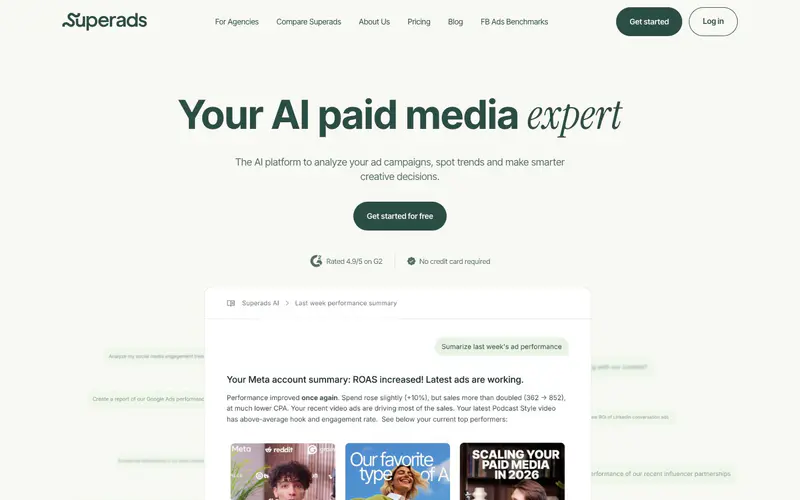
Superads costs $150 a month, and its pricing FAQ says the first 14 days of data load in about 30 minutes. Teams that look for an alternative tend to have one of five reasons:
The free plan ended. Superads built a following as a free tool, and its homepage still quotes a user who "can't believe it's free". Its LLM info page now says the free plan "has been discontinued for new signups". New users get a 14-day trial of the $150 a month plan.
Spend outside the four platforms. Superads lists Meta, TikTok, LinkedIn and Google Ads. We found no Superads page that names AppLovin, Unity, Mintegral, Moloco, Snapchat or Reddit.
Results that live in an MMP. Superads documents GA4 as its outside data source. We found no Superads page that names AppsFlyer, Adjust, Branch, Singular or Kochava, so Superads documents no way to bring in D7 ROAS or retention from your MMP.
Scores that come after spend. Superads Scores rank ads that have already run. Its pricing FAQ says a model handles "performance prediction" and returns "a performance score", but we found no Superads page describing a way to score an ad before it runs.
The next ad still has to be made. Superads analyses ads. It does not make them.
TL;DR: which Superads alternative fits which team
Mobile games and apps with an MMP or fast growing DTC brands, or anyone on networks beyond the big four: Segwise. It consolidates and analyzes your data from 15+ networks, your MMP, tags your ads creatives, and generates new ads from your winners.
DTC brands on Meta and TikTok that want an AI analyst: Motion if the budget allows $999 a month, Atria if you want something closer to Superads' price with static ad generation built in.
Creative teams that live in ad research: Foreplay, whose swipe file and competitor tracking sit next to its Lens analytics.
Large multi-channel advertisers with a data warehouse:GetCrux.
Teams that also want AI to run bids and budgets:Hawky.
App teams already paying AppsFlyer or Singular for attribution: check that MMP's creative module before buying anything new.
Superads alternatives compared
What each tool costs at your ad spend
Superads, Segwise, Motion and GetCrux price by monthly ad spend. Atria caps spend per plan, and Foreplay does not price by spend at all. Here is what the published monthly-billing price comes to at three spend levels.
Three things stand out:
For reporting alone, Superads is cheap. Below $100K a month it costs $150, but that buys analytics only: Superads says it does not generate ads. Segwise costs more and includes ad generation. If price is your only complaint, Atria and Foreplay are the like-for-like swaps.
Motion and GetCrux cost far more at the entry level. Motion is $999 for up to $50K of spend, about 6.7 times Superads' monthly price at that spend. GetCrux Starter is 10 times.
A move away from Superads should buy you something Superads doesn't do: more networks, MMP data, pre-launch scoring or ad generation. Otherwise you are paying more for the same reports.
Should you switch? A decision rule
Stay on Superads if all your spend runs on Meta, TikTok, LinkedIn and Google Ads, your success metric is a purchase or a lead that Meta or GA4 already reports, and your main job is reporting to clients or stakeholders.
As a rule of thumb, move once two of these five are true:
More than about 20% of your spend runs on a network Superads does not list, such as AppLovin, Unity, Mintegral, Moloco, Snapchat or Reddit.
The number you are judged on lives in an MMP: installs, D7 ROAS, retention or subscription starts.
You run playable ads and want to know which mechanic or end card works.
You ship 20 or more new creatives a month and production, not analysis, is the bottleneck.
You want to score new creatives before they get any budget.

The 8 best Superads alternatives in 2026
1. Segwise

Best for: mobile game, app, DTC and agency teams whose spend runs across several networks, and teams that want new ads built from what already works.
Like Superads, Segwise does AI tagging, chat over your ad data, scheduled reporting and competitor research. The differences are reach and what happens next. Where Superads reads four platforms, Segwise's integration docs list Meta, Google Ads, TikTok, Snapchat, AppLovin (Axon), Unity, Mintegral, Moloco, Liftoff, LinkedIn, Reddit and more. Segwise also connects five MMPs: AppsFlyer, Adjust, Branch, Singular and Kochava. An MMP is optional.
Key features:
Creative tagging of video, images, audio, text and playables. Segwise plays each playable end to end, then tags the mechanic, hook scene, end card and CTA. On top of 20+ standard tags you can add custom tags and pull tags from your naming conventions, much like Superads' custom breakdowns.
Fatigue tracking with thresholds you set, for example a 20% ROAS drop over seven days, and warnings by email and Slack.
The Creative Strategy Agent, a chat that answers from your network and MMP data and writes briefs from your winning patterns.
Pre-flight Testing: upload up to 10 new images or short videos and get a score out of 100, a run-or-hold verdict and the reasons, benchmarked against the ads already winning in your account.
Creative generation: statics, video up to 30 seconds and AI UGC-style video, with playables and CTV spots as managed services that Segwise's team finishes.
Competitor tracking of Meta ads, a read-only MCP for Claude, ChatGPT, Cursor and Codex, and unlimited seats.

Pricing: Segwise starts at $499/month for advertisers spending up to $250K/month, with a special 50% discount for startups spending under $50K/month, and includes a 7-day free trial with no credit card.
Proof: ecobee runs paid media across six platforms, including Meta, TikTok, YouTube and Amazon DSP. The company reports getting about 30 hours a week back on creative reporting, according to its case study.
Limitations:
Below $250K of spend it costs more than Superads, which covers reporting only; Segwise's price includes ad generation.
The trial is 7 days, against Superads' 14.
Paid plans import 3 months of history at setup. Superads keeps 12.
Playables and CTV are managed services, not self-serve builders.
The MCP is switched on by your account manager on request.
2. Motion

Best for: DTC brands and performance agencies whose spend is mostly on Meta and who want an AI analyst on top of their reports.
Motion is the tool Superads compares itself with most. It connects Meta, TikTok, YouTube and LinkedIn, and its Runneth AI agent writes reports, briefs and static ads, runs scheduled routines with alerts, and can launch ads to Meta.
Key features: creative reports, frame-by-frame video drop-off analysis, Inspo for browsing competitor ads from Meta's Ad Library, a read-only MCP that Motion's help center says "supports Meta only" for now, and GA4 and Northbeam attribution on Pro.
Pricing: Starter is $999 a month for up to $50K of monthly ad spend. Pro (over $50K) and Growth (over $125K) don't show a price. There is a 14-day free trial with no credit card.
Limitations: at $999 against Superads' $150, the entry price is the big jump. Motion's help center says "AI Tagging is only available for Meta creatives", so TikTok, YouTube and LinkedIn ads aren't AI-tagged. No MMP integration is listed, and it is not built for mobile game UA. Our Motion alternatives guide covers it in more depth.
3. Atria

Best for: ecommerce brands and small agencies on Meta that want Superads-level pricing plus image ad generation.
Atria is the closest like-for-like swap on price. Its analytics read Meta and TikTok ad accounts, and its AI teammate, Raya, tags ads by persona, hook, offer and emotion. Radar grades each recent ad on hook, retention, click-through and conversion, a lot like Superads Scores.
Key features: static image ad generation from a reference, a competitor ad or a chat, ad launching to Meta, an ad library with brand following, custom tags, and an MCP server and REST API.
Pricing: Core lists at $219 a month, Plus at $549 and Business at $1,549, with lower rates billed annually. Core covers up to $500K of spend, 5 ad accounts and 5 seats, and extra seats cost $20 each.
Limitations: analytics cover Meta and TikTok only. Google Ads data reaches the Raya chat but not the dashboards, according to Atria's connector guide. The attribution tools it names are Triple Whale and Northbeam, not an MMP, and its documented generation is static images. See our Atria alternatives guide.
4. Foreplay

Best for: creative strategists and agencies whose day starts in ad research rather than in reports.
Foreplay began as a swipe file. Today it also sells Spyder, which tracks competitors' Meta ads, Briefs for AI scripts and storyboards, and Lens, which analyses your own Meta and TikTok ads with AI metadata and shareable custom reports.
Key features: an ad search engine Foreplay sizes at over 100M ads, a free Chrome extension, Spyder, which saves every ad your competitors launch on Meta, AI scripts and storyboards in 150+ languages, and an ad library MCP server.
Pricing: Workflow, which includes Lens for one brand, is $175 a month billed monthly or $149 billed annually. Agency is $459 or $389 and covers 10 brands. Basic ($59) has no Lens. Its pricing page promises "unlimited usage and ad spend", so the price does not rise with spend, and every paid plan has a 7-day free trial.
Limitations: Lens connects Meta and TikTok only, and is usable only once 7 days of history has loaded. No MMP is named. Briefs produces scripts and storyboards, and Foreplay doesn't list finished ad generation. Our Foreplay alternatives guide compares the options.
5. GetCrux

Best for: large advertisers on many channels who want creative data in their own BI stack.
GetCrux calls itself a "Creative OS". It covers AI tagging with custom labels and rule-based tags, a Copilot chat, competitor and social listening, and creative generation. On higher plans it connects data warehouses, BI tools and the MMPs AppsFlyer, Adjust and Singular.
Key features: custom taxonomies reused across accounts, alerts, pre-flight testing on Professional, and an MCP on Professional.
Pricing: Starter is $1,500 a month for up to $100K of spend and up to 2 ad accounts across Meta, Google, TikTok and LinkedIn. Professional ($100K to $1M of spend) adds AppLovin, DV360, Snapchat, Reddit and more, at a price set by scope. You start with a 30-minute call with the founders. No free trial is listed.
Limitations: the entry price is 10 times Superads'. MMP connections and AppLovin only start on Professional, and no free trial is listed on its pricing page; you start with a founder call.
6. Hawky

Best for: teams that want one vendor to analyse creative and also run bids and budgets with AI agents.
Hawky is an "agentic performance marketing platform". It breaks ads down by hook, frame, copy, audio and CTA across Meta, Google (including YouTube and Performance Max) and TikTok, and pulls about 18 months of history on day one.
Key features: fatigue alerts on every tier, scoring of draft creatives before launch, a Copilot chat on higher tiers, Creative Studio for images and video, and agents that buy media inside spend caps.
Pricing: not published. Hawky says pricing "is per brand and scales with how much you use", and every tier is "Talk to sales". Its own content aims at teams spending $50K to $5M+ a month.
Limitations: there is no public price, and the pricing page offers a sales walkthrough on your own data rather than a free trial. The Copilot is not on the entry Dashboards tier, and AppsFlyer is the only MMP Hawky names. No mobile game networks are listed. It is a bigger change than a reporting swap, because its agents touch your campaigns.
7. Singular Creative IQ

Best for: app and game teams that already use Singular for attribution or analytics.
Singular Creative IQ is Singular's creative analytics package. It pulls creatives from the networks Singular integrates with, including Meta, TikTok, Google, AppLovin and Unity, and ties every variant to "installs, ROAS, retention, and revenue".
Key features: 17 built-in AI tags plus the option to create custom AI tags, slicing of performance by any tag combination, and clustering that groups identical or near-identical creatives across networks with image recognition.
Pricing: we found no Creative IQ price on Singular's pricing page. The product page offers 14 days free with no credit card.
Limitations: Creative IQ sits inside Singular's marketing analytics platform, so it fits best if Singular is already part of your stack. Its product page describes analysis, not ad generation or competitor ad tracking.
8. AppsFlyer Creative Optimization

Best for: app teams that already measure with AppsFlyer and want creative data inside the same platform.
AppsFlyer Creative Optimization breaks creatives into "scenes, text, visuals, and audio components" and connects each part to installs, in-app events, retention and LTV. It matches the same creative across networks without relying on names.
Key features: AI search by visuals, text, themes or performance, automatic grouping of similar iterations such as localizations or aspect ratios, a creative hub that ranks top performers with "smart AI-powered scoring" and activates them across ad networks, and data warehouse export.
Pricing: we found no Creative Optimization price on AppsFlyer's pricing page, and the product page's call to action is "Request a demo".
Limitations: it is part of AppsFlyer's Measurement Suite and, in the product page's words, "works alongside your existing AppsFlyer implementation", so it suits teams already on AppsFlyer. The product page describes analysing and activating existing creatives, not generating new ones.
Superads Scores vs pre-flight scoring
Superads Scores and Segwise's Pre-flight Testing both put a number from 0 to 100 on a creative, but they answer different questions:
Superads Scores rank an ad against your other ads after it has spent. A 90 means it beat 90% of your ads on that measure, so they tell you what to scale or pause.
Pre-flight Testing scores a creative before it runs. Segwise tags what is inside it, compares it with the ads already winning for you, and returns a run-or-hold verdict with the reasons. It also checks which placements the file is eligible for, so a wrong aspect ratio gets caught before upload.
Pre-flight needs connected ad network data to compare against. It does not fix the creative; your team reworks it and scores it again.
Tip: If you keep Superads' GA4 connection while you trial another tool, put the ad ID in a standard UTM parameter, for example { {ad.id} } on Meta. Superads' GA4 help article says name-based matching fails when any one of ad, ad set or campaign names differs.
How to switch from Superads without losing history
Superads is billed monthly with no yearly contract, so switching is mostly about history and habits, not paperwork.
Export what you want to keep. Superads keeps 12 months of history, but a new tool imports less at setup. Segwise imports 3 months on paid plans and 14 days on the trial. Export year-over-year views and client reports to CSV or PDF first.
Write down your breakdowns and Workflows. List your custom breakdowns, naming-convention rules and the prompts behind each Workflow. These are the parts you rebuild.
Connect everything, not just the four platforms. Add the networks and the MMP Superads never saw, so the new tool's numbers include all of your spend.
Rebuild tags and alerts. In Segwise, naming-convention tags and custom tags replace custom breakdowns. Fatigue thresholds and scheduled reports replace fatigue-hunting Workflows.
Run both side by side for about two weeks. Compare spend totals per platform in both tools. A mismatch usually means an account or an attribution window was missed.
Cancel before your next billing date. According to Superads' cancellation guide, reports and boards are "locked, not deleted", so you can reopen them by subscribing again.

For a wider view of the category, see our list of top creative analytics tools. If you run an agency, our guide to creative analytics tools for agencies compares client reporting and multi-account setups.